
culture fit interview
How to Pass a Culture Fit Interview: Why ChatGPT Prep Fails (and Voice AI Wins)
By Job Sparrow Team

You have the skills. You have the experience. You know exactly what you want to say. But when the hiring manager leans back and asks, "Describe your ideal work environment," you freeze. Or worse, you recite a perfectly scripted, highly polished answer you memorized from a text prompt. The interviewer smiles politely, but you can feel the rapport evaporating in real time.
If you are wondering how to pass a culture fit interview, this is the core problem with modern preparation. Job seekers, whether you are new to the local market, pivoting industries, or simply out of practice, often know the correct answers on paper. However, they still fail culture fit interviews because their delivery, tone, and cultural nuances feel unnatural or rehearsed. Relying on text-based AI tools to write your interview scripts actually makes this problem worse. In regions like Australia and New Zealand, where casual professionalism is the gold standard, sounding like a corporate robot is a fast track to rejection.
At JobSparrow, our team of recruiters has reviewed over 100,000 resumes and conducted thousands of interviews across Australia, New Zealand, and global markets. We know exactly what hiring managers are looking for. In this comprehensive guide, we will explore why standard text preparation fails, how to navigate values fit interview questions, and why practicing with a mock interview voice simulator is the ultimate secret to landing the offer.
What is a Culture Fit Interview? (And Why It Matters More in 2026)
A culture fit interview is not a test to see if you are fun to grab a coffee with. It is a strategic assessment designed to uncover how well your core beliefs, behaviors, and working style align with the daily realities of the organization.
Companies are increasingly prioritizing this alignment over pure technical skills. As noted by Impact Workforce Solutions, when there is a strong cultural fit, skills develop more easily over time, relationships form more naturally, and overall retention rates rise. Hiring managers know that they can teach a new software program, but they cannot teach someone to thrive in a highly collaborative, fast-paced environment if that person prefers working in isolated silos.
This shift is particularly obvious in the current job market. According to research highlighted by CFO Tech, Australian employers are now placing greater weight on cultural fit and demonstrated skills than on formal qualifications or previous prestigious employers.
Culture Fit vs. Culture Add
While "culture fit" is the traditional term, many modern companies are shifting toward "culture add." They do not want clones of their current employees. Instead, they want candidates who share the company's core values but bring diverse perspectives, new problem-solving approaches, and unique backgrounds to the table. When you prepare for your interview, your goal is to show that you align with their foundational values while bringing something fresh to the team.
To demonstrate a "culture add" effectively, you must move beyond generic statements. For instance, instead of simply saying, "I value collaboration," you can pivot to a more impactful answer: "I value collaboration, and I bring a background in cross-functional remote team management that I have not seen represented in your current team structure based on my research." This shows that you have analyzed the company's existing dynamic and identified a specific, complementary strength you can introduce to their ecosystem.
Cracking the Code: The Australian and New Zealand Workplace Culture
If you are targeting roles in Australia or New Zealand, understanding the local workplace culture is mandatory. Many international candidates struggle here, not because they lack skills, but because they misread the social cues of the interview room.
Here are the three pillars of ANZ workplace culture you must master:
1. Casual Professionalism
Workplaces in Australia and New Zealand are famously egalitarian. Hierarchies exist, but they are flattened in day-to-day communication. You are expected to treat the CEO with the same respectful, friendly tone as the receptionist. Using overly formal language (like "Sir" or "Madam") can actually hurt your chances, as it signals that you might struggle to integrate into a relaxed team dynamic.
2. The "Tall Poppy" Syndrome
In some markets, aggressive self-promotion is expected. In Australia and New Zealand, boasting about your individual brilliance will trigger the "Tall Poppy Syndrome," where people who stand out for arrogance are quickly cut down to size. You must learn to advocate for yourself confidently while consistently sharing credit with your team. Use "we" as often as you use "I" when discussing major victories.
3. Mateship and Collaboration
ANZ employers highly value people who are willing to pitch in, even if a task falls slightly outside their job description. They want to know you will support your colleagues during a crisis.
If you are a migrant trying to navigate these unwritten rules, you can learn more in our dedicated guide on Australian Job Interview Tips for Migrants: How to Beat the 'Local Experience' Trap | JobSparrow Blog | JobSparrow.
Top 5 Culture Fit Interview Questions (And What They Really Mean)
Preparing for a culture fit interview means understanding the hidden meaning behind the questions. As detailed by Michael Page, these behavioral questions aim to uncover your alignment with the organization's ecosystem.
Here are five common questions, what the interviewer is actually asking, and how you should structure your response.
1. "Describe your ideal work environment."
What they really mean: "Will you be miserable working in our office?" How to answer: Research the company beforehand. If they are a fast-paced startup, talk about how you thrive in dynamic, agile environments. If they are a highly structured government agency, emphasize your appreciation for clear processes and deep, focused work.
2. "Tell me about a time you disagreed with a coworker. How did you resolve it?"
What they really mean: "Are you toxic, defensive, or capable of mature conflict resolution?" How to answer: Use the STAR method (Situation, Task, Action, Result). Choose a minor, professional disagreement, not a massive personal feud. Focus heavily on the Action phase, highlighting your active listening skills, your willingness to compromise, and how you kept the project moving forward.
3. "How do you prefer to receive feedback?"
What they really mean: "Are you going to fall apart if I tell you your work needs improvement?" How to answer: The best answer demonstrates a growth mindset. Explain that you welcome constructive criticism because it is the fastest way to improve. Give a brief example of a time you received tough feedback, applied it immediately, and achieved a better result.
4. "What values are most important to you in a workplace?"
What they really mean: "Did you read our company's 'About Us' page?" How to answer: Pick two values that the company publicly champions (such as transparency, innovation, or sustainability) and connect them to your personal working style. Do not just list the values; provide a short anecdote proving that you live by them.
5. "Tell me about a time you went above and beyond for your team."
What they really mean: "Are you a team player, or do you only care about your own KPIs?" How to answer: Share a story where you helped a colleague meet a deadline or took on extra work to ensure the team succeeded. This is especially critical in the ANZ market, where teamwork and "mateship" are heavily prioritized.
To ensure you are fully prepared to answer these questions authentically, start with a free diagnosis to identify any gaps in your application before the interview stage.
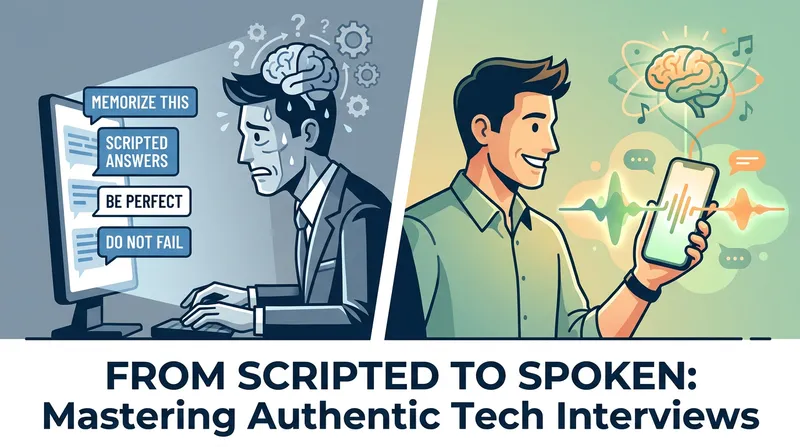
The "Uncanny Valley" of ChatGPT Answers: Why Text AI Fails
Many traditional career platforms will tell you to copy and paste interview questions into a text-based AI, memorize the generated answers, and recite them in the interview. This is terrible advice.
When you use text-based AI to write your interview scripts, you fall into the "uncanny valley" of human communication. Text AI is designed to produce grammatically flawless, highly structured, and dense paragraphs. But humans do not speak in paragraphs.
Consider this AI-generated answer: "I synergistically collaborated with cross-functional stakeholders to optimize our key deliverables, resulting in a 20 percent paradigm shift in efficiency."
If you say that out loud in an interview, the hiring manager will instantly disconnect. It sounds robotic, inauthentic, and completely devoid of personality.
A natural, human answer sounds like this: "I worked really closely with the design and engineering teams. We had a tight deadline, but by getting everyone on the same page early, we actually managed to cut our processing time by about 20 percent."
Furthermore, text AI completely ignores the most critical element of a culture fit interview: your delivery. In our experience reviewing thousands of interviews, tone, pacing, natural hesitation, and warmth make up the vast majority of how you are perceived. A text screen cannot tell you if you are speaking too fast because you are nervous, or if you sound arrogant when discussing your achievements.
Beyond delivery, ChatGPT prep fails for three other major reasons. First, there is a high hallucination risk. ChatGPT may generate plausible-sounding but completely false information about a company's projects or values. Second, text preparation lacks real-time conversational pressure. It cannot simulate the unexpected follow-up questions that happen in a live interview. Finally, standard text AI lacks cultural calibration for specific markets, often missing the nuances of ANZ norms like the "Tall Poppy Syndrome."
If you want to learn more about striking the right tone, check out our guide on How to Answer 'Tell Me About Yourself' in Australia & NZ (Without Sounding Arrogant) | JobSparrow Blog | JobSparrow.
Tone is Everything: Why Voice AI is the Ultimate Interview Prep Tool
To truly prepare for a behavioral interview, you must practice speaking out loud under pressure. This is where voice AI interview prep completely changes the game.
As highlighted by Xavier University, leveraging conversational AI tools allows candidates to simulate real-time interviews, providing instant feedback to refine answers and improve vocal delivery.
JobSparrow takes this concept and builds it specifically for the job hunt. Our ai mock interviews do not just give you a list of questions to read. They provide a real-time, role-specific audio simulation.
Here is why practicing with a mock interview voice simulator wins every time:
- It Tests Your Spontaneous Recall: You cannot rely on a script when a voice simulator asks you a follow-up question you did not expect. It forces you to think on your feet, which is exactly what happens in a real interview.
- It Analyzes Your Delivery: JobSparrow's AI listens to your real-time audio recording. It analyzes your pacing, your use of filler words, and your overall tone. It tells you if you sound confident, nervous, or overly rehearsed.
- It Builds Muscle Memory: Interviewing is a physical skill. By speaking your answers out loud repeatedly, you build the vocal muscle memory required to sound relaxed and confident when the real pressure is on.
How to Pass a Culture Fit Interview: A Step-by-Step Strategy
JobSparrow's method is built on a five-stage journey: Diagnose, Position, Execute, Prepare, and Close. Here is how you can use this framework to ace your next culture fit interview.
Step 1: Diagnose Your Experience Gaps
Before you can talk about your cultural fit, you need absolute clarity on your career history. Start by identifying the achievements and soft skills you may have forgotten to include on your resume. Having a rich, detailed profile means you will never struggle to find a relevant story during an interview. You can use our gap filler tool to analyze your history and ask you targeted questions to build a comprehensive master profile.
Step 2: Position Yourself for the Specific Company
Generic answers fail. Before the interview, research the company's core values, their recent projects, and their leadership style. Organize this research meticulously. Using a job application tracking dashboard can help you review the specific job description and identify the cultural keywords they care about most.
Step 3: Execute the Perfect Application
If you have not secured the interview yet, ensure your application proves your cultural fit from the first glance. Rewrite your bullet points to match the job's specific requirements, and weave your personal values into a compelling narrative. Tools like job-specific resume tailoring and an intelligent cover letter generator can streamline this process significantly.
Step 4: Prepare with Real-Time Voice Roleplay
Treat your practice sessions like the real thing. Put on your interview clothes, sit in a quiet room, and speak your answers out loud. You can launch our ai mock interviews directly from your saved job application for maximum relevance. Review the AI feedback on your clarity and tone, and repeat the process until you feel completely natural.
Step 5: Close with Confidence
When you walk into the real interview, you will not be trying to remember a text script. You will rely on the natural confidence you built through voice practice. You will be able to read the room, smile, and engage in a genuine conversation.
For more insights on the preparation phase, read our Australian graduate programs 2027 guide: Timelines, resumes & assessment centre prep | JobSparrow Blog | JobSparrow.
Frequently Asked Questions (People Also Ask)
Can ChatGPT help me prepare for a culture fit interview? Yes, but only for foundational research. You can use text AI to brainstorm potential questions or research a company's core values. However, relying on it to write your answers will make you sound robotic and unnatural. You must practice speaking your answers out loud to master the delivery.
What is the difference between text AI and voice AI for interview prep? Text AI (like standard ChatGPT) only tests your knowledge and writing ability. Voice AI (like a mock interview voice simulator) tests your verbal delivery, pacing, tone, and ability to think on your feet during a real-time conversation.
How do I pass an Australian workplace culture interview? Focus on demonstrating casual professionalism, teamwork, and a lack of ego. Australian employers value candidates who are highly competent but remain approachable and willing to collaborate. Avoid bragging, and use the STAR method to show how you support your colleagues.
How can migrants improve their communication skills for local interviews? Migrants often have the right technical skills but struggle with local corporate jargon and conversational pacing. The fastest way to improve is through repetition in a safe environment. Using a mock interview voice simulator allows you to practice local communication styles without the fear of judgment.
Your Success Story Starts Here
The job market is too competitive to lose out on a role just because your interview delivery felt a little stiff. You deserve to walk into every interview room feeling completely confident in both what you are saying and how you are saying it.
JobSparrow is not just a resume tool; it is your complete AI career advisor. From diagnosing your initial CV to coaching you through to the final offer, we provide the insider perspective you need to succeed.
Ready to land more interviews and ace the culture fit test? Start with a free diagnosis to see your recruiter-lens score and uncover the exact gaps costing you opportunities. When you are ready to commit, unlock the full Offer Path.
Take control of your career today. Practice your delivery, master your tone, and go get that offer.
Tags
Keep reading
Recommended articles.
interview preparation · voice ai
Why Good Answers Fail: How to Practice Mock Interviews Online with Voice AI
Good answers fail if you sound robotic. Learn how to practice mock interviews online using voice AI to fix your delivery, pacing, and confidence.
career advice · resume tips
How to Explain Taking a Step Back in Your Career
Applying for a lower-level job? Learn how to explain a career step back in an interview, format your resume for a hands-on role, and control your narrative.
interview preparation · case study interview
How to Ace a Case Study Presentation Interview in Australia (2026 Guide)
Learn to structure a 5-slide case study presentation for Australian panels, manage your Q&A, and practice with AI. Start your free diagnosis today.