
human-ai collaboration
Human-AI Collaboration: Future-Proof Your Career for 2026
By Job Sparrow Team

Introduction: Beyond the Job Search - Thriving in the Human-AI Workplace of 2026
If you're a job seeker or career changer today, you're likely already using AI to find your next role—tailoring your resume, preparing for interviews, and tracking applications. But a bigger question looms: once you land the job, how will you do the work alongside AI?
The conversation is shifting. By 2026, the workplace will look dramatically different, populated by a hybrid human-AI workforce where digital agents are as common as human colleagues. This isn't a far-off sci-fi concept; it's the next immediate step in our professional evolution.
This guide is designed for forward-thinking professionals like you. We'll explore how to move beyond simply using AI as a tool and learn to collaborate with it as a partner. You'll discover the skills you need to become 'AI-complementary,' ensuring your career is not just safe, but essential. And with new risk-free tools emerging, you can start building these skills with confidence, knowing you only invest when you see results.
The New Coworker: What is an AI Agent Workforce?
Forget the simple chatbots of the past. The next wave is the 'AI agent workforce'—specialized AI systems designed to function as digital colleagues. Think of them as autonomous assistants that can manage complex, multi-step tasks that once required significant human effort. The analyst firm Gartner predicts that by 2026, over 80% of enterprises will have used generative AI, paving the way for these agents to become standard.
What does this look like in practice? Imagine:
- For a Marketing Manager: An AI agent that autonomously analyzes daily campaign performance, reallocates ad spend to the best-performing channels, and generates a strategic summary report for your morning review.
- For a Customer Support Team: An AI agent that handles the entire initial triage process, resolving common issues instantly and escalating complex problems to a human specialist with a full summary and suggested solutions.
This isn't about replacing people. It's about augmentation—freeing up your time and cognitive energy from repetitive tasks so you can focus on strategy, creativity, and complex problem-solving. It's a shift from 'doing' to 'directing.' But this change can be intimidating. Understanding this new dynamic is the first step to conquering any algorithm anxiety in your job search and in the workplace itself.
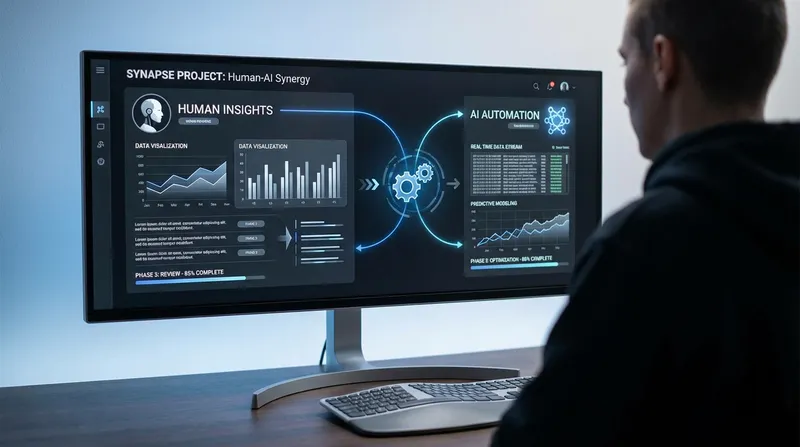
How AI is Reshaping Job Roles and Creating Opportunities
The narrative of 'robots taking our jobs' is outdated and incomplete. The reality is one of transformation. The World Economic Forum's Future of Jobs Report projects that while 83 million jobs may be displaced by 2027, an estimated 69 million new jobs will be created. The net change is less about mass unemployment and more about a massive shift in the types of roles and skills that are in demand.
This shift is happening in two primary ways: the creation of entirely new jobs and the augmentation of existing ones.
Emerging Jobs in the AI Era
While 'Prompt Engineer' has become a well-known new title, it's just the tip of the iceberg. As AI becomes more integrated, a whole ecosystem of roles is emerging to manage, direct, and optimize it. According to analysis from publications like MIT Technology Review, we are seeing a rise in roles that didn't exist five years ago, such as:
- AI Operations Engineer: The professional who ensures AI models are running efficiently, ethically, and in alignment with business goals.
- AI Business Analyst: The translator who bridges the gap between technical AI capabilities and practical business needs.
- Human-AI Collaboration Designer: The strategist who designs workflows and processes that allow humans and AI to work together seamlessly.
- AI Ethics & Governance Specialist: The crucial expert who ensures AI is used responsibly and without bias.
How Your Current Job Will Be AI-Augmented
Even if your job title doesn't change, the way you perform your job certainly will. A landmark report from McKinsey & Company estimates that generative AI has the potential to automate activities that absorb 60 to 70 percent of employees' time today.
Consider these 'before and after' scenarios:
- Before (Financial Analyst): Spends 15 hours a week manually pulling data from different systems, cleaning it in Excel, and creating basic charts for a quarterly report.
- After (AI-Augmented Analyst): Spends 1 hour defining the parameters for an AI agent. The agent pulls, cleans, and visualizes the data. The analyst then spends the remaining 14 hours interpreting the deep insights, modeling future scenarios, and advising leadership on strategic financial decisions.
The value shifts from data manipulation to strategic interpretation.
The AI-Ready Skillset: Upskilling for Your Future-Proof Career
To thrive in this new environment, you need to become AI-ready. This isn't just about learning to use a new app; it's a fundamental shift in your professional skillset. As experts from Cranfield University note, the future of work requires a dramatic change in the tasks people do and the skills they need. These skills fall into two distinct but equally important categories.
Essential Hard Skills for Human-AI Collaboration
These are the practical competencies you need to interact effectively with AI systems. The demand is already here; the Stanford University AI Index Report highlights a massive surge in US job postings that require AI skills.
- AI Literacy: You don't need to be a coder, but you do need to understand what AI can and can't do. This means knowing the difference between various AI types (e.g., analytical vs. generative) and understanding their limitations to avoid errors.
- Data Interpretation: AI can generate mountains of data, but it can't always tell you what it means for your business. The ability to look at AI-generated reports and extract meaningful, actionable insights is paramount.
- Prompt Engineering: This is the art and science of asking AI the right questions to get the best results. It's about clear, contextual communication with a machine.
Irreplaceable Soft Skills in the Age of AI
As AI handles more of the technical and repetitive work, uniquely human skills become your primary value proposition. These are the abilities that AI cannot replicate. As Harvard Business Review points out, the new era of AI requires a fundamental rethinking of leadership and strategy.
- Strategic Thinking: While an AI can optimize a process, it can't set the vision. The ability to see the big picture, define goals, and make long-term plans is more critical than ever.
- Critical Thinking & Problem-Solving: This is your ability to question the AI's output. Is this data correct? Did it consider all the variables? What happens if this assumption is wrong? You are the final quality check and the creative problem-solver.
- Creativity & Innovation: AI is a powerful tool for execution, but true originality—the spark of a brand new idea—remains a human domain.
- Leadership & Emotional Intelligence: Managing hybrid human-AI teams, motivating colleagues, and navigating complex interpersonal dynamics are skills where humans will always lead.
Want to see which of these AI-ready skills you already have? Upload your resume for a free skill gap analysis in under 60 seconds.
Your Action Plan: How to Become AI-Complementary Today
Understanding these trends is the first step. Taking action is what will future-proof your career. Here is a simple, three-step plan to start building your AI-ready skillset today.
Step 1: Identify Your AI Skill Gaps
Before you can build new skills, you need a clear baseline of where you stand. Compare your current resume to the skills listed in this article and, more importantly, to the requirements in job descriptions for the roles you want in 2-3 years.
This is where JobSparrow's platform gives you an edge. By analyzing a job description, it can instantly show you a match score and highlight the specific skills you're missing. This moves you from guesswork to a data-driven plan, showing you exactly how a gap analysis fuels your career growth.
Step 2: Build Your AI-Ready Resume and Profile
As you begin learning new skills and working on projects—even small ones using public AI tools—you need a central place to document them. Don't let these valuable experiences get lost.
Start building a comprehensive career database for yourself. This is the philosophy behind JobSparrow's Master Career Profile. It acts as your professional 'digital twin,' a single source of truth where you can store every skill, role, and accomplishment. When you're ready to apply for a job, our AI can then pull the most relevant details to create a perfectly tailored resume in minutes, ensuring you always put your best, most relevant foot forward. Think of it as your AI 'digital twin' for lifelong career success.
Step 3: Practice Articulating Your Value in an AI-Driven World
Having the skills isn't enough. You must be able to confidently communicate your value in an interview. Future interview questions will evolve. Expect to be asked:
- "How have you used AI tools to improve a process or outcome?"
- "Describe a time you disagreed with the output of an AI or data model. What did you do?"
- "How would you approach managing a project that involves both human team members and AI agents?"
Answering these questions requires practice. This is where AI-powered mock interviews become invaluable. By simulating these scenarios, you can build the confidence to articulate how you think strategically and collaborate effectively with technology. JobSparrow's AI Mock Interviews allow you to ace your technical interview and behavioral rounds by preparing you for the questions of tomorrow.
Conclusion: Your Future is Human-Led and AI-Powered
The rise of the hybrid human-AI workforce isn't a threat—it's an opportunity. It's a chance to offload the tasks that drain your energy and double down on the work that inspires you: strategy, creativity, and leadership. The future of your career isn't about competing with AI; it's about becoming its indispensable partner.
By taking control of your professional development now—identifying your skill gaps, building your expertise, and practicing how you communicate your unique value—you position yourself not just to survive, but to lead in the automated age.
Ready to build your future-proof career? Upload your resume now to discover your AI skill gaps and get your first tailored CV in under 2 minutes. Start your risk-free trial—you only pay if you land an offer.
Frequently Asked Questions
Will AI take my job by 2026?
The conversation is shifting from job replacement to job transformation. While data from the World Economic Forum shows some roles will be automated, most jobs will be augmented by AI, allowing professionals to focus on more strategic work. The key is to adapt your skills to collaborate with these new tools, not compete against them.
Do I need to learn how to code to get a job in the AI era?
For the vast majority of professionals, the answer is no. More important than coding is developing 'AI literacy'—understanding how to use AI tools effectively, interpret their output, and recognize their limitations. Think of it like learning to use a powerful spreadsheet; you don't need to program the software, but you need to know how to use it to get results.
What is the single most important skill for human-AI collaboration?
While many skills are valuable, critical thinking is arguably the most crucial. This is the uniquely human ability to evaluate AI-generated suggestions, question assumptions, identify potential biases in the data, and make a final, strategic decision. Your role is to be the intelligent filter and director for the AI's powerful engine.
How can I show 'AI skills' on my resume if I don't have direct experience?
Focus on demonstrating proactive upskilling and practical application. You can add a 'Professional Development' section to list relevant online courses, or better yet, use publicly available AI tools for a personal project and describe the outcome. For example: "Leveraged generative AI to analyze market data for a mock business proposal," shows initiative and practical skill.
Which jobs are most likely to be created by AI?
New jobs will center on managing, directing, and ensuring the quality of AI systems. Look for the rise of titles like AI Operations Managers (who keep AI running), AI Auditors (who check for bias and errors), AI Trainers (who improve AI performance), and Human-AI Interaction Designers (who create the workflows for collaborative teams). These roles all sit at the intersection of technology and business strategy.
See how AI-ready you are today. Get your free analysis.
Tags
Keep reading
Recommended articles.
career development · job search
How to Create a 12-Month Career Roadmap with a Skill Gap Analysis
Turn your job search into a growth strategy. Learn to create a 12-month career roadmap with a skill gap analysis to land your dream job and build your future.
skill mastery · career development
From 'Match Score' to Skill Mastery: How a Gap Analysis Fuels Your Career Growth
Move beyond a simple job match score. Learn how an AI skill gap analysis can build your career roadmap and help you master the skills needed to land your dream job.
resume writing · career development
The Ultimate 2026 Guide to Your Internal Promotion Resume (AU/NZ): From CV to C-Suite
Internal promotion resume guide for AU & NZ in 2026. Learn to craft a CV that beats the 'Curse of Knowledge' and secures your next role. Examples inside.