
nursing resume
Nursing Resume for Australian Migration: 2026 AHPRA CV & ANMAC Reference Guide
By Job Sparrow Team
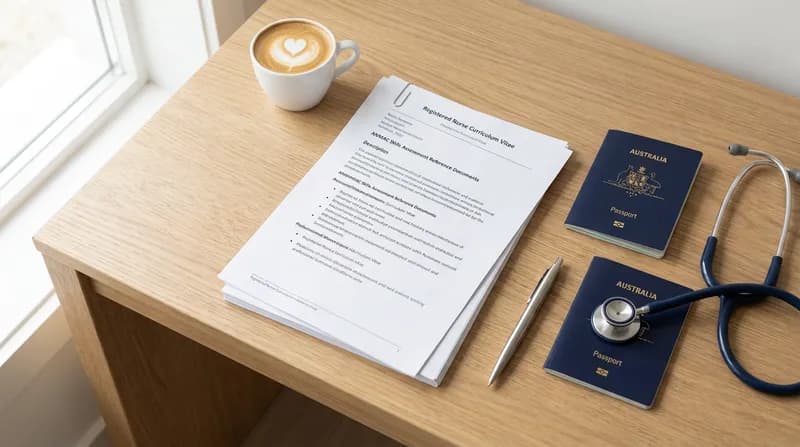
Migrating to Australia as a nurse is a thrilling career milestone, but the reality of the application process is often buried in paperwork. If you are an overseas nurse migrating to Australia, you likely share a common anxiety. You are terrified of having your Australian migration delayed by months, or rejected entirely, because of minor bureaucratic formatting errors. Translating your overseas clinical experience into the rigid, gap-free formats demanded by regulatory bodies is incredibly stressful. On top of that, getting your overseas supervisors to comply with strict official letterhead and email rules can feel like an impossible hurdle.
You are not alone in this frustration. Securing your future in the Australian healthcare system requires passing two major checkpoints. First, you need a skills assessment from the Australian Nursing and Midwifery Accreditation Council (ANMAC) for your visa. Second, you must secure your clinical registration from the Australian Health Practitioner Regulation Agency (AHPRA) to legally practice.
A standard job-hunting resume will result in immediate rejection by these regulatory bodies. In this guide, we will walk you through exactly how to structure your AHPRA registration international nurses application, master the ANMAC professional reference requirements, and confidently move toward your job offer. Ready to see how your current CV stacks up? Start with a free diagnosis to get your recruiter-lens score and identify the exact gaps costing you interviews in minutes.
Navigating the bureaucracy: Migrating to Australia as a nurse in 2026
The journey to working in Australian hospitals is a sequential process. Many international nurses confuse the roles of ANMAC and AHPRA, which leads to critical mistakes on their application documents.
ANMAC is the assessing authority for the Department of Home Affairs. They evaluate your educational qualifications and work experience to ensure they meet Australian standards for migration purposes. AHPRA, on the other hand, is the regulatory body that grants you the license to touch patients in Australia.
Both organizations require comprehensive documentation, but they look for very different things. A standard resume designed to catch a hospital recruiter's eye will fail an AHPRA audit. If you want to understand the foundational rules of global resume lengths before diving into these strict regulations, read our guide on How Long Should a Resume or CV Be? 2026 Guide for AU, NZ, US & UK. However, keep in mind that for AHPRA, length limits do not apply. Compliance is your only goal.
The difference between a standard nursing resume and an AHPRA standard CV format
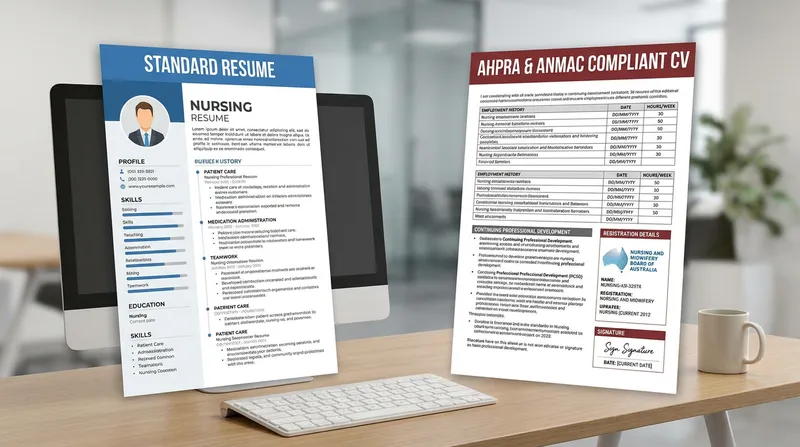
At JobSparrow, we look at applications from both sides of the hiring table. Our team and advisors have collectively reviewed 100,000+ resumes. When you apply for a job at a hospital in Sydney or Melbourne, the Nurse Unit Manager wants to see your clinical highlights, leadership skills, and patient outcomes in a concise format. Most recruiters spend less than 10 seconds on an initial CV scan.
An AHPRA assessor operates entirely differently. They are not looking to hire you. They are auditing you. The AHPRA standard CV format requires exhaustive, gap-free chronological compliance. Marketing yourself takes a back seat to proving your regulatory history.
Unlike a standard registered nurse CV Australia format, your AHPRA document must include:
- Exact start and end dates for every single position (format: DD/MM/YYYY).
- An explanation of any period since you qualified when you were not practising.
- Your full registration history, including registration numbers.
- A legally binding, signed declaration on the final page.
If you are pivoting into nursing from another field and need to understand standard formatting first, explore The Best Career Change Resume Format for 2026 (Section-by-Section Guide & Templates). But when submitting to AHPRA, you must abandon marketing and embrace strict chronological reporting.
Step-by-step: Building your AHPRA CV template for nurses
Creating an AHPRA CV template for nurses requires meticulous attention to detail. According to the Australian Health Practitioner Regulation Agency (AHPRA), your curriculum vitae must cover a specific set of details. AHPRA notes it is not a fixed template, but leaving out a required element can slow your application down.
Here is exactly how to build each section.
1. Personal details and qualifications
Start with your full legal name as it appears on your passport. Include your current residential address, phone number, and a professional email address. Follow this immediately with your educational qualifications. List your nursing degrees, the institution names, the country of study, and the exact dates of commencement and completion.
2. Registration history
You must list every nursing registration or license you have ever held worldwide. Include the name of the regulatory authority, your registration number, and the dates you held the license. Do not omit any past registrations, even if they are currently inactive.
3. Continuous practice history
This is where most nursing CV examples Australia fail. You must document your entire professional history in reverse chronological order. For every role, you must include:
- The exact start and end dates (DD/MM/YYYY).
- The facility name and location.
- Your official job title.
- Your employment status (full-time, part-time, or casual).
- A brief list of clinical duties and the specific ward or setting (e.g., ICU, Medical-Surgical, Pediatrics).
If there is any period since you qualified when you were not practising, you must explicitly state the reason. Do not leave the timeline blank. Create a distinct entry for the gap (e.g., "15/03/2023 to 20/07/2023: Maternity Leave" or "Travel"). Unexplained gaps will result in AHPRA returning your application for clarification.
4. Continuing professional development (CPD)
AHPRA's CV guide does not list CPD as a required section, but documenting your CPD nursing resume Australia history is still useful. The Nursing and Midwifery Board's CPD standard requires a minimum of 20 hours of CPD each registration year, so keep a clear record of recent activities, including the date, the course or seminar name, the provider, and the hours completed.
Before you submit any document for a job application later in the process, you can run it through our Free AI CV Review: How to Instantly Optimize Your Resume for ATS (2026) to ensure it meets hospital tracking system standards.
The mandatory AHPRA resume declaration
A missing or incorrect declaration is an easy way to have your CV sent back. You cannot simply sign the bottom of the page.
The Australian Health Practitioner Regulation Agency (AHPRA) mandates exact wording that must appear on the final page of your CV. You must include this precise AHPRA resume declaration:
"The curriculum vitae is true and correct as at (insert date)."
You must then physically or digitally sign the document next to this statement. Without this exact phrasing and your signature, your application will not proceed.
Ready to see how your current CV stacks up for hospital applications? Start with a free diagnosis to get your recruiter-lens score and identify the exact gaps costing you interviews.
ANMAC skills assessment requirements: Mastering the statement of service
While AHPRA handles your registration, ANMAC dictates your visa eligibility. To secure a positive ANMAC skills assessment requirements outcome, you must provide a Statement of Service (often called a professional reference).
A standard reference letter praising your work ethic is useless here. The statement of service nursing Australia requirements are strictly bureaucratic. According to the Australian Nursing and Midwifery Accreditation Council (ANMAC), your professional reference must be written on the official letterhead of your employing hospital or health service.
The ANMAC professional reference template must explicitly state:
- Your exact dates of employment.
- Your areas of clinical experience, such as your ward or setting.
- A statement, with examples, about your professional competence and safety as a nurse.
- Details of your continuing professional development.
- The date, plus the name, position, work email address and signature of your referee, who should be the person who directly manages or supervises you.
Overcoming the official email hurdle with overseas supervisors
One of the most massive pain points for an overseas nurse migrating to Australia is the ANMAC email rule. The Australian Nursing and Midwifery Accreditation Council (ANMAC) does not accept emails from free web-based accounts, and your referee must include a work email address. If your supervisor only has a Gmail, Yahoo, or Hotmail account, the reference is unlikely to be accepted as it stands.
This is incredibly frustrating if your overseas hospital simply does not issue corporate email addresses to its nursing managers. Do not guess at a workaround. Contact ANMAC before you submit, explain the situation, and ask what alternative it will accept. In the meantime, keep your payslips, tax records and employment contract ready in case extra evidence is requested. ANMAC states that it must be able to verify any work experience you claim, and non-genuine claims lead to a negative outcome and a two-year lock-out.
Aligning your nursing experience with your ANZSCO code
The Department of Home Affairs relies on the Australian and New Zealand Standard Classification of Occupations (ANZSCO) to process skilled migration visas. Your ANZSCO code nursing resume alignment is crucial.
According to the Australian Bureau of Statistics (ABS) and the Department of Home Affairs (Australia), Registered Nurses fall under ANZSCO Unit Group 2544. Within this group, there are specific codes for specializations, such as Registered Nurse (Medical) or Registered Nurse (Critical Care and Emergency).
When drafting your registered nurse CV Australia and your Statement of Service, ensure the language mirrors the official government definitions. If your overseas job title was "Ward Sister" or "Staff Nurse," make sure your bullet points clearly describe the duties of an Australian "Registered Nurse" so the assessor does not misclassify your skill level.
From diagnosis to offer: JobSparrow's approach to Australian nursing jobs
You have cleared the regulatory hurdles. Now the Offer Path shifts from proving your credentials (Execute) to marketing your clinical value to Australian hiring managers (Position and Close).
JobSparrow is your AI career advisor, guiding you through the entire Offer Path: Diagnose, Position, Execute, Prepare, and Close. You cannot send your dense, 10-page AHPRA CV to a hospital recruiter via SEEK. They will not read it.
Once you have your AHPRA registration, upload your compliance CV to your JobSparrow Master Career Profile. Our AI strips the regulatory detail and rebuilds a hospital-ready resume tailored to each SEEK listing using our Job-Specific Resume Tailoring feature. You will even receive a Match Score showing exactly how well you fit before you apply. To understand why standard job boards fail candidates with generic resumes, read ATS Scanners vs Job Trackers: The $100/Month Trap (And Why You Are Still Rewriting Resumes at Midnight).
Please note that AHPRA and ANMAC submissions must be made directly by the applicant. JobSparrow assists with your job-application resume, not the regulatory CV itself.
Ready to land more interviews in the Australian healthcare system? Start with a free diagnosis. Try the full Offer Path for 7 days for US$5.99, then US$45 a month. Cancel anytime.
Frequently asked questions
Do I need an ANMAC skills assessment before applying for AHPRA registration?
Not necessarily. They are separate processes. ANMAC assesses your skills for migration on behalf of the Department of Home Affairs, while AHPRA handles registration so you can legally practise. The right order depends on your pathway and visa subclass, so check the current requirements on both the ANMAC and AHPRA websites before you start.
How do I explain employment gaps on my AHPRA CV?
AHPRA asks you to explain any period since qualifying when you were not practising. State the reason for each gap in your chronological timeline. Use clear entries like "March 2023 to July 2023: Maternity Leave" or "August 2024 to November 2024: Relocation and Travel." Never leave gaps blank, as assessors will return the CV for clarification.
Can my ANMAC professional reference be signed by a charge nurse?
Only if they are the person who directly manages or supervises you. ANMAC asks for a reference from your direct manager or supervisor, who must be a nurse, midwife or clinical supervisor, and it does not accept references from Human Resources or Payroll. A charge nurse who only covers some shifts is unlikely to qualify, so a Nurse Unit Manager is usually the safer choice.
How many hours of CPD do I need to list for AHPRA?
The Nursing and Midwifery Board's CPD standard requires a minimum of 20 hours of Continuing Professional Development per registration year. AHPRA's CV guide does not require a CPD section, but listing recent CPD with the date, course name, provider, and hours completed gives assessors and employers a clear picture.
Does my AHPRA CV need to be ATS-friendly?
No. The CV submitted directly to AHPRA is read by human regulatory assessors, so ATS compliance does not matter. However, the version of your resume used to apply for hospital jobs via SEEK or hospital careers portals absolutely must be ATS-friendly to pass the initial screening.
Tags
Keep reading
Recommended articles.
vetassess · anzsco
VETASSESS Resume Format 2026: Guide, Templates & ANZSCO Matching
Master the 2026 VETASSESS resume format. Avoid rejections with our document checklist and ANZSCO matching tips. See your recruiter-lens score free.
acs skills assessment · anzsco codes
ACS Skills Assessment Resume Guide: Prove ANZSCO Alignment & Avoid Rejection (2026)
Master the 2026 ACS CV format. Map ANZSCO codes, avoid rejection, and secure your migration points. Start free at JobSparrow.
accountant resume · australian migration
How to Write an Accountant Resume for Australian Migration (Aligned with CPA Standards)
Write an accountant resume aligned with CPA Australia and ANZSCO 221111. Secure migration points and land top Australian jobs. Start free today.