
interview prep
Overcoming Interview Anxiety: Why Voice AI Mock Interviews Beat ChatGPT
By Job Sparrow Team
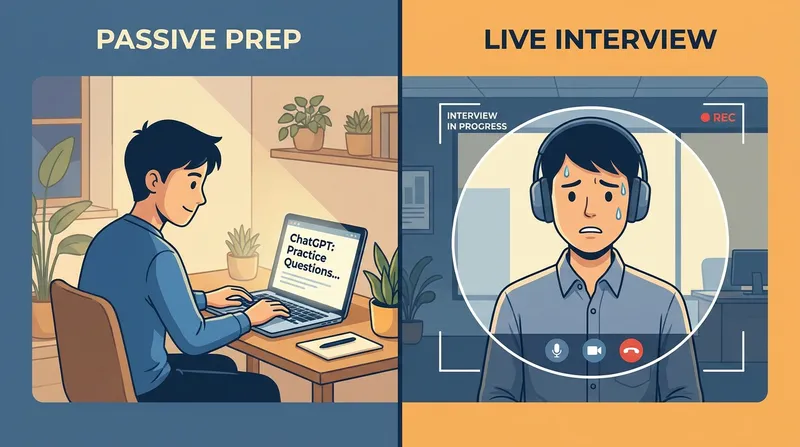
You have spent hours preparing to overcome interview anxiety for your upcoming job interview. You typed every possible question into an AI prompt, carefully crafted the perfect responses, and read through your notes until you felt completely ready. But the moment the hiring manager turns on their camera and asks the first question, your mind goes completely blank.
Your heart races, your palms sweat, and the articulate answers you prepared in your head suddenly turn into a rambling mess.
At JobSparrow, we view the job search as a five-stage journey: Diagnose, Position, Execute, Prepare, and Close. Getting your resume noticed on platforms like SEEK is only the beginning. To truly conquer the Prepare and Close stages, especially for rigorous panel interviews common in Australian enterprises and government roles, you must move beyond written scripts. Practicing interview answers in your head or typing them into a text box creates a dangerous illusion of competence. It simply does not prepare you for the adrenaline and pressure of speaking aloud to a real human being.
Job interviews are verbal performances, not written exams. To truly overcome interview anxiety, you need to bridge the gap between text-based preparation and real-time verbal delivery. In this guide, we will explore the biological reasons behind interview nerves and explain why voice AI mock interviews are the ultimate tool to build genuine confidence.
The hidden trap of text-based interview prep
Many candidates rely heavily on text-based tools to prepare for their job hunt. It is incredibly satisfying to feed a job description into a text prompt and watch it generate a flawless, structured response. However, this method traps job seekers in a false sense of security.
When you type an answer, you have the luxury of time. You can pause, delete a sentence, reorganize your thoughts, and find the perfect vocabulary word. Real conversations do not work this way. As Business Insider reported when a former Disney recruiter tested the approach, standard text AI can help formulate answers, but it often gives vague or overly positive feedback and praises general responses that most recruiters would expect to be specific and detailed.
Text-based preparation completely ignores the physical mechanics of speaking. It does not test your breathing, your pacing, or your ability to recover from a stumbled word. Just as we discussed in our guide on Are AI Resume Builders Worth It? Pros, Cons, and ATS Optimization in Australia, relying solely on automated text generation can leave your application materials feeling robotic. The exact same principle applies to your interview answers.
Actionable tip: Audit your current interview prep routine today. Calculate how much time you spend reading or typing answers versus how much time you spend actually speaking them out loud. If your ratio is heavily skewed toward typing, you need to adjust your strategy immediately.

The biology of interview anxiety: why your mind goes blank
To conquer interview anxiety, you must first understand that it is a biological response, not a personal failure. When you step into an interview setting, your brain perceives the high-pressure social evaluation as a physical threat.
This triggers your sympathetic nervous system, launching you into a "fight-or-flight" state. Research published by Charlie Health confirms that job interviews trigger a biological stress response causing physical symptoms like a racing heart, mental blanking, and shaky hands. Your body is prioritizing immediate survival over complex thought processes.
When adrenaline floods your system, your vocal cords tighten, causing your voice to shake or pitch higher. Your breathing becomes shallow, which leads to speaking too quickly and running out of breath mid-sentence. You are physically reacting to danger, which makes it nearly impossible to sound relaxed and confident.
Actionable tip: Practice tactical breathing to lower your heart rate before the camera turns on. Inhale deeply through your nose for four seconds, hold for four seconds, and exhale slowly through your mouth for six seconds. Repeat this cycle four times to manually signal to your brain that you are safe.
How anxiety sabotages memory recall
The most terrifying symptom of interview anxiety is the sudden inability to remember your own career history. You know your resume inside and out, but under pressure, the details simply vanish.
This happens because anxiety actively disrupts your working memory. Research published in Frontiers in Psychology found that higher state anxiety and stress are associated with poorer working memory performance, which is exactly the system you rely on to hold a question in mind while retrieving and structuring a relevant example from your career history. The cognitive load of managing your physical symptoms leaves no mental bandwidth for storytelling.
If you are relying on a complex system to remember your history, as we noted in Why Your Job Application Tracking Spreadsheet is Hiding Your Skill Gaps (And What to Use Instead), anxiety will make that mental spreadsheet completely inaccessible. You need a simpler way to retrieve information.
Actionable tip: Create a minimalist, bulleted cheat sheet of your core achievements rather than trying to memorize full paragraphs. Write down three powerful keywords for each story. When your mind goes blank, glancing at a single keyword is enough to jog your memory without requiring you to read a script.
The production effect: why you must practice interview questions aloud
If typing answers does not work, how should you prepare? The answer lies in a cognitive phenomenon known as the Production Effect.
The Production Effect is a proven psychological principle demonstrating that producing information aloud cements it in your long-term memory far better than reading it silently. Research highlighted by the University of Waterloo proves that speaking information aloud combines motor action with self-referential auditory input, making the memory highly distinctive and easier to retrieve.
When you practice interview questions aloud, you are building muscle memory in your jaw, tongue, and vocal cords. You are training your brain to string thoughts together verbally. Most importantly, speaking aloud forces you to confront awkward phrasing. A sentence that looks brilliant on a screen might sound incredibly unnatural when spoken.
Actionable tip: Record yourself answering a common behavioral question on your smartphone. Do not look at any notes. Listen back to the recording and take note of where you hesitated, used filler words, or lost your train of thought. This exercise is uncomfortable, but it is the fastest way to identify your verbal weaknesses.
Voice AI interview practice vs. ChatGPT: the recruiter lens
At JobSparrow, our team has collectively reviewed over 100,000 resumes and conducted thousands of interviews across Australia, New Zealand, the US, and the UK. We approach career advice from both sides of the table. From a recruiter's perspective, we can instantly tell when a candidate has only practiced by writing scripts.
Candidates who rely on text-based tools sound rehearsed, monotone, and inflexible. When a hiring manager interrupts them or asks a follow-up question, they completely derail because they cannot find their place in their mental script.
This is why voice AI interview practice is fundamentally superior to standard ChatGPT preparation. A dedicated AI interview prep tool simulates the unpredictable environment of a real conversation. It forces you to listen to a spoken question, process it in real-time, and respond verbally.
| Feature | Text-based AI (ChatGPT) | Voice AI Mock Interviews |
|---|---|---|
| Feedback type | Vague, text-based edits | Real-time audio analysis |
| Simulates real pressure | Low | High (ticking clock, spoken prompts) |
| Vocal delivery analysis | None | Analyzes tone, pace, and filler words |
| Memory retention | Poor (reading only) | High (Production Effect) |
| Anxiety desensitization | Minimal | High (Exposure therapy) |
Furthermore, voice AI provides critical feedback that text tools cannot offer. It analyzes your tone, your speaking pace, your clarity, and your use of filler words. It tells you if you sound confident or unsure. As we explore in our guide From Application to Offer: Integrating Your Job Search Tracker with an AI Interview Prep Tool, treating interview practice as a dynamic, verbal exercise is the key to converting applications into job offers.
Actionable tip: Stop writing out full sentences for your interview prep. Transition entirely to outlining high-level bullet points. Use a voice-to-voice simulation tool to practice delivering those points naturally, focusing on conversational flow rather than rigid memorization.
How an AI interview coach acts as exposure therapy
Psychologists often treat severe anxiety using exposure therapy, a technique where a person is gradually exposed to the source of their fear in a safe environment. Voice AI mock interviews serve as the perfect exposure therapy for job search anxiety.
When you use an AI interview coach, you trigger a mild version of the adrenaline response. The pressure of a ticking clock and a voice asking you difficult questions forces you to practice managing your physical symptoms. By doing this repeatedly in a low-stakes environment, your brain slowly learns that the interview setting is not a physical threat.
An AI interview coach allows you to stumble, fail, and try again without any human judgment. You can bomb an answer completely, review the real-time objective feedback, and immediately retry the question. This is especially critical for career pivoters, as highlighted in How to Change Careers Without Taking a Pay Cut: A Recruiter's Playbook for Transferable Skills, because you are often forced to articulate unfamiliar achievements and transferable skills for the very first time.
Actionable tip: Schedule a 15-minute voice AI mock interview every single day during the week leading up to your real interview. Treat it like a daily workout. This repeated exposure will dramatically desensitize you to the pressure of the camera and the microphone.
4 actionable interview anxiety tips to reduce nerves
Beyond using the right technology, you need practical strategies to manage your nerves in the moment. Here are four proven tips to keep your anxiety in check:
1. Master the STAR method verbally The STAR method (Situation, Task, Action, Result) is the gold standard for behavioral questions. However, knowing the acronym is not enough. You must practice structuring your stories aloud. According to Harvard University, practicing behavioral questions aloud and participating in mock interviews are critical steps to evaluate past performance and improve real-time communication strategies.
2. Use the pause and breathe technique When a hiring manager asks a curveball question, your instinct will be to start talking immediately to fill the silence. Resist this urge. It is perfectly professional to say, "That is a great question, let me think about that for a second." Take a deep breath, gather your thoughts, and then speak. That three-second pause shows immense confidence.
3. Shift your mindset Stop viewing the interview as an interrogation where you must prove your worth. Reframe it as a professional conversation between equals to determine mutual fit. From our experience conducting thousands of interviews, candidates who approach the conversation as a two-way evaluation consistently present as more confident. You are interviewing them just as much as they are interviewing you.
Actionable tip: Prepare three insightful questions to ask the hiring manager about the company culture or daily challenges. Having your own questions ready reinforces your position as an equal evaluator.
4. Build genuine muscle memory Confidence is not a personality trait: it is a byproduct of competence. The only way to feel competent speaking under pressure is to practice speaking under pressure. Use simulated voice practice to build the muscle memory required to deliver your answers smoothly.
Actionable tip: Choose one of your strongest behavioral stories today. Practice delivering it aloud using the STAR framework until it feels entirely conversational and takes less than two minutes to share.
The offer path: preparing for the close with JobSparrow
As mentioned earlier, the job search is a five-stage journey: Diagnose, Position, Execute, Prepare, and Close. Getting your resume past the ATS and into a recruiter's hands is only the beginning. An optimized resume gets you in the room, but confident, articulate verbal delivery is what actually wins you the job offer.
Relying on outdated templates or text-only AI tools will leave you unprepared for the final hurdle. As we explain in The 'Mad Libs' trap: Why a cover letter template generator fails (and AI writers win), generic preparation leads to generic results. You need tools that adapt to your specific career history and simulate real-world challenges.
JobSparrow's AI Mock Interview feature is designed specifically to cure interview anxiety. By simulating role-specific interviews with real-time audio recording and AI analysis, we help you practice in a safe environment. You can launch an interview directly from a saved job application URL for maximum relevance, or via an Instant Interview path. You receive instant, actionable feedback on your answer quality, clarity, and delivery tone, allowing you to fix mistakes before you ever face a hiring manager. While AI feedback accelerates your improvement significantly, we recommend supplementing your practice with at least one session with a trusted peer or mentor to get human-perspective feedback before your real interview.
Actionable tip: Ready to land more interviews and conquer your nerves? Start with a free diagnosis today. Upload your current resume to see your recruiter-lens score and identify the exact gaps costing you interviews. Then, unlock the full Offer Path for a one-time fee of $129 to access our complete suite of tools, including unlimited AI mock interviews.
Frequently asked questions
Is ChatGPT good for interview prep?
While ChatGPT is excellent for brainstorming potential questions and outlining high-level bullet points, it falls short for actual practice. It does not simulate the physical pressure of speaking aloud, nor does it provide feedback on your tone, pacing, or verbal delivery.
How do I stop my voice from shaking during an interview?
A shaky voice is a biological response caused by adrenaline tightening your vocal cords. To combat this, use deep tactical breathing before the interview to lower your heart rate. During the interview, make a conscious effort to speak slightly slower than your normal pace. Regular practice with voice AI mock interviews will also build your stress tolerance over time.
What is the best AI tool for mock interviews?
The best tools move beyond text and offer voice-to-voice simulation. JobSparrow is the ideal choice because it combines a recruiter-lens perspective with real-time audio feedback. It generates questions based on the specific job description you are applying for, ensuring your practice is highly relevant.
How do I practice the STAR method out loud?
Do not write a full script for your STAR stories. Instead, write down four single bullet points (one each for Situation, Task, Action, and Result). Use a voice AI interview coach to practice transitioning smoothly between these four points. The goal is to sound conversational, not memorized.
How can I deal with post-interview anxiety?
The waiting period after an interview can be incredibly stressful. Channel that nervous energy into productive actions. Send a thoughtful follow-up email to the hiring manager, log the specific questions you were asked for future practice, and continue applying to other roles to maintain your momentum.
Tags
Keep reading
Recommended articles.
interview prep · career advice
How to Explain Being Fired in an Interview (With Scripts & Examples)
Learn how to explain being fired in an interview without panic. Get actionable scripts, recruiter insights, and tips to answer with total confidence.
ai mock interview · interview prep
Last-Minute Interview Prep: Generate a Custom AI Mock Interview from Any Job URL
Need last-minute interview prep? Generate a custom AI mock interview from any job URL in seconds with JobSparrow. Practice out loud and land the offer.
interview preparation · career advice
Ace Your AU & NZ Interview: 5 Signs You Need an AI Prep Tool
Beat interview anxiety with AI mock interviews for AU & NZ. Practice role-specific questions, get instant feedback, and build real confidence. Try free.