
resume gap
Explain a Resume Gap Due to Illness (AU/NZ Guide)
By Job Sparrow Team

Explain a Resume Gap Due to Illness (AU/NZ Guide)
You have been out of the workforce for a while due to a health crisis, mental health break, or ongoing disability. Now that you are ready to return, a massive hurdle stands in your way: the resume gap.
The core pain point for most job seekers in this situation is immense anxiety. You might feel terrified that disclosing a medical issue will automatically disqualify you. Worse, generic career advice often forces you to either lie by claiming you are "fully recovered" or feel inadequate because you did not spend your sick leave learning to code.
Let us clear the air. You do not need to be 100 percent cured to return to work, and you certainly did not need to upskill while fighting for your health. JobSparrow approaches this differently. We speak from both sides of the hiring table. We have reviewed over 100,000 resumes across Australia, New Zealand, the United States, Singapore, and Hong Kong. Recruiters are not looking for perfection. They are looking for clarity and readiness.

In this 2026 guide, we will walk you through exactly how to explain a resume gap for health reasons, navigate the AU and NZ legal frameworks, and position yourself for the job offer using JobSparrow's five-stage Offer Path: Diagnose, Position, Execute, Prepare, and Close.
Should you disclose a disability or illness? (AU/NZ legal context)
Before you type a single word on your resume, you must understand your rights. Many candidates overshare out of fear, thinking they owe the employer their entire medical history. You do not.
In Australia, the Disability Discrimination Act 1992 protects your privacy. According to the Australian Human Rights Commission, you are not legally required to disclose a specific diagnosis. You only need to share information if your condition affects your ability to perform the inherent requirements of the job, or if you need reasonable adjustments to carry out your duties safely.
Similarly, in New Zealand, guidelines from Employment New Zealand emphasize that medical incapacity or disability should be handled with fairness and good faith, and employers must consider reasonable accommodations without discrimination.
Actionable Tip: Never put your specific medical diagnosis on your resume. If you need workplace adjustments, save that conversation for the interview stage or after a job offer is extended.
The "managed, not cured" approach: addressing chronic illness
Most online resume builders give you a rigid script: "I took time off for a medical issue, but I am now fully recovered." But what if you have a chronic illness? What if you are returning to the workforce after a disability that will always be part of your life?
Forcing yourself into the "fully recovered" box is unrealistic and stressful. Instead, adopt the "Managed, Not Cured" approach. Employers primarily want to know that your health situation will not unexpectedly disrupt your work. You can confidently explain a chronic illness by focusing on your management strategies and your readiness to work.
Research and advocacy from organizations like the Australian Network on Disability highlight the importance of emphasizing resilience and adaptability. You navigated a complex health system and managed a major life disruption. Those are highly transferable skills.
Actionable Tip: Reframe your narrative. Instead of saying you are cured, say: "I took a career break to manage a health condition. I now have an effective management plan in place and am fully ready to take on this role."
Leveraging soft skills gained during your health journey
Competitor guides often assume that if you were not taking a formal coding class during your sick leave, you were doing nothing. This is a fundamental misunderstanding of the human experience. Managing a complex health condition builds incredible soft skills that employers desperately need.
Think about the project management required to coordinate multiple specialists, insurance claims, and treatment schedules. Consider the resilience required to face a difficult diagnosis and keep moving forward. Think about the empathy and emotional intelligence you have developed. These are not just buzzwords. They are critical workplace competencies.
Actionable Tip: In your cover letter or during an interview, do not be afraid to translate your health journey into professional strengths. You can say: "Navigating my recent health challenges required intense adaptability, crisis management, and clear communication. These are skills I am excited to bring to your fast-paced operations team."
How to explain an employment gap on your resume (ATS-friendly formatting)
Applicant Tracking Systems (ATS) are software programs used by the vast majority of mid-to-large employers in Australia and New Zealand. They parse your resume for keywords, dates, and job titles. If an ATS detects a multi-year gap with no explanation, it may automatically assign your profile a lower match score. This means a human recruiter might never see your application.
To prevent this, you must explicitly format the gap so the ATS reads it as a planned period rather than missing data. Here is how to format a health gap on your CV without triggering red flags:
- Use years instead of months: If your gap was shorter than a year, simply list your employment dates by year (e.g., 2023 to 2025). Note: Only use this if your gap genuinely spans across a calendar year boundary. Do not use this technique to obscure a gap that falls entirely within a single year.
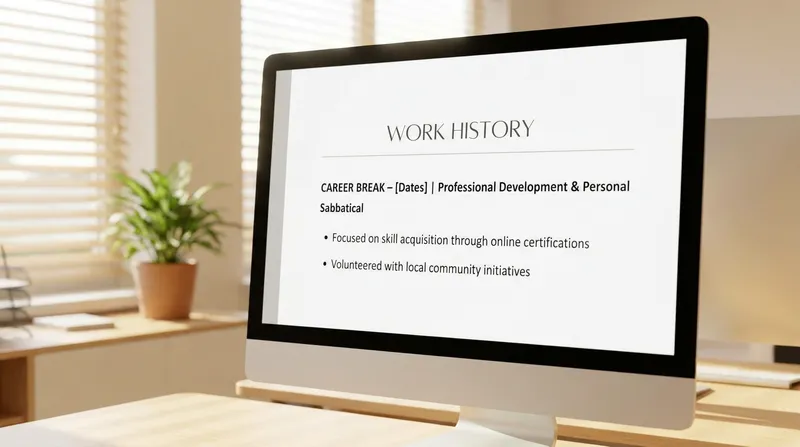
- Create a "Career Interruption" entry: If the gap is longer, treat it like a job entry. Use a title like "Planned Career Break" or "Health Sabbatical."
- Keep the description brief: Add one bullet point stating you took time off to manage a personal health matter and are now ready to re-enter the workforce.
For example, if you took two years off, you can create a specific header in your experience section:
Title: Planned Health Sabbatical Dates: 2024 to 2026 Description: Took a deliberate career pause to manage a personal health condition. Condition is now successfully managed, and I am fully prepared to return to full-time employment with updated industry knowledge.
This formatting ensures the ATS sees continuous chronological data.
Mid-Article Action Step: Not sure how your current CV handles your gap? Start with a free diagnosis at JobSparrow to see your recruiter-lens score and the exact gaps costing you interviews in minutes. JobSparrow's free diagnosis gives you your recruiter-lens score instantly. The full Offer Path (including Gap Filler, resume tailoring, and mock interviews) is available on the Offer Path plan at US$45 per month, or US$33 a month when billed US$99 every three months. Cancel anytime.
Think of the Master Profile as your comprehensive career database. Our AI Gap Filler acts as an interactive coach, identifying unexplained career gaps in your profile and walking you through a targeted Q and A to fill them in professionally. Our platform is not just a formatting tool. It is a comprehensive career advisor. You can read more about Why single-purpose ATS resume tools fail: The case for integrated voice AI interview prep | Blog | JobSparrow on our blog.
Tailoring your application even as a returning candidate
A gap explanation is only part of the puzzle. Generic applications fail, but personalization wins. Even as a returning candidate, tailoring your resume language to match each specific role is critical. Highlighting your past achievements with targeted keywords shows employers that your foundational skills are highly relevant to their current needs.
Best resume formats for career breaks
Chronological resumes are the standard, but they highlight gaps glaringly. If you have a long-term illness on your CV, a hybrid (or combination) resume format is often better. This format places your core competencies and skills at the top, immediately showing the recruiter what you bring to the table, followed by a condensed work history.
JobSparrow's Instant Resume feature allows you to seamlessly switch between formats. You can choose from five templates (Professional, Two Column, Elegant, Colorful, and Contemporary) and our AI will automatically restructure your experience to highlight your strengths, minimizing the visual impact of your medical break. For specific regional expectations, check out our guide on the NZ CV Format 2026: What Kiwi Employers Want | JobSparrow | Blog | JobSparrow.
Actionable Tip: Place a "Key Achievements" or "Core Competencies" section right below your professional summary. Force the recruiter to read about your skills before they ever look at your timeline.
How to address a health gap in your cover letter
Your cover letter is the perfect place to control the narrative. However, do not turn it into a medical journal. The goal is to address the gap proactively, briefly, and then pivot immediately to why you are the best fit for the role.
Here is a simple formula: Acknowledge the break + State your readiness + Connect to the job.
Example: "As you will see on my resume, I took a planned career break in 2024 to manage a health matter. That situation is now successfully managed, and I am eager to bring my five years of project management experience to the Senior Coordinator role at your company."
Writing a unique cover letter for every application is exhausting, especially when you are already managing health-related fatigue. JobSparrow's Intelligent Cover Letter Generator creates personalized cover letters that weave your specific experiences into a compelling narrative, handling the gap explanation gracefully.
Interview questions about resume gaps and how to answer them
Getting the interview means your resume worked. Now, you have to talk about the gap face-to-face. Interviewers are legally restricted in what they can ask about your health, but they will ask about the gap itself.
Preparation breeds confidence. If you are returning to work after a mental health break, organizations like Beyond Blue in Australia and the Mental Health Foundation NZ recommend focusing on your transition plan and readiness rather than the specifics of your burnout or depression.
Let us look at a few examples of how to handle intrusive or tricky interview questions regarding your health gap.
Scenario 1: The direct question. Interviewer: "Why did you leave your last job in 2023?" Your Answer: "I needed to step away to manage a health issue that required my full attention. I am grateful I had the opportunity to focus on my recovery, and I am now fully ready to re-enter the workforce. I have been keeping up with industry trends, particularly in digital marketing, and I am very excited about the campaigns your team has been running."
Scenario 2: The probing question (which borders on inappropriate). Interviewer: "Are you fully cured now? Will this issue come back?" Your Answer: "I have an excellent management plan in place that allows me to perform at my absolute best. My health will not interfere with my ability to meet and exceed the expectations of this role."
Notice how both answers use a pivot technique. You acknowledge the question briefly, provide a reassuring but boundary-setting answer, and immediately pivot the conversation back to the job, the company, or your skills.
To master this delivery, you need practice. JobSparrow's AI Mock Interviews simulate real interview scenarios with real-time audio recording. You can practice answering questions about your resume gap in a safe environment and get instant feedback on your tone and clarity. This is crucial because your delivery matters just as much as your words. If you sound defensive, the recruiter will worry. If you sound confident, they will move on.
Overcoming the psychological pivot
The hardest part of returning to the workforce after a disability or long-term illness is often the psychological battle. You might feel guilty that you did not take online courses, learn a new language, or volunteer while you were sick.
Let us be completely transparent. Surviving a health crisis is a full-time job. You do not need to justify your survival by wrapping it in productivity. When you use JobSparrow's Job Application Tracking and Analysis dashboard, you can see your exact Match Score for a role based on your actual past experience. Your gap does not erase the years of expertise you built before you got sick.
This is a mindset issue, not a qualifications issue. You must pivot your internal narrative before you can convince a recruiter. Remember that employers are hiring you for your brain, your experience, and your potential. A gap of one, two, or even five years does not erase the foundational knowledge you built over your career.
If you are struggling with the emotional weight of this transition, do not hesitate to seek professional support from resources like Beyond Blue or the Mental Health Foundation NZ.
When you use JobSparrow's Gap Filler, our AI does not just ask you about your work history. It prompts you to uncover hidden achievements and quantify your past successes. Seeing your Master Profile fill up with metrics and strong action verbs is an incredible confidence booster. It reminds you of exactly how capable you are. Before you even apply, you can use our system to read Should You Apply? How to Calculate Your Job Match Score Before Wasting Time | Blog | JobSparrow to ensure you are targeting the right level of seniority.
Actionable Tip: Stop apologizing for your health gap. When you speak about it, use a neutral, matter-of-fact tone. Confidence signals to the hiring manager that the gap is a non-issue.
Navigating reasonable adjustments and accommodations
If you require reasonable adjustments (such as a modified workstation, flexible hours, or specific software), timing is everything. Do not list these requirements on your resume. Your resume is a marketing document designed to get you an interview.
Once you have secured an interview and proven your value, or when an offer is on the table, you can discuss accommodations. Employers in Australia and New Zealand are legally obligated to provide reasonable adjustments unless it causes unjustifiable hardship to the business. Frame these adjustments not as special favors, but as the tools you need to deliver peak performance.
If you are concerned about addressing past performance issues related to your health before you took leave, check out our guide on How to Explain Being Fired in an Interview (With Scripts & Examples) | Blog | JobSparrow.
The smart way to manage your return to work
Managing a job search across multiple platforms is fragmented and exhausting. When returning from a health break, your energy is a precious resource. You cannot afford to waste hours scrolling through irrelevant listings on LinkedIn or Seek.
JobSparrow's Smart Job Search and Recommendations aggregates and ranks jobs from multiple platforms in one place. More importantly, our AI tailors your resume for every single application, rewriting your bullet points to match the job's keywords and requirements in under 60 seconds. This is how you beat the bots and land interviews without burning out. Discover more about this in our article on Why You Keep Seeing the Same 10 Jobs (And How to Beat the LinkedIn & Seek Algorithms) | Blog | JobSparrow.
Take the next step on your offer path
Returning to work after an illness or disability is a massive achievement. Do not let a resume gap hold you back from the career you deserve. Generic tools will just give you a blank template, but JobSparrow is an AI career advisor that coaches you through the whole hunt to the offer.
Ready to land more interviews and step back into the workforce with confidence? Start with a free diagnosis on JobSparrow. See your recruiter-lens score and identify the exact gaps costing you interviews in minutes. When you are ready, unlock the full Offer Path from US$33 a month (billed US$99 every three months) or US$45 monthly, with no hidden costs and cancel anytime.
Upload your CV today and let us help you translate your resilience into your next great job offer.
Frequently asked questions
Do I have to disclose my medical condition on a resume in Australia or New Zealand?
No. Under the Australian Disability Discrimination Act and the New Zealand Human Rights Act, you are not legally required to disclose a specific diagnosis on your resume. You only need to discuss your health if it impacts your ability to perform the inherent requirements of the role or if you require reasonable workplace adjustments.
How do I explain a resume gap for mental health reasons without facing stigma?
Keep your explanation brief and professional. Frame it as a "planned health sabbatical" or "personal health matter." You do not need to specify that it was for mental health. Focus the conversation on your readiness to return to work and the management strategies you have put in place to ensure your ongoing success.
What is the best resume format if I have a long-term illness gap?
A hybrid (or combination) resume format is highly recommended for long-term gaps. This layout places your core competencies, skills, and key achievements at the very top of the page. By forcing the recruiter to focus on your qualifications first, you minimize the visual impact of the chronological gap in your work history section.
How do I answer interview questions about my health gap if I have a chronic condition?
Use the "Managed, Not Cured" approach. You do not need to claim you are 100 percent recovered. Instead, confidently state that you took time away to manage a health condition, you now have an effective management plan in place, and you are fully prepared to take on the responsibilities of the role. Immediately pivot the conversation back to your skills.
Can an employer ask about my medical history during an interview?
In both Australia and New Zealand, employers are generally not allowed to ask intrusive questions about your medical history unless it directly relates to your ability to safely perform the essential duties of the job. If asked an inappropriate question, pivot by reassuring them of your capability to fulfill the job requirements.
Tags
Keep reading
Recommended articles.
resume gap · caregiving
How to Explain a Resume Gap for Family Care (With Examples)
Learn how to explain a resume gap for family care. Discover resume examples, interview scripts, and tips to highlight transferable skills.
career break · return to work
Returning to Work After a Career Break in AU & NZ (2026): A Guide to Relaunching Your Career with Confidence
Return to work in AU & NZ with confidence. Get AI resume help, gap-filling strategies, and returnship opportunities. Only pay when you get a job. Start free.
ai cover letter · applicant tracking system
Generic AI Cover Letter Tools vs. JobSparrow: Why One-Size-Fits-All Fails AU/NZ ATS
Generic AI cover letters fail AU/NZ ATS filters. See how JobSparrow creates localized, recruiter-approved applications that land interviews. Try free.