
new zealand cv
NZ CV Format 2026: What Kiwi Employers Want | JobSparrow
By Job Sparrow Team
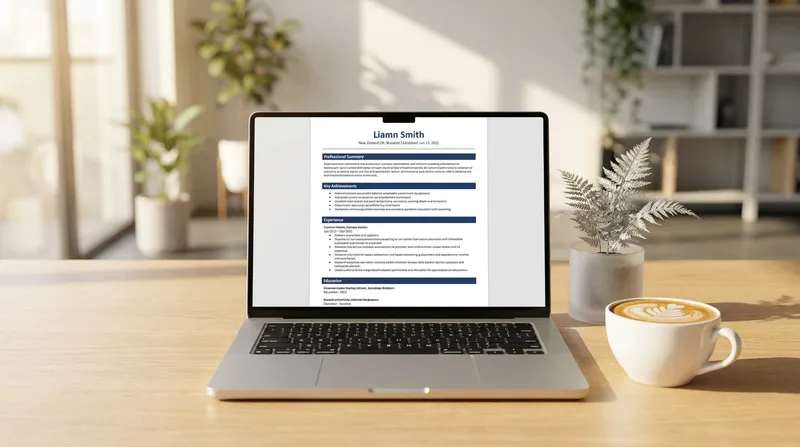
You have sent out 50 job applications this month. You have tailored your cover letters, double-checked your spelling, and hit submit with high hopes. Yet, all you hear is radio silence. If you are a migrant, a career changer, or an international student trying to break into the New Zealand job market, the problem is likely not your experience. The problem is your CV format.
Adapting to a new job market while navigating visa requirements and cultural norms is genuinely hard, and you deserve support that reflects that reality. Every week, highly qualified international job seekers get automatically rejected by Kiwi employers because they use US-style one-page resumes or European-style CVs packed with photos and personal details. They fail to realize that New Zealand employers require a conservative, two to three-page document that explicitly states visa status and includes local referees.
At JobSparrow, our team has collectively reviewed over 100,000 resumes and hired across Australia, New Zealand, Singapore, Hong Kong, and the United States. We know exactly what real recruiters react to in the first few seconds of a resume scan. In this comprehensive guide, we will walk you through the exact New Zealand CV format for 2026, show you how to navigate local cultural nuances, and explain how our five-stage Offer Path (Diagnose, Position, Execute, Prepare, and Close) can coach you from your first application all the way to a job offer.
Start with a free CV diagnosis at JobSparrow today.
What is the standard New Zealand CV format for 2026?
If you are using a flashy, graphic-heavy template with progress bars for your skills, you are already at a disadvantage. The New Zealand job market leans heavily toward the "Anti-Flashy Approach." Kiwi hiring managers and local job boards like Seek or Trade Me Jobs prefer plain, text-based, black-and-white CVs.
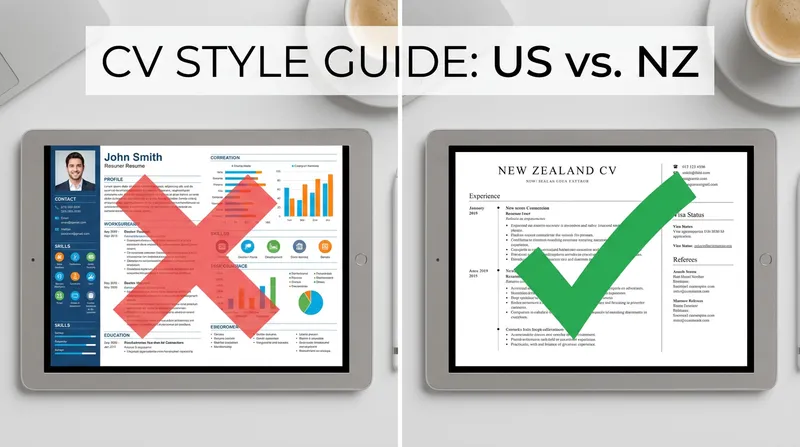
There are three main reasons why conservative formatting wins in New Zealand:
- Applicant Tracking Systems (ATS): Complex designs, columns, and graphics confuse the software used by most mid-to-large New Zealand companies. Research shows that 75% of applications are rejected by ATS before human review. If the ATS cannot parse your contact details or work history, a human will never see your application.
- Readability: According to Ladders, recruiters spend less than 10 seconds on an initial scan. A standard reverse-chronological format allows them to find your most recent experience instantly.
- Cultural Expectations: New Zealand workplace culture values substance over style. A highly stylized document can sometimes be perceived as trying to mask a lack of actual experience.
According to the New Zealand Government, employers in New Zealand expect a dedicated curriculum vitae or resume, along with a cover letter that clearly outlines your skills, experience, and interests.
CV vs resume New Zealand: what do Kiwi employers expect?
In the United States, a resume is a short, one-page summary, while a CV is a lengthy academic document. In New Zealand, the terms "CV" and "resume" are used interchangeably. However, the expectations for the document itself are uniquely local.
So, what is the ideal resume length New Zealand employers look for? The sweet spot is two to three pages.
A one-page resume often looks too brief to a Kiwi hiring manager, making it seem like you lack experience or are not providing enough detail about your responsibilities. On the other hand, a five-page document is overwhelming. You need enough space to detail your achievements, list your core competencies, and include your referees, all without rambling.
The migrant blueprint: formatting visa status and local experience
If you are writing a New Zealand CV format for migrants or a New Zealand CV for international students, you must address the elephant in the room: your right to work.
Many international candidates bury their visa status at the bottom of page three or leave it off entirely. This is a critical mistake. If a recruiter cannot immediately tell if you are legally allowed to work in the country, they will move on to the next candidate to save time.
Where to put your visa status
Place your visa status right at the top of your CV, directly under your name and contact information. Be specific. Do not just write "Visa Holder." Instead, use clear terms:
- "Visa Status: New Zealand Citizen"
- "Visa Status: Permanent Resident"
- "Visa Status: Accredited Employer Work Visa (AEWV) valid until [Date]"
- "Visa Status: Post-Study Work Visa valid until [Date]"
If you need help framing your application for immigration purposes, check out our guide on writing a New Zealand work visa cover letter.
Framing overseas experience
When listing international experience, provide context. A well-known company in your home country might be completely unknown in Auckland or Wellington. Under the company name, add a brief, one-sentence description of the business (e.g., "The largest logistics provider in Southeast Asia with 5,000 employees"). This helps Kiwi employers gauge the scale and scope of your previous roles.
Navigating tall poppy syndrome (how to sell yourself in NZ)
One of the biggest content gaps we see in generic career advice is the failure to address "Tall Poppy Syndrome." In New Zealand (and Australia), there is a cultural tendency to dislike people who boast or act arrogant.
However, you still need to sell yourself to get the job. The key is to be confident but egalitarian. You must rely on facts, metrics, and team-oriented language rather than self-aggrandizing adjectives.
Instead of writing: "I was the best sales manager in the company and single-handedly revolutionized the entire marketing department with my genius strategies."
Write this: "Led a team of 5 sales representatives to increase regional revenue by 22% over 12 months by implementing a new CRM system."
The second example proves your worth without sounding arrogant. It focuses on the work and the results. This is the core difference between a poorly written document and a highly effective work-focused CV New Zealand employers appreciate.
Not sure if your current CV strikes the right balance? Upload it for a free recruiter-lens diagnosis and see exactly where you stand.
Essential sections to include in your NZ CV (and what to leave out)
To build an ATS-friendly NZ CV template, you need to structure your document with clear, standard headings. Here is exactly what you need to include, in order.
1. Contact information
A common question we get is, "Do NZ CVs need a photo?" The answer is an absolute no. Including a photo, your date of birth, marital status, or religion is a massive red flag in New Zealand. Due to strict anti-discrimination laws, employers do not want to see this information. Including a photo can actually get your CV automatically rejected by HR departments trying to avoid unconscious bias.
Stick to the basics:
- Full Name
- Phone Number (with NZ country code if applying from overseas)
- Professional Email Address
- LinkedIn Profile URL
- General Location (e.g., Auckland, NZ or "Relocating to Wellington, NZ in October")
- Visa Status
2. Personal statement or career summary
Keep this to three or four sentences. Highlight your current professional standing, your top two or three transferable skills, and what you are looking to achieve in your next role. Tailor this section for every single application.
3. Core skills
Whether you are using a skills-focused CV New Zealand format or a traditional chronological one, a bulleted list of 6 to 8 core competencies helps ATS software parse your profile quickly. Match these skills directly to the keywords found in the job description.
4. Work experience
List your experience in reverse-chronological order (most recent first). For each role, include the job title, company name, location, and dates of employment (Month and Year). Use bullet points to describe your responsibilities and achievements. Start each bullet point with a strong action verb (e.g., Managed, Developed, Facilitated) and include measurable results wherever possible.
5. Education and qualifications
Keep this concise. List your highest degree or qualification first, the institution name, and the year of graduation. If you have international qualifications, it can be helpful to note their New Zealand equivalent if you have had them assessed by the New Zealand Qualifications Authority (NZQA).
6. Referees (the unique Kiwi requirement)
In the US or UK, writing "References available upon request" is standard practice. In New Zealand, this is often viewed as an annoyance.
Kiwi employers expect you to list at least two contactable referees right on your CV. Ideally, these should be former managers, not just colleagues or friends. You must include their name, job title, company, phone number, and email address. Make sure you contact your referees in advance to let them know they might receive a call. If you are a new migrant, it is acceptable to use overseas referees, but try to note their time zone or preferred contact method to make the recruiter's life easier.
Free ATS-friendly New Zealand CV templates (careers.govt.nz alternative)
Many job seekers start by looking for a careers.govt.nz CV template alternative because government templates are accurate but not optimized for modern ATS parsing or contemporary recruiter expectations. Conversely, commercial resume builders often push you into single-page, highly colorful designs that fail ATS checks and alienate conservative Kiwi hiring managers.
This is where JobSparrow changes the game. We are not just an NZ resume builder: we are an AI career advisor for the whole hunt.
Instead of making you manually format Word documents, JobSparrow uses a "Master Career Profile." Think of this as your comprehensive career database. You store every skill, project, and role you have ever had. From there, our AI analyzes the specific job description you want to apply for, intelligently selects the most relevant experience from your Master Profile, and generates a perfectly tailored, ATS-optimized CV in seconds.
If you do not have a specific role in mind yet, our Instant Resume feature generates a polished, role-appropriate CV from your Master Profile with no job listing required. You can choose from five professional templates: Professional, Two Column, Elegant, Colorful, and Contemporary. All are specifically designed to pass ATS filters and appeal to human recruiters, and you can download them directly as a PDF or DOCX file.
If you want to learn more about optimizing your layout, read our guide on changing your resume format for ATS and career changes.
NZ cover letter format: the perfect companion
Your CV tells the employer what you have done, but your cover letter tells them who you are and why you want to work for them specifically. A standard NZ cover letter format should be no longer than one page (about 300 to 400 words) and must be tailored to the specific company.
Generic cover letters that start with "To Whom It May Concern" and blindly repeat your CV bullet points have a near-zero success rate. Recruiters can spot a generic application instantly.
Writing a unique cover letter for every application is mentally draining, which is why JobSparrow includes an Intelligent Cover Letter Generator. It weaves your specific experiences into a compelling narrative that matches the exact tone and requirements of the target role, reducing your application time from hours to minutes.
Stop guessing and start applying: the JobSparrow offer path
Job hunting in New Zealand can feel overwhelming, especially when you are trying to adapt to new cultural norms and formatting rules. Single-purpose ATS resume tools often fail because they only solve one small part of the problem.
At JobSparrow, we guide you through the entire "Offer Path": Diagnose, Position, Execute, Prepare, and Close.
Here is how we help you land your dream job in New Zealand:
- Free CV Diagnosis: Start by uploading your current CV. Our AI provides a recruiter-lens score out of 100, identifying the exact gaps that are costing you interviews (such as missing metrics or vague descriptions). This diagnosis is completely free.
- The Gap Filler: Our interactive AI coach asks you targeted questions to pull out hidden achievements you forgot you had, strengthening your Master Profile.
- Smart Job Search: Set your preferences, and we will aggregate and rank jobs from LinkedIn, Indeed, and Seek into one convenient dashboard, matching them to your profile. You can even check your fit before applying by reading our guide on calculating your job match score.
- Instant Tailoring: Generate a hyper-personalized CV and cover letter for every single application in under 60 seconds.
- AI Mock Interviews: Once you land the interview, practice in a safe environment. Our AI simulates real interview scenarios tailored to the specific job title, providing instant feedback on your tone and clarity. Learn more about this feature in our last-minute interview prep guide.
Unlike per-document career consultants who charge hundreds of dollars for a single resume, JobSparrow offers access to the entire Offer Path for a transparent, one-time fee of $129, with no sneaky auto-renewals. We believe everyone deserves expert career support, and we have built the tools to give you a massive competitive advantage.
If you are tired of getting rejected by automated systems and want to see how your current CV stacks up against New Zealand standards, read our post on choosing between a CV writing service and an AI career advisor.
Ready to land more interviews in New Zealand? Start your journey with a free CV diagnosis at JobSparrow today.
Common mistakes to avoid
Before you hit submit, ensure you have not fallen into these common traps:
- Omitting your visa status: Always list your legal right to work at the top of page one.
- Using a one-page format: Kiwi employers prefer two to three pages to properly assess your experience.
- Including a photo or personal details: Pictures, marital status, and age can trigger automatic rejection due to anti-discrimination policies.
- Hiding your referees: Always list at least two contactable referees directly on the document.
Frequently asked questions
Do NZ CVs need a photo?
No. Including a photo on a New Zealand CV is highly discouraged. Due to strict anti-discrimination and equal employment opportunity laws, employers prefer not to see photos, ages, or marital statuses. Including a photo can result in your CV being discarded entirely to avoid unconscious bias.
How long should a resume be in New Zealand?
The standard resume length in New Zealand is two to three pages. Unlike the one-page rule common in the United States, Kiwi employers expect enough detail to fully understand your work history, achievements, and core competencies without feeling rushed.
What is the difference between a CV and a resume in New Zealand?
In New Zealand, the terms "CV" (Curriculum Vitae) and "resume" are used interchangeably. Both refer to the same two to three-page document outlining your professional experience, education, and skills. There is no practical difference in the local job market.
Should I include my visa status on my New Zealand CV?
Yes, absolutely. If you are a migrant or international student, your visa status (and its expiry date) should be listed prominently at the top of your CV, right below your contact information. Employers need to verify your legal right to work immediately.
How many referees do I need for a New Zealand job application?
You should list at least two professional referees directly on your CV. Provide their names, job titles, companies, and contact details. Avoid using the generic phrase "References available upon request," as Kiwi employers expect to have this contact information readily available.
Is a skills-focused or work-focused CV better for NZ employers?
It depends on your career stage. A work-focused (reverse-chronological) CV is the standard and is highly preferred for professionals with a solid career history. A skills-focused CV is better for career changers or recent graduates who need to highlight transferable skills over a chronological work history.
Tags
Keep reading
Recommended articles.
ai cv review · ats optimization
Free AI CV Review: How to Instantly Optimize Your Resume for ATS (2026)
Stop getting ghosted. Use JobSparrow's free AI CV review to identify keyword gaps and fix formatting issues for instant ATS resume optimization.
ai resume builder · ats optimization
Tailor Applications Fast with an AI Resume Creator
Stop choosing between time and quality. Use an AI resume and cover letter generator to tailor your applications fast. Try free with JobSparrow.
resume tips · layoff
Resume After Layoff: How to Explain Redundancy (Without Looking Like a Hiring Risk)
Learn how to write a resume after layoff and explain redundancy confidently. Get ATS-friendly examples and proven tips to handle employment gaps.