
military transition
Military to Civilian Resume Australia: Translating ADF Ranks & PMKeyS for ATS
By Job Sparrow Team

You have spent years leading teams, managing complex logistics, and executing high-stakes operations in the Australian Defence Force (ADF). Yet, when you apply for civilian roles, you face total radio silence. The problem is not your experience. The problem is that highly skilled veterans are profoundly undervalued because their resumes are written in a foreign language.
Civilian recruiters and Applicant Tracking Systems (ATS) simply cannot decode PMKeyS records, military musterings, or Performance Appraisal Reports (PARs). When they see unrecognized acronyms and fragmented posting histories, they automatically filter you out.
Here is what a recruiter actually sees when a military resume lands on their desk: a list of acronyms, fragmented dates, and no clear evidence of business impact. They do not move on because they are biased against veterans, they move on because the document does not answer their core question: can this person do this job? We know this because JobSparrow is built by HR leaders and hiring professionals who have reviewed over 100,000 resumes.
This guide will show you exactly how to translate your ADF ranks into corporate job titles, decode your military records, and use JobSparrow's AI career advisor to build an ATS-friendly civilian resume that gets you to the interview stage.
The hidden barrier: why your military record gets lost in translation
Transitioning out of the military carries a heavy emotional weight. You are leaving behind a structured environment where your rank, capabilities, and reputation are instantly understood by everyone around you. In the civilian corporate world, that built-in credibility disappears.
The biggest hurdle transitioning veterans face is not a lack of transferable skills. It is a fundamental language barrier. According to the Australian Institute of Health and Welfare, transitioning from ADF service to civilian life presents significant challenges, particularly because veterans frequently experience difficulty having their military skills recognized by civilian employers.
Recruiters often give a CV only a few seconds on the initial scan. If they see "OIC", "2IC", or "JLU" without context, they move on to the next candidate. They do not have the time to research what your specific unit did or what your rank entails.
This is where JobSparrow's Offer Path changes the game. Our platform is designed to coach you through a proven five-stage framework: Diagnose, Position, Execute, Prepare, and Close. It starts with a free CV diagnosis. By uploading your current military resume, you can instantly see your recruiter-lens score out of 100. This score reveals exactly how a civilian hiring manager views your document right now, highlighting the specific jargon and gaps that are costing you interviews.
Why your PMKeyS posting history fails ATS algorithms
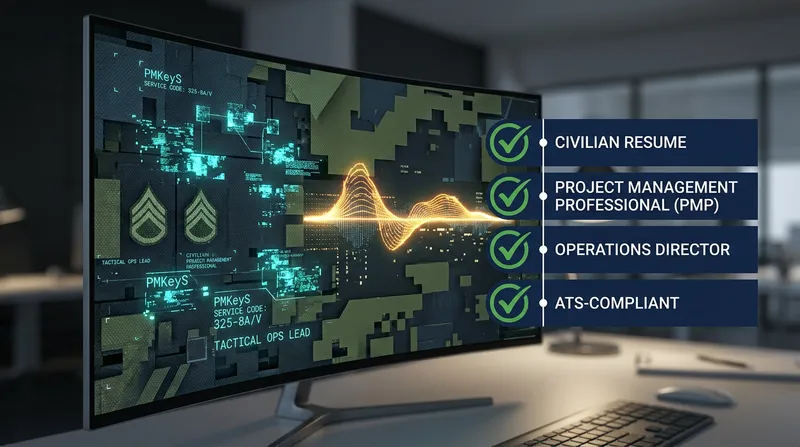
Applicant Tracking Systems (ATS) are the gatekeepers of the modern job market. These software programs scan your resume for specific keywords that match the civilian job description. If your resume is full of military codes, the ATS will reject it before a human ever sees it.
Your PMKeyS posting history is one of the biggest culprits. In the military, it is normal to rotate through different postings, deployments, and training courses every 12 to 24 months. However, if you list every single PMKeyS posting as a separate job on your civilian resume, you will look like a chronic job hopper. Civilian employers value longevity and stability, and a fragmented work history raises immediate red flags.
The Veteran's Employment Program officially advises transitioning members to articulate their Defence skills into language the public sector understands and to consolidate multiple short-term postings. To fix this, you must group your military experience under a single overarching tenure.
For example, instead of listing five different units as five different employers, list "Australian Defence Force" or "Department of Defence" as your employer for the total duration of your service. Underneath this main heading, you can break down your specific roles (e.g., Operations Manager, Logistics Coordinator) as bullet points. This shows loyalty and progression rather than instability.
If you are unsure how your current format is being parsed by these systems, you can learn more about our free CV review tool or read our guide on Free AI CV Review: How to Instantly Optimize Your Resume for ATS (2026).
How to translate ADF ranks to civilian job titles
Civilian recruiters hire for scope and responsibility, not just rank. While you earned your rank through rigorous training and dedication, a civilian hiring manager does not automatically know what a corporal or a major actually does daily.
To bridge this gap, you need a direct mapping strategy that translates your rank into a corporate equivalent. Here is a general guide to mapping ADF ranks to civilian job titles:
- Private, Able Seaman, Leading Aircraftman (PTE/AB/LAC): Map these to titles like Coordinator, Specialist, Technician, or Administrator. Focus on your technical execution and specialized trade skills.
- Corporal, Leading Seaman (CPL/LS): Map these to Team Leader, Supervisor, or Frontline Manager. Highlight your experience managing small teams, overseeing daily operations, and ensuring compliance with safety protocols.
- Sergeant, Petty Officer (SGT/PO): Map these to Operations Manager, Department Manager, or Senior Supervisor. Emphasize your ability to manage larger teams, oversee complex logistics, and train personnel.
- Warrant Officer, Chief Petty Officer (WO/CPO): Map these to Senior Operations Manager, Regional Director, or General Manager. Focus on your strategic oversight, policy implementation, and high-level advisory roles.
- Commissioned Officers (Lieutenant, Captain, Major, and above): Map these to Project Manager, Program Manager, or Operations Manager, moving to Director-level titles only at senior officer ranks. Highlight your strategic planning, budget management, and cross-functional leadership.
When writing your resume, you can list your civilian title first, followed by your military rank in parentheses. For example: "Operations Manager (Sergeant)". This provides immediate context for the recruiter while honoring your military achievement. For a deeper dive into framing high-level leadership, review our guide on Translating Seniority: The Expat's Guide to Australian Executive & Board Resumes.
Mapping defence roles to APS classifications
Many veterans choose to transition into the Australian Public Service (APS) because the structured environment feels familiar. However, applying for APS roles requires a nuanced understanding of how military ranks align with public service classifications.
The Department of Defence explicitly states that their ADF to APS rank mapping is a guide for comparing duties, not an automatic statement of equivalent rank. This means you cannot simply demand an APS6 salary because you were a sergeant. You must prove that your capabilities match the APS6 work level standards.
Generally, the mapping looks like this:
- APS3 to APS4: Aligns with foundational administrative and technical roles, often suited for junior ranks.
- APS5 to APS6: Aligns with middle management, complex problem solving, and specialized technical work, often suited for corporals and sergeants.
- Executive Level 1 (EL1): Aligns with high-level management, strategic direction, and policy development, often suited for warrant officers and mid-level commissioned officers (captains/majors).
- Executive Level 2 (EL2) and SES: Aligns with senior executive leadership, suited for senior officers (lieutenant colonels and above).
When writing a defence to APS resume, you must translate your military mustering into the specific core competencies listed in the APS Integrated Leadership System (ILS). Many APS roles also require a written pitch or selection criteria response. JobSparrow's intelligent cover letter generator can help you map your military achievements directly to the ILS.
Decoding PARs: extracting leadership metrics for your resume
Your Performance Appraisal Reports (PARs) are a goldmine of data, but they are buried in military frameworks like Defence Mastery, Social Mastery, and Technical Mastery. Civilian employers do not use these frameworks, but they desperately want the skills these frameworks represent.
Research from the LinkedIn Australian Veteran Opportunity Report notes the rapid skill acquisition of service members, indicating that veterans often gain more skills per year than the average university graduate. You just need to extract those metrics correctly.
To decode your PARs, look at the supervisor narratives. Did your reporting officer praise your ability to manage a $5 million equipment inventory with zero losses? That is a highly sought-after civilian metric. Did they highlight your ability to de-escalate conflicts during high-stress deployments? That translates directly to advanced stakeholder management and crisis resolution.
Convert "Technical Mastery" into hard skills like "Heavy Diesel Maintenance" or "Supply Chain Logistics". Convert "Social Mastery" into soft skills like "Cross-Functional Team Leadership" and "Conflict Resolution". By extracting these quantifiable achievements, you transform a generic military record into a compelling corporate value proposition.
Not sure which achievements from your PARs to include? Start your free CV diagnosis to see exactly what is missing.
The master profile strategy for transitioning veterans
Managing a complex military history requires a strategic approach to resume formatting. You do not want to erase your proud military past, but you also cannot submit a document that reads like a tactical briefing.
The most effective approach is the functional-chronological hybrid structure. This strategy allows you to highlight your transferable skills at the top of the resume while maintaining a clear, consolidated work history at the bottom.
Start with a powerful professional summary that defines your new civilian target. Follow this with a "Core Competencies" section that lists civilian keywords (e.g., Risk Management, Strategic Planning, Logistics Coordination). Then, create a "Key Achievements" section where you highlight three to four major wins from your military career, completely stripped of jargon.
Finally, list your consolidated chronological work history. This structure directs the recruiter's attention to what you can do for them now, rather than forcing them to decipher what you did in the past. To learn how to build this foundational document, explore The Master Profile Strategy: How to Write a Career Transition Resume Without Erasing Your Past.
Using AI to instantly build your corporate resume
Translating your military experience manually is exhausting. A traditional resume writer in Australia typically charges A$400 to A$600 for a single document, and a full career coaching program can run to A$3,000 or more. Even then, you will wait a week to get your resume back.
JobSparrow leverages cutting-edge AI to solve this problem instantly. Our AI gap filler acts as a dedicated translator for your military records. You can import your existing master profile, and the AI will analyze your data, identify missing metrics, and guide you through targeted Q&A to fill in the blanks.
Once your profile is enhanced, our job-specific resume tailoring feature takes over. It reads the civilian job description you want to apply for, selects the most relevant experience, and rewrites your bullet points to match the civilian keywords required by the ATS. Combined with smart job recommendations and job application tracking and analysis, you stay in total control of your Execute stage.
What used to take hours of frustrating manual editing now happens in less than 60 seconds. You receive a perfectly formatted, ATS-optimized PDF ready for submission. For a step-by-step look at this process, read How to Tailor Your Resume Instantly: The Proactive Guide to AI Resume Builders.
Beyond the resume: preparing for the civilian interview and negotiation
A perfectly translated resume will get you in the door, but you still need to speak the civilian language during the Prepare stage. Many veterans struggle in interviews because they fall back on military acronyms or assume the interviewer understands the context of their stories.
JobSparrow's AI mock interview feature allows you to practice answering behavioral questions tailored specifically to your target civilian role. The AI simulates a real interview environment, records your audio, and provides instant, actionable feedback on your clarity, tone, and delivery. It will flag if you are using too much jargon and help you refine your answers using the STAR (Situation, Task, Action, Result) method. To see how this builds interview confidence, check out The 'Instant Interview' Shortcut: How to Generate an AI Mock Interview from Any SEEK or LinkedIn URL.
Finally, when the offer comes, our offer and negotiation coaching helps you secure the right civilian salary in the Close stage, ensuring you do not accept below-market rates just because you lack civilian benchmarks.
Take the first step in your career transition
Your military service has equipped you with unparalleled leadership, resilience, and operational expertise. Do not let a language barrier prevent you from landing the civilian career you deserve.
Data from the Australian Bureau of Statistics (ABS) proves that former ADF members aged 15 to 64 are significantly more likely to be engaged in full-time work compared to those who have never served. This means veterans who successfully communicate their skills achieve strong employment outcomes.
Ready to land more interviews? Start your free CV diagnosis. See your recruiter-lens score and the exact gaps costing you interviews in minutes. Try the full Offer Path for 7 days for A$8.99, then A$59 a month. Cancel anytime.
Frequently asked questions
How do I list multiple military postings on a civilian resume without looking like a job hopper?
The most effective strategy is to group all of your postings under one main employer heading, such as "Australian Defence Force" or "Department of Defence". List your total dates of service next to this main heading. Below that, create sub-sections or bullet points for your distinct roles, deployments, or promotions. This format demonstrates long-term loyalty while showcasing your career progression rather than instability.
What is the civilian equivalent of an ADF corporal or sergeant?
While it depends on your specific mustering, an ADF corporal generally aligns with a civilian Team Leader, Frontline Supervisor, or Shift Manager. A sergeant typically aligns with an Operations Manager, Department Manager, or Senior Supervisor. When translating these ranks, focus on the number of personnel you managed and the scope of your operational responsibilities instead of just the title.
Will civilian ATS systems reject my resume if I use military acronyms?
Yes. Applicant Tracking Systems are programmed to scan resumes for specific keywords found in the civilian job description. If the software encounters unrecognized military codes, unit abbreviations, or specialized jargon, it cannot parse the information. As a result, the ATS will likely filter your resume out before a human recruiter ever sees it.
How can I translate my military mustering into civilian skills?
Start by identifying the core function of your mustering. For example, if you were in transport, your civilian skills are Supply Chain Logistics, Fleet Management, and Route Optimization. If you were in infantry, your skills include Risk Assessment, Crisis Management, and Cross-Functional Team Leadership. Use JobSparrow's AI to automatically map your daily military tasks to standard corporate competencies.
Do I need to hire an expensive resume writer for my ADF transition?
No. While traditional human resume writers are an option, they often charge hundreds of dollars and take a week to deliver a single document. Modern AI career advisors like JobSparrow can instantly translate your military experience, fill critical gaps, and tailor your resume for specific civilian roles at a fraction of the cost, giving you total control over your career transition.
Tags
Keep reading
Recommended articles.
ai resume builder · ats optimization
Tailor Applications Fast with an AI Resume Creator
Stop choosing between time and quality. Use an AI resume and cover letter generator to tailor your applications fast. Try free with JobSparrow.
resume tips · layoff
Resume After Layoff: How to Explain Redundancy (Without Looking Like a Hiring Risk)
Learn how to write a resume after layoff and explain redundancy confidently. Get ATS-friendly examples and proven tips to handle employment gaps.
job search burnout · ai resume builder
Job Search Burnout: How an AI Resume and Cover Letter Creator Saves Your Energy
Beat job search fatigue with an AI resume and cover letter creator. Automate tailoring, pass ATS filters, and save your energy with JobSparrow.