
career change
The Master Profile Strategy: How to Write a Career Transition Resume Without Erasing Your Past
By Job Sparrow Team
One of the most frustrating experiences for any professional is looking at a blank page and feeling like ten years of hard-earned experience is suddenly worthless. When you decide to pivot to a new industry, the core pain point is almost universal: career changers feel forced to erase their past to fit a new mold. This often results in a career change resume that makes a seasoned professional look like an entry-level candidate, stripping away their professional identity and leadership weight.
But changing paths is the modern norm. According to data on employee tenure from the U.S. Bureau of Labor Statistics, the median number of years that wage and salary workers stay with their current employer is just 4.1 years. Frequent shifts are expected, yet the standard advice for writing a career changer CV remains outdated.
At JobSparrow, our team has reviewed over 100,000 resumes and hired across four major markets, including Australia, New Zealand, the US, Singapore, and Hong Kong. We know exactly what real recruiters react to in the first few seconds of a resume scan. In this guide, we will show you how to use the "Master Profile" strategy to write a career transition resume that preserves your seniority, highlights your transferable skills, and lands you the interview.
Ready to see where your current application stands? Start with a free diagnosis from JobSparrow to see your recruiter-lens score and identify the exact gaps costing you interviews. When you are ready, you can unlock our full Offer Path for a transparent, one-time fee of $129 with no hidden subscriptions or auto-renewals.
What is a career change resume? (And why most fail)
A career change resume is a strategic document designed to pivot your professional narrative from your past industry to your future target role. It requires a delicate balance. You must prove you have the foundational skills for the new job while leveraging the unique value of your past experience.
Most career pivot resumes fail for two reasons. First, they rely on generic templates that strip away context. Second, they use the dreaded "functional resume" format.
The anti-functional resume stance
If you search for advice on how to write a career change resume, many outdated sources will tell you to use a functional resume. A functional resume groups your achievements by skill category rather than chronological work history, intentionally hiding your employment dates.
Here is the truth from the other side of the hiring table: recruiters hate functional resumes. When a hiring manager sees a resume with hidden dates and no clear timeline, their immediate thought is that the candidate is hiding something. It triggers red flags about unexplained gaps or lack of real-world application. If you are trying to figure out how to explain a resume gap for family care or write a resume after layoff, hiding your timeline is the worst strategy you can use.
Instead, you need a hybrid resume format, which we will detail later in this guide.
The master profile as a translation matrix
The foundation of a successful career transition is not a single resume. It is a comprehensive database of your entire professional life. We call this the Master Profile.
Governmental career resources, such as those provided by the Government of Alberta, advise that a master resume should act as a private database listing all work experience, training, and achievements rather than a document submitted to employers. Similarly, guidelines from CareerOneStop confirm that a master resume sums up the length and breadth of a career, making it easier to create targeted resumes without forgetting past achievements.
However, a Master Profile is not just a digital filing cabinet or a dumping ground for old bullet points. For career changers, it must function as a Translation Matrix.
How to translate your skills
Every industry has its own jargon. When you change careers, your primary job is to translate your past industry jargon into universal business value. Employers do not want to guess how your past relates to their needs. You have to connect the dots for them.
Here is how to build your Translation Matrix:
- List the specific duty from your old job (e.g., "Managed patient triage in a busy ER").
- Identify the core transferable skill (e.g., Risk assessment, prioritization, working under extreme pressure).
- Rewrite the achievement using the language of your new target industry (e.g., "Prioritized high-stakes workflows and allocated critical resources in fast-paced, high-pressure environments").
Manually building this matrix for every application is where most career changers stall. This is where JobSparrow's Master Career Profile acts as your single source of truth. You can import your existing PDF or Word document instantly.
Pro Tip: Use the AI Gap Filler Our AI Gap Filler acts as an interactive coach. It analyzes your Master Profile, identifies vague descriptions or missing metrics, and walks you through targeted Q-and-A to pull out the universal business value of your past roles.
Transparency note: Our AI suggests rewrites and tailors your CV to match job requirements, but you should always review and add your personal touch before submitting.

Seniority preservation: How to pivot without looking entry-level
One of the biggest mistakes career changers make is stripping away too much of their past context in an attempt to look relevant. If you remove all the details of your previous roles because they do not perfectly match the new job description, you inadvertently erase your seniority.
A former retail store manager pivoting into IT project management might delete all references to inventory and staff scheduling. But in doing so, they also delete their evidence of managing large budgets, leading teams of 50 people, and handling complex logistics. Suddenly, a professional with ten years of leadership experience looks like a recent graduate.
To preserve your seniority, focus on the universal markers of professional maturity:
- Budget Management: Did you oversee P-and-L, reduce costs, or manage vendor contracts? Money speaks the same language in every industry.
- Leadership and Mentorship: Hiring, training, and resolving conflicts are highly sought-after skills everywhere.
- Process Improvement: Did you identify a bottleneck and build a system to fix it? That shows strategic thinking.
- Stakeholder Communication: Managing expectations across different departments or dealing with difficult clients is a premium skill.
When you use an intelligent system to build your application, it selects the most relevant experience from your Master Profile while preserving the metrics that prove your leadership and seniority.
Choosing the right resume format: The hybrid approach
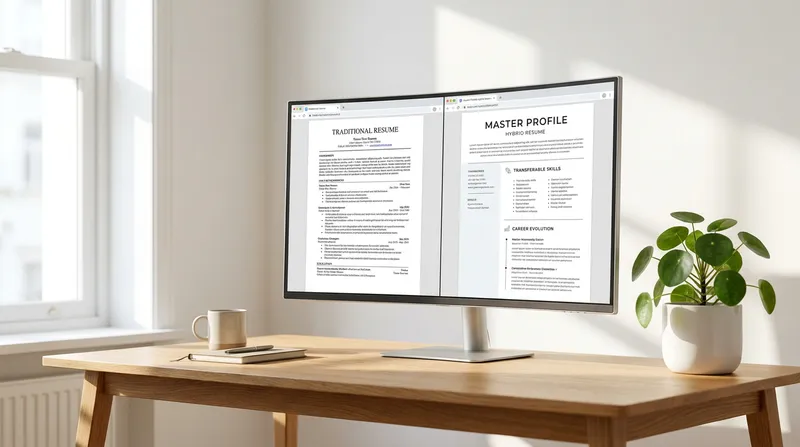
If functional resumes are out, what should you use? The answer is the hybrid resume format, also known as the combination resume. In our team's hiring experience, combination resume formats are highly effective for career changers because they place equal emphasis on both skills and experience.
Here is a quick comparison of how different formats perform:
| Format | Recruiter Perception | ATS Friendliness | Focus Area |
|---|---|---|---|
| Functional | Red flag (hides dates) | Poor | Skills only |
| Chronological | Standard but rigid | High | Work history |
| Hybrid (Combination) | Highly effective | High | Skills and Work history |
A hybrid resume format structures your document to highlight your transferable skills at the very top, immediately followed by a clear, chronological work history. This satisfies Applicant Tracking Systems (ATS) and human recruiters alike.
Here is the ideal structure for a hybrid resume format:
- Header: Name, contact info, LinkedIn profile.
- Professional Summary: A targeted career transition resume summary (more on this below).
- Core Competencies (Skills Section): A bulleted list of 6 to 9 highly relevant skills tailored to the new industry.
- Professional Experience: Your chronological work history. The bullet points here should utilize your Translation Matrix to emphasize relevant achievements over daily duties.
- Education and Certifications: If you are wondering how to list bootcamps and online certificates on your resume, place them here to prove your commitment to upskilling in your new field.
For job seekers in New Zealand, adapting this structure to meet local expectations is crucial. You can learn more about optimizing the Careers Govt NZ CV PDF format for modern ATS systems on our blog.
How to write a career objective or professional summary
Your resume summary for a career change is the most important real estate on the page. It is your elevator pitch. Do not use an outdated "Career Objective" that simply states what you want (e.g., "Seeking a position in marketing"). Instead, use a Professional Summary that clearly explains what you offer.
We recommend the Present-Past-Future formula, which is the exact same structure you should use when figuring out how to answer 'Tell Me About Yourself' in Australia.
- Present: Who are you right now? (e.g., "Data-driven project manager...")
- Past: What is your unique background? (e.g., "...with 7 years of experience in healthcare administration, specializing in process optimization and cross-functional team leadership.")
- Future: How does this apply to the target role? (e.g., "Leveraging a proven track record of reducing operational bottlenecks to drive efficiency in SaaS product development.")
Career transition resume summary examples
Transitioning from Teaching to Corporate Training: "Dynamic instructional designer and facilitator with a decade of experience developing engaging curriculum and managing diverse classrooms. Proven ability to translate complex concepts into actionable learning modules. Eager to leverage expertise in adult learning theories to elevate employee onboarding and development programs in the tech sector."
Transitioning from Hospitality to B2B Sales: "Client-focused professional with 5 years of experience managing high-volume operations and VIP customer relations in luxury hospitality. Recognized for resolving complex escalations and driving repeat business through exceptional service. Ready to apply advanced communication and relationship-building skills to drive revenue growth in B2B software sales."
Migrant and expat career pivots (Australia and New Zealand focus)
Changing careers is hard. Changing careers while migrating to a new country like Australia, New Zealand, the UK, or the US is a massive dual challenge. You are not just translating industry jargon, you are translating cultural and regional business norms.
In the Australian and New Zealand job markets, there is a well-known bias toward "local experience." Employers often hesitate to hire migrants because they fear the candidate will not understand local compliance, workplace culture, or market dynamics. When you combine this with a career pivot, the barrier to entry can feel insurmountable.
To overcome this on your resume, you must explicitly connect your international experience to local standards. If you are applying for roles in the healthcare sector, familiarizing yourself with local structures, such as the ASMS MECA Salary Scale 2026, helps you speak the language of local hiring managers and proves you understand local market dynamics.
Furthermore, be prepared for rigorous vetting. Employers will want to verify your past, so understanding Xref reference checks in Australia is critical. Use your Professional Summary to frame your international background as a unique asset (bringing global best practices) while explicitly stating your readiness and legal right to work in the local market.
How to identify and highlight transferable skills
Transferable skills are the bridge between your past and your future. Industry hiring trends show that employers highly value transferable skills because they represent a mix of workplace and technical abilities that allow candidates to transition with minimal additional training.
To identify your strongest transferable skills, look at your Master Profile and ask yourself these questions:
- What problems did I solve that exist in every industry? (e.g., miscommunication, budget overruns, inefficient processes)
- What software or tools did I use that are universally applicable? (e.g., Salesforce, Excel, Jira, Asana)
- How did I interact with people? (e.g., negotiating contracts, presenting to stakeholders, training new hires)
Once identified, weave these skills directly into your bullet points. Do not just list "Leadership" in a skills section. Prove it by writing, "Led a cross-functional team of 12 to streamline delivery processes, reducing turnaround time by 15 percent."
Tailoring your resume with keywords (without lying)
Applicant Tracking Systems filter resumes based on keywords. If you are changing careers, you might lack the exact technical keywords the ATS is hunting for. The solution is not to lie or stuff keywords invisibly in white text (a tactic that will immediately get you disqualified by modern systems).
The solution is intelligent tailoring. JobSparrow's AI analyzes the specific job description you are targeting and intelligently selects the most relevant experience from your Master Profile. It then rewrites your bullet points to naturally match the job's keywords and requirements without fabricating experience.
For example, if the job description asks for "cross-functional collaboration" and your Master Profile says you "worked with different departments," JobSparrow will suggest updating your phrasing to match the exact keyword the ATS requires.
Managing this process manually for every application is exhausting. That is why we recommend moving beyond spreadsheets and building a personal ATS using JobSparrow. Our centralized dashboard tracks your applications, provides a Match Score for new job URLs, and highlights exactly what skills you are missing so you can address them before you apply.
The path to your next offer
Writing a career transition resume does not mean starting from scratch. Your past experience is your greatest asset, provided you know how to translate it. By building a comprehensive Master Profile, utilizing a hybrid resume format, and preserving your seniority through universal business metrics, you can confidently pivot into any new industry.
But you do not have to do this alone. JobSparrow is built to coach you through the entire Offer Path: Diagnose, Position, Execute, Prepare, and Close. We are not just a one-off resume tool. Our AI Mock Interviews help you ace a case study presentation interview by simulating real scenarios tailored to your target role, giving you actionable feedback on your delivery.
Stop sending generic applications into the void. Start with a free CV diagnosis today to see your recruiter-lens score. When you are ready, unlock the full JobSparrow Offer Path for a one-time fee of $129, with no hidden subscriptions or auto-renewals. Your new career is waiting.
Frequently asked questions
How do I write a resume for a career change with no direct experience?
Focus entirely on transferable skills and adopt the hybrid resume format. Map past accomplishments to the new role using a Translation Matrix. Highlight relevant projects, bootcamps, volunteer work, and how your past achievements demonstrate the core competencies required for the new role.
Should I use a functional resume for a career pivot?
No. Recruiters actively dislike functional resumes because they obscure employment dates and make it look like you are hiding gaps. Use a hybrid (combination) resume instead to highlight skills at the top while maintaining a clear, chronological work history.
What is a master resume and how do I create one?
A master resume (or Master Profile) is a comprehensive, private document that contains every job, achievement, skill, and metric from your entire career. You do not send this directly to employers. Instead, you use it as a foundational database to quickly generate highly tailored, one-to-two page resumes for specific job applications.
How far back should I go on a career change resume?
Generally, stick to the last 10 to 15 years of experience. If you have older experience that is highly relevant to your new career path, you can include it in a brief "Previous Relevant Experience" section without dates, or simply summarize it in your professional summary.
How do ATS systems handle career change resumes?
Applicant Tracking Systems (ATS) scan for specific keywords related to the job description. If your career change resume lacks these keywords, it will likely be filtered out. You must translate your past experience into the terminology of your new industry to ensure you pass the initial ATS screen.
How do I highlight transferable skills without sounding generic?
Avoid simply listing buzzwords like "leadership" or "communication" in a vacuum. Instead, attach metrics and context directly to your bullet points. For example, rather than saying "problem-solving," write "Resolved complex client escalations, retaining $50K in recurring revenue."
Tags
Keep reading
Recommended articles.
career change · resume summary
Career Change Resume Summary & Objective Examples (2026 Guide)
Write a career change resume summary that passes ATS and gets recruiter attention with fill-in-the-blank templates and real examples for 2026. Try free.
career change · salary negotiation
How to Change Careers Without Taking a Pay Cut: A Recruiter's Playbook for Transferable Skills
Learn how to change careers without a pay cut. Use adjacent pivot strategies and AI tools to reposition your transferable skills. Start your free diagnosis today.
career change · resume tips
How to Write a Resume for a Career Change: Translating Skills & Filling Gaps
Learn how to write a resume for a career change. Reframe transferable skills, fill experience gaps, and beat the ATS. Start free with JobSparrow.