
career change
Career Change Resume Summary & Objective Examples (2026 Guide)
By Job Sparrow Team

Career Change Resume Summary & Objective Examples (2026 Guide)
You have years of solid experience. You are good at your job. But you are switching industries, and suddenly your resume feels like it belongs to a stranger.
This is the most common pain point we hear from career changers: your old resume tells the wrong story. It leads with the industry you are leaving, not the value you bring to the one you are entering. Recruiters glance at it for six to seven seconds and move on, not because you are unqualified, but because your resume did not make the connection fast enough.
The fix starts at the very top of your resume, in the professional summary or career change resume objective. Get that section right, and the rest of the document has a fighting chance. Get it wrong, and even a strong background gets filtered out by Applicant Tracking Systems (ATS) before a human ever reads it.
This guide gives you recruiter-approved templates, real examples, and a step-by-step process for writing a career change resume summary that works, whether you are pivoting industries in Australia, New Zealand, the UK, or the US.
Ready to see where your current resume stands? Start with a free CV diagnosis at JobSparrow to get your recruiter-lens score in minutes.
Resume summary vs objective: which one should career changers use?
This is one of the most searched questions on this topic, and the answer depends on where you are in your transition.
A professional summary is a three to five sentence paragraph that highlights your most relevant skills, experience, and value proposition. It works best when you have transferable experience to draw from, even if it comes from a different industry.
A career change resume objective is a one to two sentence statement that names the role you are targeting and explains what you bring to it. It works best when you have limited direct experience in the new field and need to signal intent clearly.
Here is a simple rule to follow:
- If you have five or more years of experience and clear transferable skills, use a professional summary.
- If you are entry-level in the new field or making a dramatic pivot, use a career change objective to frame your intent.
- If you are somewhere in between, a hybrid approach works: open with your objective, then follow with two to three sentences of relevant evidence.
According to research from the National Careers Service (UK), candidates who clearly articulate their career direction in their application materials are significantly more likely to progress to interview. This is especially true when making non-linear career moves.
Why your career change resume summary is failing (and what recruiters actually see)
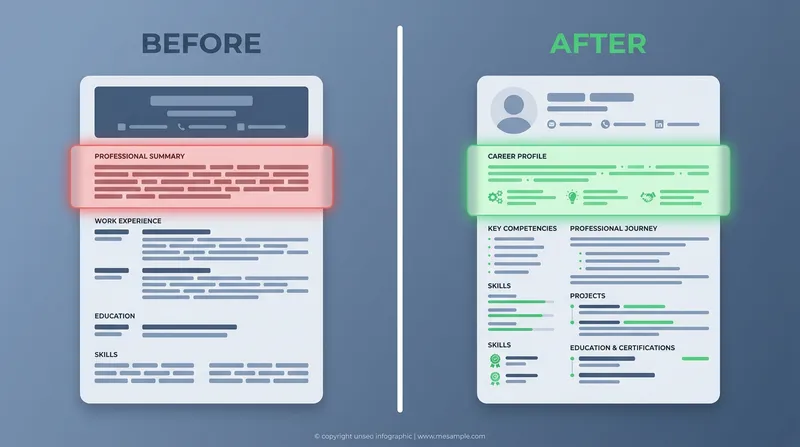
Having sat on both sides of the hiring table, our team has reviewed more than 100,000 resumes and hired across Australia, New Zealand, the US, Singapore, and Hong Kong. Here is what we actually see when a career change resume lands on our desk. Career change resumes fail at the top for three predictable reasons.
Reason 1: Leading with the old industry, not the new value. A summary that opens with "Experienced retail manager with 10 years in fast fashion..." immediately signals to a hiring manager in, say, project management that this person is a retail person. The connection to the new role is never made fast enough.
Reason 2: Being vague about transferable skills. Phrases like "strong communicator" and "team player" appear on almost every resume. They carry no weight without context. Recruiters want to see the skill applied, not just named.
Reason 3: Omitting the target role entirely. A career change resume without a clear target reads as unfocused. Recruiters are not paid to figure out where you fit. You need to tell them.
According to LinkedIn's Global Talent Trends research, 92% of talent professionals say that soft skills matter as much or more than hard skills when hiring. However, those skills still need to be demonstrated in context, not just listed.
How to write a career change resume summary in 5 steps
Follow this process before you write a single word of your summary. We break this down into the first two stages of a successful job search: Diagnose and Position.
Phase 1: Diagnose your value
Step 1: Identify your transferable skills Transferable skills are capabilities you have built in one context that apply directly in another. They fall into three categories:
- Functional skills: things you can do (data analysis, budget management, stakeholder communication, project coordination)
- Industry-adjacent knowledge: understanding of adjacent domains (a teacher moving into instructional design brings curriculum development expertise)
- Soft skills with evidence: leadership, problem-solving, and adaptability, backed by specific examples
Write down your top five to eight transferable skills before drafting your summary. Be specific. "Managed a team" is weak. "Led a team of 12 across three locations to deliver a $2M project on time" is strong.
If you are working through a broader career transition, the process of identifying and articulating these skills is also covered in our guide to focusing a generalist resume for a specialist role.
Step 2: Research the target role's language Every industry has its own vocabulary. A "client" in consulting is a "customer" in retail and a "patient" in healthcare. Your summary needs to speak the language of the industry you are entering, not the one you are leaving.
Pull three to five job descriptions for your target role and highlight the recurring terms. These become your keywords. According to JobScan's ATS research, 75% of resumes are rejected by Applicant Tracking Systems before a human ever reads them. Using the right keywords in your summary is not optional.
Phase 2: Position your narrative
Step 3: Choose your format (summary or objective) Use the guidance from the previous section. If you are unsure, default to a hybrid: one sentence of objective, two to three sentences of evidence.
Step 4: Write a first draft using the formula Here is a fill-in-the-blank template for a career change professional summary:
[Years of experience] professional with a background in [previous field], transitioning into [target field]. Proven ability to [transferable skill 1] and [transferable skill 2], demonstrated through [specific achievement or context]. Seeking to bring [unique value] to [type of organization or role].
And here is a fill-in-the-blank template for a career change resume objective:
Motivated [previous role] with [X years] of experience in [previous industry], seeking to transition into [target role] at [type of company]. Bringing demonstrated strengths in [transferable skill 1] and [transferable skill 2] to contribute to [specific outcome or team goal].
Step 5: Cut the fluff and tighten Your summary should be three to five sentences maximum. Every sentence must earn its place. Read it aloud. If a sentence does not add new information about your value, cut it.
Not sure if your current summary is working? Run a free CV diagnosis and get your recruiter-lens score in minutes.
Career change resume summary examples (by industry)
These are recruiter-approved examples based on real transition scenarios. Each one uses the formula above and leads with transferable value.
Teaching to corporate training or L&D
Secondary school teacher with eight years of experience designing and delivering curriculum for diverse learners, transitioning into Learning and Development. Skilled in instructional design, stakeholder engagement, and measurable learning outcomes, with a track record of improving student performance by 22% through targeted program redesign. Eager to bring structured, evidence-based learning strategies to a corporate L&D environment.
Hospitality to project management
Operations manager with 10 years in high-volume hospitality, transitioning into project management. Experienced in coordinating cross-functional teams, managing budgets up to $500K, and delivering time-sensitive outcomes under pressure. Currently completing a PMP certification. Seeking a project coordinator role where operational precision and people leadership create measurable results.
Military to civilian corporate roles
Former Army logistics officer with six years of experience managing complex supply chains and leading teams of up to 40 personnel, transitioning into operations or supply chain management. Proven ability to execute under pressure, optimize processes, and develop high-performing teams in resource-constrained environments. Holds a Bachelor of Business Administration and a Six Sigma Green Belt.
Nursing to healthcare administration
Registered nurse with nine years of clinical experience in acute care, transitioning into healthcare administration. Deep understanding of clinical workflows, patient safety protocols, and multidisciplinary team coordination. Completed a Graduate Certificate in Health Management. Seeking a healthcare operations role where clinical insight drives administrative improvements.
Accountant to UX/product design
Chartered accountant with seven years of experience in financial analysis and systems optimization, transitioning into UX design. Brings a data-driven approach to user research and a strong foundation in identifying process inefficiencies. Currently completing a UX design bootcamp and building a portfolio of case studies. Seeking a junior UX role at a fintech or SaaS company.
Retail to digital marketing
Retail team leader with five years of experience in customer engagement and sales strategy, transitioning into digital marketing. Hands-on experience managing social media accounts, running in-store promotional campaigns, and analyzing sales data to optimize performance. Completed a Google Digital Marketing certification. Looking to bring customer-first thinking to a digital marketing coordinator role.
Career change resume objective examples (for those with no direct experience in the new field)
If you are making a significant pivot and do not yet have direct experience in the target field, a career change resume objective with no experience in the new field is the right approach. Be honest, be specific, and lead with what you bring.
Career changer with no direct experience: general template
[Previous role] with [X years] of experience in [industry], seeking an entry-level opportunity in [new field]. Bringing strong [skill 1] and [skill 2] skills developed through [specific context], along with a genuine commitment to building expertise in [target area].
Example: IT support to cybersecurity
IT support specialist with four years of experience in network troubleshooting and systems administration, seeking an entry-level cybersecurity analyst role. Currently completing a CompTIA Security+ certification. Bringing hands-on experience with firewall configuration, incident logging, and user access management.
Example: Journalist to content strategy
Journalist with six years of experience in long-form editorial and digital publishing, seeking a content strategy role in a B2B SaaS environment. Proven ability to research complex topics, write for diverse audiences, and manage editorial calendars across multiple platforms. Familiar with SEO fundamentals and content performance analytics.
Best resume format for a career change
The format of your resume matters as much as the content of your summary. Career changers often wonder whether to use a chronological or functional resume. Here is the honest answer.
Chronological resume: Lists experience in reverse date order. Best for candidates with a clear career progression. For career changers, this format can highlight the wrong things.
Functional resume: Groups skills and achievements by category rather than by employer. It downplays dates and job titles. However, most recruiters and ATS systems are suspicious of functional resumes because they obscure career history.
Hybrid (combination) resume: The best format for most career changers. It opens with a strong summary and a skills section, then follows with a reverse-chronological work history. This lets you lead with transferable value while still providing the timeline recruiters expect.
According to the Australian Government's Jobs and Skills Australia resource, the Australian labour market increasingly values demonstrated skills over industry-specific titles, which makes the hybrid format particularly effective for career changers in the AU/NZ market.
For career changers who have previously run their own business, the hybrid format is also the recommended approach. Our guide on how to write a resume after owning a business covers this specific scenario in detail.
Transferable skills to highlight on a career change resume
These are the skills that travel across industries and carry real weight with hiring managers. When writing your summary, prioritize the ones you can back with evidence. Avoid vague lists; instead, anchor your skills in specific achievements.
| Vague Skill | Evidence-Backed Example |
|---|---|
| Leadership | Led a team of 12 across three locations to deliver a $2M project on time. |
| Budget Management | Managed a $500K annual departmental budget with a 15% cost reduction. |
| Data Analysis | Analyzed quarterly sales data to identify trends, increasing revenue by 10%. |
| Stakeholder Communication | Facilitated weekly briefings for C-suite executives and external partners. |
| Process Improvement | Redesigned onboarding workflows, reducing new hire ramp-up time by two weeks. |
| Project Management | Coordinated cross-functional teams of up to 15 people to launch three major products. |
For each skill you include in your summary, ask yourself: can I back this up with a specific example? If yes, it belongs in your summary. If not, it belongs in the bin.
The Society for Human Resource Management (SHRM) consistently identifies adaptability and communication as the two most sought-after transferable skills across industries, making them strong anchors for any career change summary.
Common mistakes to avoid in a career change resume summary
These are the errors we see most often when reviewing career change resumes.
Mistake 1: Writing a summary for your old career, not your new one. Your summary must speak to the role you want, not the role you had. Rewrite it from scratch for each application.
Mistake 2: Using jargon from your old industry. Industry-specific terms that make sense in your previous field may confuse or alienate hiring managers in your new one. Translate everything.
Mistake 3: Being apologetic about the change. Phrases like "although I don't have direct experience" or "despite being new to this field" undermine your credibility before you have even made your case. Lead with what you have, not what you lack.
Mistake 4: Writing one summary for all applications. This is the fastest way to get ignored. Every summary should be tailored to the specific role and company. According to research cited by the Harvard Business Review, personalized applications consistently outperform generic ones across all hiring stages.
Mistake 5: Making it too long. Five sentences is the maximum. Three is often better. Recruiters spend seconds on the top of your resume. Make every word count.
If you are managing multiple tailored applications at once, our guide on why a job application tracking spreadsheet hides your skill gaps explains a smarter approach to staying organized.
Career change resume tips specific to Australia and New Zealand
The AU/NZ job market has some specific norms that career changers should know.
- CV length: In Australia and New Zealand, a two to three page resume is standard for experienced professionals. Do not cut your career history to fit one page if it means losing relevant context.
- Personal details: Do not include a photo, your date of birth, or your marital status. These are not standard in AU/NZ and can trigger unconscious bias.
- Selection criteria: Many Australian government and public sector roles require you to address key selection criteria separately. Your summary should still be included, but it is not a substitute for selection criteria responses.
- LinkedIn alignment: Australian recruiters frequently cross-reference LinkedIn profiles. Make sure your summary on LinkedIn mirrors the positioning in your resume.
- References: In AU/NZ, it is standard to include "References available upon request" or to list two referees. In the US and UK, this line is typically omitted.
- Certifications and registrations: If your new field requires registration (for example, teaching registration, nursing registration, or financial planning licensing), mention your status clearly in your summary.
For migrants transitioning careers in Australia or New Zealand, it is also worth understanding local salary structures. Our guide on salary expectations in Australia covers the "plus super" vs. "including super" distinction that often catches international candidates off guard.
How JobSparrow helps career changers write stronger summaries
Career changers are at the Positioning stage of the job search, and that is exactly where JobSparrow's tools are built to help. We guide you through the complete Offer Path: Diagnose, Position, Execute, Prepare, and Close.
Here is how the process works:
- Diagnose with a Master Career Profile. Upload your existing resume or build from scratch. JobSparrow stores every skill, role, and achievement in one place. Run a free CV diagnosis to get a recruiter-lens score out of 100 and see exactly which gaps are costing you interviews.
- Position with Instant Resume. If you are still exploring which roles fit your transferable skills, JobSparrow's Instant Resume feature recommends best-fit roles based on your Master Profile and generates a tailored resume without needing a specific job posting.
- Execute tailored applications. JobSparrow's AI reads the job description, identifies the most relevant experience from your profile, and rewrites your summary to match the language and priorities of that specific role.
- Prepare and Close. You can iterate on your summary up to 10 times per application, with AI guidance on what to strengthen.
Get your diagnostic score for free, then unlock the complete, tailored Offer Path for a one-time flat fee of $129. There are no recurring subscriptions.
If you are preparing for interviews alongside your resume work, our guide on overcoming interview anxiety with AI mock interviews covers how to build confidence for the conversations that follow your application.
Frequently Asked Questions
Should I use a resume objective or a professional summary for a career change?
It depends on how much relevant experience you have in the new field. If you have transferable skills and a solid work history, a professional summary is the stronger choice because it leads with your value rather than your intent. If you are making a dramatic pivot with little direct experience in the new field, a career change resume objective is more appropriate because it clearly signals your direction and what you bring. Many career changers benefit from a hybrid approach: one sentence of objective followed by two to three sentences of evidence-based summary.
How long should a career change resume summary be?
Three to five sentences is the ideal length. Recruiters typically spend six to seven seconds on the top section of a resume before deciding whether to read further. A summary that is too long risks losing their attention before you make your case. Every sentence should add new, specific information about your value. If a sentence does not do that, cut it.
How do I write a resume objective with no experience in the new field?
Focus on three things: your transferable skills, any relevant training or certifications you are pursuing, and a clear statement of the role you are targeting. Avoid apologetic language. Do not say "despite having no experience." Instead, lead with what you do have. For example: "IT support specialist with four years of systems administration experience, seeking an entry-level cybersecurity analyst role. Currently completing CompTIA Security+ certification." This approach is honest, confident, and specific.
What is the best resume format for a career change?
The hybrid (or combination) resume format works best for most career changers. It opens with a strong professional summary and a skills section, which lets you lead with transferable value, then follows with a reverse-chronological work history, which is what recruiters and ATS systems expect to see. A purely functional resume (which groups skills without a clear timeline) is often viewed with suspicion by recruiters and can be poorly parsed by ATS software. The hybrid format gives you the best of both approaches.
How do I identify my transferable skills for a career change resume?
Start by listing every major responsibility and achievement from your previous roles. Then ask: which of these apply in my target field? Group them into categories: functional skills (what you can do), industry-adjacent knowledge (what you understand), and soft skills with evidence (how you work with others). For each skill, write one specific example that demonstrates it. If you cannot think of an example, the skill is too vague to include in your summary. Tools like JobSparrow's Gap Filler feature can help you identify and articulate skills you may have overlooked.
Do I need a different resume summary for every job I apply for?
Yes, every application should have a tailored summary. This is not optional if you want to be competitive. Each job description uses different language, prioritizes different skills, and targets different outcomes. A summary written for one role will not resonate with a hiring manager screening for another, even within the same industry. Tailoring your summary to each job description also improves your ATS score, since it aligns your language with the keywords the system is scanning for. JobSparrow automates this process, generating a tailored summary for each specific job posting from your master career profile.
Is a career change resume in Australia different from one in the US or UK?
There are some important regional differences. In Australia and New Zealand, a two to three page resume is standard for experienced professionals, whereas in the US a one page resume is often expected for non-senior roles. Australian government and public sector roles frequently require separate selection criteria responses in addition to a resume. In the UK, the document is called a CV rather than a resume, and personal details like a photo or date of birth are not included. Across all markets, the principles of a strong career change summary remain the same: lead with transferable value, use the language of the target industry, and tailor to each specific role.
Ready to see where your current resume stands? Start with a free CV diagnosis at JobSparrow and get your recruiter-lens score in minutes.
Not ready to start your diagnosis yet? Read our guide to identifying your transferable skills before you write a single word.
Tags
Keep reading
Recommended articles.
career change · salary negotiation
How to Change Careers Without Taking a Pay Cut: A Recruiter's Playbook for Transferable Skills
Learn how to change careers without a pay cut. Use adjacent pivot strategies and AI tools to reposition your transferable skills. Start your free diagnosis today.
career change · resume tips
How to Write a Resume for a Career Change: Translating Skills & Filling Gaps
Learn how to write a resume for a career change. Reframe transferable skills, fill experience gaps, and beat the ATS. Start free with JobSparrow.
career change · resume tips
Career Change Resume Help: 7 Tips to Translate Transferable Skills for a New Industry
Need career change resume help? Discover 7 actionable tips to translate your transferable skills, beat ATS filters, and confidently enter a new industry.