
resume tips
How to List Bootcamps & Online Certificates on Your Resume in 2026 (With Examples)
By Job Sparrow Team
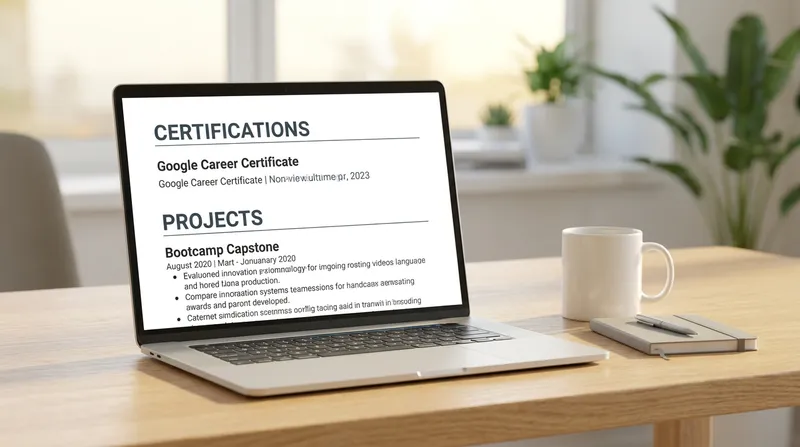
If you are wondering how to list bootcamps and online certificates on your resume in 2026, you have likely invested months of late nights and thousands of dollars into your education. You have built the projects, passed the assessments, and acquired the exact skills employers are asking for. Yet, when you send out your resume, you are met with instant rejection.
This is the core frustration for modern career changers. You know you can do the job, but you feel underqualified when competing against candidates with traditional university degrees. The problem is rarely your lack of ability. The problem is that your resume formatting hides your practical competency, leaving both recruiters and Applicant Tracking Systems (ATS) unable to see your true value.
At JobSparrow, our team has reviewed over 100,000 resumes and brings over 10 years of hands-on recruiting experience hiring candidates across Australia, New Zealand, the United States, Singapore, and Hong Kong. We know exactly what hiring managers look for when they scan a page. In this guide, we will show you how to format your micro-credentials, where to place them to prove real competency, and how our AI tools can help you tailor your experience to land more interviews.
If you want to skip straight to seeing how your current resume handles these credentials, run a free diagnosis at JobSparrow and get your recruiter-lens score in minutes.
The 2026 Hiring Landscape: Are Online Certificates Worth It for Jobs?
Before you worry about formatting, you need to banish the imposter syndrome. Many career changers fear that employers do not take online certificates seriously. In 2026, this could not be further from the truth.
Research published by the University of Minnesota indicates that an overwhelming 95% of employers see clear value in credentialing programs. Furthermore, 76% of these employers express that micro-credentials convey a candidate's dedication to continuous skill development. Employers are actively seeking out candidates who take the initiative to upskill.
This demand translates directly into financial reward. According to Forbes, a significant majority of employers offer higher starting salaries for candidates with targeted micro-credential certifications, sometimes up to 15% more than their non-certified peers.
Actionable Tip: Stop hiding your micro-credentials at the very bottom of your resume. If a certificate directly aligns with the job description, treat it as a primary selling point. If you are feeling exhausted by the constant rejection of your current strategy, it might be time to learn how an AI resume and cover letter creator saves your energy by putting these credentials front and center automatically.
Does a Bootcamp Count as Education or Experience?
One of the most common questions we hear from career changers is whether a bootcamp belongs in the education section or the work experience section. The answer requires looking through a recruiter-lens.
Bootcamps are a hybrid. The program itself is educational, but the capstone projects you build are practical experience. A study by the Council of Graduate Schools demonstrates that micro-credentials are seen by employers as valuable complements to traditional degrees rather than outright replacements. Therefore, you must present them in a way that highlights both your foundational learning and your hands-on execution.
Here is a quick breakdown of how to separate these elements:
| Feature | Education Section | Projects / Experience Section |
|---|---|---|
| What to List | Bootcamp name, graduation date, certificate title | Capstone projects, specific apps built, client work |
| Focus | Foundational learning and credential verification | Hands-on execution and measurable outcomes |
| Formatting | Simple bullet points or single line entry | Role, technologies used, and outcome-driven bullets |
Actionable Tip: Split your bootcamp experience into two distinct sections using the logic above. This strategy works exceptionally well when using the hybrid (combination) resume format, which allows you to highlight skills above chronological work history.
Showcasing Portfolio Projects on Your Resume
To effectively bridge the gap between education and experience, you must transition from simply listing a bootcamp to proving your capabilities. Theoretical knowledge from a bootcamp is not enough to convince a hiring manager. They need proof that you can apply what you learned to solve real business problems.
When you list a bootcamp project, you must format it like a professional job role. Do not just list the name of the app or website you built. You need to detail the exact technologies used and the measurable outcomes of your work.
Here is a comparison of how to list a project:
- Before (Weak): Built a customer data dashboard for a final project.
- After (Strong): Built a responsive dashboard using React and Node.js that visualizes customer retention metrics, reducing data processing time by 30% for simulated client scenarios.
Actionable Tip: Link directly to your GitHub repository, live website, or digital portfolio right next to the project title. Recruiters spend less than 10 seconds on an initial scan. Giving them a clickable link allows them to verify your work instantly. As you manage these different links and versions of your resume, consider how to build a personal ATS (job application tracker) to stay organized.
How to Add a Coursera or Google Career Certificate to Your Resume
Highly recognized programs like the Google Career Certificates carry significant weight in the job market. According to Grow with Google, more than 70% of US Google Career Certificate graduates report a positive career outcome, such as a new job, promotion, or raise, within six months of completion.
However, simply dropping the name of the certificate onto your resume is a missed opportunity. You must provide context.
Step-by-Step Certificate Formatting Example
Use this clear formatting template for online certificates to ensure you capture every important detail:
- Certificate Name: Google Data Analytics Professional Certificate
- Issuing Organization: Coursera / Google
- Date of Completion: November 2025
- Credential ID: [Insert ID or Link to Digital Badge]
- Key Skills Acquired: Data cleaning in SQL, visualization in Tableau, statistical analysis in R.
Actionable Tip: Do not just list the certificate name. Always add one or two bullet points beneath it detailing the specific technical skills you mastered. This ensures that ATS software picks up the exact keywords the employer is scanning for.
Common Bootcamp Resume Mistakes to Avoid
Before you finalize your formatting, ensure you are not making these critical errors that commonly disqualify career changers:
- Listing expired certificates: Tech moves fast. If your certification required a renewal that you missed, remove it. Focus on credentials earned within the last 3 to 5 years.
- Using vague skill descriptions: Writing "Coding" or "Web Development" is too broad. You must name the specific technologies (e.g., Python, AWS, Figma) to pass ATS keyword checks.
- Burying credentials: Placing a highly relevant bootcamp at the bottom of page two, beneath ten years of unrelated hospitality experience, ensures the recruiter will never see it.
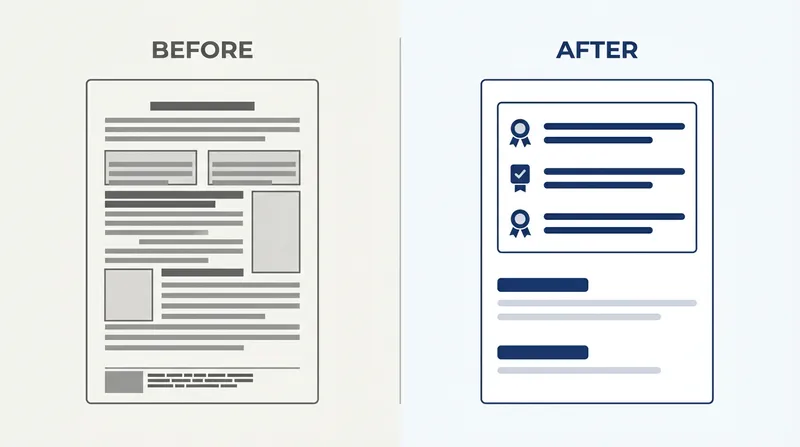
- Using heavy graphic templates: Multi-column Canva templates frequently break ATS parsing software, turning your hard-earned certificates into unreadable text blocks.
Where to Put Professional Certificates on a Career Change Resume
Strategic placement is everything. If you are transitioning from hospitality to IT, your ten years of restaurant management is valuable for soft skills, but it will not get you an IT interview on its own. Your newly acquired IT certificates are your strongest asset.
Research from Northeastern University emphasizes that to bolster hiring managers' confidence in micro-credentials, candidates must align them accurately with the specific job roles they are targeting.
If the certificate is your primary qualification for the new career, it must sit at the top of your resume, immediately below your professional summary.
Actionable Tip: Use a dedicated "Professional Development" or "Certifications" header above your unrelated work history. This immediately signals your career pivot to the recruiter. If you are also dealing with a gap in employment during your studies, read our guide on how to explain redundancy without looking like a hiring risk to frame your time off as active upskilling.
Job-Specific Resume Tailoring for Applicant Tracking Systems
Generic resumes fail because Applicant Tracking Systems are programmed to look for strict keyword matches based on the job description.
Looking at this from the recruiter's side, the process is ruthless. When your resume says "Project Management" but the job description explicitly requires "Agile Methodology", the ATS scores your application near zero before a human ever opens the file. Even if your bootcamp covered Agile in depth, the system only reads the text on the page.
Leveraging AI to Beat the Bots
This is where JobSparrow's dynamic tailoring changes the game. JobSparrow's Master Career Profile stores every credential, project, and skill you have ever acquired. When you apply for a role, the Gap Filler feature identifies which of those credentials match the job description and surfaces them automatically.
Our AI reads the specific job description you are applying for and intelligently selects the most relevant experience. It automatically elevates the exact certificates and bootcamp projects that match the job requirements to the top of your resume, ensuring your bootcamp work is never buried again.
Actionable Tip: Stop guessing what the ATS wants. Run your current resume through JobSparrow's free diagnosis tool. You will receive a recruiter-lens score out of 100 and see exactly which of your micro-credentials are being ignored by the system. Discover how you can tailor applications fast with an AI resume creator to beat the bots in under 60 seconds.
Regional Advice: Creating a Career Change Resume in Australia and New Zealand
While the advice above applies globally, hiring managers in Australia and New Zealand have specific preferences. The ANZ market places a massive premium on practical competency and cultural fit. Employers here highly value candidates who show continuous learning, making well-placed bootcamps incredibly effective.
However, Australian and New Zealand ATS platforms can be strict regarding formatting. Overly designed templates with multiple columns or heavy graphics often scramble your text. For example, a two-column layout might parse a bootcamp credential as "Google Analytics November 2025 Data Professional", scrambling the title and date. A clean, single-column layout ensures the ATS reads "Google Data Analytics Professional Certificate" exactly as intended.
Actionable Tip: Ensure your CV formatting matches local standards. Stick to clean, single-column layouts for the best ATS parsing. For a deep dive into local requirements, review our guide on how to optimize the standard New Zealand format for ATS.
Ready to Prove Your Competency?
You have done the hard work of upskilling. Do not let poor formatting stand between you and your new career.
Start with a free diagnosis at JobSparrow to instantly reveal your recruiter-lens score and uncover the exact gaps costing you interviews in under two minutes. Unlock the full Offer Path for a one-time $129 fee (no subscription, no auto-renewal) and let our intelligent platform tailor your bootcamp experience perfectly for every single application.
Frequently Asked Questions
Should I list uncompleted online certificates on my resume?
Yes, provided you are actively pursuing the credential. Label the entry as "In Progress" and include your expected completion date. This shows employers that you have current momentum and are dedicated to continuous learning.
Do employers actually verify Coursera or Google certificates?
Absolutely. Many employers conduct background checks that include credential verification. Always provide the official Credential ID or include a hyperlink directly to your verified digital badge to make this process seamless for the recruiter.
How far back should I list online certificates?
Keep your resume highly relevant by only listing certificates acquired within the last 3 to 5 years. In fast-moving fields like tech, digital marketing, and data science, older certificates may highlight outdated software or methodologies.
Can a bootcamp replace a university degree on a resume?
A bootcamp is generally viewed as a complement to a degree, not a direct replacement. However, a rigorous bootcamp paired with a strong, verifiable project portfolio can fulfill the requirements for many modern roles that prioritize hard skills and execution over traditional academic pedigrees.
Does JobSparrow's AI know where to place my micro-credentials?
Yes. JobSparrow's AI analyzes the specific job description you provide. It automatically restructures your resume, ensuring that the micro-credentials and bootcamp projects most relevant to that specific role are placed front and center for both the ATS and the human recruiter.
Tags
Keep reading
Recommended articles.
career change · resume tips
How to Structure a Career Change CV to Bypass the 'No Industry Experience' Filter
Learn how to write a career change CV that beats the ATS filter. Discover the best templates, formats, and transferable skills to land more interviews.
career change · resume tips
Career Change Resume Help: 7 Tips to Translate Transferable Skills for a New Industry
Need career change resume help? Discover 7 actionable tips to translate your transferable skills, beat ATS filters, and confidently enter a new industry.
resume tips · layoff
Resume After Layoff: How to Explain Redundancy (Without Looking Like a Hiring Risk)
Learn how to write a resume after layoff and explain redundancy confidently. Get ATS-friendly examples and proven tips to handle employment gaps.