
career change
Career Change Resume Help: 7 Tips to Translate Transferable Skills for a New Industry
By Job Sparrow Team
You've sent out 50 applications this month. Radio silence. If you're looking for career change resume help, the problem isn't your actual experience: it's how you're presenting it.
Many career changers and migrants hit a wall early in their job search. They feel their past professional experience is completely worthless because they don't know how to translate foreign job titles or industry-specific jargon into terms local employers understand. This translation failure leads to immediate Applicant Tracking System (ATS) rejection, leaving highly capable candidates feeling unqualified and stuck.
At JobSparrow, our team has reviewed over 100,000 resumes across Australia, New Zealand, the United States, Singapore, and Hong Kong. We know exactly what happens behind the scenes. If you want to stop getting automated rejection emails, you need to learn how to write a resume for a career change that speaks the new industry's language.
The seven tips below focus on the first two stages of the JobSparrow Offer Path: Diagnosing what is holding your resume back, and Positioning your experience to speak the new industry's language.
Why your career change resume is getting rejected
Research consistently shows recruiters spend just seconds on an initial CV scan. We call this the "recruiter-lens." When a hiring manager looks at your application, they are not trying to figure out your potential. They are looking for immediate proof that you can solve their specific problems.
Traditional resumes fail career pivoters because they rely entirely on past job titles rather than future capabilities. If you are applying for a Marketing Manager role but your last three job titles say "Admissions Counselor," a tired recruiter (and a rigid ATS algorithm) will instantly categorize you as unqualified.
If you are currently working but looking to pivot, a great strategy is to start tweaking your profile quietly. You can learn more about this in our guide on The Stealth Job Search: How to Discreetly Update Your CV While Employed.
If you are ready to stop guessing and see how your current CV performs, start with a free CV diagnosis today to uncover your blind spots before you apply.
What are transferable skills (and why do they matter)?
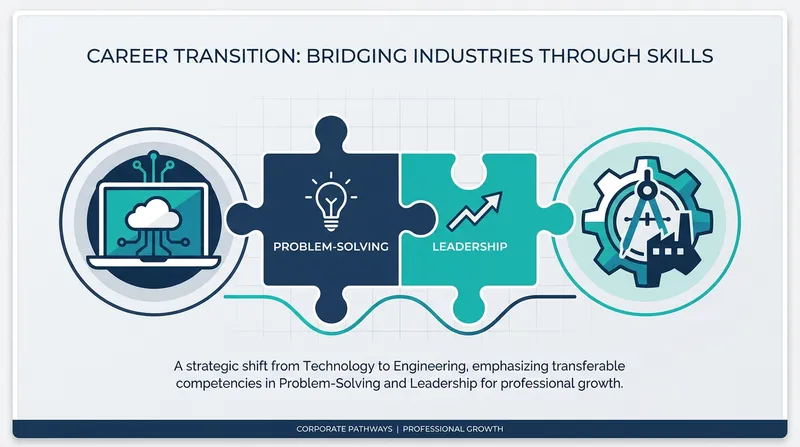
Transferable skills are the core abilities you take with you from one job to another, regardless of the industry or specific role. They are the universal language of the working world.
Employers highly value these skills because they drastically reduce the training time required for new hires. According to industry insights from Coursera, critical thinking, problem-solving, adaptability, and teamwork rank among the most in-demand transferable skills that help candidates transition with minimal additional training.
When you highlight transferable skills on a resume, you shift the focus away from what you lack (direct industry experience) and shine a spotlight on what you bring (proven, universal competencies).
7 actionable tips to translate transferable skills for a new industry
You already have the experience needed to succeed. The secret is simply reframing it. Here is our seven-step framework to help you build a no-experience career change resume that actually gets interviews.
1. Choose a skills-based resume format
The standard reverse-chronological resume format actively hurts career changers. By putting your most recent job title at the very top, you accidentally highlight your lack of direct experience in your new target field.
Research from Wharton Executive Education at the University of Pennsylvania notes that 66 percent of survey respondents have recently considered changing careers, meaning this translation struggle is widespread. To stand out from the crowd, you need to use a combination (or hybrid) resume format. This is essentially a functional resume for career changers that still satisfies ATS requirements.
A combination format places a heavy emphasis on a categorized skills section at the top of the document, followed by a brief chronological work history at the bottom.
Actionable Tip: Create a "Core Competencies" section right below your summary. Group your skills into three main buckets that directly match the new job description (for example: Project Management, Client Relations, and Data Analysis).
2. Write a career transition resume summary that hooks recruiters
A resume objective for a career change is outdated. Saying "Seeking a challenging role in IT to utilize my skills" tells the employer what you want, but it fails to tell them what value you provide.
You need a powerful career transition resume summary instead. Creating a dedicated summary section that mirrors the language of the job posting is critical to passing automated scans and capturing a recruiter's attention instantly.
Actionable Tip: Use this simple formula for your summary: Current professional identity + Years of transferable experience + Core relevant skills + Immediate value to the new industry.
Before: "Former teacher looking to transition into corporate training." After: "Dynamic instructional designer with 6 years of experience developing engaging curriculum and facilitating group learning. Proven ability to translate complex concepts into accessible training modules, driving a 30% increase in learner retention. Ready to optimize employee onboarding programs for the tech sector."
3. Translate international experience for local employers
If you are a migrant moving to Australia, New Zealand, the UK, or the US, you face a unique challenge. Your job titles and university degrees might mean nothing to a local hiring manager. Translating international experience on a resume is mandatory.
Recruiters will not pause to research foreign companies or educational grading systems. You must do the translation work for them.
Actionable Tip: When figuring out how to list overseas experience on a resume, use local equivalents. If your previous title was "Director of Commerce" but your daily duties were identical to an Australian "Sales Manager," list your title as "Sales Manager (Equivalent to Director of Commerce)." Do the same for education by listing the local equivalent of your degree in brackets.
4. Reframe industry jargon into universal achievements
Every industry has its own secret language. The military has acronyms, healthcare has medical terminology, and tech has coding frameworks. If you use your old industry's jargon, you will confuse your new audience.
You must provide transferable skills resume examples that focus on universal business outcomes. The best way to do this is by using the STAR method (Situation, Task, Action, Result) to quantify your achievements.
Actionable Tip: Strip away the jargon. Jargon: "Managed logistics for a battalion deployment to a forward operating base." Translated: "Directed end-to-end supply chain operations for a 500-person organization, ensuring 100% on-time delivery of critical assets under strict deadlines."
5. Format your resume to explain a career gap confidently
Career pivots often come with employment gaps. Whether you took time off to study, travel, care for family, or simply figure out your next move, gaps are completely normal. The mistake is trying to hide them.
Proper resume formatting for a career gap shows confidence and intentionality. If you leave an unexplained blank space, recruiters will assume the worst.
Actionable Tip: Use years instead of months for your employment dates (e.g., 2021 to 2023 instead of March 2021 to November 2023) to naturally smooth out short gaps. For longer gaps, add a single line item framing it positively: "Sabbatical and Professional Upskilling (2023). Completed intensive data analytics bootcamp and earned Google Data Analytics Certification."
6. Beat the ATS with tailored keywords
Applicant Tracking Systems are ruthless to career changers. These software programs scan your resume for exact keyword matches based on the job description. If the job asks for "Agile methodology" and your resume says "flexible project management," you will be rejected.
Tailoring every single application is emotionally draining and frustrating, but it is absolutely necessary. An ATS-friendly career change resume must be customized for every single role. Sending a generic CV is a guaranteed way to fail.
Actionable Tip: Read the target job description and highlight the recurring verbs and hard skills. Weave those exact words into your summary and bullet points. To automate this, use JobSparrow's Match Score and Gap Analysis tools to instantly identify missing keywords and optimize your application. To see exactly how to speed up this process, read our guide on How to Tailor Your Resume to Any Job Description (& Beat the ATS in 60 Seconds).
7. Use a skills inventory to uncover hidden strengths
Most people vastly undersell themselves because they cannot see their own blind spots. When you stare at a blank page, it is incredibly difficult to remember every relevant project you have ever completed.
The best way to start is by performing a manual skills inventory: list out every major project you completed in the last five years and extract the universal skills (like budget management or stakeholder communication) required to finish them.
Actionable Tip: Once you have your basic inventory, use an AI coach to refine it. JobSparrow's Gap Filler analyzes your Master Profile, identifies missing metrics or vague descriptions, and walks you through targeted Q&A to fill them in. Curious about how we stack up against basic text generators? Read ChatGPT vs. AI Resume Builders: Choosing the Best AI Tool for Resume Writing.
Don't forget the career change cover letter
While resumes look backward, cover letters look forward. For a career pivoter, the cover letter is your greatest asset. It is your chance to explicitly connect the dots for the hiring manager and tell the story of why your non-traditional background is actually a massive advantage.
Actionable Tip: Use your opening paragraph to explicitly bridge the gap. Try a formula like: "While my background is in [Former Industry], my proven success in [Transferable Skill 1] and [Transferable Skill 2] makes me uniquely equipped to drive [Specific Result] for [Company Name]." This immediately frames your non-traditional background as an asset rather than a liability.
Before you hit submit, make sure you review our insights on Generic AI Cover Letter Tools vs. JobSparrow: Why One-Size-Fits-All Fails AU/NZ ATS to ensure your story sounds authentic and professional.
Frequently asked questions
How do I write a resume for a career change with no direct experience?
Focus entirely on transferable skills, volunteer work, relevant side projects, and a strong combination resume format. You must highlight your capabilities and potential over your chronological job history. Instead of listing duties from past roles that do not apply, detail the universal problems you solved, such as managing budgets, leading teams, or optimizing processes.
What is the best resume format for a career pivot?
The combination (or hybrid) resume format is the absolute best choice for career changers. It places a heavy emphasis on a categorized skills section at the top of the page, followed by a brief chronological work history. This structure ensures the recruiter sees your relevant abilities before they see your unrelated past job titles.
How do I list overseas experience on a resume for Australian employers?
Translate your foreign job titles into their closest Australian equivalents to avoid confusing local recruiters. Provide brief context for unknown company names (for example: Top 3 telecommunications provider in Brazil), and list your overseas degrees alongside their local educational equivalents. This removes the guesswork for hiring managers and helps you pass automated ATS filters.
Should I include a resume objective for a career change?
Avoid outdated objectives that just state what you want from the employer. Instead, write a powerful professional summary that clearly states your transition goals and highlights the specific transferable skills and immediate value you bring to the new industry. A strong summary hooks the reader by showing how your unique background solves their current problems.
How do I explain a career gap on my resume?
Be transparent but brief. Use a single line in your experience section to define the gap (for example: Sabbatical and Professional Upskilling) and highlight any courses, certifications, or relevant volunteer work completed during that time. Smoothing out employment dates by using years instead of months (like 2022 to 2024) can also help naturally frame shorter gaps without looking deceptive.
Ready to land more interviews in your new industry? Start with a free CV diagnosis today. See your recruiter-lens score and identify the exact gaps costing you interviews in minutes. When you are ready to accelerate your search, unlock the full Offer Path for a one-time $129 fee, with no auto-renewal traps.
For more tips on speeding up your application process, check out How to Use an AI Resume and Cover Letter Creator to Apply in Under 5 Minutes.
Tags
Keep reading
Recommended articles.
career change · resume examples
5 Career Change Resume Examples (And Why Recruiters Love Them)
Explore 5 career change resume examples and learn the combination format recruiters love. Translate transferable skills and beat the ATS today.
career change · resume format
The Best Career Change Resume Format for 2026 (Section-by-Section Guide & Templates)
Discover the best career change resume format for 2026. Learn how to highlight transferable skills, beat ATS bots, and confidently land your new dream job.
career change · resume tips
The Master Profile Strategy: How to Write a Career Transition Resume Without Erasing Your Past
Learn how to write a career change resume that highlights transferable skills and preserves your seniority using the hybrid format and master profile strategy.