
stealth job search
The Stealth Job Search: How to Discreetly Update Your CV While Employed
By Job Sparrow Team

You've sent out 50 applications this month. Radio silence. The problem is not your experience, it's your CV. But when you're already employed, updating your resume and applying for jobs feels like walking a tightrope. The intense anxiety of being discovered and fired before securing a new role, combined with the sheer exhaustion of job hunting after a full workday, is a heavy burden. You need a high-impact, low-visibility strategy that protects your livelihood.
Welcome to the stealth job search. This guide walks you through the first three stages of the JobSparrow Offer Path: diagnosing what your CV is missing, positioning yourself for the hidden job market, and executing a discreet application strategy.
At JobSparrow, we've reviewed over 100,000 resumes and hired across five major markets (Australia, New Zealand, the United States, Singapore, and Hong Kong). We sit on both sides of the hiring table. We know exactly what recruiters look for, and we know how passive job seekers can position themselves without tipping off their current employers. This guide will show you how to safely update your CV, tailor it for the hidden job market, and land your next role discreetly.
Why You Should Job Search While Employed
There is an old saying in recruitment that it's easier to find a job when you already have one. Recruiters actively seek out employed candidates because they're perceived as valuable, stable, and pre-vetted by another organization. Furthermore, frequent career transitions are now the standard. According to the U.S. Bureau of Labor Statistics, the median job tenure for wage and salary workers has dropped to 3.9 years, underscoring that frequent career transitions are now the norm.
You're not alone in keeping your options open. Research from HR Cloud indicates that approximately 70% of the global workforce consists of passive job seekers. These are professionals who are currently employed but open to superior opportunities.
Moreover, many of these transitions are not just lateral moves. Recent data from the Federal Reserve Bank of Richmond shows the number of people transitioning to a completely different industry grew by 12.5%, driving the vast majority of new job-to-job transitions. This proves that a career change resume is highly relevant today. If you're planning a massive pivot, you need a strategy that works.
The Hidden Job Market: Building Your Master Career Profile
When you're conducting a confidential stealth job search, you can't simply blast your resume across public job boards. Doing so risks your current boss finding your profile. Instead, you need to tap into the hidden job market.
Estimates compiled by NGPF from CNBC reporting suggest that up to 70% of all job openings fall into the hidden job market and are never publicly advertised on job boards. These roles are filled through networking, internal mobility, and direct recruiter outreach.
To capture these opportunities at a moment's notice, you need a Master Career Profile. Think of this as your comprehensive career database. It holds every skill, project, and role you've ever held. JobSparrow's Master Career Profile acts as your single source of truth. Instead of maintaining a public LinkedIn profile that broadcasts your every move, you keep your complete history secure in JobSparrow.
When a recruiter reaches out discreetly, our Instant Resume feature generates a professional PDF from this master profile in seconds, requiring no public job listing. This ensures you're always ready for unexpected opportunities.
Build your Master Career Profile now - it takes minutes and keeps your search completely private. Start free.
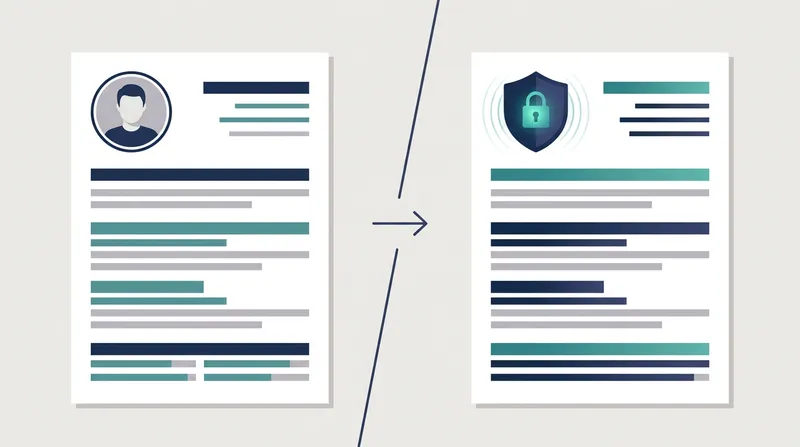
The Redacted CV Method: Updating Your Resume Without Your Boss Knowing
One of the biggest content gaps in traditional career advice is how to actually format a resume for a discreet job hunt. If you work in a niche industry, a recruiter might accidentally forward your CV to a partner of your current company, or even to your own boss.
Enter the Redacted CV Method. This strategy involves anonymizing your current employer and specific metrics to prevent reverse-engineering.
- Obscure the Company Name: Instead of listing "Acme Corporation", write "Leading Mid-Sized SaaS Provider (Confidential)". This gives the recruiter an idea of your environment without naming names.
- Generalize Your Metrics: If your company publicly celebrates hitting $14.2 million in Q3 revenue, don't put that exact number on your CV. Write "Drove multi-million dollar revenue growth in Q3".
- Focus on Transferable Skills: Highlight your capabilities rather than proprietary company projects.
This method protects your identity during the initial outreach phase. Once you reach the interview stage and have established mutual trust with the recruiter, you can share full company details under a confidentiality agreement if appropriate. (Note that NDA practices vary by company and industry). If you're unsure how to structure your document, review our guide to NZ CV formatting for 2026 for best practices that apply across all major markets.
Quality Over Quantity: The Danger of AI Auto-Apply Bots
Many employed job seekers are exhausted. After a 9-to-5 workday, the idea of manually tailoring and applying to jobs is draining. This fatigue drives people toward AI auto-apply platforms.
Don't use them.
Auto-applying is highly dangerous for a stealth job search. These bots blast your resume to hundreds of job postings without human oversight. You can't guarantee your resume won't be sent to your current company, a subsidiary, or a vendor your boss works with closely.
Quality always beats quantity. Research consistently shows the vast majority of applications are filtered by Applicant Tracking Systems (ATS) before reaching a recruiter, and generic applications have an incredibly low success rate. Instead of auto-applying, use JobSparrow's Job-Specific Resume Tailoring.
Our AI analyzes a specific job description and intelligently selects the most relevant experience from your Master Career Profile. It rewrites your bullet points to match the job requirements, optimizing for the ATS without exposing your data to the public internet. What used to take hours of manual editing now happens safely in under 60 seconds. You maintain total control over where your customized CV goes.
The Migrant Stealth Search: High Stakes in Australia and New Zealand (and Beyond)
For expats and migrants, a confidential job search carries significantly more weight. If your current visa is tied to your employer, being discovered could mean losing your job and your right to remain in the country.
Migrants in Australia and New Zealand face unique hurdles. You must signal your work rights clearly without triggering alarms. On your CV, include a simple line in your header: "Full Work Rights in Australia (Subclass 482, Open to Sponsorship Transfer)". This tells recruiters you're viable without requiring you to post your status publicly online.
For more targeted advice on migrating your career, read our guide on writing an accountant resume for Australian migration. If you're looking to express interest directly to an employer, check out how to write an Expression of Interest (EOI) for AU and NZ roles.
Updating Your LinkedIn Profile Secretly
Can your boss see if you update your resume on LinkedIn? Yes, if you're not careful.
Before making any changes to your LinkedIn profile, go to your privacy settings and turn off "Share profile updates with your network". This prevents LinkedIn from sending a notification to your boss and colleagues every time you add a new skill or update your headline.
However, even with notifications off, a sudden overhaul of your profile is a red flag. The safest route is to keep your LinkedIn profile static and use a private, tailored CV for your outreach. If you must use LinkedIn, slowly drip-feed updates over several months. If you're frustrated by the algorithm, read how to beat the LinkedIn and Seek algorithms.
Filling the Gaps Before You Apply
Most people undersell themselves because they forget their past achievements. JobSparrow's Gap Filler acts as an interactive AI coach. It analyzes your Master Career Profile, identifies missing metrics or unexplained career gaps, and walks you through targeted questions to fill them in.
If you have a gap you're worried about, check out our guide on how to explain a resume gap due to illness in AU/NZ. Alternatively, if you've been doing temporary work, learn how to list contract work on your resume.
Don't Use Company Time or Resources
Never use company time, company Wi-Fi, or company equipment for your job hunt. It's a massive risk, and many corporate IT departments monitor web traffic and email attachments.
Don't print your resume on the office printer. Don't use your work email address to correspond with recruiters. Set up a dedicated, professional Gmail account specifically for your job search. When you're ready to reach out, use our guide on what to write in an email when sending your resume to ensure your communication is flawless.
How to Schedule Interviews Around Your Work
When you land an interview, schedule it during your lunch break, early in the morning, or late in the afternoon. Use personal time off (PTO) if necessary. Don't take the call in a glass-walled conference room at your current office.
Preparation is equally challenging when you're time-poor. This is where JobSparrow's AI Mock Interviews shine. You can practice in a safe environment after hours. The AI mirrors a real interview tailored to the specific role you're applying for, providing instant feedback on your clarity and delivery.
It builds your confidence so you don't stumble when you finally step out of the office for the real thing. You can practice tough questions, like how to answer 'Why do you want to work here?' or even how to explain being fired in an interview.
Who to Use as a Professional Reference
A common question passive job seekers ask is: "What happens if a recruiter contacts my current employer?"
You must be proactive to prevent this. Clearly state "References available upon request and mutual NDA" at the bottom of your CV. When it's time to provide references, don't use your current manager.
Instead, use former managers, trusted colleagues who have left the company, or clients with whom you have a strong, confidential relationship. Make sure you brief them beforehand so they know to keep your search a secret.
Common Stealth Job Search Mistakes to Avoid
Before you launch your discreet job hunt, ensure you aren't making these critical errors:
- Updating LinkedIn publicly: Always double-check your privacy settings before making tweaks.
- Using work devices: Never search, apply, or interview using your company laptop or Wi-Fi.
- Applying via auto-apply bots: You risk accidentally applying to your own company or its subsidiaries.
- Using your current manager as a reference: Rely on former managers or trusted former colleagues instead.
Conclusion: Your Next Steps
Navigating a stealth job search while employed requires strategy, discretion, and the right tools. You don't need to risk your current job to find a better one. By building a secure Master Career Profile, using the Redacted CV Method, and leveraging targeted AI tailoring instead of dangerous auto-apply bots, you can safely land your next role.
JobSparrow is your AI career advisor, guiding you from diagnosis to offer. We don't just fix your resume, we coach you through the whole hunt. If you're wondering whether you need a CV writing service or an AI career advisor, the answer is clear. You need a comprehensive strategy.
Ready to land more interviews without alerting your boss? Start with a free diagnosis. See your recruiter-lens score and the exact gaps costing you interviews in minutes. Unlock the full Offer Path for a one-time $129, with no auto-renewal.
Frequently Asked Questions
Should I put my current employer on my resume if I am looking secretly?
Yes, but you must use the Redacted CV Method to protect your identity. Instead of naming your specific company, describe its industry, size, and your general environment. For example, use "Global Logistics Firm (Confidential)" or "Leading Mid-Sized SaaS Provider". This proves you're currently employed, which recruiters highly value, without giving away your exact location. Once you reach the interview stage and establish mutual trust, you can reveal the specifics under a confidentiality agreement if appropriate.
Can my boss see if I update my resume on LinkedIn?
Yes, if your network notifications are turned on. Before making any changes to your LinkedIn profile, you must navigate to your privacy settings and turn off "Share profile updates with your network". However, even with notifications disabled, a sudden and massive overhaul of your profile is a major red flag to colleagues. The safest route is to keep your public LinkedIn profile static and use a private, tailored CV for your confidential outreach.
How do I explain why I am looking for a new job while currently employed?
Keep your answer positive, forward-looking, and completely professional. Never badmouth your current employer, as this signals toxicity to a hiring manager. Instead, frame your search around career growth. You can say, "I have learned a great deal in my current role, but I am looking for an opportunity to take on more leadership responsibilities," or "I am seeking a role that aligns closer to my long-term career goals in this specific industry."
What happens if a recruiter contacts my current employer?
This is a worst-case scenario that you must actively prevent. Always inform recruiters upfront in your cover letter and email outreach that your search is strictly confidential. At the bottom of your CV, explicitly state "References available upon request and mutual NDA". This sets a firm professional boundary immediately. When it's time to provide references, use former managers or trusted colleagues who have already left the company.
Is it illegal to job search on a work computer?
While it is rarely illegal in a criminal sense, it almost certainly violates your company's acceptable use policy. Doing so is grounds for immediate termination. Many corporate IT departments monitor web traffic, keystrokes, and email attachments. Never use company time, company Wi-Fi, or company equipment for your job hunt. Always use your personal devices and a dedicated personal email address.
Tags
Keep reading
Recommended articles.
career change · resume tips
The Master Profile Strategy: How to Write a Career Transition Resume Without Erasing Your Past
Learn how to write a career change resume that highlights transferable skills and preserves your seniority using the hybrid format and master profile strategy.
resume tips · career change
How to List Bootcamps & Online Certificates on Your Resume in 2026 (With Examples)
Learn how to list bootcamps and online certificates on your resume in 2026. See formatting examples, beat the ATS, and land more interviews.
career change · resume summary
Career Change Resume Summary & Objective Examples (2026 Guide)
Write a career change resume summary that passes ATS and gets recruiter attention with fill-in-the-blank templates and real examples for 2026. Try free.