
resume tailoring
How to Tailor Your Resume to Any Job Description (& Beat the ATS in 60 Seconds)
By Job Sparrow Team

You have spent hours manually rewriting your resume for every single application, only to face instant rejection. The radio silence feels exhausting and demoralizing. You know you are highly qualified for the roles you are targeting, but you feel completely blind to what recruiters and automated keyword scanners actually want to see.
The truth is that the problem is not your experience. It is the automated gatekeeper standing between you and the hiring manager. To land interviews consistently, you must learn how to tailor a resume to a job description effectively.
This guide covers the first stage of JobSparrow's Offer Path: Diagnose. Before you can position yourself and execute a winning application, you need to understand what is blocking you from getting interviews. This comprehensive breakdown explains the exact mechanics of Applicant Tracking Systems (ATS) and shows you how to extract the right keywords manually.
(Want to skip ahead? Jump to the AI section to see how to automate this entire tedious process in under 60 seconds, or read on to understand the mechanics behind it first.)
The ATS Black Hole: Why Highly Qualified Candidates Get Rejected
Job hunting is stressful enough without the feeling that your applications are disappearing into a void. When you apply to dozens of jobs and hear nothing back, it is easy to take it personally. However, the initial rejection is rarely a human decision. It is a mechanical one.
The Applicant Tracking System (ATS) is the primary software employers use to collect, scan, and filter incoming applications. These systems are designed to manage massive volumes of candidates by weeding out resumes that do not meet specific criteria. Unfortunately, this focus on efficiency comes at a severe cost to highly qualified professionals.
According to a landmark study on hidden workers by Harvard Business School and Accenture, 88 percent of employers admit their ATS filters out highly skilled candidates simply because their resumes do not match the exact language of the job description. These automated systems create a crisis where great talent is rejected over rigid formatting rules and missing buzzwords.
Tailoring your application is no longer optional. It is a mandatory step to survive the initial scan. You need an ATS friendly resume format and a hyper-targeted keyword strategy to ensure your document reaches a human reader.
What It Actually Means to Tailor Your Resume to a Job Description
Many job seekers misunderstand what resume tailoring actually entails. It does not mean lying, exaggerating, or inventing experience you do not have. True tailoring is about relevance and alignment. It means highlighting the specific skills the employer is asking for and moving irrelevant details to the background.
At JobSparrow, we look at hiring from both sides of the table. Our team has reviewed over 100,000 resumes and brings 10+ years of recruiting experience across four markets: Australia, New Zealand, the United States, and Singapore. From the recruiter's perspective, research from an eye-tracking study by Ladders shows a human reviewer spends less than 10 seconds on an initial resume scan. They are not reading your life story; they are hunting for specific evidence that you can solve their immediate business problem. If they do not see the required skills jumping off the page immediately, they will move on to the next candidate.
Sending a one-size-fits-all document guarantees failure in today's competitive market. You must customize your resume for the job to prove you are the perfect fit for that specific role, at that specific company.
Why Generic Applications Fail in Australia and New Zealand
Localized hiring nuances matter immensely, particularly in the Australian and New Zealand job markets. When searching on platforms like SEEK (the dominant job board in Australia and New Zealand), local recruiters look for specific terminology, regional spelling conventions, and clear evidence of local or easily transferable experience.
A generic resume often uses Americanized terms or broad statements that fail to resonate with a Sydney or Auckland hiring manager. If a job posting asks for a "Stakeholder Engagement Lead" and your generic resume says "Client Relations Manager," the ATS and the local recruiter might both miss the connection. To understand more about why regional localization is critical, read our guide on Generic AI Cover Letter Tools vs. JobSparrow: Why One-Size-Fits-All Fails AU/NZ ATS.
How an Applicant Tracking System (ATS) Keyword Scanner Works
To beat the system, you must first understand how it operates. AI resume screeners are not intelligent, empathetic readers. They are rigid databases designed to parse, rank, and filter text based on exact character matches.
When you upload your document, the ATS strips away all the design elements and extracts the raw text. According to formatting guidelines from the University of Minnesota, ATS software reads documents strictly from left to right, and top to bottom. It then categorizes your text into database fields like "Education," "Experience," and "Skills."
From the employer's perspective, this resume keyword scanner is an absolute necessity. As the Society for Human Resource Management (SHRM) notes, modern talent acquisition teams receive hundreds of applications per role. The ATS keyword matching function allows them to filter a mountain of applications down to a manageable shortlist of 10 or 20 people.
The Myth of the Multi-Column Resume (And What to Use Instead)
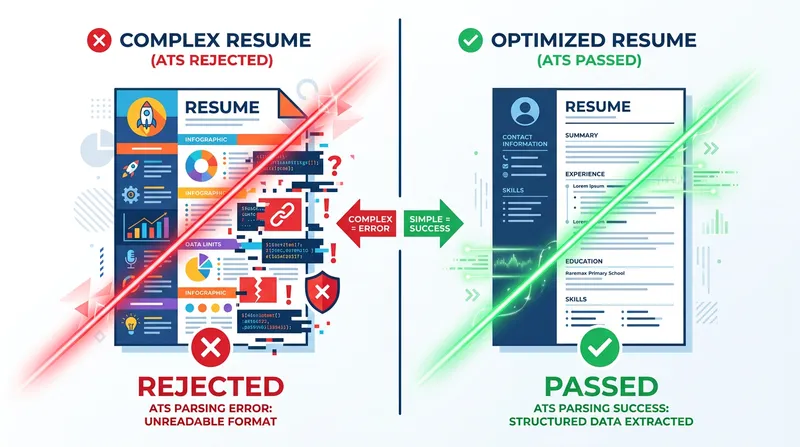
Many generic resume builders and online platforms sell highly designed, multi-column templates with colorful graphics and skill-rating bars. These templates are a dangerous trap.
Because an ATS reads strictly from left to right, a two-column layout causes catastrophic parsing errors. The software will read the text from the left column and merge it directly into the text from the right column on the same line. Your carefully crafted bullet points will turn into a jumbled, unreadable mess, leading to instant disqualification.
The U.S. Social Security Administration (SSA) confirms that complex formatting confuses hiring software. To ensure your application is parsed correctly, you must use a single-column resume format saved as a standard PDF or DOCX file. Keep it simple, clean, and text-based.
How to Tailor Your Resume Manually (The 15-Minute Method)
If you want to understand the exact mechanics of resume keyword optimization, you can perform the process manually. This method is highly effective, but it requires patience. Manually tailoring a document takes about 15 to 20 minutes per application. If you are applying to 20 jobs a week, this becomes a massive, exhausting time sink.
Here is how to execute the manual method correctly.
Step 1: Extract the Core Keywords from the Job Posting
Your first task is to act as a human job description keyword extractor. Print out the job posting or copy it into a digital document, and begin highlighting the core requirements.
You need to identify three distinct categories:
- Hard Skills: Technical abilities, specific software, and industry methodologies.
- Soft Skills: Communication, leadership, and problem-solving traits.
- Qualifications: Degrees, certifications, and years of experience.
Pay close attention to the "must-haves" (usually listed at the very top of the requirements section) versus the "nice-to-haves."
Exact phrasing is critical. If the job description asks for "Project Management," do not write "Managed Projects" on your resume. The ATS is looking for the exact noun phrase. For more advice on structuring modern technical requirements, check out How to List Agentic AI and Automation Skills on Your Resume: 2026 Guide for Tech & Business Roles.
Step 2: Contextualize Your Experience to Match
Once you have your list of keywords, you must integrate them into your document. Do not simply stuff a list of buzzwords at the bottom of the page. Recruiters hate keyword stuffing because it provides no context.
Instead, weave the keywords naturally into your experience bullet points. You need to show how you used that specific skill to achieve a measurable result.
Consider these before-and-after examples:
- Before: Handled customer complaints and issues.
- After: Resolved escalated customer complaints using Salesforce CRM, improving overall client retention by 15%.
- Before: Led a team of marketers.
- After: Directed a cross-functional B2B marketing team to execute data-driven campaigns, increasing inbound lead generation by 22%.
If you have unconventional work history, you can still maintain keyword density while being completely honest. Learn how to reframe specific periods of employment in our guide on How to List Contract Work on Your Resume: Temp to Permanent (AU/NZ).
Common Mistakes to Avoid
Before you start editing, ensure you are not falling into these frequent resume tailoring traps:
- Tailoring only the skills section: Adding a few keywords to a bulleted list at the bottom of the page while leaving your professional summary and experience generic will not fool a recruiter.
- Using synonyms instead of exact phrases: If the job asks for "Client Retention," writing "Customer Loyalty" might cause the ATS to miss the match completely. Use the exact noun phrase.
- Over-tailoring to the point of misrepresentation: Never invent experience to match a keyword. True tailoring is about reframing your genuine background to highlight relevance, not writing fiction.
Want to skip the manual process entirely? Get your free ATS diagnosis in 60 seconds and see exactly what is costing you interviews.
How to Beat the ATS in 60 Seconds with an AI Resume Tailor
The 15-minute manual method works, but it inevitably leads to applicant burnout. When you are juggling a current job, family responsibilities, and a job hunt, spending hours rewriting bullet points is simply not sustainable.
What if you could achieve perfect resume optimization for ATS in under 60 seconds?
Instead of manually cross-referencing documents, you can use an AI resume tailor to automate the heavy lifting. Purpose-built AI tools are designed to read the job description, identify the core requirements, and instantly restructure your existing career profile to highlight your most relevant qualifications.
This is not about generating fake experience. A high-quality resume tailoring tool uses your actual, verified work history (your master career profile) and intelligently selects the best bullet points for the specific job you are targeting. It rewrites your achievements to mirror the exact vocabulary of the job posting, ensuring you pass the ATS keyword matching threshold instantly.
For a deep dive into choosing the right software and avoiding generic chatbots, read ChatGPT vs. AI Resume Builders: Choosing the Best AI Tool for Resume Writing.
The JobSparrow Approach: From Free Diagnosis to Job Offer
At JobSparrow, we believe that providing a one-off resume tool is not enough. We do not just fix your formatting; we act as your AI career advisor, coaching you through the entire Offer Path: Diagnose, Position, Execute, Prepare, and Close.
Our platform is built around a centralized master career profile. You input everything you have ever done once, and our gap filler AI identifies missing metrics or vague descriptions, coaching you to improve them. When you find a job you want, our job-specific resume tailoring feature analyzes the listing and generates a hyper-personalized, ATS-optimized PDF in seconds. Once your resume lands an interview, our AI mock interview tool simulates role-specific interview questions and gives you real-time feedback on your delivery, so you walk in prepared instead of nervous.
We prioritize transparency. You can start with a free ATS resume checker and diagnosis. We will give you a recruiter-lens score out of 100 and show you the exact gaps costing you interviews before you ever spend a dime. Unlike traditional career consultants who charge $300 or more per resume and $2,000+ for a full program, JobSparrow's complete Offer Path is available for a one-time flat fee of $129, with no hidden subscriptions.
Ready to see where you stand? If you are currently employed and need to manage this process quietly, read The Stealth Job Search: How to Discreetly Update Your CV While Employed, and then upload your document to our secure platform.
Start with a free diagnosis today.
Next Steps: Submitting Your Tailored Application
Once your resume is perfectly tailored, you have a few final checks to complete before hitting submit.
First, always save your document in a standard format. Unless the job description explicitly requests a Word document, save your file as a PDF to lock in your formatting. Use a professional, clear filename, such as "Firstname_Lastname_Resume_2026.pdf".
If you are applying via email rather than a portal, the body of your email matters just as much as the attachment. You need to stand out to the human reading it. Follow our proven communication frameworks in What to Write in an Email When Sending Your Resume (7 AU/NZ Templates).
Job hunting is a demanding process. Every rejection, as frustrating as it feels, gives you data. With the right tools and a targeted strategy, each application gets sharper, and the right offer gets closer. Remember that preparation breeds confidence. When you customize your resume for the job, practice your interview delivery, and leverage smart automation, the job offers will follow.
Frequently Asked Questions
How much of my resume should I change for each job application?
Your core work history and job titles remain the same, but you should heavily edit your professional summary, key skills section, and the framing of your bullet points. Adjust these areas to reflect the specific priorities and exact keywords outlined in the target job description.
Can I just copy and paste the job description in white text to beat the ATS?
Absolutely not. This is a persistent and dangerous myth. Modern ATS software strips all formatting and displays raw text in a uniform color to recruiters. The hidden white text will be completely visible, it will look highly deceptive, and it will result in your immediate disqualification from the hiring process.
What is the best ATS friendly resume format for 2026?
The safest and most effective format is a clean, single-column layout. You should use standard, universally readable fonts like Arial or Calibri, employ clear section headings (like "Work Experience" and "Education"), and save the final document as a text-based PDF or DOCX file. Avoid tables, text boxes, and graphics entirely.
Does JobSparrow work for Australian and New Zealand applicant tracking systems?
Yes. JobSparrow is specifically optimized for the nuances of the Australian and New Zealand job markets. Our AI recognizes local terminology, regional spelling conventions, and the specific formatting expectations of AU/NZ recruiters and regional ATS platforms.
How do I match my resume to a job description if I am a career changer?
Career changers must focus heavily on transferable skills. An AI resume tailor can help you identify overlapping keywords between your past experience and your new target industry. For more specific advice on handling complex work histories, read our guide on how to Explain a Resume Gap Due to Illness (AU/NZ Guide).
Tags
Keep reading
Recommended articles.
ai resume builder · ats optimization
Tailor Applications Fast with an AI Resume Creator
Stop choosing between time and quality. Use an AI resume and cover letter generator to tailor your applications fast. Try free with JobSparrow.
ai resume builder · job search strategy
Job Tracker vs. ATS Scanner vs. AI Resume Generator: Which 2026 Tool Actually Writes Your Resume?
Discover the best ATS scanner alternatives in 2026. Learn why moving from job trackers to a unified AI resume generator saves time and lands more interviews.
ats optimization · resume tailoring
ATS Keyword Stuffing: Why Your 'Optimized' Resume Fails the Human Test (And How to Fix It)
Stop failing the human test. Learn why ATS keyword stuffing costs you interviews and how to beat the ATS with contextual AI resume tailoring. Start free today.