
ai resume builder
Job Tracker vs. ATS Scanner vs. AI Resume Generator: Which 2026 Tool Actually Writes Your Resume?
By Job Sparrow Team
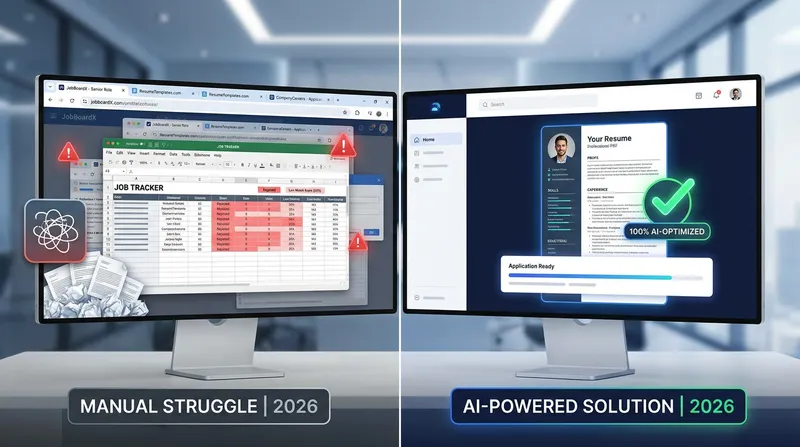
You've sent out dozens of applications this month, but all you hear is radio silence. The mental drain of that silence is real, and it compounds with every application you send into the void. The problem isn't your experience. The problem is that your current job search workflow is exhausting you before you even get to the interview stage. You're likely juggling multiple platforms: a tracker to organize your links, a scanner to check your keywords, and a builder to format your PDF. But despite paying for all these premium subscriptions, you're still doing the heavy lifting. You're still the one staring at a blank page, trying to figure out how to manually rewrite your bullet points to match a demanding algorithm.
If you are looking for the best ATS scanner alternatives in 2026, you've likely realized that most tools only score your keywords or track your applications. Job seekers are wasting hours manually rewriting their resumes because popular tools force candidates to juggle expensive subscriptions without actually generating the ready-to-submit, tailored PDF they desperately need.
JobSparrow approaches this differently. We believe that knowing your resume is broken isn't the same as having software fix it for you. In this guide, we will compare the top tools on the market and show you how to consolidate your workflow into a single platform that tracks, scores, and instantly generates your tailored documents.
The hidden trap of AI job tools in 2026
The modern job hunt is a battle of volume and precision. Employers rely heavily on software to filter out candidates before a human ever reads a single word. According to data from Coursera, the average corporate job posting receives 250 applicants. This massive volume makes automation necessary for employers, but it places a massive burden on you as the applicant.
To keep up, candidates have turned to job search automation and ATS optimization tools. The trap, however, lies in what these tools actually automate. Most platforms automate the diagnosis but leave the execution entirely up to you. They tell you that your resume is missing a specific skill, but they do not write the new bullet point required to highlight that skill naturally.
This creates a frustrating cycle. You paste your resume into a scanner, receive a low score, and then spend the next hour manually tweaking your document. You're essentially doing the job of a copywriter, formatting expert, and career coach all at once.
Actionable Tip: Audit your current job search workflow today. Track exactly how many hours you spend manually editing documents after getting an ATS score. If you are spending more than 30 minutes manually rewriting your resume for each application, your tools are doing the diagnosing but leaving the execution entirely to you.
Job trackers vs keyword scanners: understanding the core differences
When candidates look for ways to optimize their applications, they usually encounter two major types of platforms. Understanding the tracker versus scanner debate requires looking at the specific bottlenecks each tool was designed to solve.
Job trackers are primarily organizational powerhouses. They excel at helping you track your job pipeline. You can save jobs from various boards, move them through different stages (like "Applied" or "Interviewing"), and keep your notes in one place. They often offer a basic builder interface to help you construct a resume. However, they function more like highly specialized spreadsheets combined with document formatters.
Keyword scanners, on the other hand, are built around their algorithms. They act as ATS resume checkers that compare your existing resume against a specific job description. They highlight missing skills and provide a match rate to tell you how well your document aligns with the employer's requirements.
The critical gap here is that neither tool actually writes the new, tailored bullet points for you. Trackers organize your search, and scanners grade your current document. If your match rate is 30 percent, you are still the one who has to sit down and rewrite your career history to boost that score to 80 percent.
| Feature | Job Trackers | Keyword Scanners | JobSparrow |
|---|---|---|---|
| Job Tracking | Yes | No | Yes |
| ATS Keyword Scoring | No | Yes | Yes |
| Resume Generation | Manual | Manual | Automated |
| Cover Letter Generation | No | No | Yes |
| Interview Prep | No | No | Yes |
| Regional Optimization | US-focused | US-focused | Global & AU/NZ |
Actionable Tip: Stop obsessing over a 100 percent match rate if the context of your experience doesn't make sense to a human reader. A high score means nothing if the sentences are unreadable. Learn more about balancing algorithms and human readers in our guide on ATS Keyword Stuffing: Why Your 'Optimized' Resume Fails the Human Test (And How to Fix It).
The problem with the score and ignore method
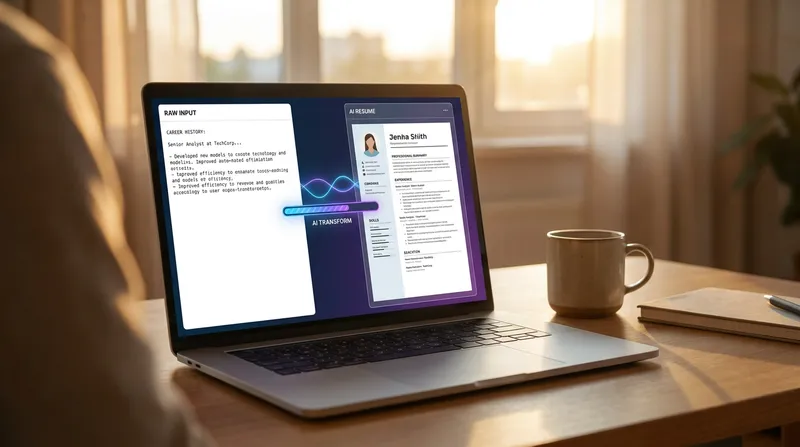
Relying exclusively on a resume keyword scanner creates a psychological toll. You are constantly met with a low score and a blank page. This "score and ignore" method leaves you with the burden of figuring out how to naturally incorporate complex keywords into your past roles without sounding like a robot.
Furthermore, there is a massive risk of automated rejection when candidates try to manually stuff keywords into poorly formatted templates. According to SHRM (Society for Human Resource Management), nearly 70 percent of business leaders plan to use AI in their hiring process, and 71 percent state their organization lets AI reject candidates without human oversight. If you force keywords into a complex, multi-column design to appease the algorithm, the ATS will fail to parse the text. This results in immediate rejection despite your hard work.
Actionable Tip: Focus on semantic relevance rather than exact keyword stuffing. Your goal is to ensure you pass both the AI screening and the human recruiter review. Discover exactly what systems look for in our breakdown of the 5 Tests the Best AI Resume Builder in 2026 Must Pass to Beat the ATS.
Why ATS scanner alternatives in 2026 must do more than scan
The landscape of career technology has evolved rapidly. A few years ago, pointing out missing keywords was revolutionary. Today, the best ATS scanner alternatives in 2026 must function as generative AI assistants, not just passive graders.
According to the University of Washington, 99 percent of Fortune 500 companies use an Applicant Tracking System to process job applications. To compete in this environment, you need the best AI resume writer that actively bridges the gap between tracking, scoring, and generating.
This is where JobSparrow changes the paradigm. Instead of starting from scratch every time you apply, JobSparrow utilizes a Master Profile concept. You input your entire career history, every project, every metric, and every skill into one centralized database. When you find a job you want, the AI resume builder 2026 technology takes over. It analyzes the specific job description, intelligently selects the most relevant experience from your Master Profile, and automatically rewrites your bullet points to match the job requirements perfectly.
It doesn't just give you a score. It gives you a fully formatted, ready-to-download PDF in seconds.
Actionable Tip: Consolidate your career history into a single Master Profile document today. Write down every achievement, even the ones that do not fit on a one-page resume, so you never have to start from scratch again. See how this strategy opens new doors in our guide to The 'Reverse' Job Search: Using AI to Discover Alternative Careers From Your Master Profile.
The regional advantage: SEEK resume optimization for Australia and New Zealand
Most mainstream career tools are built entirely around the United States job market. However, ATS rules vary significantly by region. For job seekers, career changers, and migrants focusing on Australia and New Zealand, standard US-centric advice can actually harm your chances.
In the AU and NZ markets, SEEK is the dominant platform. SEEK resume optimization requires a specific approach. According to official guidelines from SEEK, complex designs can confuse ATS software, leading to misinterpretation or omission of critical information. SEEK relies heavily on plain text parsing, meaning that tables, graphics, and unique fonts will often break when processed by their system. For instance, if you use a popular two-column layout with a skills sidebar, SEEK's parser will often read straight across the page, jumbling your skills directly into your work history.
JobSparrow is built with these regional nuances in mind. Our team has hands-on recruiting experience across Australia, New Zealand, and global markets. When JobSparrow generates your tailored resume, it automatically formats the document to meet these strict regional guidelines. This saves migrants and local professionals hours of formatting headaches and ensures your application is actually read by the hiring manager.
Actionable Tip: Strip complex columns, headshots, and graphics from your resume if you are applying through regional portals like SEEK. Keep it clean and text-based. For more strategies on pivoting your career in these markets, read How to Structure a Career Change CV to Bypass the 'No Industry Experience' Filter.
Free vs premium tools: is the cost worth the fragmented workflow?
When evaluating tools, pricing transparency is just as important as feature sets. Many job seekers find themselves reading reviews trying to figure out if upgrading their free tracker is worth the cost. The free versus premium debate often comes down to how much you value advanced tracking metrics and unlimited keyword comparisons.
However, you have to analyze the true cost of job hunting. If you are paying a monthly subscription for a tracker, another monthly fee for a keyword scanner, and potentially a third fee for a premium resume template builder, you are experiencing severe subscription fatigue. Worse, because these are monthly recurring charges, the longer your job search takes, the more you are penalized financially.
JobSparrow eliminates this fragmented workflow and the associated financial stress. The complete Offer Path covers every stage of your search: Diagnose, Position, Execute, Prepare, and Close. Your CV diagnosis is free. The full Offer Path is part of the Land the Job membership, billed monthly or every three months, and you can cancel anytime. You get the best AI job tracker, the semantic AI resume generator, the gap analysis, and the interview prep all in one unified platform.
Actionable Tip: Calculate your current monthly spend on job search subscriptions. Cancel any tool that only gives you a score and does not actively save you writing time. To ensure the tools you do use sound professional, check out AI Tools for Resume Writing: How to Avoid the 'ChatGPT Voice' and Beat the ATS.
Beyond the resume: integrated cover letters and interview prep
Getting a high ATS score is only the first step. The ultimate goal isn't a perfect resume: the goal is a job offer. The tools you use must prepare you for the entire journey, including the conversation that follows the application.
Most platforms stop once the PDF is downloaded. JobSparrow acts as a comprehensive AI career advisor. Because all your data lives in your Master Profile, JobSparrow functions as an incredibly accurate AI cover letter generator. It instantly drafts a cover letter that perfectly matches the tone, claims, and specific keywords of the tailored resume you just created. This ensures complete consistency across your application materials. As with all AI-generated content, you should always review your tailored resume and cover letter before submitting to ensure it accurately reflects your voice and experience.
Furthermore, JobSparrow features voice AI mock interviews. Once your application is submitted, you can launch a practice interview based exactly on the job description you applied for. You get real-time audio recording and instant AI feedback on your delivery, helping you build genuine confidence before you speak to a human recruiter. For users who prefer working within AI assistants like Claude or other SKILL.md-compatible agents, JobSparrow's public API lets you manage your entire application workflow without switching apps.
Actionable Tip: Always review your AI-generated cover letter to ensure it aligns perfectly with the bullet points on your tailored resume. Inconsistencies are a major red flag for recruiters. Learn more about this in The Consistency Rule: How an Integrated Resume and Cover Letter Creator Lands More Interviews.
Conclusion: stop scanning and start generating
You don't need another tool that grades your work. You need a platform that actually does the work for you. By moving away from fragmented scanners and trackers, and embracing a unified generative AI platform, you can apply to more high-quality roles in a fraction of the time.
Our team at JobSparrow has reviewed over 100,000 resumes. We built this platform to answer job search questions the way people who have sat on both sides of the hiring table would. For more on preparing for the final step of the hiring process, read Why Good Answers Fail: How to Practice Mock Interviews Online with Voice AI.
Ready to land more interviews? Start with a free diagnosis: see your recruiter-lens score and the exact gaps costing you interviews. Unlock the full Offer Path.
Frequently asked questions
Is a high ATS match rate actually required to get an interview?
While a baseline match rate is important for ATS visibility, human recruiters care much more about the context and impact of those keywords. A 100 percent score filled with unnatural phrasing will still be rejected by the hiring manager. Focus on readability and semantic relevance first.
What are the best ATS scanner alternatives in 2026?
The best alternatives, like JobSparrow, have moved beyond basic keyword scanning to semantic generation. They use a Master Profile to understand your complete career history and automatically write the missing keyword context into your resume, saving you hours of manual editing.
How does SEEK resume optimization differ from standard ATS rules?
SEEK relies heavily on plain text parsing. Complex formatting, tables, and unique fonts that might pass newer US-based ATS systems often break when processed by SEEK in Australia and New Zealand. Keeping your design simple and text-focused is mandatory for this region.
Does upgrading from a free tracker to premium actually save time?
While premium tracking features are helpful for organization, they do not solve the core bottleneck: manually rewriting your resume for every application. Consolidating your tools into an all-in-one generative platform often provides a much better return on investment and saves significantly more time.
Can an AI cover letter generator really sound like a human?
Yes, provided it is trained on a comprehensive Master Profile rather than generic prompts. JobSparrow avoids the robotic tone by using your actual career history and recruiter-tested templates, ensuring your cover letter sounds professional, authentic, and highly relevant to the role.
Tags
Keep reading
Recommended articles.
ats optimization · job search strategy
ATS Scanners vs Job Trackers: The $100/Month Trap (And Why You Are Still Rewriting Resumes at Midnight)
Stop paying for ATS scanners that leave you rewriting resumes at midnight. See why the manual approach fails and get a free recruiter-lens diagnosis today.
ai resume builder · ats optimization
Tailor Applications Fast with an AI Resume Creator
Stop choosing between time and quality. Use an AI resume and cover letter generator to tailor your applications fast. Try free with JobSparrow.
resume tailoring · ats optimization
How to Tailor Your Resume to Any Job Description (& Beat the ATS in 60 Seconds)
Learn how to tailor a resume to a job description and beat the ATS in seconds with JobSparrow. Stop getting auto-rejected and land more interviews today.