
resume formats
The Hybrid (Combination) Resume Format: Examples & Free ATS Template
By Job Sparrow Team
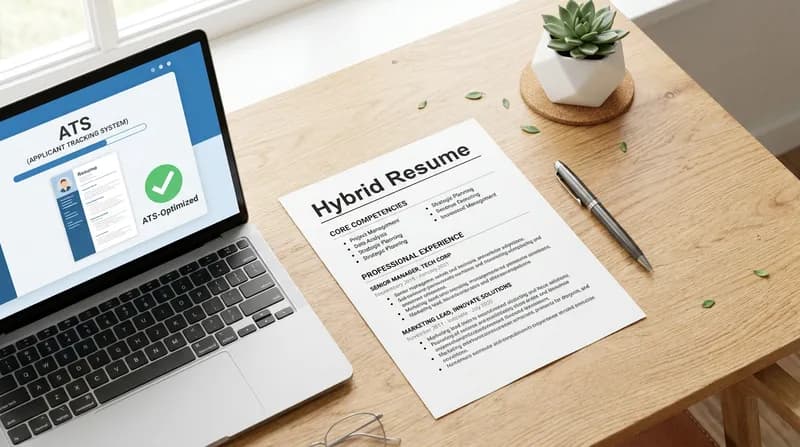
You have a gap in your employment, you are changing careers, or you just moved to Australia. You sit down to write your application, and a quiet panic sets in. You are terrified that an Applicant Tracking System (ATS) will automatically reject you because your work history is not a perfect chronological ladder.
Most competitors and online tools push you toward rigid, flashy visual builders that actually fail ATS scans, or they offer vague advice without explaining how to format the document to beat the bot. They leave you guessing. As recruiters who have reviewed over 100,000 resumes across Australia, New Zealand, the US, and the UK, we know exactly what happens to those flashy templates: they end up in the digital trash bin.
Here is the truth: if you have a non-linear career path, you need a plain-text hybrid resume. Also known as a combination resume, this format highlights your transferable skills without confusing the software that reads it.
In this comprehensive guide, we will break down exactly how a hybrid resume works, why it beats the outdated functional format, and how to write one. We have even included a literal copy-paste plain text skeleton that you can use immediately to maximise ATS readability.
What is a Combination (Hybrid) Resume?
A combination resume, or hybrid resume, is a document that blends the best elements of a reverse-chronological resume and a functional resume.
To understand why this is powerful, you need to understand the alternatives:
- Reverse-Chronological Resume: This lists your work experience in reverse order, starting with your most recent job. It is the standard format, but it exposes employment gaps and makes career changes look disjointed.
- Functional Resume: This format focuses entirely on skills and completely hides or minimizes your work history timeline.
The hybrid format sits right in the middle. It opens with a robust, highly detailed skills and achievements section (like a functional resume) but follows up with a clear, date-stamped work history (like a chronological resume).
According to the University of Alabama Career Center, a combination of the chronological and functional formats is highly recommended for career changers and veterans translating military experience to civilian jobs. It allows you to control the narrative before the recruiter ever looks at your timeline.
The ATS Problem: Why Functional Resumes Get Rejected and Hybrid Resumes Get Interviews
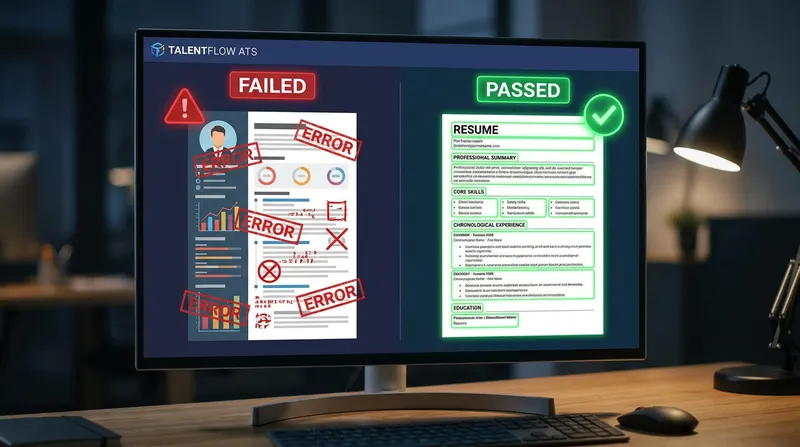
Many job seekers with employment gaps are told to use a functional resume. This is terrible advice.
Here is the recruiter lens on why functional resumes fail: Applicant Tracking Systems are programmed to parse data in specific ways. Many legacy ATS systems, including those used by large enterprise employers, are programmed to calculate your total years of experience by attaching skills to specific date ranges. When a purely functional resume omits this timeline, these systems may assign zero years of experience and auto-reject your application.
Furthermore, visual templates with columns and graphics destroy your chances. Greenhouse's own support documentation lists graphics, photos, tables, headers and footers, text boxes, and columned layouts among the most common reasons a resume fails to parse.
The hybrid resume solves this problem entirely. By providing a dedicated skills section at the top, you catch the human recruiter's eye. By following it up with a clean, date-stamped work history, you satisfy the ATS robot.
To ensure your document passes, you must keep the formatting simple. Research from the University of Illinois Chicago (UIC) confirms that to pass an ATS, applicants must stick to a single-column format without headers, footers, borders, or symbols. If you are wondering Are AI Resume Builders Worth It? Pros, Cons, and ATS Optimization in Australia, the answer is yes, but only if they output clean, single-column PDFs or DOCX files like JobSparrow does.
Who Should Use a Combination Resume?
The combination format is not for everyone. If you have a perfect, uninterrupted ten-year history in the exact same industry, stick to reverse-chronological. However, if your path is unique, the hybrid format is your best weapon.
1. Career Changers
When you pivot to a new industry, your past job titles might not make sense to your new target audience. The hybrid format allows you to extract transferable skills (like project management, leadership, or data analysis) and put them front and center. For more strategies on pivoting, learn how to focus a jack-of-all-trades resume.
2. Migrants and International Job Seekers
If you have just moved to Australia, New Zealand, or the UK, local recruiters might not recognize your previous employers. A combination resume allows you to highlight the scale of your achievements (e.g., managed a $5M budget) before the recruiter gets bogged down in unfamiliar company names.
3. Job Seekers with Employment Gaps
The Illinois workNet Center System clearly defines that the combination format gives flexibility to group skills together, placing more emphasis on capabilities and less on past experience. This makes it ideal for mature workers, parents re-entering the workforce, or those recovering from layoffs.
APAC, UK, and US Formats: Naming and Expectations
If you are applying for roles in the APAC region (Australia and New Zealand), the UK, or the US, you need to localize your terminology and formatting expectations.
First, understand the naming conventions and length requirements. In Australia and New Zealand, recruiters highly value competency-based applications, and the terms 'CV' and 'resume' are often used interchangeably. Australian and UK CVs traditionally run slightly longer than the strict one-page US standard. A two-page hybrid CV is perfectly acceptable and often preferred in Sydney, Melbourne, Auckland, or London, provided the first page contains all the critical, tailored information.
According to Princeton University, in Europe, Ireland, and New Zealand, the term 'CV' is used to mean the exact same thing as a 'resume' in the US.
Finally, when preparing for the Australian market, ensure you understand local nuances like referencing SEEK as a dominant job board or understanding compensation phrasing. Be sure to review our guide on Salary Expectations in Australia: How to Answer 'Plus Super' vs. 'Including Super' so you are ready for the phone screen.
How to Write a Combination Resume That Passes the Bots
Writing a hybrid resume requires a strategic layout. You are essentially building a bridge between what you can do and where you have been. Here is the step-by-step recruiter lens on how to build it.
1. The Professional Summary
Do not write an outdated objective statement. Instead, write a 3 to 4 sentence professional summary that acts as a highlight reel of your career. State your professional identity, your top two achievements, and the specific value you bring to the target role. Need inspiration? Check out our Career Change Resume Summary & Objective Examples.
2. The Core Competencies and Skills Section
This is the magic of the hybrid format. Create a section titled "Core Competencies" or "Areas of Expertise." Under this, create 3 to 4 subheadings based on the target job description (e.g., Project Management, Client Relations, Technical Troubleshooting). Under each subheading, write 2 to 3 bullet points detailing your achievements in that area, regardless of which job they happened in.
3. The Streamlined Work History
Because you already listed your major achievements in the skills section, your work history can be lean. List your Job Title, Company Name, Location, and Dates of Employment (Month Year to Month Year). Under each role, you only need 1 or 2 bullet points for context. This satisfies the ATS timeline requirements without forcing the recruiter to read a novel.
4. Education and Certifications
Keep this section clean and at the bottom of the document unless you are a recent graduate. List the degree, the institution, and the graduation year.
Pro Tip: Build Your Master Profile Once If you find yourself struggling to remember all your achievements to fill these sections, JobSparrow's Master Profile feature is the solution. Think of it as a centralized career database. You store every skill, project, and role in one place. From there, our Gap Filler AI acts as an interactive coach, asking you targeted questions to pull out missing metrics and achievements you forgot you had.
Copy-Paste Hybrid Resume Skeleton (ATS-Friendly Plain Text)
Competitors want to lock you into their paid builders just to see a template. We believe in transparency. Here is a plain-text, single-column hybrid resume skeleton that follows standard ATS parsing rules. Copy and paste this directly into a Word document or Google Doc, and fill in your details.
Actionable Tip: Once you finish editing your document, always export it as a PDF or DOCX file to lock in your single-column formatting and ensure ATS compliance.
[FIRST NAME] [LAST NAME] [City, State/Province, Zip/Postal Code] [Phone Number] | [Professional Email Address] [LinkedIn URL or Portfolio Link]
PROFESSIONAL SUMMARY [Target Job Title] with [Number] years of experience in [Key Skill 1], [Key Skill 2], and [Key Skill 3]. Proven track record of [Major Achievement or Metric, e.g., reducing operational costs by 15%]. Adept at [Soft Skill, e.g., cross-functional team leadership] and translating complex problems into actionable solutions. Seeking to leverage diverse background to drive [Specific Company Goal] at [Target Company Name].
CORE COMPETENCIES & ACHIEVEMENTS
[Skill Area 1: e.g., Strategic Project Management]
- Spearheaded [Project Name], resulting in [Quantifiable Result, e.g., $50,000 in annual savings].
- Directed a team of [Number] across [Number] departments to deliver [Outcome] ahead of schedule.
[Skill Area 2: e.g., Client Relationship Development]
- Grew client portfolio by [Percentage]% over [Timeframe] through targeted outreach and relationship building.
- Resolved escalated client issues, maintaining a [Percentage]% customer retention rate during organizational restructuring.
[Skill Area 3: e.g., Process Optimization]
- Implemented [Software/Tool/Process], reducing manual data entry time by [Percentage]%.
- Audited existing workflows and introduced new standard operating procedures adopted globally.
PROFESSIONAL EXPERIENCE
[Most Recent Job Title] [Company Name], [City, State/Country] [Month Year] to [Month Year]
- Maintained daily operations and supported the deployment of the initiatives listed above.
- [Optional: One brief bullet point outlining the daily scope of the role].
[Previous Job Title] [Company Name], [City, State/Country] [Month Year] to [Month Year]
- Managed [Specific Department/Task] and contributed to core business objectives.
[Previous Job Title] [Company Name], [City, State/Country] [Month Year] to [Month Year]
- Supported team deliverables and executed foundational tasks in [Skill Area].
EDUCATION & CERTIFICATIONS
[Degree Name, e.g., Bachelor of Arts in Business Administration] [University Name], [City, State/Country] | [Graduation Year]
[Certification Name, e.g., Certified ScrumMaster (CSM)] [Issuing Organization] | [Year Issued]
Common Mistakes to Avoid
When building your hybrid resume, avoid these top four errors that commonly lead to rejection:
- Copying bullet points verbatim: Do not repeat the exact same achievements in your Core Competencies section and your Professional Experience section. The skills section should highlight your best metrics, while the work history provides brief, high-level context.
- Using multi-column layouts: Placing your skills in a left-hand column and your work history on the right will break ATS parsing. Always stick to a clean, single-column format.
- Omitting the month and year: Listing only the years of your employment (e.g., 2020 to 2023) confuses the ATS. Always include the month and year (e.g., March 2020 to August 2023) so the system can accurately calculate your experience.
- Using a generic skills section: Your "Core Competencies" subheadings must be tailored to match the specific job description you are applying for. Do not use the exact same headers for every application.
Combination Resume Examples by Scenario
How you adapt the skeleton above depends on your unique situation.
For the Career Changer: If you are moving from teaching to corporate training, your "Core Competencies" should focus on Curriculum Development, Stakeholder Presentation, and Performance Metric Tracking. Your actual work history will list "High School Teacher," but the recruiter will have already read about your corporate-ready skills.
For the Former Business Owner: Returning to the corporate world requires a specific touch. You must prove you can be a team player, not just a boss. Read our dedicated guide on Founder to Employee: How to Write a Resume After Owning a Business (And Pass the ATS). Your hybrid skills section should focus on cross-functional collaboration and budget adherence.
For the Internal Promotion: If you are applying for a higher role within your current company, use the hybrid format to highlight leadership traits you have shown outside your official job description. See our tips on How to Update Your Resume for an Internal Promotion (And Pass the ATS).
Pros and Cons of the Hybrid Format
To make an informed decision, consider both sides.
Pros:
- Hides gaps naturally: By moving the focus to skills, dates become secondary.
- ATS compliant: Unlike functional resumes, it still provides the timeline data robots need.
- Highly customizable: You can swap out the "Core Competencies" subheadings for every single job application to perfectly match the job description.
Cons:
- Takes longer to write: Writing a unique skills section requires deep thought.
- Can become repetitive: You must be careful not to repeat the exact same bullet points in the skills section and the work history section.
- Lengthy: It is difficult to keep a hybrid resume to a single page, which is why it is better suited for mid-level professionals or the Australian and UK markets where two pages are standard. If you are aiming for the C-suite, check out How to Write a Director-Level Resume (Without Making It 5 Pages Long).
Frequently Asked Questions
What is a hybrid resume, and what is the difference between a hybrid and a combination resume? There is no difference. The terms are used interchangeably in the recruitment industry to describe a resume that combines a heavy skills section with a chronological work history. It places a robust skills section at the top while keeping a clean, date-stamped work history at the bottom.
Why do functional resumes fail ATS scans compared to hybrid resumes? Functional resumes completely remove or obscure the chronological timeline of your work history. Applicant Tracking Systems are programmed to calculate your total years of experience based on strict date ranges attached to specific job titles. When an ATS cannot find this timeline, it assumes you have zero experience and auto-rejects your application. A hybrid resume solves this by providing the timeline data the ATS needs.
How do I format the skills section of a combination resume? Your skills section should be divided into three to four core competencies relevant to the target job description, such as "Project Management" or "Client Relations." Under each heading, include two to three bullet points detailing specific, quantifiable achievements. This structure allows you to showcase your best work immediately, regardless of which past role it belongs to.
How do I list employment gaps on a combination resume? You list your work history exactly as it occurred, gaps and all. The trick is that because your massive skills section takes up the top half of the first page, the recruiter is already impressed by your capabilities before they even notice a gap in your timeline on page two.
How many pages should a combination resume be? In the US, aim for one to two pages depending on experience. In Australia, New Zealand, and the UK, two pages is the standard expectation for a professional CV.
Should recent graduates use a hybrid resume format? Generally, no. Recent graduates usually do not have enough professional experience to fill a comprehensive skills section. For entry-level candidates, a standard reverse-chronological resume that highlights education, internships, and relevant coursework is much more effective. The hybrid format is best reserved for mid-level professionals, career changers, or those with employment gaps.
How does a hybrid resume help international migrants? When applying in a new country like Australia, New Zealand, or the UK, local recruiters may not recognize your previous employers. A hybrid CV brings your transferable skills and major achievements to the very top of the page. By the time the recruiter reaches your work history, they are already sold on your capabilities, making unfamiliar company names much less of an obstacle.
What file format is best for submitting a combination resume? Always submit your combination resume as a PDF unless the job description specifically requests a Word document (DOCX). A PDF ensures that your formatting, bullet points, and single-column layout remain perfectly intact across different devices and operating systems. JobSparrow allows you to download both ATS-friendly PDFs and DOCX files automatically.
Stop Fighting the Formatting: Let JobSparrow Handle the Heavy Lifting
Manually rewriting your hybrid resume for every single application is exhausting. It leads directly to application fatigue. If you want to know how much energy you are wasting, read about Job Search Burnout: How an AI Resume and Cover Letter Creator Saves Your Energy.
Building your hybrid resume is the Position stage of your Offer Path. Once your document is optimized, JobSparrow walks you through Execute (tailoring to each role), Prepare (AI mock interviews), and Close (offer negotiation).
With JobSparrow, you do not have to struggle with formatting. You simply build your Master Profile once. From there, our AI analyzes the specific job description you want and intelligently selects the most relevant experience from your profile. It generates a perfectly tailored, ATS-optimized hybrid resume and cover letter in seconds.
Once your hybrid resume is ready, JobSparrow's Smart Job Search aggregates roles from LinkedIn, Indeed, and SEEK in one dashboard, and the Application Tracker shows your Match Score before you even apply. We also offer tools to help you overcome anxiety, as detailed in Overcoming Interview Anxiety: Why Voice AI Mock Interviews Beat ChatGPT. For advanced users, we even support API integrations so you can learn How to Automate Job Applications with AI: Build an Auto-Apply Bot Using Claude & APIs.
Ready to land more interviews? Start with a free diagnosis. See your recruiter-lens score and the exact gaps costing you interviews in minutes. Unlock the full Offer Path for a one-time $129, with no sneaky auto-renewals.
Start your free diagnosis today and take control of your career narrative.
Tags
Keep reading
Recommended articles.
career change · resume formats
The Best Resume Templates for a Career Change (And Why Hybrid Beats Chronological)
Pivoting careers? Discover the best resume format for a career change. Learn how hybrid templates highlight transferable skills. Start your free diagnosis.
resume format · career change
How to Write a Resume With No Degree: The 2026 Skills-Based Format for Career Changers
No degree? No problem. Build a skills based resume template that bypasses ATS filters and lands corporate interviews. Free diagnosis at JobSparrow.
ai resume builder · career change
AI Resume Strategies: Raw Prompting vs. Smart Resume Builders for Your 2026 Career Move
Compare raw AI prompting vs. smart resume builders for 2026. JobSparrow tailors your CV to beat ATS and land interviews. Start your free diagnosis today.