
career change
The Best Resume Templates for a Career Change (And Why Hybrid Beats Chronological)
By Job Sparrow Team
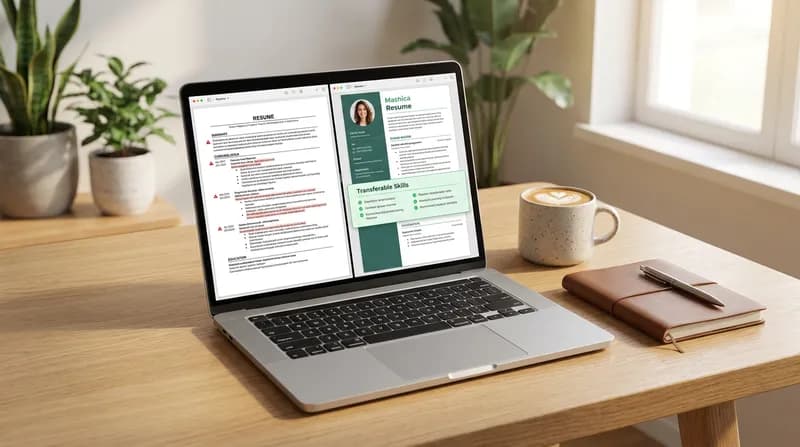
You have years of rich, hard-earned professional experience. You know you can do the job. But when you sit down to write a resume format for a career change, panic sets in. Forced into a standard chronological template, your varied background suddenly looks irrelevant. You worry that Applicant Tracking Systems (ATS) will reject you instantly, and you fear looking unqualified on paper for roles you could easily master in real life.
This is the core dilemma for career changers. You have the transferable skills, but you lack the exact job titles recruiters are scanning for. The good news is that your experience is not the problem. The problem is your presentation format.
This is the Position stage of JobSparrow's Offer Path, the point where your presentation strategy determines whether your experience gets a fair hearing. In this guide, we will break down exactly why traditional formats fail career pivoters, why functional formats are a dangerous trap, and how a hybrid approach will help you land interviews in a completely new industry.
The resume format dilemma for career changers
When you are pivoting to a new industry, the standard chronological resume is your worst enemy. This traditional layout lists your work history in reverse chronological order, placing your most recent job title front and center at the top of the page.
If your most recent title does not match the role you want, recruiters will simply move on. We answer this question the way people who have sat on both sides of the hiring table would, because we have. Our team at JobSparrow has collectively reviewed over 100,000 resumes and hired across Australia, New Zealand, the US, the UK, Singapore, and Hong Kong. We know firsthand that hiring managers scan a resume in about 10 seconds. They are looking for immediate alignment. If they are hiring a Marketing Manager and your last title says "High School Teacher," human bias kicks in immediately.
This frustration often leads career changers to consider tweaking past job titles to sound more relevant. However, altering your job titles is a dangerous game. As we have discussed in our guide on whether you can change your job title on a resume, doing so can cause you to fail formal background checks and lose job offers at the final stage. You need a format that highlights your transferable skills without lying about your chronological work history.
Why functional resumes are a trap (the ATS nightmare)
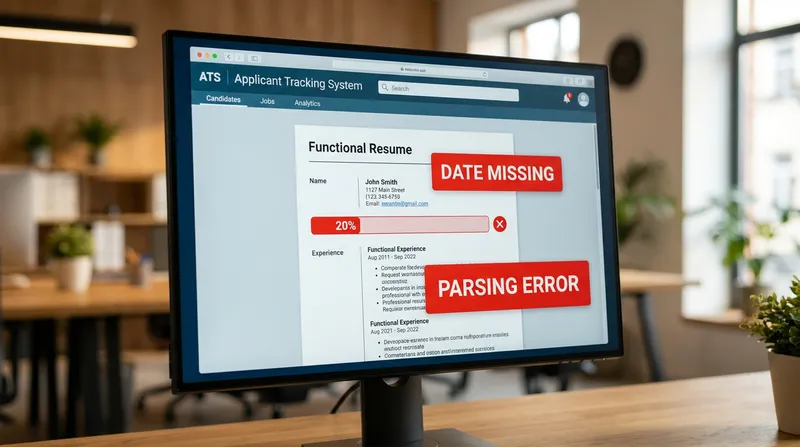
Many traditional career coaches recommend a functional resume for career change scenarios. A functional resume focuses entirely on skills and achievements, completely removing or hiding the dates and specific chronological timelines of your work history.
From a recruiter's perspective, this format immediately triggers red flags. When hiring managers see a skills-only document with no dates attached to specific roles, they assume you are trying to hide massive employment gaps, a history of job hopping, or a lack of recent experience.
Worse, this format will almost certainly get you rejected by automated recruitment software. Resume formatting guidelines from Pennsylvania Western University (PennWest) are clear on this point. Job seekers must explicitly avoid the functional format to ensure ATS compatibility. ATS platforms are programmed to parse dates and associate them with specific job titles. When they cannot find that chronological data, they generate parsing errors, and your application goes straight to the digital trash bin.
The solution: what is a hybrid resume format?
The ultimate solution for a career pivot is the hybrid resume format. Also known as a combination resume template, this layout bridges the gap between showcasing your relevant skills and satisfying the rigid requirements of ATS platforms.
A hybrid resume leads with a robust, highly detailed skills and achievements section. This allows you to front-load your most relevant qualifications before the reader even sees your past job titles. Then, it follows up with a concise chronological work history to prove your reliability and give the ATS the data it needs to process your application correctly.
Official career advice from the State of North Dakota confirms that combination resumes allow candidates to highlight impressive accomplishments and marketable skills from several previous positions while maintaining the expected chronological work history.
Here is the mental model for a successful hybrid layout:
- Contact Information: Keep it clean and standard.
- Career Summary: A targeted paragraph explaining your pivot and immediate value.
- Core Competencies (Skills): Categorized transferable skills with bulleted achievements.
- Work Experience: A brief chronological list of past roles, companies, and dates (without repetitive bullet points).
- Education & Certifications: Relevant upskilling for your new industry.
Transform your work history today. Upload your current resume for a free recruiter-lens diagnosis and see how JobSparrow builds your perfect hybrid layout in seconds.
How to write a career change resume (step-by-step)
Creating an ATS-friendly career change resume requires a strategic approach. You cannot simply drop your old bullet points into a new template. You must translate your past experience into the language of your future industry. Follow these three actionable steps to build a compelling career transition resume.
Step 1: craft a powerful career change resume summary
Your career change resume summary is the most valuable real estate on the page. Its purpose is to immediately connect your past experience with your future goals, answering the recruiter's first question: "Why is this person applying for this job?"
Academic guidance from the University of Pennsylvania (UPenn) emphasizes that a combination format should start with an objective and a summary of relevant skills to immediately highlight transferable abilities over a chronological work history.
Actionable Formula: [Adjective] professional with [Number] years of experience in [Past Skill/Industry], seeking to leverage expertise in [Transferable Skill 1] and [Transferable Skill 2] to drive results as a [Target Job Title] at [Target Company].
Before (Generic): "Experienced retail manager looking for a new opportunity in B2B tech sales."
After (Targeted): "Client-focused professional with five years of experience managing high-volume retail operations. Seeking to leverage proven expertise in consultative selling, CRM management, and team leadership to drive revenue growth as a B2B Sales Development Representative."
Step 2: identify and categorize your transferable skills
The core of a transferable skills resume is the categorized achievements section. This is where you map your old duties to new industry jargon. If you are struggling to identify which of your past experiences qualify as transferable skills, JobSparrow's Gap Filler feature walks you through targeted questions to surface achievements you may have overlooked.
According to official career guidelines from the Government of Alberta, a successful combination resume organizes accomplishments into three to six targeted skill categories (like Project Management or Client Relations) to show employers your value before briefly outlining your work history.
If you are moving from teaching to corporate training, do not just write "taught high school students." Instead, categorize your skills like this:
- Curriculum Development & Instructional Design: Designed and delivered over 200 hours of instructional content, adapting complex concepts for diverse learning styles and improving overall comprehension scores by 15%.
- Stakeholder Communication: Facilitated weekly progress meetings with cross-functional stakeholders (parents and administrators), maintaining a 98% satisfaction rating.
Always attach a metric or a specific outcome to your skills. A skills-based resume template only works if you provide concrete evidence of your abilities.
Step 3: handle employment gaps and temp work gracefully
Career pivots rarely happen overnight. They often involve time off for study, bridging jobs, or contract work while you search for the right permanent role. This reality can make creating a no experience career change resume feel incredibly daunting.
The beauty of the hybrid format is that it allows you to group these bridging experiences neatly without drawing undue attention to them. In your brief chronological section at the bottom, you can list "Independent Consultant" or "Contract Professional" to group temporary roles together, keeping the focus on the skills section above.
For example, instead of leaving a confusing gap or listing irrelevant side jobs, you can format your history like this:
Before (Functional/Hidden): No dates provided, triggering instant ATS rejection.
After (Hybrid/Chronological):
- Independent Consultant, Self-Employed (2024 - Present)
- High School Teacher, Springfield High (2018 - 2024)
This strategy keeps the timeline intact for the ATS while keeping the recruiter focused on your transferable skills. If you took time off to upskill, list that education prominently. For deeper strategies on handling time away from the workforce, read our comprehensive guide on how to explain an employment gap on your resume.
The migrant's pivot: changing careers in a new country
Migrating to a new country like Australia or New Zealand is already a massive life transition. Trying to change careers at the same time adds a difficult layer of complexity. Migrants often face a frustrating "no local experience" bias from recruiters who are hesitant to take a chance on unfamiliar overseas companies.
If you are navigating this double pivot, the hybrid resume format is absolutely essential. It allows you to frame your international experience as a unique asset rather than a liability. By leading with your core competencies, you force the recruiter to evaluate your actual skills before they look at the geographic locations of your previous employers.
Furthermore, ensure you clearly state your current visa status and working rights at the very top of your document. Recruiters in AU and NZ will not guess your eligibility, and leaving it off can result in instant rejection. For a complete roadmap on breaking into these specific markets, review our dedicated guide on how to get a job in Australia without local experience.
JobSparrow's approach: the Master Profile vs. presentation
The biggest mistake career changers make is trying to edit their resume directly inside a presentation template. When you do this, you delete valuable past experiences just to make things fit on one page, losing data that might be highly relevant for a different application tomorrow.
At JobSparrow, we solve this by separating your career data from the final presentation. We use a Master Profile system. Think of this as a comprehensive database of everything you have ever done. You store every skill, project, volunteer gig, and past role here.
When you find a new job you want to apply for, JobSparrow's AI acts as your personal career advisor. It analyzes the specific job description, identifies the exact transferable skills needed, and intelligently selects the most relevant experience from your Master Profile.
Our AI then automatically rewrites your bullet points to match the new industry's keywords and requirements. It generates a hyper-personalized, ATS-friendly career change resume in seconds. You can then choose from our five professional templates (Professional, Two Column, Elegant, Colorful, and Contemporary) to download a perfectly formatted PDF or DOCX file.
This automated tailoring is far superior to traditional manual methods. It is the exact same reason we strongly recommend using an AI online cover letter maker rather than relying on generic templates that recruiters spot instantly.
Conclusion: your next steps on the Offer Path
A successful career pivot requires more than just a positive attitude. It requires a strategic presentation of your past achievements. By ditching the traditional chronological format and embracing the hybrid layout, you can highlight your transferable skills while keeping ATS platforms happy.
Remember, JobSparrow is here to coach you through the entire Offer Path, from your initial resume diagnosis to final interview preparation. Once you have your hybrid resume ready, make sure you stay organized by reading why you need to ditch the spreadsheet for a dedicated job application tracker.
Ready to land more interviews in your new industry? Start with a free diagnosis today to see your recruiter-lens score and the exact gaps costing you interviews. Unlock the full Offer Path for a one-time $129, no auto-renewal.
Frequently asked questions
What is the best resume format for a career change?
The hybrid (or combination) format is definitively the best choice for career changers. It highlights your transferable skills in categorized sections at the top of the page while maintaining an ATS-friendly chronological work history at the bottom.
Will a functional resume pass ATS?
No, functional resumes almost always fail ATS parsing. Because they lack clear date ranges attached to specific job titles, the automated software cannot verify your timeline, leading to parsing errors and automatic rejections.
How do I write a resume for a career change with no experience?
Focus on the Master Profile concept. Pull transferable skills from past unrelated jobs, volunteer work, or educational projects. Let AI help you translate those past experiences into the target industry's terminology, proving you have the underlying competencies even without the exact job title.
How long should a career change resume summary be?
We recommend three to four concise sentences. It should immediately state your career pivot, highlight your most relevant transferable skills, and express the specific value you bring to the new role and company.
Can AI help me write a career pivot resume?
Yes. JobSparrow's AI does much more than just format the document. It acts as a career advisor to identify your skill gaps, analyze job descriptions, and intelligently rewrite your past bullet points to align perfectly with the jargon and requirements of your new industry.
Tags
Keep reading
Recommended articles.
career change · resume format
The Best Career Change Resume Format for 2026 (Section-by-Section Guide & Templates)
Discover the best career change resume format for 2026. Learn how to highlight transferable skills, beat ATS bots, and confidently land your new dream job.
resume formats · ats optimization
The Hybrid (Combination) Resume Format: Examples & Free ATS Template
Free hybrid resume template that passes ATS scans. Built for career changers and migrants in Australia. Copy the plain-text skeleton and apply today.
resume format · career change
How to Write a Resume With No Degree: The 2026 Skills-Based Format for Career Changers
No degree? No problem. Build a skills based resume template that bypasses ATS filters and lands corporate interviews. Free diagnosis at JobSparrow.