
resume tips
Can You Change Your Job Title on a Resume? A Recruiter's Guide to Background Checks & ATS
By Job Sparrow Team

You are staring at your resume, feeling completely trapped. Your official job title is obscure, confusing, or simply does not reflect the high-level work you actually do every day. You know that if you leave it as it is, the Applicant Tracking System (ATS) will automatically reject you. However, if you change your job title on a resume, background check processes might flag you as a liar.
Job seekers face this painful dilemma constantly. You need a safe, ethical way to prove your capabilities without triggering red flags or failing an employment verification check.
At JobSparrow, we have reviewed over 100,000 resumes across Australia, New Zealand, the United States, Singapore, and Hong Kong. We look at applications through a signature 'recruiter-lens' to see what actually works in the real world. In this guide, we will show you exactly how to align your resume with market expectations safely.
Before you risk changing your headers, start with a free CV diagnosis to see exactly how recruiters view your current titles.
The job title dilemma: when your resume job title doesn't match
It is incredibly common for your official title to misalign with your daily duties. Companies often create unique internal titles that make sense to their HR department but mean absolutely nothing to the outside world.
When your resume job title doesn't match the roles you are applying for, you face an immediate disadvantage. According to research from TheLadders, recruiters spend an average of just 7.4 seconds on an initial resume scan. They do not have the time to decode what a "Client Happiness Hero" actually does. They are looking for an "Account Manager."
This creates a massive roadblock. You have the exact skills the employer wants, but your header is actively hiding your qualifications. Fortunately, you can fix this alignment issue without resorting to dishonesty.
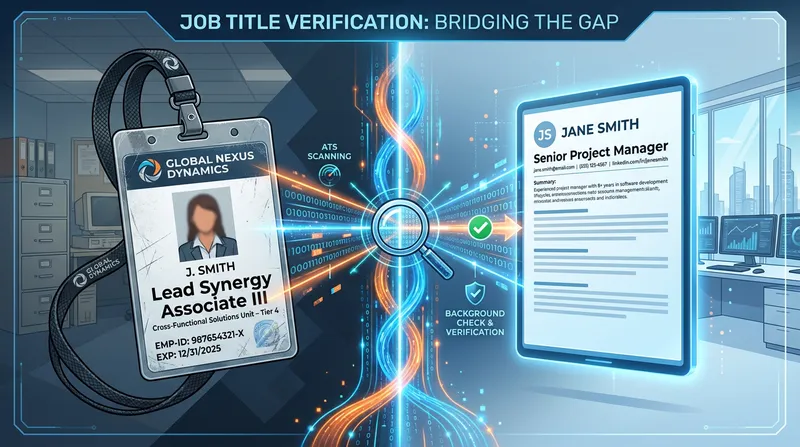
Official vs. actual job title on a resume: what is the difference?
To solve this problem, you first need to understand the difference between your legal title and your functional title.
Your official job title is the exact legal name written on your employment contract. It is the title registered with your company's HR and payroll departments. This is the only title that a third-party background checker will be able to verify.
Your actual job title (or functional title) is the industry-standard term for the work you performed. This is the keyword that recruiters and software algorithms are actively searching for.
Startups and tech companies are notorious for giving employees inflated or quirky titles. A "Director of First Impressions" is usually a Receptionist. A "Marketing Ninja" is typically a Digital Marketing Coordinator. When you understand the official vs actual job title resume dynamic, you can start strategizing how to present your history clearly.
Can I use a different job title on my resume? The ethics of tailoring
Many candidates wonder if they can simply erase their weird internal title and write down the industry standard. The ethics of resume tailoring can be a gray area, and hiring managers are sharply divided on the issue.
According to research from Ivy Exec, 54 percent of hiring managers say it is okay to change a title to reflect your actual responsibilities. However, that means nearly half of all hiring managers still view any title alteration as lying.
Minor tweaks for the sake of clarity are generally acceptable. For example, changing "Level II Marketing Analyst" to "Marketing Analyst" is perfectly fine.
However, completely changing a title to inflate your seniority is a major red flag. If you were a "Sales Associate" but you list "Director of Sales" because you occasionally trained new staff, you are crossing the line from tailoring into deception.
Changing job title for ATS: how algorithms read your application
Applicant Tracking Systems are the software gatekeepers of the modern job hunt. When you submit your application, the ATS parses your document and extracts specific keywords to build a candidate profile.
As noted by industry leader Checkr, ATS platforms rank candidates based on exact keyword matches from the job description. If the system is programmed to find the phrase "Project Manager" and your resume says "Scrum Facilitator," your application might be automatically discarded. This is why generic applications have a success rate below 1 percent, while tailored applications can increase your response rate by up to 40 percent, according to industry data.
Career centers, such as those at Utah Valley University, advise using the exact legal job title to ensure the ATS reads your history accurately. While this is the safest approach to avoid flagging discrepancies later on, it is often suboptimal for passing keyword filters. This is why a dual-title strategy is necessary.
If you are struggling to get past these digital filters, you need to rely on smarter tools. Discover why traditional methods fail in our guide on the Online Cover Letter Maker: Why Traditional Templates Are Ineffective in 2026 (Use AI Instead).
Will a job title mismatch fail a background check?
This is the most critical question: what happens during the background check employment verification job title phase? The short answer is that a complete mismatch will absolutely trigger a red flag.
When an employer offers you a job, they usually hire a third-party agency to verify your history. These agencies contact the HR or Payroll departments of your previous employers.
Candidates often think, "They will call my manager and learn I did the work!" But the reality is much colder. Third-party checkers only match database fields, and they do not care about your daily context.
According to Precise Background Services in Australia, verification is conducted through an organization's official records. They verify the exact title recorded by the HR system, even if your day-to-day responsibilities far exceeded that role.
Furthermore, ADC Background Checks confirms that title verification is a standard and unavoidable part of the process. Background checkers do not evaluate your daily tasks or interview your old manager. They simply check if the title on your resume matches the title on the HR screen. If it does not match, they report a discrepancy to your new employer.
This is the critical transition in the JobSparrow Offer Path. Moving from the Diagnose phase to Position and Execute requires getting your story straight. Before you finalize your strategy, start your free CV diagnosis to ensure you are on the right track.
The consequences of a fake job title on your resume
The fake job title on resume consequences are severe and long-lasting. If a company discovers you lied about your title, they will almost certainly rescind your job offer.
Beyond losing the immediate opportunity, you risk being permanently blacklisted from that company. If you are applying through a recruitment agency, they will drop you as a client immediately to protect their own reputation.
There is also a massive emotional toll. If you fake a title to get an interview, you will suffer from intense imposter syndrome. You will spend the entire interview process terrified that someone will uncover the truth. The short-term reward of landing an interview is never worth the long-term anxiety.
Safe alternatives to changing your job title
You do not have to choose between ATS rejection and background check failure. The safest alternative to changing job title on resume documents is using the "Dual-Title Format."
The dual-title format allows you to list your official HR title alongside your functional, industry-standard title. This satisfies the background checker while providing the ATS with the exact keywords it needs.
Here are three safe ways to format this on your resume:
- Parentheses: Operations Associate (Marketing Manager)
- Hyphenation: Operations Associate - Marketing Manager
- Slashes: Operations Associate / Marketing Manager
This strategy is highly transparent. It tells the recruiter exactly what your legal title was while immediately translating your functional value. For more complex employment histories, check out our guide on How to List Temp Work and Contracting on Your Resume (Without Looking Like a Job Hopper).
Translating internal job titles for career changers and migrants
Migrants moving to Australia, New Zealand, the UK, or the US face a unique hurdle. Your home-country job titles might not resonate with local recruiters at all.
For example, a "Commercial Executive" in parts of Asia is often equivalent to a "B2B Sales Representative" in Australia. If you use your exact foreign title, local recruiters will skip your profile because they do not understand your seniority.
Career changers face a similar issue. You need to highlight transferable skills without misleading anyone. In both cases, the dual-title format is your best friend.
Research the local market equivalent by browsing LinkedIn profiles of professionals doing similar work in your target city. Use those standard titles in parentheses next to your official foreign titles. If you are navigating an international move, read our comprehensive How to Get a Job in Australia Without Local Experience (2026 Guide).
The JobSparrow method: tailor your bullet points, not just the header
Changing your header is a cheap trick. Rewriting your bullet points to prove your capability is the winning strategy.
This is where JobSparrow changes the game. Instead of risking your reputation by faking a job title, you should use our AI to ethically tailor your experience.
With JobSparrow, you start by building a Master Profile. This is your central career database where you store every skill, project, and official job title. When you find a job you want, our AI analyzes the job description and intelligently selects the most relevant experience from your Master Profile.
The AI then rewrites your bullet points to match the job's keywords and requirements. It proves you have the skills of a "Marketing Manager" even if your official title was "Operations Associate." This solves the ATS problem ethically, saves you hours of manual editing, and keeps your background check 100 percent safe.
How to explain a job title discrepancy in an interview
If you use the dual-title format, a recruiter might ask you about it during the interview. You must be prepared to explain the discrepancy confidently.
Do not apologize for your official title. Instead, own your actual responsibilities and immediately pivot the conversation to your measurable impact.
Here is a simple script you can use:
"My official HR title was Operations Associate, but because we were a lean team, I actually took over the entire digital marketing strategy. I functioned as the Marketing Manager for two years, overseeing a $50,000 budget and increasing our lead generation by 40 percent. I listed both titles on my resume to be completely transparent while accurately reflecting my daily work."
Recruiters respect this level of honesty and clarity. To ensure you deliver this explanation smoothly under pressure, you need to practice out loud. Learn more in our post: A Recruiter's Take: Why You Need an AI Voice-Based Mock Interview Tool.
Stop guessing: let JobSparrow tailor your experience ethically
Navigating the official vs actual job title resume trap does not have to be stressful. Honesty, combined with smart AI tailoring, is the only sustainable way to job hunt in 2026.
You do not need to lie to get past the ATS. You just need to translate your experience into the language the employer is looking for. Stop worrying about background checks and start focusing on proving your value.
Ready to stop guessing and start landing interviews? Get your free CV diagnosis and see your recruiter-lens score, plus the exact gaps costing you opportunities. Start free, then unlock the full Offer Path for a transparent, one-time payment of $129, with no automated subscriptions.
Frequently asked questions
Can a job offer be rescinded for lying about a job title?
Yes. If an employment verification check reveals a significant discrepancy between the title on your resume and your official HR record, employers view this as a major breach of trust. They will frequently rescind the offer immediately.
How do background checks verify my employment history?
Background check companies contact the HR or Payroll departments of your previous employers. They verify your exact dates of employment and the official legal job title on file. They do not verify your daily tasks or functional responsibilities.
Should I use my legal job title or my functional job title on my resume?
You should use a combination of both. List your official legal title to pass the background check, followed by your functional title in brackets or separated by a hyphen. This passes the ATS algorithms and provides clarity to recruiters.
Does ATS reject resumes if the job title does not match?
Yes, many Applicant Tracking Systems are programmed to rank candidates based on exact keyword matches. If your internal title does not contain the keywords from the job description, your resume may be scored lower or auto-rejected.
How do I list an inaccurate internal job title on my resume?
Use the dual-title format. For example, if your official title was "Operations Associate" but you worked as a "Marketing Manager," list it as "Operations Associate (Marketing Manager)" and use your bullet points to prove your marketing impact.
Tags
Keep reading
Recommended articles.
ai resume builder · ats optimization
Are AI Resume Builders Worth It? Pros, Cons, and ATS Optimization in Australia
Are AI resume builders worth it? JobSparrow reveals the pros, cons, and ATS optimization tips to land more interviews in Australia without sounding robotic.
remote jobs · resume tips
How to Write a Resume for Remote Jobs: 2026 Format, Skills & ATS Guide
Write a remote job resume that passes ATS and impresses hiring managers in 2026. Get a free recruiter-lens diagnosis with JobSparrow.
job application · resume tips
What to Write in an Email When Sending Your Resume (7 AU/NZ Templates)
Learn what to write in an email when sending your resume with 7 AU/NZ templates from JobSparrow. Discover the Shadow ATS strategy and land more interviews.