
remote jobs
How to Write a Resume for Remote Jobs: 2026 Format, Skills & ATS Guide
By Job Sparrow Team
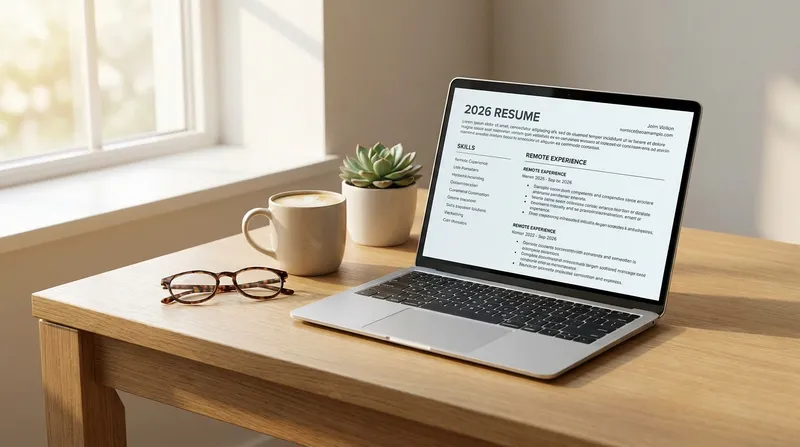
You have sent out dozens of applications for remote roles this month. Radio silence. The problem is not your work ethic or your professional background. The problem is a specific, underlying fear that plagues job seekers today: you are terrified that your traditional, in-office experience will be automatically rejected by remote employers. You struggle to articulate hidden remote-ready skills like self-directed project management without sounding generic, and you fear Applicant Tracking Systems (ATS) will instantly filter you out because your past job titles do not explicitly say "Remote."
If this sounds familiar, you are not alone. The transition from an office-based resume to a remote-optimized application requires a complete shift in how you present your value. JobSparrow is here to help you navigate this transition. Our team and advisors have collectively reviewed over 100,000 resumes and hired across four global markets, so we understand exactly what recruiters are looking for.
At JobSparrow, we coach you through five stages of the Offer Path: Diagnose, Position, Execute, Prepare, and Close. This guide focuses on the first two stages, helping you diagnose what your current resume signals and position your remote readiness correctly.
The 2026 Remote Job Market Reality: Why Traditional Resumes Fail
Remote work is no longer a temporary pandemic perk. It has evolved into a stabilized, highly competitive permanent fixture of the global economy. According to TrulyRemoteWork and Stanford WFH Research, full work-from-home days account for approximately 25% to 26% of all paid US workdays in 2026. This stabilization means that the barrier to entry is higher than ever.
When you apply for a remote job, you are no longer competing just with professionals in your local city. You are competing with talent across the country, and often across the globe. Traditional resumes fail in this environment because they focus entirely on what you did, rather than how you did it.
Through our "recruiter lens," we can tell you a hard truth: recruiters are not simply scanning your resume for the word "remote." They are desperately looking for proof of autonomy, discipline, and reliable communication. If your resume reads like a standard list of office duties, it will be discarded.
Actionable Tip: Stop submitting the exact same resume to every job. Start your journey by getting a free recruiter-lens diagnosis from JobSparrow to see exactly which gaps are costing you interviews.
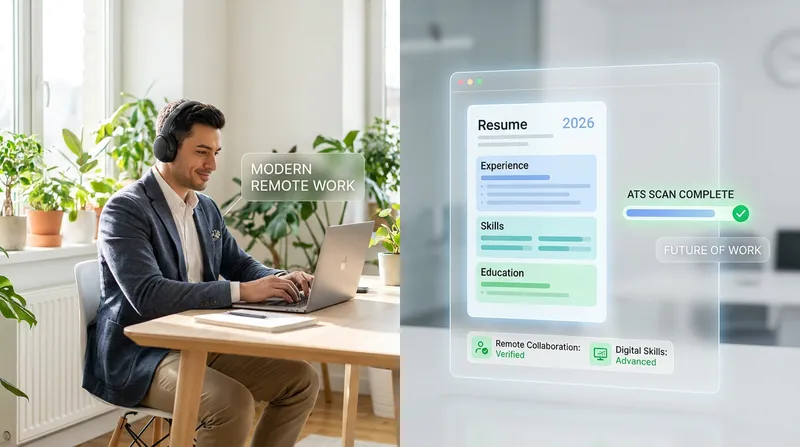
What Hiring Managers Actually Look For in Remote Candidates
There is a pervasive myth that you must have prior explicit remote experience to land a remote job. This is entirely false. You do not need a history of working from your living room to prove you are a capable remote worker.
What you do need is an understanding of a remote manager's greatest fear: micro-managing from afar. Hiring managers cannot walk past your desk to see if you are stuck on a problem. They need absolute confidence that you can manage your own time, troubleshoot basic issues independently, and escalate problems clearly when necessary.
To alleviate this fear, you must highlight "remote-ready skills." These are behavioral indicators rather than technical checkboxes. They demonstrate your capacity to function in a decentralized team.
Actionable Tip: Audit your past roles for moments where you worked completely independently. Did you manage a project while your boss was traveling? Did you coordinate an event with vendors in another time zone? Note these down immediately.
The Core Remote Skills to Highlight (And How to Prove Them)
To build a highly effective resume for remote jobs, you must focus on three core competencies: asynchronous communication, self-directed project management, and proactive problem-solving.
Asynchronous communication is the lifeblood of distributed teams. It means communicating in a way that does not require an immediate response, allowing colleagues in different time zones to collaborate efficiently. Indeed highlights that asynchronous communication minimizes distractions and allows employees to align work with their peak productivity hours.
Self-directed project management is equally critical. You must show that you can take a vague directive, break it down into actionable steps, and deliver the final product without someone holding your hand.
Finally, proactive problem-solving is paramount. The University of Phoenix notes that remote environments lack traditional nonverbal cues and immediate desk walk-bys, making the ability to troubleshoot independently and escalate issues clearly a highly sought-after skill.
Actionable Tip: Replace vague claims like "great team player" with specific examples. Write a bullet point detailing how you created written handover documents that reduced onboarding time for new hires.
How to Show Remote Work on Your Resume Without Sounding Cliche
There is a massive difference between telling a recruiter you are a good remote worker and actually showing them. Anyone can write "Excellent remote communication skills" in their summary. Very few candidates can prove it through their achievements.
Forbes reinforces this strategic advice, noting that hiring managers look for candidates who intersperse examples of digital collaboration and self-management throughout their resume bullets, providing tangible proof of remote readiness.
The strategy here is to weave remote competencies directly into your achievement bullets. Do not isolate your remote skills in a separate section. Embed them into the core of your professional narrative.
Actionable Tip: Use the "Skill + Tool + Result" formula. Instead of saying "Managed a team," say "Managed a cross-functional team of 5 using asynchronous Slack updates and Jira, resulting in a 15% faster project delivery."
Translating Office Work into Transferable Skills for Remote Work
If you have only ever worked in a traditional office, you might feel you lack transferable skills for remote work. This is a framing problem, not an experience problem. You simply need to translate your office achievements into a remote context.
For example, did you regularly coordinate with a branch office in another city? That is cross-border communication. Did you manage external vendors or communicate with clients via digital portals? That proves digital fluency and the ability to build relationships without face-to-face interaction.
When you use JobSparrow's Smart Job Search, we aggregate remote roles from local platforms like Seek alongside global platforms like LinkedIn and Indeed. To compete on these platforms, career changers can heavily leverage their past organizational skills to prove remote readiness. If you are pivoting into a new field, your ability to self-manage is one of your greatest assets. You can see exactly how to frame this in our guide on 5 Career Change Resume Examples (And Why Recruiters Love Them).
Actionable Tip: Map out your stakeholder geography. Write down every person you interacted with who did not sit in the same building as you. Use those interactions to build bullet points proving your distributed communication skills.
Embedding Remote Collaboration Tools Naturally
A common mistake job seekers make is creating a massive list of software at the bottom of their CV. Listing "Zoom, Slack, Microsoft Teams, Asana, Google Workspace" tells the recruiter nothing about your proficiency.
Instead, you must integrate these tools into action-driven bullet points. This proves you do not just know how to turn on a webcam, but that you know how to leverage software to drive business results.
Actionable Tip: Rewrite one bullet point today. Change "Organized daily meetings" to "Facilitated daily cross-functional alignment using Jira and asynchronous Slack updates, eliminating the need for 3 weekly sync meetings."
The 2026 ATS-Friendly Remote Resume Format
Many job seekers live in fear of Applicant Tracking Systems. They worry that a robot will instantly reject their carefully crafted application because of a formatting error. In 2026, ATS technology has advanced, but the fundamental rules of formatting remain surprisingly strict.
When it comes to an ATS-friendly remote resume, the golden rule is that "boring is better." According to guidelines from the Massachusetts Institute of Technology (MIT), resumes should avoid text boxes, tables, and fancy graphics as they can distort or erase candidate information during parsing.
Furthermore, modern semantic AI reads for context, not just exact keyword matches. Simply stuffing your resume with the word "remote" will not work anymore. A 90% keyword match is a trap if the context of your achievements is missing. We cover this exact phenomenon in our deep dive on The ATS Score Trap: Why a 90% Match Will Cost You the Interview in 2026.
Actionable Tip: Strip out all tables, graphs, and multi-column layouts from your current resume. Use a clean, single-column format with standard fonts like Arial, Calibri, or Helvetica.
Location Rules: Where to Put Remote Experience on Your Resume
Formatting locations for remote jobs can be confusing. Do you list your home address? The company's headquarters?
In your header, you should only list your City and State/Country. Full street addresses are outdated and pose privacy risks. For the Australia, New Zealand, and UK markets, listing your specific suburb or city is sufficient to establish your tax and timezone residency.
In your experience section, format previous remote roles clearly. The standard best practice is "Job Title | Company Name | Remote". If the role was hybrid, list the primary office location and add a bullet point detailing the hybrid nature of the role to demonstrate flexibility. For a comprehensive look at exact parser rules, read our guide on Workday Illuminate 2026: The Exact Resume Format to Pass Parsers and Semantic AI.
Actionable Tip: Update your header right now. Remove your full street address and ensure your past remote roles explicitly state "Remote" in the location field.
Remote Job Resume Summary Examples (Copy & Paste)
Your professional summary is prime real estate. It sits at the very top of your resume and is the first thing a recruiter reads. This is where you establish your remote capabilities immediately.
Below are copy-and-paste remote job resume summary examples tailored for different situations.
For Career Changers:
- "Detail-oriented professional transitioning into digital marketing, bringing 5 years of self-directed project management experience. Proven ability to drive cross-functional alignment and manage external stakeholders asynchronously, ensuring 100% on-time project delivery."
- "Operations specialist with a strong foundation in autonomous problem-solving and digital documentation. Adept at leveraging cloud-based collaboration tools to streamline workflows and reduce communication bottlenecks in fast-paced environments."
For Migrants (AU/NZ Focus):
- "Global project manager with 7 years of experience coordinating distributed teams across 4 time zones. Highly skilled in asynchronous communication and remote stakeholder management, delivering complex IT infrastructure upgrades ahead of schedule."
- "Adaptable finance professional with extensive experience managing cross-border client portfolios. Expert in maintaining high-touch client relationships via digital portals and video conferencing, ensuring seamless service delivery regardless of location."
If you are a migrant worried about cultural nuances, you can learn how to perfectly calibrate your summary in our article on Resume Localization for AU/NZ: How Migrants Can Use AI to Adapt Tone & Beat 'Tall Poppy Syndrome'.
Actionable Tip: Copy one of these templates, paste it into your resume, and replace the generic metrics with your specific years of experience and achievements.
Common Remote Resume Mistakes to Avoid
Before you finalize your application, ensure you are not making these critical errors that instantly flag you as unprepared for remote work.
First, avoid listing remote tools without proper context. Simply dropping "Zoom" or "Slack" into a skills section is a wasted opportunity. You must tie these tools to business outcomes within your bullet points.
Second, do not ignore time zones. Remote recruiters are highly sensitive to scheduling overlaps. If you successfully managed teams or vendors across multiple time zones in the past, explicitly state this. It proves you understand the logistical realities of global work.
Finally, stop focusing on daily duties instead of measurable outcomes. In a remote environment, managers cannot see you working, so they measure your value entirely by your output. Your resume must reflect this by highlighting quantifiable results rather than a list of responsibilities.
How JobSparrow's AI Builder Extracts Your Hidden Remote Skills
If you have made it this far, you already have the self-direction that remote employers are looking for. Now, let the tools catch up to your effort. Staring at a blank page and trying to remember every time you used asynchronous communication is exhausting. This is where JobSparrow changes the game.
Instead of manual data entry, JobSparrow utilizes a Master Profile concept. Think of this as your comprehensive career database. You import your existing history, and our AI acts as a dedicated career coach.
Using our Gap Filler technology, the AI analyzes your profile and prioritizes your most critical gaps first. It walks you through targeted Q&A to pull out forgotten achievements that prove your remote readiness. Your answers are automatically woven back into your Master Profile, meaning a stronger profile improves every future resume and cover letter you generate. If you struggle to remember your past wins, our guide on Resume Blank Page Syndrome: How an AI Coach Extracts Your Forgotten Achievements explains exactly how this coaching process works.
Once your Master Profile is optimized, you can generate a hyper-personalized, ATS-friendly resume for a specific remote job description in under 60 seconds. The AI reads the job posting, selects your most relevant remote skills, and rewrites your bullet points to match the employer's exact needs.
Actionable Tip: Ready to land more remote interviews? Start with a free diagnosis to see your recruiter-lens score and fix the exact gaps costing you job offers today. Your first recruiter-lens diagnosis is free. When you are ready, you can unlock the full Offer Path.
Frequently Asked Questions
How do I list a hybrid job on my resume?
You should list the primary office location in the header of the job entry. Then, add a specific bullet point detailing the hybrid nature of the role (e.g., "Managed a hybrid schedule, working autonomously 3 days a week while coordinating in-person strategy sessions 2 days a week"). This demonstrates both flexibility and self-management.
Do I need to put my full home address on a remote resume?
No. Full street addresses are outdated and pose privacy risks. Simply use your City and State/Country. This is entirely sufficient for employers to determine your tax residency and timezone for remote work compliance.
Will ATS reject me if I do not have "remote" in my past job titles?
No, modern semantic ATS systems are smarter than simple keyword scanners. They look for contextual skills such as asynchronous communication, digital collaboration, and self-directed project management. As long as you highlight these competencies in your bullet points, you will pass the parser.
What are the best remote collaboration tools to list on a CV?
Focus on essential categories: communication (Slack, Microsoft Teams), project management (Jira, Asana, Trello), and documentation (Confluence, Google Workspace). However, emphasize embedding these tools into your achievement bullets rather than just listing them in a skills section.
How do I prove asynchronous communication skills if I have only worked in an office?
Provide examples of office tasks that required you to work without immediate feedback. This includes writing detailed handover documentation, managing shared team drives, coordinating with external vendors via email, or creating standard operating procedures (SOPs) for your department.
Tags
Keep reading
Recommended articles.
resume tips · layoff
Resume After Layoff: How to Explain Redundancy (Without Looking Like a Hiring Risk)
Learn how to write a resume after layoff and explain redundancy confidently. Get ATS-friendly examples and proven tips to handle employment gaps.
ai resume builder · ats optimization
Are AI Resume Builders Worth It? Pros, Cons, and ATS Optimization in Australia
Are AI resume builders worth it? JobSparrow reveals the pros, cons, and ATS optimization tips to land more interviews in Australia without sounding robotic.
job application · resume tips
What to Write in an Email When Sending Your Resume (7 AU/NZ Templates)
Learn what to write in an email when sending your resume with 7 AU/NZ templates from JobSparrow. Discover the Shadow ATS strategy and land more interviews.