
resume localization
Resume Localization for AU/NZ: How Migrants Can Use AI to Adapt Tone & Beat 'Tall Poppy Syndrome'
By Job Sparrow Team
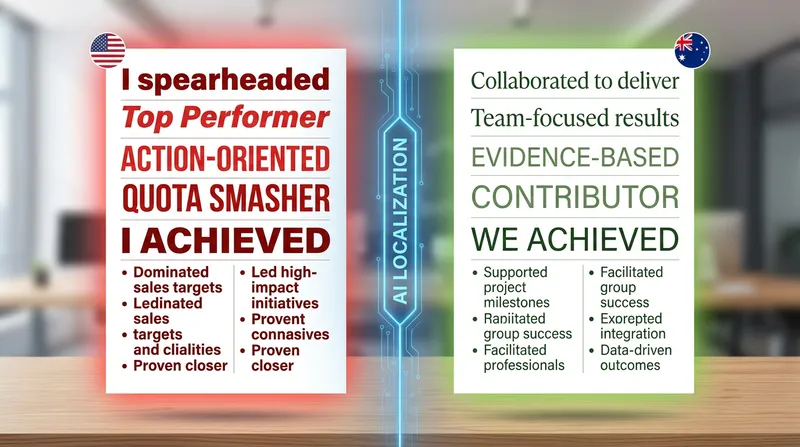
The hidden barrier: Why your international resume is failing in AU/NZ
You are a highly qualified professional. You have years of overseas experience, a strong track record of success, and you match the job description perfectly. Yet, your inbox is full of automated rejection emails. The problem is likely not your skills. It is your cultural capital.
Migrants face a unique, often invisible hurdle in the Australia and New Zealand job markets. Local hiring managers read resumes through a specific cultural lens. If your application uses the aggressive, self-promotional tone common in the United States or parts of Asia, it can immediately alienate an Aussie or Kiwi recruiter.
This is a documented systemic issue. According to peer-reviewed research published in Taylor & Francis Online, skilled migrants frequently experience underemployment simply because they lack the cultural capital to navigate local human resource management contexts.
Using standard, US-centric AI resume builders often makes this problem worse. These generic tools default to American corporate jargon, stripping away the nuanced, team-oriented language required in Australia and New Zealand. This is exactly Why Recruiters Reject Disjointed Applications (And How an AI Resume and Cover Letter Creator Fixes It).
At JobSparrow, our team has reviewed over 100,000 resumes across four global markets. We built our AI with a "recruiter-lens" to help you translate your international experience, adapt your tone, and land the interview.
What is 'Tall Poppy Syndrome' and how does it kill resumes?
To succeed in the Australian and New Zealand job markets, you must understand "Tall Poppy Syndrome." This is a cultural phenomenon where people who boast, act arrogantly, or elevate themselves above their peers are resented or "cut down to size."
This cultural trait heavily influences professional behavior. A study by the University of Melbourne found that negative responses to success drive many professionals in the region to adopt coping strategies, such as staying under the radar and taking pains not to flaunt their achievements. The impact is widespread. Data from SEEK indicates that one in three Australian workers (33%) say they have experienced Tall Poppy Syndrome, and almost a quarter say it is a problem in their current workplace.
How does this apply to your resume? It all comes down to how you frame your impact.
In the US market, candidates are taught to be highly aggressive self-promoters. A standard American resume might say: "I single-handedly revolutionized the sales department and crushed revenue targets by 200%."
To an Australian or New Zealand hiring manager, that sentence reads as arrogant, individualistic, and potentially toxic to a team environment. Local workplace culture values egalitarianism, collaboration, and "mateship." They want to see your achievements, but they want to see them grounded in reality and teamwork.
Here is how to adjust your approach:
- Focus on "We" over "I" where appropriate: Highlight leadership and collaboration.
- Let the data speak for itself: Instead of using adjectives like "phenomenal" or "unprecedented," simply state the metric.
- Acknowledge the team: Use phrases like "Led a cross-functional team to..." or "Collaborated with stakeholders to achieve..."
Want to know if your current resume triggers Tall Poppy Syndrome? Get your free recruiter-lens score and see the exact phrases costing you interviews. Start your free diagnosis at JobSparrow.ai
The AU/NZ resume format for migrants: Rules for 2026
Beyond tone, the physical structure of your application must align with local expectations. If you are using a template designed for the US or European markets, you are immediately signaling to the recruiter that you do not understand local norms.
While Australia and New Zealand share an egalitarian workplace culture, they are distinct markets. For example, New Zealand job seekers should prioritize platforms like TradeMe Jobs alongside SEEK, and understand that local community connections often play a role in Kiwi hiring. However, the foundational resume rules remain consistent across both countries.
Here are the critical formatting rules for an Australian or New Zealand resume in 2026:
1. Embrace the two to three-page rule
Many international candidates try to cram their entire career onto a single page because that is the golden rule in the United States. In AU/NZ, a one-page resume often looks light on detail and experience. According to Hays Recruitment, the standard New Zealand CV is usually around two pages long. This allows you enough space to detail measurable achievements with strong action verbs rather than just listing basic duties. Three pages is perfectly acceptable for senior professionals.
2. Put your visa status front and center
The number one fear a local recruiter has when viewing an international resume is that the candidate does not have legal working rights. Do not make them guess. Place your visa status at the very top of your resume, directly under your contact information.
- Good: "Visa Status: Permanent Resident"
- Good: "Working Rights: Full unrestricted working rights in Australia"
- Good: "Visa Status: Subclass 482 (Employer Sponsored) with 2 years remaining"
3. Use regional spelling (UK/AU English)
Applicant Tracking Systems (ATS) scan for specific keywords. If a local job description asks for someone who is "organised" and "specialises" in a field, and your resume says "organized" and "specializes" (US spelling), the ATS might lower your match score. Always set your word processor to UK or Australian English before finalizing your document.
4. Ditch the objective statement
Do not use an outdated objective statement like "Seeking a challenging role to utilize my skills." Instead, use a powerful Professional Summary. This should be a 3 to 4 sentence paragraph at the top of your resume that clearly outlines your professional identity, years of experience, and top local-market value proposition.
5. Avoid common migrant formatting mistakes
- Do not include a photo: This can trigger unconscious bias and cause parsing errors.
- Use local date formats: Always use DD/MM/YYYY rather than the US standard of MM/DD/YYYY.
- Remove "References available upon request": This phrase is outdated and wastes valuable space.
If you want to ensure your layout meets all modern technical requirements, review our guide on Workday Illuminate 2026: The Exact Resume Format to Pass Parsers and Semantic AI.
Translating international experience for local hiring managers
One of the most frustrating feedback lines a migrant can hear is: "You lack local experience."
Often, this is not a true reflection of your skills, but rather a failure of translation. The hiring manager simply does not understand the context, scale, or prestige of your overseas roles. It is your job to translate your international career into terms a local recruiter instantly respects.
Contextualize unknown companies
If you worked for the largest telecommunications company in your home country, a local recruiter in Sydney or Auckland might still have never heard of it. Do not assume they will Google it.
Add a brief, one-line contextual description next to or below the company name. For example: "TechCorp International (A leading Asian fintech with $500M annual revenue and 2,000+ employees)."
Map foreign job titles to local equivalents
Job titles vary wildly across the globe. A "Director" in one country might be equivalent to a "Manager" in Australia.
If your official overseas job title does not make sense in the local market, provide the local equivalent in parentheses. For example: "Head of Commercial Operations (Equivalent to General Manager, AU/NZ)."
Focus on universal metrics
While local regulations or software might differ, universal business metrics translate perfectly across borders. Focus your bullet points on percentages, dollar amounts (converted to local currency if appropriate), team sizes, and time saved.
For more strategies on reframing your background, read our Career Change Resume Help: 7 Tips to Translate Transferable Skills for a New Industry.
How to use AI resume localization to calibrate your tone
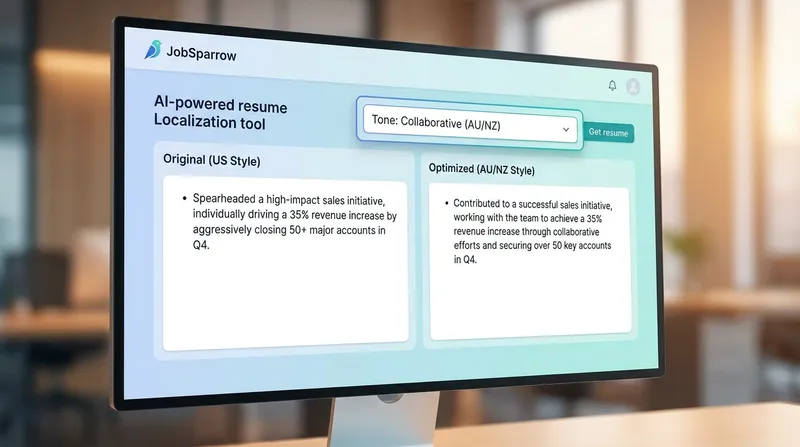
Manually rewriting your entire career history to match a new cultural tone is exhausting. This is where AI should help. However, generic AI chatbots are trained heavily on American internet data. If you ask a standard AI to "improve my resume," it will inject aggressive words like "spearheaded," "synergized," and "masterminded."
JobSparrow takes a different approach. Our platform features a specialized Gap Filler AI designed to act as your cultural translator and career coach.
Here is how JobSparrow helps you calibrate your tone for the AU/NZ market:
1. The master profile creation
Instead of editing a messy Word document, you upload your current international resume into JobSparrow to create a Master Career Profile. This acts as your single source of truth.
2. AI-guided gap analysis
Our Gap Filler AI scans your profile through a recruiter-lens. It identifies areas where your achievements sound too boastful (triggering Tall Poppy Syndrome) or too passive. Instead of just rewriting it without your permission, the AI acts as a coach. It asks you targeted questions to extract the real, collaborative data behind your achievements.
If you struggle to remember specific metrics from past jobs, our AI coach can help you uncover them. Learn more about overcoming Resume Blank Page Syndrome: How an AI Coach Extracts Your Forgotten Achievements.
3. The 'before and after' tone calibration
Once the AI gathers your data, it rewrites your bullet points to strike the perfect balance of confidence and humility.
- Original (US Style): "I dominated the regional sales market, personally crushing quotas by 150% and leaving competitors in the dust."
- JobSparrow AI (AU/NZ Style): "Directed a regional sales initiative that outperformed quarterly targets by 150%, securing a dominant market share through strategic client partnerships."
The second version is factual, professional, and highlights strategic leadership rather than individual ego.
Beating local ATS systems: Why tone matters more than keywords
Many job seekers obsess over "beating the bots" by stuffing their resumes with keywords taken directly from the job description. While keyword matching is important, it is only half the battle in Australia and New Zealand.
Local employers heavily utilize specific Applicant Tracking Systems like PageUp, LiveHire, and localized configurations of Workday. However, these platforms do not just count keywords. They format your profile for a human recruiter to read. If you force keywords into a resume that is culturally misaligned, you might pass the initial automated screen, but the human recruiter will reject you within 10 seconds.
Cultural tone matters more than raw keyword density. Your resume must be "agent-readable." This means it needs a clean, standard format that an ATS can parse perfectly, while containing the nuanced, localized tone that a human hiring manager expects.
JobSparrow's Instant Resume builder handles both sides of this equation. It selects the most relevant experience from your Master Profile, rewrites the bullet points to match the specific job's requirements, and outputs a clean PDF or DOCX using one of five ATS-optimized templates.
Preparing for the AU/NZ interview: What to expect
Landing the interview is a huge milestone, but the cultural translation does not stop there. In Australia and New Zealand, interviews heavily index on "culture fit" and behavioral questions. Hiring managers are looking for quiet confidence, collaborative problem-solving, and humility.
To help you prepare, JobSparrow includes interactive AI Mock Interviews. This feature acts as your personal interview coach, simulating real AU/NZ interview scenarios. It helps you practice articulating your achievements without sounding boastful, ensuring your spoken tone matches the calibrated professional tone of your localized resume.
From diagnosis to offer: Your next steps in the local market
Job hunting in a new country is stressful, but you do not have to navigate the cultural nuances alone. JobSparrow provides a complete five-stage Offer Path to guide you:
- Diagnose: Uncover the invisible cultural gaps in your current resume.
- Position: Build a Master Profile that translates your international experience.
- Execute: Generate tailored, ATS-friendly applications for every job.
- Prepare: Practice your tone with our AI Mock Interviews.
- Close: Secure the offer with confidence in your local market value.
To keep everything organized, JobSparrow's built-in application dashboard lets you track every customized application, match score, and interview prep document in one place. No messy spreadsheets are required. You can also read more about this approach in The Smart Job Search Tracker: Organize Applications & Predict Match Scores.
Ready to see exactly how local recruiters view your current application? Start with a free diagnosis and get your recruiter-lens score out of 100.
Once you are ready, unlock the full Offer Path for US$45 per month, or US$33 a month when billed US$99 every three months. Same access either way, and you can cancel anytime. That covers your entire journey from diagnosis to offer, letting our AI tailor every application to the local market.
Start your free resume diagnosis today at JobSparrow.ai
Frequently asked questions
Should I include a photo on my Australian or New Zealand resume?
No. Photos are highly discouraged in Australia and New Zealand. Including a headshot can trigger unconscious bias and often causes parsing errors in local Applicant Tracking Systems. Stick to a clean, text-based format.
How long should a New Zealand or Australian CV be?
Unlike the strict one-page rule common in the United States, a standard AU/NZ resume is typically two to three pages long. This format allows you enough room to detail measurable achievements and provide context for your international experience.
Where should I list my visa status on my resume?
You should place your visa status or right-to-work information at the very top of your resume, immediately under or next to your contact details. This immediately reassures local recruiters that you are legally authorized to work in the country.
Will an AI resume builder make my CV sound robotic or Americanized?
Generic AI tools often default to aggressive American corporate jargon. However, purpose-built tools like JobSparrow feature tone calibration specifically designed to match the collaborative, evidence-based style expected in the AU/NZ markets.
Do I need local references to get a job in Australia or New Zealand?
While local references are helpful, overseas references are perfectly acceptable. Ensure you format international phone numbers correctly (including the country code) and note their local time zones to make it as easy as possible for local HR teams to contact them.
Tags
Keep reading
Recommended articles.
linkedin optimization · au/nz job market
How to Show Local AU/NZ Status on LinkedIn: The 'Hidden' Signals Recruiters Look For
Optimize your LinkedIn profile to show AU/NZ working rights and bypass recruiter filters. Start your free diagnosis with JobSparrow today.
ats optimization · job search strategy
ATS Scanners vs Job Trackers: The $100/Month Trap (And Why You Are Still Rewriting Resumes at Midnight)
Stop paying for ATS scanners that leave you rewriting resumes at midnight. See why the manual approach fails and get a free recruiter-lens diagnosis today.
adhd job search · executive dysfunction
The ADHD-Friendly Job Search: Overcoming Executive Dysfunction & Application Paralysis with AI Tools
Overcome job application paralysis and executive dysfunction with AI. See how neurodivergent job seekers use JobSparrow to land more interviews. Start free.