
job application tracker
Ditch the Spreadsheet: Why You Need a Dedicated Job Application Tracker in 2026
By Job Sparrow Team

You have sent out 50 applications this month. You are tracking every single one in a massive Excel spreadsheet. Then, the phone rings. It is a recruiter from a company you applied to three weeks ago. Because your static spreadsheet does not link to the actual documents you submitted, you panic. You scramble to find which highly tailored resume version you sent, what the job description actually said, and what the company even does. By the time you figure it out, you sound flustered and unprepared.
It is not a lack of preparation. It is a lack of the right system.
This is the core pain point of the modern job hunt. When you send hundreds of applications into a void, losing track of your data is incredibly easy. If you are still using a basic job application tracking spreadsheet in 2026, you are putting yourself at a massive disadvantage. You need a dedicated job application tracker.

The job application black hole of 2026
The modern recruitment landscape has fundamentally changed. We are currently dealing with the job application black hole, a phenomenon where candidates send their information into the digital abyss and receive nothing back.
According to Fast Company, nearly 70% of organizations use artificial intelligence at some point in the hiring process. This heavy reliance on AI screening has resulted in a high volume of auto-rejections and ignored applications. To survive this, candidates are applying to more jobs than ever before. Data from HiringThing reveals that job seekers now submit between 32 and 200 applications on average before receiving an offer, with cold online applications resulting in a mere 0.1% to 2% success rate.
This sheer volume of applications breaks traditional tracking methods. You simply cannot manage 150 unique, tailored applications in a static grid without losing your mind. The psychological toll is severe. Job seekers are exhausted by the endless cycle of applying and waiting. They need efficient, automated tools to manage their mental health and keep their job search organized.
What is a job application tracker?
A job application tracker is a specialized job application management tool designed to organize, monitor, and optimize your entire job search process. It is not just a digital list of company names and dates. A true job tracker app acts as a Customer Relationship Management (CRM) system for your career.
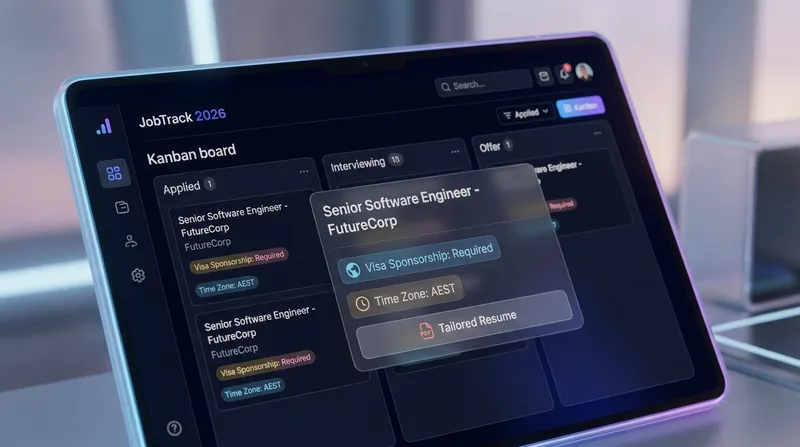
Instead of just logging data, an automated job search tracker centralizes your master career profile, links specific job descriptions to the exact resume and cover letter you submitted, and provides a visual pipeline of your progress. It moves you away from passive data entry and towards active career management.
Spreadsheet vs. job tracking app: Which is better?
The debate between a spreadsheet vs job tracking app usually comes down to familiarity. Many people love Excel. They enjoy building complex formulas and color-coded rows. However, when you treat your job search like a full-time job, a spreadsheet quickly becomes a liability.
Here is why an excel job tracker template fails at scale:
- Disconnected Data: Your spreadsheet lives in one folder, your resumes live in another, and the job descriptions are lost in your browser history.
- Manual Entry: You have to manually type in the company name, role, date applied, and status. This wastes valuable time that you could spend tailoring your application.
- No Version Control: If you tailor your resume for 50 different jobs, your spreadsheet cannot easily tell you which version went where.
- Lack of Analytics: Spreadsheets do not automatically calculate your interview conversion rates or flag when it is time to follow up.
A dedicated job application tracker solves all of these problems. It offers real-time status updates, centralized document storage, and automated reminders.
The complexity multiplier: When standard tracking completely breaks down
Generic advice rarely works for complex situations. If you are migrating to Australia or New Zealand, or if you are completely pivoting your career, your tracking requirements are significantly higher. This is where standard spreadsheets completely break down.
For migrant job seekers, a basic spreadsheet cannot capture the nuances of international applications. You need to track visa sponsorship statuses, local formatting requirements, and international time zones for interviews. If you are navigating the transition from a working holiday visa to a sponsored role, organization is your best asset. Learn more in our guide on From WHV to Sponsorship: The 2026 Guide to the 417/462 to 482 Visa Transition. Furthermore, if you are trying to figure out How to Get a Job in Australia Without Local Experience (2026 Guide), you will be sending highly customized applications that require rigorous tracking.
Career changers face a similar hurdle. You must track which transferable skills you highlighted for different roles. If you are explaining an employment gap, you need to remember exactly which narrative you used for which company. Read our advice on How to Explain an Employment Gap on Your Resume: AU/NZ Guide (2026) to master this framing.
The CRM methodology: How to track your job search effectively
At JobSparrow, our team has reviewed over 100,000 resumes and hired across four major markets. We view the job search from both sides of the table. From a recruiter lens, candidates who treat their job search like a sales pipeline are the ones who succeed.
You need to adopt a CRM methodology. This means calculating your conversion rates to diagnose exactly where your application is failing. If you send 50 applications and get zero interviews, your resume is the problem. If you get 10 interviews and zero offers, your interview skills need work. A proper job search tracker gives you this data instantly.
Here is how to structure your pipeline:
- Lead Generation: Source jobs from multiple platforms. Use JobSparrow's Smart Job Search feature to aggregate real opportunities. Be careful to vet your leads using our guide on Ghost Jobs vs. Job Scams: How to Spot Fake Listings on SEEK and Indeed (2026 Guide).
- Document Tailoring: Never send a generic application. When applying for specialized roles, such as mining, you need a specific approach. Check out our FIFO Resume Australia 2026: How to Write an Entry-Level Mining Resume (No Experience) for industry-specific tailoring tips.
- Application Submitted: Log the date and link the exact documents used.
- Interview Preparation: Store your research and practice notes directly on the job card.
- Follow-Up: Set a strict deadline to reach out if you hear nothing.
Want to see this pipeline in action? Start with a free CV diagnosis at JobSparrow and get your recruiter-lens score in minutes.
Key features of the best job application tracker in 2026
When evaluating the best job application tracker 2026 has to offer, you must look beyond basic data entry. The ideal platform guides you through the entire Offer Path: Diagnose, Position, Execute, Prepare, and Close.
Here is what your job application management tool must include:
- A Master Career Profile: This is your single source of truth. It holds every skill, project, and role you have ever completed. Whether you are figuring out How to List Temp Work and Contracting on Your Resume (Without Looking Like a Job Hopper) or managing a long career history, a centralized profile is essential.
- Gap Analysis and Match Score: Before you even apply, JobSparrow's Gap Analysis shows you exactly which skills are missing from your profile relative to the job description. You can address weaknesses upfront rather than discovering them in a rejection email.
- Instant Resume Generation: If you do not have a specific listing yet, JobSparrow can generate an Instant Resume based on your Master Profile and AI-recommended roles, so you are never caught unprepared when a recruiter reaches out.
- Job-Specific Resume Tailoring: Your tracker should integrate directly with your resume builder. JobSparrow analyzes the specific job description and intelligently selects the most relevant experience from your Master Profile to create a targeted resume.
- Intelligent Cover Letter Generation: Stop using static templates. Discover why in our post about the Online Cover Letter Maker: Why Traditional Templates Are Ineffective in 2026 (Use AI Instead).
- Integrated Interview Prep: Tracking your application is only half the battle. You must prepare for the interview. The best tools link your application data directly to practice modules. Learn more in A Recruiter's Take: Why You Need an AI Voice-Based Mock Interview Tool.
What information should you track for each job?
To stay perfectly organized, you must track specific data points for every single application. Based on our experience reviewing over 100,000 resumes, creating a systematic tracking system is vital to avoid missing deadlines and maintaining momentum.
Make sure your tracker captures:
- Company Name and Job Title: The basics.
- The Original Job Description: Copy and paste the text. Companies often delete the listing once they start interviewing. If you are applying for government roles, save the specific requirements and see How to Address Key Selection Criteria for Australian Government Jobs: STAR Method & Examples (2026).
- Date Applied and Follow-Up Deadlines: Never let an application sit idle for more than two weeks.
- Tailored Documents: Keep a direct link to the exact resume and cover letter you submitted.
- Salary Information: Track the posted salary range to prepare for negotiations. Read How to Answer 'What Are Your Salary Expectations?' in Australia (2026 Scripts & Strategies) to master this conversation.
Ditching the spreadsheet: Your migration plan
If you are currently relying on an excel job tracker template, transitioning to an automated app might feel daunting. Here is a simple, actionable migration plan to move your data without losing your progress.
- Export Your Current Data: Save your existing spreadsheet as a CSV file for backup.
- Establish Your Master Profile: Sign up for JobSparrow and upload your most comprehensive resume to build your Master Career Profile. This replaces the need to keep multiple messy folders.
- Log Active Applications Only: Do not waste time migrating applications that are months old and dead. Only input the jobs where you are currently awaiting a response or actively interviewing.
- Upload Targeted Documents: Attach the specific resumes and cover letters you used for those active applications into your new visual pipeline.
- Set Your Next Actions: Immediately assign a follow-up date or interview prep task for every active item in your new tracker.
Conclusion
Job hunting in 2026 is a data-heavy, high-volume endeavor. Relying on a manual spreadsheet to track job applications online is a guaranteed path to burnout and missed opportunities. By upgrading to a dedicated job application tracker, you transform a chaotic process into a streamlined, measurable pipeline.
You regain control over your career trajectory. You will never again have to panic when a recruiter calls, because your tailored documents, company research, and interview notes will all be accessible in one centralized dashboard. For technically sophisticated users, if you use AI assistants like Claude or other SKILL.md-compatible tools, JobSparrow's public API lets you run your entire application workflow without switching apps.
Ready to land more interviews and stay perfectly organized? Start with a free diagnosis at JobSparrow to see your recruiter-lens score and the exact gaps costing you interviews. When you are ready to fully automate your search, unlock the complete JobSparrow Offer Path for a one-time fee of $129, with no auto-renewal traps. Take control of your job search today.
Frequently asked questions
What is the best job application tracker in 2026?
The best job application tracker is one that goes beyond simple data entry by integrating your master career history with job-specific resume tailoring and interview preparation. Instead of just logging dates, a platform like JobSparrow acts as a complete career CRM, coaching you from your initial diagnosis all the way to the job offer.
Is a job tracking app better than an Excel spreadsheet?
Yes. While an Excel spreadsheet requires manual updates and cannot natively store or link to your actual resume files, a dedicated job tracking app automates status updates. It links your highly tailored documents directly to the job description and provides clear analytics on your application success rate, saving you hours of administrative work.
How do I track job applications effectively?
To track applications effectively, you must treat your search like a sales pipeline. Always save the original job description (since companies often delete them), link the exact tailored resume and cover letter you submitted, log the date applied, and set strict, automated deadlines for following up with the hiring manager.
How do I follow up on a job application without being annoying?
The key is timing and brevity. Set a reminder in your job application tracker for 7 to 14 days after applying. Send a concise, polite email referencing the specific role, restating one core value proposition that makes you a great fit, and asking if they need any additional information. If you do not hear back, move on.
Can I track visa sponsorship status in a job tracker?
Absolutely, and this is crucial for migrants to Australia, New Zealand, or the UK. Modern job trackers allow you to add custom tags and notes to your pipeline. You can filter your applications by employers who have explicitly stated they are willing to offer 482 visa sponsorship, ensuring you prioritize the right opportunities.
Tags
Keep reading
Recommended articles.
ats optimization · resume tailoring
ATS Keyword Stuffing: Why Your 'Optimized' Resume Fails the Human Test (And How to Fix It)
Stop failing the human test. Learn why ATS keyword stuffing costs you interviews and how to beat the ATS with contextual AI resume tailoring. Start free today.
master resume · resume tailoring
The 'Master CV' Method: Why Managing 50 Resume Versions is Sabotaging Your Job Search
Stop drowning in PDFs. Learn how to manage multiple resumes using a master CV template and cure callback panic for a smarter, faster job search.
resume tailoring · ats optimization
How to Tailor Your Resume to Any Job Description (& Beat the ATS in 60 Seconds)
Learn how to tailor a resume to a job description and beat the ATS in seconds with JobSparrow. Stop getting auto-rejected and land more interviews today.