
selection criteria
How to Address Key Selection Criteria for Australian Government Jobs: STAR Method & Examples (2026)
By Job Sparrow Team
You have stared at the blank page for hours. You know you have the skills to do the job, but you are completely paralyzed by the rigid, bureaucratic rules of Australian government applications. Translating your real-world experience into the strict STAR method or the dreaded two-page Statement of Claims feels like learning a foreign language.
If you are feeling overwhelmed, you are not alone. Applying for Australian Public Service (APS) or state government roles requires a completely different approach than private sector jobs. Whether you are a career changer, a new migrant, a first-time applicant, or an experienced professional re-entering the public sector, this guide is for you.
At JobSparrow, our team has reviewed over 100,000 resumes and hired candidates across Australia/NZ, the United States, Singapore, and Hong Kong. We know exactly what happens on both sides of the hiring table. In the private sector, recruiters might read between the lines of your resume. In the public sector, hiring panels are legally bound by merit-based assessment frameworks. They cannot guess your skills. You have to prove them using highly specific, evidence-based examples.
This guide will break down exactly how to address key selection criteria examples using the STAR method. We will show you how to structure your Australian Public Service pitch, provide real-world examples, and explain how to use AI-assisted cover letter strategies for government jobs to save hours of frustration.
Ready to land more interviews? Start with a free diagnosis to see your recruiter-lens score and the exact gaps costing you job offers in minutes. JobSparrow offers this free CV diagnosis to start, while our full Offer Path is a one-time flat fee of $129 with no subscription or auto-renewal.
The Australian Public Service Pitch: Why Generic Applications Fail
Many job seekers spend hours on a government application only to hear nothing back. The problem is usually simple: they submitted a standard corporate resume and a generic cover letter.
Government recruitment relies on Key Selection Criteria (KSC) to filter candidates fairly and transparently. These criteria are specific skills, knowledge, and attributes required to perform the role. When you apply, you are not just telling a story about your career. You are systematically proving that you meet every single requirement listed in the job description.
JobSparrow's method is a five-stage journey to your next role: Diagnose, Position, Execute, Prepare, and Close. Tackling selection criteria sits squarely in the Position and Execute phases. You must position your past experience to align perfectly with the APS Capability Framework, and then execute your application by following strict formatting rules.
If you simply state that you have "great communication skills" without providing a structured example of a time you used those skills to achieve a specific result, you will be screened out immediately.
Decoding the STAR Method for Selection Criteria
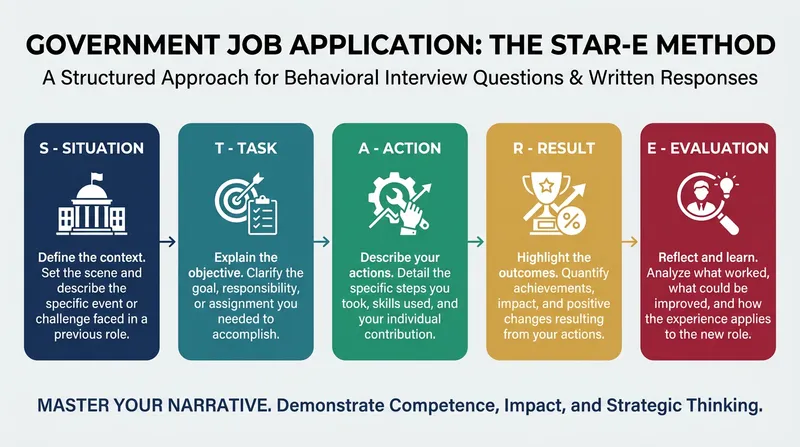
To prove your demonstrated ability selection criteria, you must use the STAR method. This framework ensures you provide concrete evidence of your skills rather than vague statements.
Here is how to break down the S.T.A.R. acronym for government roles:
- Situation: Briefly describe the context. Where were you working, and what was the specific challenge?
- Task: Explain your specific role and responsibility in that situation.
- Action: Detail the exact steps you took to solve the problem. Use "I" instead of "we" to highlight your individual contribution.
- Result: Share the measurable outcome of your actions. Did you save time, reduce costs, or improve a process?
The Golden Ratio of a STAR Response
A common mistake applicants make is wasting too many words on the background story. According to structural guidelines from The Resume Writers Australia, a successful STAR response should dedicate roughly 50 percent of its word count to the Action phase and 25 percent to the Result. The remaining 25 percent is split between setting up the Situation and Task (about 10 to 12 percent each). This keeps your context punchy and forces you to focus on what you actually did.
Upgrading to the STAR-E Method
To truly stand out, you can upgrade your response to the STAR-E method. Research from The University of Queensland shows that adding an Evaluation (E) to the end of your response demonstrates a mindset of continuous improvement. Add a single sentence at the end of your example explaining what you learned from the experience or how you would apply that knowledge to the government role you are applying for.
Statement of Claims vs. Traditional Cover Letters
There is a massive difference between a standard corporate cover letter and a government Statement of Claims.
A traditional cover letter is usually a one-page summary of your enthusiasm and high-level career achievements. A Statement of Claims (often referred to as a two-page pitch) is a highly structured document that directly addresses the selection criteria using multiple STAR examples.
According to official guidelines from the Australian Public Service Commission (APSC), candidates must focus on highlighting individual contributions rather than general team achievements. The APSC strictly enforces word limits, and exceeding them can result in your application being discarded.
How to Structure a 2-Page Pitch
If you are wondering how to write a 2-page pitch for the government, follow this basic template:
- Introduction (100 words): State the role you are applying for and provide a brief summary of your value proposition.
- Criterion 1 Example (200-250 words): Use a STAR example to address the first major capability (e.g., Strategic Thinking).
- Criterion 2 Example (200-250 words): Use a STAR example for the next capability (e.g., Stakeholder Engagement).
- Criterion 3 Example (200-250 words): Continue this pattern for the remaining core criteria.
- Conclusion (50 words): Reiterate your enthusiasm and readiness for the role.
Formatting this manually takes hours. If you want to speed up the process, you can learn how to use AI-assisted cover letter strategies to build the foundation of your pitch, ensuring you hit the right keywords before adding your personal metrics.
Common Selection Criteria Mistakes to Avoid
Before diving into real-world examples, it is important to understand where most applicants go wrong. Avoid these common pitfalls to ensure your application passes the initial screening:
- Using "We" Instead of "I": Government panels want to know what you contributed, not what your team achieved. Always focus on your individual actions.
- Exceeding Word Limits: The APSC strictly enforces length requirements. If a criterion has a 250-word limit, do not write 300 words. Your application may be discarded.
- Addressing Desirable Criteria First: Always prioritize essential criteria. You will be screened out if you miss an essential requirement, even if you meet all the desirable ones.
- Copy-Pasting the Same Example: While you can reuse a core story, you must tailor the Action and Result sections to match the specific capability framework language of each new role.
Real-World APS Level 3, 4, and 5 Selection Criteria Examples
To help you understand how to answer selection criteria questions, let's look at two concrete examples. Notice how both examples focus heavily on the Action and Result phases.
Example 1: APS 3/4 Administration Role
Criterion: Demonstrated ability to deliver excellent customer service and improve administrative processes.
- Situation: As an Administrative Assistant at TechCorp, our team was receiving over 100 customer complaints per month regarding delayed processing times for service requests.
- Task: I was tasked with identifying the bottleneck and improving our response times.
- Action: I analyzed our shared email inbox and discovered that requests were not being categorized. I created a new triage system using Microsoft Excel and Outlook rules to automatically sort emails by urgency. I then trained three team members on this new process, creating a step-by-step digital manual for future reference.
- Result: Within four weeks, our average response time dropped from 48 hours to 12 hours, and customer complaints decreased by 85 percent.
- Evaluation: This experience taught me the value of proactive problem-solving, a skill I plan to bring to the administrative team at the Department of Health.
As you move from APS 3/4 to APS 5/6, hiring panels look for less task-oriented actions and more strategic stakeholder management. Notice the shift in complexity in the next example.
Example 2: APS 5 Clinical Coordinator Role
Criterion: Proven ability to engage with complex stakeholders to achieve strategic outcomes.
- Situation: While working as a Clinical Coordinator at City Hospital, we needed to implement a new patient handover protocol across three different wards with competing priorities.
- Task: My role was to ensure all 50 nursing staff adopted the new protocol without disrupting daily patient care.
- Action: I initiated a series of brief, 10-minute consultation sessions during shift changes to gather feedback from senior nurses. Recognizing their concerns about the time the new protocol would take, I collaborated with the IT department to digitize the handover form. I then ran pilot tests in one ward, using the feedback to refine the digital form before rolling it out hospital-wide.
- Result: The new protocol was successfully adopted across all three wards a week ahead of schedule, reducing handover errors by 22 percent as measured by our quarterly audit.
When reviewing these APS level 3/4/5 selection criteria examples, remember to prioritize essential vs desirable criteria. Essential criteria are mandatory: you will be screened out if you do not meet them. Desirable criteria are a bonus that can separate you from other top candidates.
Translating Private Sector and Overseas Experience
If you are a career changer or a migrant, you might feel disadvantaged because you lack local government experience. The good news is that you do not need prior government experience to win an APS job. You just need to translate your skills into their language.
Government recruiters use Applicant Tracking Systems (ATS) to manage high volumes of applications. According to insights from PS Interview Coach, government ATS platforms like PageUp scan your application for exact capability framework terminology. If you use the wrong jurisdiction's language, your relevance score drops, which can lead to early rejection.
To beat this system, you must map your private sector achievements to public sector values. For example, if you "increased sales" in the private sector, frame it as "delivering strategic outcomes" or "maximizing resource efficiency" for the government role.
If you are applying from overseas or trying to break into the local market, check out our guide on Australian job interview tips for migrants to learn how to overcome the "local experience" barrier by focusing on highly transferable skills.
How to Write Selection Criteria Using AI (The Right Way)
Writing a two-page pitch from scratch is exhausting. Many applicants turn to mainstream AI chatbots for help, but standard AI tools were not built with the APS Capability Framework in mind. They often miss the strict STAR structure and lack the specific evidence-based language needed to pass a government panel review.
JobSparrow's recruiter-lens approach is different. Our platform understands the specific tone and formatting required to impress human panels.
Here is how to write selection criteria using AI safely and effectively with JobSparrow:
- Build Your Master Profile: Input all your past experience into JobSparrow. Our Gap Filler AI will ask you targeted questions to extract the specific metrics and results you might have forgotten.
- Analyze the Job Description: Paste the government job URL into JobSparrow. Our AI will identify the exact essential and desirable criteria required.
- Generate the Draft: Use the Intelligent Cover Letter Generator to create a baseline two-page pitch. The AI will select the best examples from your Master Profile and format them into the STAR structure.
- Personalize and Refine: Never just hit submit. Review the generated document and ensure your personal voice shines through.
Even if a recruiter asks for your resume before you have a formal job description, you can still prepare. Learn how to generate a targeted resume without a job description to stay ahead of the competition.
Next Steps: From Submission to the Assessment Centre
Submitting your tailored resume and Statement of Claims is only the Execute phase of your journey. Once you pass the initial screening, you will move into the Prepare phase.
Government hiring processes often involve behavioral panel interviews and sometimes group exercises. You will be expected to deliver STAR examples verbally, often expanding on the very stories you wrote in your application.
To build your confidence, use JobSparrow's AI Mock Interviews to practice your delivery out loud. You can also review our comprehensive 2026 guide to assessment centres in Australia to understand exactly what to expect on the day.
Unlike traditional career consultants who charge $300 or more per resume or thousands for coaching, JobSparrow offers a complete Offer Path package for a one-time flat fee of $129. This gives you access to targeted resume tailoring, cover letter generation, and AI Mock Interviews. Start your free CV diagnosis today and take the guesswork out of your government job application.
Frequently Asked Questions
What is the difference between essential and desirable criteria?
Essential criteria are absolutely mandatory. If you cannot prove you meet every single essential criterion, your application will be screened out. Desirable criteria are a bonus. Meeting them can separate you from other top candidates, but you can still win the job without them.
How long should a two-page pitch actually be?
A two-page pitch should be exactly that: no more than two pages. This usually equates to around 800 to 1,000 words. It must be formatted with clear headings, readable fonts (like Arial 11pt), and standard margins to ensure readability for the panel.
Can I use the same STAR examples for different government jobs?
While the core story of your achievement can remain the same, you must tailor the Action and Result sections to highlight the specific capability framework language of the new role. Never copy and paste exactly the same response for different departments.
Why did the government job portal reject my application immediately?
Government ATS platforms like PageUp use knockout questions and keyword scanning. If your resume and pitch lack the specific capability terminology outlined in the job description, the system may assign you a low relevance score, causing an instant rejection before a human ever reads it.
How do I write a statement of claims if I have no government experience?
You do not need government experience to succeed. Map your private sector or overseas experience to APS capabilities using transferable skills. Focus heavily on universally valued skills like stakeholder management, process improvement, and data-driven decision making, structuring all your examples using the STAR method.
Tags
Keep reading
Recommended articles.
director resume · executive resume
How to Write a Director-Level Resume (Without Making It 5 Pages Long)
Write a director-level resume that fits 2 pages without losing impact. Recruiter-backed guide to executive summaries, ROI bullets, and ATS tips.
resume tips · gap year
How to Put Travel on Your CV: The AU/NZ Guide to Gap Years & Working Holidays
Learn how to format a working holiday visa resume and confidently explain a career break on your CV to beat the ATS and land AU/NZ job offers.
ats friendly resume · resume parsing errors
ATS friendly resume: PDF or Word? (2026 guide to Workday, Taleo & ATS parsers)
Discover the best ATS-friendly resume format for 2026. Learn whether Workday, Taleo, and recruiters prefer PDF or Word, and fix parsing errors today.