
hirevue interview
How to Pass a HireVue Interview in 2026: AI Transcript Scoring & Practice Guide
By Job Sparrow Team

Introduction: Why the one-way video timer freezes great candidates (and what actually matters in 2026)
You click the assessment link in your inbox, grant camera access, and watch a 30-second preparation timer start ticking down. There is no smiling recruiter nodding along. You are staring at a tiny green webcam light and your own reflection. When the recording starts, you either freeze up or spend 90 seconds explaining the background of your project, only to have the two-minute timer cut you off mid-sentence right before you share your measurable results.
If you want to understand how does HireVue AI scoring work in 2026, you first need to know why employers rely on it so heavily. According to Greenhouse's March 2026 Hire Standard benchmark report, which covers more than 640 million applications across 6,000+ companies, applications per job rose 111% between 2022 and 2025, from about 116 to 244. To handle that surge, Society for Human Resource Management (SHRM) research shows that 85% of employers using automation or AI in recruitment do so to save time and increase efficiency.
At JobSparrow, we know how frustrating that silent digital gatekeeper feels because we have sat on both sides of the hiring table. Our team and advisors have collectively reviewed 100,000+ resumes (and CVs) and bring more than 10 years of hands-on recruiting experience across four markets, tuned with two of New Zealand's award-winning HR leaders. We built JobSparrow around a five-stage Offer Path (Diagnose, Position, Execute, Prepare, and Close) to coach you all the way to a signed contract.
In this guide, we will break down the exact transcript rubric behind one-way video algorithms and show you how to run a realistic asynchronous video interview practice session using our AI mock interview simulator. Before you record a single video, make sure your written application isn't holding you back: start with a free diagnosis to get your recruiter-lens score out of 100 and see the exact gaps costing you interviews.
How does HireVue AI scoring work in 2026? (The transcript & BARS reality)
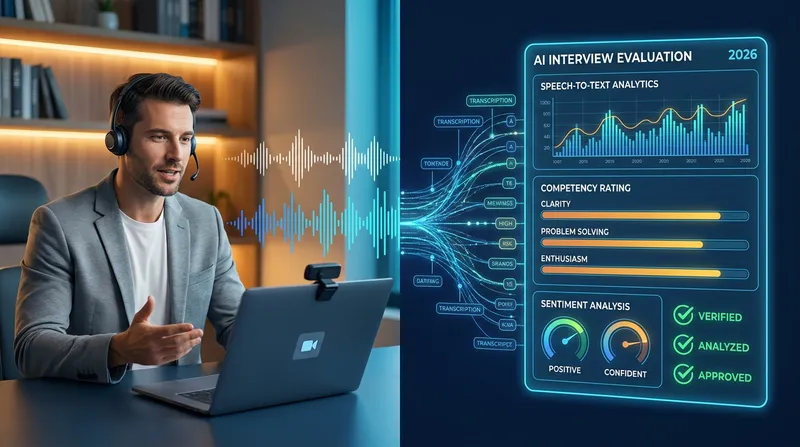
Most candidates assume an algorithm is secretly judging their charisma, outfit, or posture. In reality, HireVue transcript competency scoring is a structured text-evaluation exercise. When an employer enables AI scoring on an assessment, the software evaluates what you say using a three-step pipeline.
- Speech-to-Text (STT) transcription: As soon as you submit your video response, an automated speech recognition engine converts your spoken audio into a verbatim text transcript.
- Natural Language Processing (NLP) parsing: The algorithm scans your text transcript to evaluate the context, actions, collaborative phrases, and quantifiable outcomes in your response.
- Behaviorally Anchored Rating Scales (BARS): Industrial-Organizational (I-O) psychologists design an on-demand video interview rubric for the specific role. Your transcript is scored against this rubric to grade your proficiency across core competencies like problem-solving, stakeholder management, or commercial adaptability.
According to HireVue's official Ethical AI and Hiring Science documentation, AI-scored video assessments analyze only the verbatim transcript of your response mapped to those BARS competencies. Because the algorithm grades your spoken words like a written document, rambling or speaking in vague generalities will tank your score.
Think of your spoken answer the same way you would address Australian key selection criteria in a formal written application. Every sentence needs to supply clear evidence of what you did, how you did it, and what changed as a result.
What you can do right now:
- Print or open the job description and highlight the top four behavioral competencies listed under "Requirements."
- Write down five active, first-person verbs for each competency (such as reconciled, negotiated, automated, escalated, or redesigned).
- Use specific, first-person action verbs (such as reconciled, negotiated, automated) that clearly show the competency, because HireVue says its model reads the meaning of your whole answer rather than counting keywords.
Does HireVue track eye contact or facial expressions? Debunking the #1 myth
One of the most searched questions by anxious candidates is: does HireVue track eye contact or facial expressions? The short answer in 2026 is no.
HireVue officially removed facial analysis from its assessment models years ago. According to HireVue's Explainability Statement, the AI never evaluates your facial micro-expressions, eye gaze, clothing, background decor, or vocal tone.
However, looking at this from both sides of the hiring table reveals an important catch. While the AI only grades your text transcript to rank or filter the initial applicant pool, human recruiters and hiring managers watch the actual video recordings of shortlisted candidates.
If you pass the AI transcript gate with a high BARS score, a human reviewer in London, New York, Sydney, or Auckland will press play on your video. If your eyes are darting across a second monitor reading a script, or your bedroom lighting leaves you in shadow, the human reviewer will flag a lack of preparation.
Actionable camera setup rules for the human reviewer:
- Stack books under your laptop so the webcam sits at eye level.
- Place a small sticky note with three bullet-point keywords right next to the camera lens so you never look down.
- Sit facing a window or desk lamp rather than having a bright window behind you.
How to structure the STAR method for a one-way video interview (The 120-second blueprint)
According to career preparation benchmarks from Wesleyan University's Gordon Career Center, standard banking and consulting HireVue screens present three to seven questions with roughly 30 seconds of preparation time and 60 to 180 seconds to record.
If you have a standard 120-second (two-minute) response window and spend 75 seconds setting up the "Situation," you will run out of time before stating your "Result." Because BARS rubrics weight the Action and Result sections heavily to separate high performers from average ones, getting cut off at 2:00 leaves your transcript incomplete.
Use this strict second-by-second STAR method for one way video interview blueprint to hit every algorithmic marker on time:
- 0:00 to 0:20 (15% of time) - Situation & Task combined: State the context and your specific goal in two sentences maximum. Do not name every coworker or explain company history.
- 0:20 to 1:20 (50% of time) - Action: Spend a full minute explaining the three specific steps you took. Use first-person "I" statements rather than "we" so the NLP engine attributes the competency to you.
- 1:20 to 1:50 (25% of time) - Result & Learning: Share the measurable outcome (numbers, percentages, revenue, or hours saved) and one sentence on how you will apply that lesson in this new role.
- 1:50 to 2:00 (Buffer): Stop recording 10 seconds early with a calm closing sentence.
If you have ever prepared structured responses using our NSW Government targeted questions and capability framework guide, this discipline will feel familiar. Here is how a rambling transcript compares to a BARS-optimized transcript:
- Low-scoring transcript (cuts off at 2:00): "In my last internship we had a really big client who was unhappy with how the quarterly data was being reported because the old spreadsheets were super messy and different teams put numbers in different tabs... (spends 80 seconds describing the spreadsheet) ...so we worked hard all weekend and fixed it just in time."
- High-scoring BARS transcript (finishes at 1:45): "During my Q3 finance placement, our team needed to reduce a 48-hour reporting delay for a key retail client (Situation/Task). First, I audited the four regional Excel trackers to isolate the duplicate formula errors. Second, I built a standardized Power Query template and ran a 15-minute training huddle for the three analysts inputting data. Finally, I instituted a pre-submission checklist (Action). As a result, we cut monthly reporting turnaround by 60%, eliminated data discrepancies for the next two quarters, and retained the client account (Result)."
Big 4 and banking pre-recorded video interview questions and answers (US, UK, AU & NZ)
Whether you are applying to Deloitte, PwC, EY, or KPMG in Sydney and Auckland, or targeting JPMorgan, Goldman Sachs, Barclays, or Macquarie in New York and London, Big 4 HireVue interview questions follow predictable competency clusters. Reviewing pre-recorded video interview questions and answers ahead of time allows you to build three or four adaptable stories, just as Wesleyan University's career advisors recommend.
Below are three common question archetypes and how to structure high-scoring transcripts.
1. Behavioral adaptability & stakeholder pressure
- Prompt: "Tell me about a time you had to adapt quickly when a project scope or stakeholder priority changed unexpectedly."
- What the BARS rubric looks for: Emotional regulation, proactive communication, re-prioritization, and delivery under constraints.
- High-scoring transcript structure: "When our software vendor delayed a key API integration by three weeks right before a product launch, I had to restructure our testing timeline. First, I met with the engineering lead within two hours to identify which modules we could test offline using mock data. Second, I updated the project risk register and briefed our client sponsor with two revised delivery options. Third, I reallocated two team members to complete user documentation early. By running parallel workstreams, we launched within 48 hours of our original deadline with zero critical bugs."
2. Commercial awareness & division motivation
- Prompt: "Why are you applying to this specific division, and what recent market trend will impact our clients over the next 12 months?"
- What the BARS rubric looks for: Role-specific vocabulary, research depth, and client-centric reasoning.
- High-scoring transcript structure: "I am applying to your Audit and Assurance practice because my background in financial compliance aligns with your focus on automated risk controls. Over the next 12 months, mandatory climate-related financial disclosures and AI governance rules will force mid-market clients to overhaul how they verify non-financial data. In my previous role, I helped standardize ESG supplier audits across 30 vendors, and I want to bring that structured verification mindset to your assurance engagements."
3. Career transitions & explaining recent moves
- Prompt: "Walk us through your recent career background and why this role is the right next step for you."
- What the BARS rubric looks for: Transferable skill mapping, clear career logic, and forward-looking impact.
- How to answer: If you are pivoting industries, use the exact reframing techniques from our teacher to corporate resume translation guide so you translate classroom or non-traditional metrics into corporate stakeholder outcomes. Similarly, if the prompt asks why you are moving on from your current employer, keep your transcript positive and forward-focused by borrowing a clean transition line from our scripts on how to answer why you are leaving your current job without red flags.
Regional platform guide: HireVue vs. Vieple vs. Sapia.ai across the US, UK, Australia, and New Zealand
While "HireVue" has become the generic term for one-way video screening, employers across our four core markets use different software vendors with distinct timer rules. Understanding the HireVue vs Vieple vs Sapia AI interview landscape will keep you from getting blindsided when you click your link.
- HireVue (Dominant in the US, UK, and global multinationals): Standard in Wall Street and City of London investment banking, global FMCG, and Big 4 consulting. Preparation time, recording time, and retakes are set by each employer, so check your invite. Some employers attach short cognitive mini-games after the video section.
- Vieple (Heavily used in Australia and New Zealand): If you are applying for graduate programs, banking roles (such as major Australian retail banks), universities, or public-sector intakes in Sydney, Melbourne, Auckland, or Wellington, you will frequently encounter Vieple.
- Sapia.ai & Cappfinity (Common across Australia, New Zealand, and the UK): Sapia.ai (formerly PredictiveHire) uses a structured text-chat interview of written behavioral questions. Cappfinity, widely used in UK and Australian Big 4 strengths-based assessments, focuses on what energizes you as much as your past achievements.
If you are preparing for assessment funnels in Britain, pair these one-way video interview tips Australia UK candidates rely on with our UK graduate scheme CV format and assessment centre guide. For Australian and New Zealand job seekers, ensure the achievements you speak about on Vieple or Sapia.ai match your verified work history by reviewing our guide on SEEK Pass and verified credentials in 2026.
How to inspect your invite before the clock starts:
- Check the URL domain in your invitation email (
hirevue.com,vieple.com, orsapia.ai) so you know which interface to expect. - Click into the welcome lobby at least 24 hours before your deadline. Many platforms display the number of questions, preparation time, and retake rules in the lobby before Question 1 begins.
- If the lobby offers practice questions, use them to test your microphone gain and lighting.
Voice delivery & transcription calibration: How to reduce filler words and prevent AI transcription errors
Because AI scoring depends on an accurate speech-to-text transcript, your vocal delivery is your bridge to a high BARS score. This is especially reassuring for migrants, international students, and non-native English speakers across the US, UK, Australia, and New Zealand.
The algorithm does not deduct points for having an accent. However, speaking too fast under nervous pressure can cause speech-to-text engines to misinterpret industry acronyms or blend words together.
If you are applying for international roles using our UK Skilled Worker visa CV format guide, follow these three vocal calibration rules to help produce a clean transcript:
- Lock in a 130 to 150 words-per-minute (WPM) pace: Conversational English averages 130 to 150 WPM, which equals 260 to 300 words in a two-minute HireVue answer. Slow down by 10% whenever you say a proper noun or metric.
- Replace filler words with a one-second silent breath: Knowing how to reduce filler words in HireVue interview recordings protects both your transcript and your human review. Words like "um," "uh," "like," and "you know" clutter your text transcript. Whenever you finish a sentence, close your mouth and take a one-second silent breath.
- Use a wired headset or external USB microphone: Built-in laptop microphones pick up room echo and laptop fan noise, which muddies speech recognition. Positioning a simple headset mic or external USB microphone six inches from your mouth ensures crisp audio capture.
How to run a timed video interview rehearsal using JobSparrow's AI mock interview simulator
Practicing in front of a bathroom mirror or writing out word-for-word scripts in a Google Doc rarely works for one-way video interviews. Reading a script flattens your vocal inflection and slows your delivery. Worse, a mirror never interrupts you when you ramble past the two-minute mark.
That is why the Prepare stage of JobSparrow's Offer Path includes role-specific AI mock interviews designed for realistic timed video interview rehearsal.
Here is how to run a four-step rehearsal in JobSparrow before opening your live HireVue or Vieple link:
- Launch a tailored session: Start directly from a saved job application inside JobSparrow, or launch an Instant Interview by pasting the job description or URL. Our AI analyzes the role and generates company-specific questions for screening, culture fit, and technical rounds.
- Record out loud with real-time audio: Practice speaking your answers out loud using real-time audio recording, simulating the exact pressure of a live assessment without burning your real attempt.
- Audit your answer quality and clarity: Review JobSparrow's instant AI analysis on your answer structure, clarity, and delivery tone. Check whether you clearly stated your quantifiable Result or if you buried the lede in too much background context. (If you need to explain a brief role during your rehearsal, pair this practice with our scripts on how to explain leaving a job after 3-6 months.)
- Re-run until you hit the 105-second sweet spot: Repeat your weakest answer until you naturally land your measurable Result between the 90-second and 110-second mark without looking at notes.
A career consultant charges around US$300 for one resume and around US$2,000 for a coaching program. With JobSparrow, you can run a free application diagnosis right now to see how recruiters score your profile and pinpoint what is holding you back. When you are ready to unlock unlimited AI mock interviews, tailored resumes, and cover letters, you can try the full Offer Path for 7 days for US$5.99, then US$45 a month (or £4.99 for 7 days, then £35/month in the UK; A$8.99 for 7 days, then A$59/month in Australia; NZ$9.99 for 7 days, then NZ$59/month in New Zealand), and cancel anytime in one click.
Your 2026 legal rights: Automated interview screening rules in Australia, the UK, the US, and New Zealand
As automated hiring software has expanded, governments across all four of our core markets have enforced stricter transparency and fairness rules. Knowing your legal rights removes the intimidation factor of AI screening.
- Australia (December 2026 ADM Transparency Rules): If you are researching automated interview screening rights Australia enforces, landmark updates under the Privacy and Other Legislation Amendment Act 2024 take effect on 10 December 2026. According to official guidance from the Office of the Australian Information Commissioner (OAIC), Australian Privacy Principle (APP) entities must explicitly disclose in their privacy policies when computer programs use personal information to make, or substantially assist in making, decisions that significantly affect individuals, including automated recruitment screening.
- United Kingdom (ICO 'Recruitment Rewired' & UK Data Protection): In its March 2026 Recruitment Rewired report, based on voluntary engagement with more than 30 employers, the UK ICO found that many employers were likely relying on solely automated decisions. It stressed that candidates must be told when automated decision-making is used and must be able to request human intervention and contest decisions, safeguards that remain under the Data (Use and Access) Act 2025 reforms in force since February 2026.
- United States (NYC Local Law 144 & Federal Protections): Under NYC Local Law 144 enforced by the Department of Consumer and Worker Protection, employers in New York City using an Automated Employment Decision Tool (AEDT) must publish an annual independent bias audit. They must also notify candidates at least 10 business days before use, including instructions for how to request an alternative selection process or accommodation if one is available. Nationwide, Title VII and the Americans with Disabilities Act (ADA) still apply to algorithmic hiring tools (even though the U.S. Equal Employment Opportunity Commission (EEOC) removed its AI-specific guidance in January 2025), so employers must provide reasonable accommodations if a timed video screen disadvantages a candidate with a disability. If you are applying for public-sector roles in the US where strict merit rules apply, see our guide on how to build a federal resume for USAJOBS in 2026.
- New Zealand: Under New Zealand's Privacy Act 2020, candidates can request access to personal information held about them, including evaluative material from recruitment, subject to the Act's exceptions. The Human Rights Act 1993 also prohibits disability discrimination in recruitment, so you can ask the employer about adjustments before a timed assessment.
Ready to turn interview anxiety into a signed offer?
Passing a one-way video screen is just one milestone on your journey from application to offer. Once you pass the AI transcript screen and ace your final human rounds, you will be ready for the Close stage of the Offer Path, where you can use our scripts on how to negotiate a sign-on bonus or relocation package when base salary is fixed.
Don't leave your next application or timed video interview to chance. Get your free diagnosis on JobSparrow today to benchmark your resume, fix hidden application blind spots, and build your personalized Offer Path in minutes.
Frequently asked questions
Can HireVue detect if I am reading from notes or a second screen?
HireVue's AI scoring algorithm only grades your spoken text transcript and does not use eye-tracking software to automatically reject you. However, human recruiters watch the videos of top-scoring candidates. Darting eyes and a flat, robotic reading cadence are immediately obvious to human reviewers. Instead of reading full scripts, place three bullet-point keywords on a small sticky note right next to your webcam lens.
How many retakes do you get in a HireVue or Vieple interview?
Retake rules are configured by the employer, not the software platform. Many employers set zero retakes, so check the rules shown in your invite or lobby before you start. If the platform lobby includes built-in practice questions, you can use those to warm up before starting Question 1.
What happens if the HireVue timer cuts me off mid-sentence?
When the countdown timer hits 0:00, recording stops immediately and any unspoken words are excluded from your transcript. If you have not stated the measurable "Result" of your STAR story before the cutoff, your answer may not show the evidence the rubric is looking for. Aim to wrap up your core answer 10 to 15 seconds before the timer expires.
Does having a non-native English accent lower your HireVue AI score?
No. HireVue's AI does not grade pronunciation, voice tone, or accent. It only evaluates the words captured in the speech-to-text transcript. To prevent transcription errors on technical jargon, speak at a steady pace of 130 to 150 words per minute and use an external headset microphone.
Can I request extra time or a human accommodation for an automated video interview?
Yes. Under the US ADA, the UK Equality Act and data protection rules, and Australian and New Zealand disability discrimination laws, candidates with neurodivergence, speech differences, or disabilities can request reasonable adjustments. Contact the recruiting team listed in your invite email before clicking the assessment link to request extended preparation timers, extra recording time, or a live interview alternative.
How long after completing a HireVue interview will I hear back?
While the AI grades your transcript within minutes of submission, shortlisted video recordings are placed in a queue for human recruiters or hiring managers to review. Response times vary by employer and how many applications they are reviewing.
Tags
Keep reading
Recommended articles.
behavioural interview questions · star method
35 Popular Behavioural Interview Questions & Answers: What Recruiters Score (vs. What You Say) | JobSparrow
Prep 35 popular behavioural interview questions and answers. Learn the 1-4 recruiter scoring rubric, 15/15/50/20 STAR pacing, and practice out loud today.
hirevue interview · video interview prep
How to Pass a HireVue Interview: One-Way Video Prep & What the AI Scores
Learn how to pass a HireVue interview. Discover what the AI actually scores, get one-way video prep tips, and practice to land the job offer.
ai mock interview · interview preparation
A Recruiter's Take: Why You Need an AI Voice-Based Mock Interview Tool
Stop freezing under pressure. Use an AI mock interview tool to build real confidence and master your delivery. Start free at JobSparrow to land the offer.