
resume tips
Recruiter Asked for Your CV? How to Generate a Targeted Resume Without a Job Description
By Job Sparrow Team

A recruiter reaches out on LinkedIn. They mention an exciting, unlisted role and ask you to send over your CV immediately. Panic sets in. You do not have a specific job description to tailor your resume against. Sending a generic, untargeted document will likely kill your chances, but manually guessing what keywords to include takes hours you simply do not have.
Having reviewed over 100,000 resumes and hired across four global markets, our team knows exactly what a recruiter is looking for in those first ten seconds. It is never a generic document. This guide covers the Position stage of your Offer Path journey, showing you exactly how to get the right document into the right recruiter's hands fast.
This is a common frustration for job seekers, career changers, and migrants looking to break into new markets. You know that generic applications fail, but how can you personalize a document when you are flying blind? This guide will show you exactly how to navigate this situation, allowing you to generate a highly targeted, professional resume instantly (no formal job listing required).
The Panic of the 'Send Me Your CV' Message
It is completely normal to feel immediate anxiety when asked to send a resume to a recruiter without a formal job description. You want to put your best foot forward, but you are missing the crucial cheat sheet that tells you exactly what the employer wants.
However, this situation is actually a massive opportunity. The hidden job market is very real. According to research from Top Stack Group, up to 70% of open roles never make it to job boards or public listings. This means the majority of hiring happens through direct, relationship-driven channels.
When a recruiter asks for your details, speed is critical. You need to update your resume fast to capitalize on their immediate interest. If you take three days to reply because you are manually rewriting your CV, you might miss the window entirely.
Look at this from both sides of the hiring table. Candidates often assume they need a perfectly matched document that lists every software and task to pass keyword filters. In reality, recruiters spend less than ten seconds scanning for a clear target role and quantifiable achievements. They are trying to assess your baseline fit to see if you are worth a screening call. They do not expect a perfect match to a hidden rubric, but they do expect a clear, professional narrative that highlights your core strengths.
General Resume vs. Targeted Resume: Why Generic Fails
When faced with no job description, most candidates default to sending a general resume. A general resume is a broad overview of everything you have ever done. It lists every task, every software program, and every minor responsibility you have held over the last decade.
The danger of a general resume is that it forces the recruiter to do the hard work. They have to sift through irrelevant information to figure out where you fit. In a fast-paced hiring environment, recruiters will not do this work for you. If your value is not immediately obvious within the first ten seconds, they will move on to the next candidate.
This is where we must distinguish between a master resume format and a submission document.
According to official guidelines from the US Department of Labor, a master resume is a complete record of your work history used as a personal database. You use this database to create a targeted resume for each specific opportunity. You should never submit your master resume directly to an employer or a recruiter.
Actionable Tip: Audit your current document today. Are you burying your core value proposition under generic bullet points? We highly recommend getting a baseline understanding of how a recruiter views your current document. Learn more about how to assess your starting point in our guide on The Truth About Free Resume Reviews in AU & NZ: AI Tools vs. Traditional Upsells (2026).
How to Write a Resume Without a Job Description
So, how do you tailor your application when you have nothing to tailor it to? The secret is shifting your mindset from a "JD-Targeted" resume to a "Role-Targeted" resume.
Even without a specific company's job description, you can identify the core competencies of your target job family. For example, a Senior Marketing Manager role will universally require skills in budget management, campaign strategy, and team leadership. You do not need a specific job posting to know that these themes matter.
Understanding how to write a resume without a job description means focusing on transferable skills and quantifiable achievements. Hiring managers universally value candidates who can solve problems, generate revenue, or improve efficiency.
To build a role-targeted document, follow these steps:
- Identify the industry standard title for the job you want.
- Research three different job postings for that title online.
- Note the recurring skills and requirements across all three postings.
- Highlight your past experiences that directly align with those recurring themes.
According to Indeed, employers frequently do not advertise open roles publicly to save costs, relying instead on internal candidates or recruiter networking. When you tailor a resume without a job description, you are positioning yourself perfectly for these hidden opportunities.
Actionable Tip: Create a list of the top five industry-standard keywords for your desired role. Weave these keywords naturally into your professional summary and your most recent work experience bullet points. This ensures your document speaks the right language, even if it is not matched to a specific URL.
Mastering the Speculative Application and Expression of Interest
In markets like Australia, New Zealand, and the UK, you will frequently hear the terms "expression of interest" or "speculative application." A speculative application resume is sent to a company or recruiter proactively, well before a job is even advertised.
According to career experts at Prospects.ac.uk, speculative applications face significantly less competition than advertised roles and signal high candidate motivation. This makes them highly effective for uncovering unadvertised opportunities and building long-term relationships with recruiters.
When writing a resume for an expression of interest or an open application CV, your networking resume template must be forward-looking. Instead of just listing past duties, focus heavily on the value you can bring to a company's future growth. You are essentially pitching a business case for why they should hire you, even if they were not actively looking.
Actionable Tip: Include a "Target Roles" or "Areas of Expertise" section at the very top of your CV, right under your professional summary. This immediately guides the recruiter on exactly where to place you within their organization. For migrants looking to navigate these specific regional nuances, check out our comprehensive guide on How to Get a Job in Australia from Overseas in 2026: Visa Sponsorship and Resume Strategy.
Common Mistakes to Avoid
Before you hit send on that email to the recruiter, ensure you are not falling into these common traps:
- Sending your master resume directly: Never send your complete, unedited career history. It forces the recruiter to sift through irrelevant data.
- Waiting for the perfect JD: Delaying your response because you want to see a formal job description can cause you to miss the hiring window entirely.
- Using a template without customizing the summary: A beautiful template cannot save a generic professional summary. Always align your top section with your target role family.
The JobSparrow Solution: Use an Instant Resume Generator
Knowing the theory is helpful, but when a recruiter needs your CV in ten minutes, theory will not save you. This is where JobSparrow's unique approach can help.
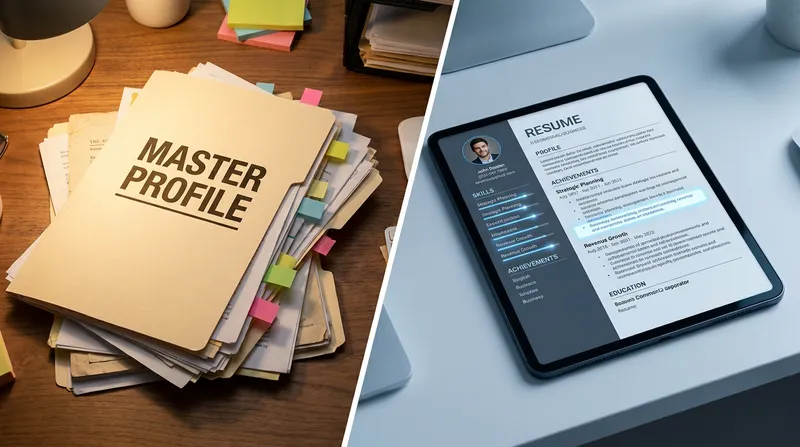
Most resume tools are built around a single workflow: paste a job description, get a tailored document. That workflow breaks the moment you do not have a job description. JobSparrow's Master Profile approach is designed differently. Your career history is the starting point, not the job listing.
Instead of relying on a single job link, our platform acts as your comprehensive career database. When you need an ATS (Applicant Tracking System) friendly resume generator but lack a job description, you simply select an AI-recommended "Role Profile" based on your background.
In seconds, JobSparrow functions as an instant resume generator, pulling the most relevant achievements from your Master Profile and structuring them into a highly targeted, professional document. You can choose from five distinct templates (Professional, Two Column, Elegant, Colorful, and Contemporary) and download your document as a clean PDF or DOCX file.
Minimal manual editing is required. Review the output, add your personal tone, and you are ready to send. You get the benefits of an AI resume builder without the friction of needing a formal job posting.
Actionable Tip: Do not wait for a recruiter to ask. Upload your existing, messy CV to JobSparrow today. Our AI will automatically build your Master Profile in minutes, ensuring you are always ready to generate a targeted document on demand. If you are starting from scratch, read our advice on How to Write a CV With No Experience in Australia & NZ (2026 Guide + Templates).
Beyond the Resume: Preparing for the Recruiter Call
Getting your resume right is just the Position phase of The Offer Path. Once you send a targeted resume for a recruiter networking opportunity, you must immediately transition into the Prepare phase.
When you submit a strong resume for a hidden role, the next step is almost always an immediate screening call. Recruiters move fast when they find a candidate who fits their upcoming needs. You cannot afford to be caught off guard.
You must be ready to articulate the value you highlighted in your newly generated CV. The recruiter will want to know why you are open to new opportunities, what your salary expectations are, and what specific problems you can solve for their clients or internal teams.
Actionable Tip: Prepare a 60-second elevator pitch that perfectly aligns with the specific Role Profile you just targeted your resume toward. Practice delivering this pitch naturally. For detailed frameworks on how to do this effectively, review our guide on How to Answer 'Tell Me About Yourself' in Australia & NZ (Without Sounding Arrogant).
Stop Guessing and Start Generating
Never send a generic resume to a recruiter, and do not waste hours manually guessing how to tailor it without a job description. In the modern job hunt, speed and relevance are your greatest assets.
JobSparrow acts as your dedicated AI career advisor. We help you present the best version of your professional self instantly, allowing you to capitalize on hidden networking opportunities the moment they arise. You can update your resume fast without sacrificing the quality or targeting that hiring managers demand.
Start with a free diagnosis: see your recruiter-lens score and identify the exact gaps in your current CV in minutes. From there, you can unlock our full suite of resume generation and Offer Path tools for a one-time $129 fee with no auto-renewals. Head to https://jobsparrow.ai/free-cv-review to begin.
Frequently Asked Questions
Can I use the same resume for every recruiter I network with?
Sending the exact same resume to every recruiter is a mistake. Different recruiters specialize in different industries and hire for distinct job functions. You should tailor your document to the specific recruiter's industry focus or the general role profile they are hiring for to ensure your most relevant skills stand out immediately.
What is the difference between a master resume and a targeted resume?
A master resume is a comprehensive, multi-page database of everything you have ever done in your career. It is meant for your eyes only. A targeted resume is a concise, curated document highlighting only the skills and achievements relevant to a specific role or job family. You use your master profile to generate your targeted resume.
How do I know what keywords to use if there is no job description?
Research three to five similar job descriptions online to find common industry keywords. Look for recurring software requirements, management methodologies, and core competencies. Alternatively, use an AI tool like JobSparrow to automatically align your Master Profile with standard role requirements, instantly injecting the right keywords into your document.
What should I include in an expression of interest CV?
An expression of interest CV should include a clear objective or target role section at the very top. It must feature a strong summary of transferable skills and quantifiable achievements that prove your baseline value to a company's future growth. It should be forward-looking, framing you as a solution to their upcoming challenges.
Is an AI resume builder ATS-friendly?
While generic AI tools might just stuff keywords unnaturally or use unreadable design elements, a high-quality ATS-friendly resume generator like JobSparrow ensures the formatting is clean, readable by software, and optimized for human recruiters to scan easily.
Tags
Keep reading
Recommended articles.
resume tips · non-technical roles
How to List Projects on Your Resume: Non-Tech & Corporate Examples
Learn to describe projects on a resume for non-tech roles. Find corporate examples for HR, marketing, and operations to land more interviews. Try it free!
chatgpt resume · ai resume
How to Use ChatGPT to Write a Resume (Without Sounding Robotic or Getting Rejected)
Learn how to use ChatGPT to write a resume without sounding robotic. Avoid AI mistakes, beat ATS parsers, and land more interviews. Get a free diagnosis.
resume tips · overqualified
How to Tailor Your Resume When You're 'Overqualified' (Without Dumbing It Down)
Learn how to tailor your resume when you are overqualified without hiding your experience. Get your free recruiter-lens score and land more interviews.