
internal promotion
How to Update Your Resume for an Internal Promotion (And Pass the ATS)
By Job Sparrow Team

You have a great relationship with your manager. You grab coffee with the team, you hit your KPIs, and everyone knows you are eyeing that newly opened senior role. It is tempting to think that your reputation will do the heavy lifting. This leads to a common, painful mistake: submitting a lazy, generic application because you assume the formal process is just a formality.
If you submit a weak resume for an internal promotion, you risk getting automatically rejected by the company's software (known as an Applicant Tracking System, or ATS) before your manager even knows you applied. Corporate HR compliance requires a strict, formalized process to ensure fairness and equal opportunity across the board.
Most large employers now run internal mobility through a formal application process, including mandatory resume submissions and structured interviews. We have seen highly qualified internal candidates lose out to external hires simply because they did not take the application seriously. Your internal mobility resume needs to be just as sharp, tailored, and professional as if you were applying to a brand new company in Sydney, Auckland, London, or New York.
Before you submit, see exactly where your resume stands. Start with a free diagnosis to get your recruiter-lens score in minutes.
Why internal applications still go through an ATS (like Workday)
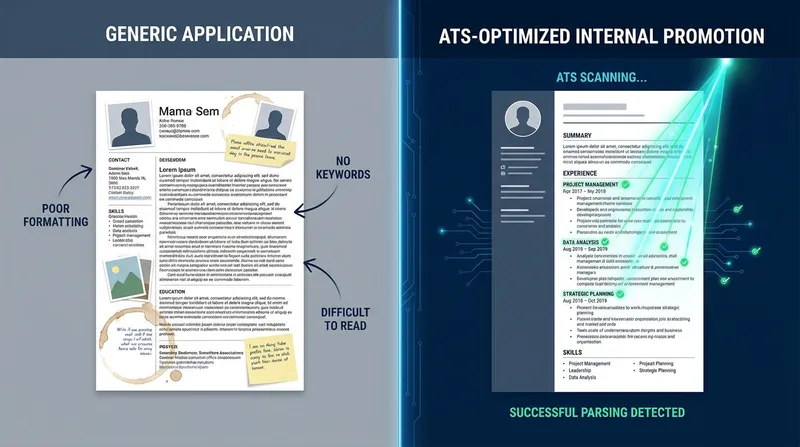
Internal talent portals are not just digital filing cabinets. They are complex Applicant Tracking Systems designed to parse your data, update your employee skill profile, and match your qualifications against the new job description. When you are applying for an internal job in Workday or a similar platform, the system reads your document to evaluate your fit.
Standard HR compliance frameworks dictate that conducting skills assessments and tracking capabilities is a core part of internal mobility best practices. This means the automated systems are actively filtering internal candidates based on the data extracted from your resume. If your internal application resume is poorly formatted or lacks the specific keywords outlined in the job posting, the ATS might flag you as an unqualified match. This can result in an automatic rejection, saving the hiring committee from having to reject you personally.
To ensure your formatting does not break the parser, you need to stick to clean, readable layouts. Avoid complex tables, graphics, and unusual fonts. For a deep dive into formatting rules, check out our guide on whether you need an ATS friendly resume in PDF or Word. Building a proper internal promotion ATS resume ensures that your application successfully bridges the gap between the software and the human hiring manager.
What hiring managers actually look for (both sides of the table)
While you see yourself as a known team player, the recruiter or HR manager sees a compliance audit risk if they cannot prove on paper why you were selected over external applicants.
They need your resume to explicitly justify the hire to cross-departmental stakeholders who might not know you. If your document lacks detail, the hiring manager cannot defend your promotion to the broader committee. Taking the application seriously gives your internal advocates the concrete data they need to push your promotion through compliance check-points.
How to write a resume for an internal job: step-by-step
Knowing how to write a resume for an internal job requires a strategic mindset. Internal mobility demands just as much effort as external job hunting. Internal vacancies are routinely opened to the external market as well, which means your application is competing against outside candidates, not just your colleagues. Securing an internal promotion takes the same deliberate effort as an external job hunt.
At JobSparrow, we guide candidates through a five-stage Offer Path: Diagnose, Position, Execute, Prepare, and Close. For an internal application, the process starts with diagnosing your current resume's gaps and positioning your institutional knowledge as your biggest asset. Here is how to execute that strategy.
1. Highlight internal progression and lateral moves correctly
One of the biggest challenges candidates face is formatting multiple roles within the same company clearly. If done incorrectly, you might look like a job hopper rather than a loyal, ascending employee. For advice on handling short-term stints, you can read our guide on whether to include a 2-month job on your resume.
When highlighting internal progression on your resume, the best internal resume format is the stacked method. List the company name once at the top. Below that, stack your specific job titles in reverse chronological order, providing distinct dates and bullet points for each role. This structure visually demonstrates your growth and increasing responsibility.
Example Format:
- TechCorp Solutions (Sydney, NSW)
- Senior Marketing Specialist (Jan 2024 to Present)
- Bullet point highlighting a major achievement.
- Marketing Coordinator (Mar 2022 to Dec 2023)
- Bullet point highlighting foundational success.
Additionally, you need a strong internal promotion resume summary at the very top of your document. This brief paragraph should frame your institutional knowledge, cross-functional relationships, and proven track record as a massive competitive advantage over any external candidate.
2. Quantify achievements using proprietary data (safely)
The biggest advantage you have as an internal candidate is your access to real company data. External applicants can only guess at the specific metrics that matter to your organization. You, however, know exactly how your current work impacts the bottom line.
When tailoring your resume for an internal role, you must translate everyday tasks into highly quantifiable bullet points.
- Weak: Managed the Q3 marketing project for the regional team.
- Strong: Managed a $500K Q3 marketing project that increased regional sales by 14 percent and reduced customer acquisition costs by $12 per lead.
However, you must balance this with strict confidentiality. Remember that your resume will be stored in the HR database and potentially reviewed by external recruiters or cross-departmental stakeholders. Share metrics safely by using percentages and relative growth figures rather than exposing highly sensitive raw revenue numbers that violate internal data policies.
3. Balance company jargon with industry standard keywords
Every company has its own unique acronyms, internal software names, and project titles. A common mistake on an internal transfer resume is overloading the document with this insider jargon. While the hiring manager might understand it, the ATS parser or an external HR screener might not recognize those terms as matching the required skills.
When tailoring your resume for an internal role, you must map your current internal duties to the exact language used in the new job description. If your company calls it the "Client Success Matrix" but the job description asks for "Customer Relationship Management," use the industry-standard term to ensure the system registers your experience.
Updating your skills data accurately is critical for future-proofing your career. Maintaining a resume that balances company-specific context with universally recognized skills ensures you remain a top candidate for internal mobility as the organization evolves, building long-term career resilience.
Common mistakes to avoid on an internal resume
- Assuming the manager makes the final call: HR and compliance teams have veto power. Your resume must convince them, not just your boss.
- Copy-pasting the job description: Do not just list what you are supposed to do. Focus on the measurable impact of what you have actually achieved.
- Skipping the cover letter: A tailored internal cover letter sets the tone and outlines your 30-day plan, proving you are ready to hit the ground running.
Using AI to tailor your application for an internal transfer
Manually rewriting your entire career history for an internal move is exhausting. If you are wondering how technology can streamline this process, our breakdown on whether AI resume builders are worth it offers a comprehensive look at ATS optimization.
Instead of rewriting your entire history for every application, you store everything once in a Master Career Profile, and our AI does the selecting and tailoring for you. JobSparrow's Job-Specific Resume Tailoring analyzes the internal job description you are targeting and intelligently restructures your bullet points to highlight your most relevant qualifications in under 60 seconds.
What used to take an hour of manual editing now happens automatically, ensuring your application speaks the exact language the ATS and the hiring committee want to hear. Ready to see where you stand? Start with a free diagnosis to get your recruiter-lens score and identify the exact gaps costing you interviews before you submit your internal application.
Do you need an internal promotion cover letter?
Candidates frequently ask if an internal promotion cover letter is genuinely necessary. The definitive answer is yes. However, a cover letter for an internal role serves a very different purpose than one written for an external company.
You do not need to introduce the company culture to the hiring manager. Instead, use this space to acknowledge your current team, explain your desire to grow within the organization, and outline a concrete 30-day plan for the new role. Highlight how your existing internal network will allow you to onboard faster than an external hire.
Writing this document can feel awkward when you already know the recipient. JobSparrow's Intelligent Cover Letter Generator removes that friction. It generates a highly personalized cover letter that strikes the perfect professional tone, weaving your specific internal experiences into a compelling narrative without sounding arrogant or overly casual.
From application to interview: preparing to face your colleagues
Submitting a flawless internal mobility resume is only the Execute phase of the JobSparrow Offer Path. Next comes the Prepare phase. Interviewing for an internal promotion brings a unique type of anxiety: you have to sit across from colleagues you work with every day and suddenly act like a formal job candidate.
It can feel uncomfortable to formally compete with people you respect. That discomfort is normal. The best thing you can do for those relationships is to apply seriously and let your work speak for itself.
It is incredibly easy to fall back into casual workplace banter during these interviews. To prevent this, you need to practice articulating your value professionally. We highly recommend using our Voice AI mock interviews to simulate the real scenario. For more insights on this method, read our article on overcoming interview anxiety and why Voice AI beats text-based tools. Practicing out loud helps you build the natural confidence to deliver strong, structured answers under pressure, ensuring your colleagues see you as the senior professional you are ready to become.
Frequently asked questions
Should I tell my current manager before applying for an internal position?
Yes, always inform your current manager before applying. Human Resources will likely notify them anyway as part of the standard internal mobility process. Controlling the narrative preserves your professional relationship and shows respect for their leadership. It also prevents them from being blindsided by the hiring committee.
Does my internal resume need to be one page?
Not necessarily. While conciseness is key, experienced professionals can use two pages. Focus on relevance to the new role rather than an arbitrary page limit, ensuring every bullet point adds value. If you have a decade of experience at the company, a two-page internal transfer resume is perfectly acceptable.
How do I list multiple promotions at the same company on my resume?
List the company name once at the top, then stack your job titles in reverse chronological order below it, each with its own dates and specific bullet points. This internal resume format highlights your progression clearly and prevents the ATS from misreading your tenure as job-hopping.
Will Workday automatically pull my current resume for an internal application?
Workday may auto-fill your profile based on old data, but you should never rely on it. Always upload a freshly tailored resume specifically optimized for the new internal role. If you rely on an outdated profile, you risk failing the automated ATS screening before the hiring manager even reviews your file.
What should I include in an internal promotion resume summary?
Highlight your tenure with the company, your deep understanding of the company's products or culture, and the specific transferable skills you bring to the new department. Frame your insider knowledge as a strategic asset that will allow you to onboard and deliver results faster than any external hire.
Ready to take the next step?
Do not let a generic resume cost you the promotion you have already earned. Start with a free diagnosis today and let JobSparrow help you secure your next internal role with confidence.
Tags
Keep reading
Recommended articles.
ai resume builder · ats optimization
Are AI Resume Builders Worth It? Pros, Cons, and ATS Optimization in Australia
Are AI resume builders worth it? JobSparrow reveals the pros, cons, and ATS optimization tips to land more interviews in Australia without sounding robotic.
resume tips · job hopping
Should I Include a 2-Month Job on My Resume? (How to Avoid the 'Job Hopper' Label)
Stressing over a 2-month job? Learn whether to include short stints on your resume, how to format contracts, and the best interview scripts to use.
ai resume builder · cover letter tips
The Consistency Rule: How an Integrated Resume and Cover Letter Creator Lands More Interviews
Stop sending mismatched applications. Discover how an integrated AI resume and cover letter generator ensures narrative consistency and lands interviews.