
salary negotiation
How to Negotiate a Salary Offer in Australia (Without Losing the Job) + Scripts
By Job Sparrow Team
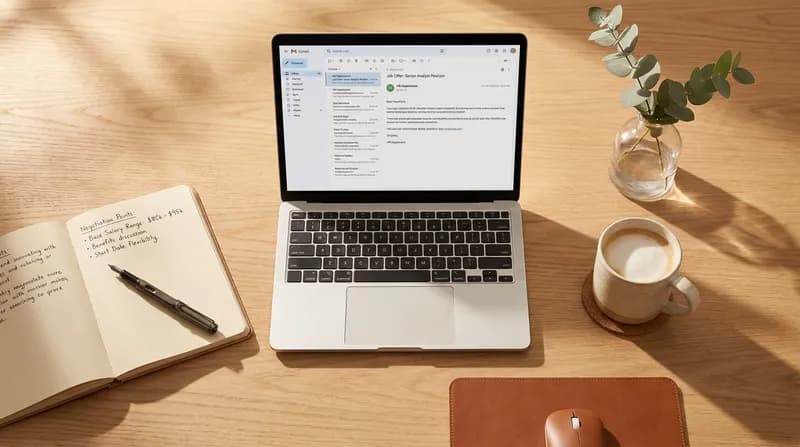
You are staring at the email on your screen. You finally have a job offer in your hands, but the salary is lower than you expected. You know you should ask for more money, but a terrifying thought creeps in: what if they pull the offer?
This fear paralyzes countless candidates. If you are looking for a salary negotiation email template Australia employers respect, or if you are a migrant worried about violating local cultural norms, that anxiety is amplified. Job seekers often accept thousands of dollars less than they are worth simply to avoid looking ungrateful.
At JobSparrow, our method is a five-stage journey: Diagnose, Position, Execute, Prepare, and Close. Negotiating your salary is the ultimate "Close." It is the final hurdle before you sign the contract. Because your starting salary dictates the baseline for all future raises, it is one of the most financially impactful conversations of your career. According to the Program on Negotiation at Harvard Law School, a 25-year-old who negotiates their starting salary from $50,000 to $55,000 will earn about $634,000 more over a 40-year career.
Failing to negotiate is an expensive mistake. This guide provides recruiter-approved scripts and strategies specifically for the Australian and New Zealand markets, helping you ask for more money with absolute confidence.
Will an Employer Actually Pull the Offer if I Negotiate?
Let us look at this from both sides of the table. Our team has reviewed over 100,000 resumes and hired candidates across four markets: Australia, New Zealand, the United States, and Singapore. We know exactly what happens behind closed doors when a candidate asks for more money.
The short answer is no. A professional employer will almost never pull a job offer simply because you tried to negotiate.
By the time a company makes you an offer, they have invested significant time and money into the hiring process. They have paid for job ads, spent hours reviewing resumes, conducted multiple rounds of interviews, and debated internally to choose you over everyone else. They want you to say yes. Starting the hiring process over is a recruiter's worst nightmare.
Guidelines from the University of California, San Diego (UCSD) emphasize that salary negotiation is not about your personal needs, but about the market rate and the company budget. Furthermore, the best time to negotiate is immediately after an offer is extended because that is when you have the most leverage.
The only time an offer gets rescinded is if the candidate becomes aggressive, arrogant, or issues an unprofessional ultimatum. If you negotiate collaboratively and respectfully, the worst a company will usually say is, "We cannot go any higher, this is our final offer."

Understanding Australian Salary Structures: Base vs. Superannuation
Before you can negotiate, you must understand exactly what the company is offering. In Australia, salary offers are typically presented in one of two ways, and confusing them can cost you thousands of dollars.
1. Base Salary plus Superannuation (Super) This means the employer will pay you a base salary, and they will pay your retirement contributions on top of that figure. According to First Super, the current superannuation guarantee rate is 12% of ordinary time earnings.
2. Total Remuneration Package (TRP) or Total Package This means the superannuation is already included in the headline number.
Here is a side-by-side comparison of how a $90,000 offer breaks down under both structures:
| Offer Type | Headline Figure | Base Salary | Superannuation (12%) | Total Package Value |
|---|---|---|---|---|
| Base plus Super | $90,000 | $90,000 | $10,800 | $100,800 |
| Total Package (TRP) | $90,000 | $80,357 | $9,643 | $90,000 |
Actionable Tip: If the job offer email is vague, you must clarify this before countering. You can simply reply: "Thank you for the offer. Before I review the details, could you please clarify if the $90,000 figure is inclusive or exclusive of Superannuation?"
How Much More Should You Ask For?
One of the biggest hurdles in salary negotiation is not knowing what number to say. If you ask for too little, you leave money on the table. If you ask for double the offer, you look out of touch with the market.
Data from the Hays Salary Guide Australia suggests a common guideline is to ask for 5% to 10% more than the initial offer. You can push for up to 20% if the initial offer falls significantly below industry benchmarks.
To determine your exact target, follow these steps:
- Research the market: Use platforms like Seek and Glassdoor to find the average salary for your role and experience level in your specific Australian city (salaries in Sydney will differ from Adelaide).
- Pick an odd number: Instead of asking for a round $90,000, ask for $91,500. Research shows that specific, slightly odd numbers make it look like you have done precise calculations, making employers less likely to negotiate you down steeply.
- Identify non-monetary levers: If the company has a strict budget, be ready to pivot. You can negotiate for an extra week of annual leave, a sign-on bonus, a guaranteed six-month salary review, or a flexible work-from-home schedule.
Ready to land more interviews and negotiate better offers? Start with a free diagnosis to get your recruiter-lens score and use our Gap Analysis feature to know exactly where you stand before you negotiate.
Common Mistakes to Avoid
Before drafting your counter-offer, ensure you do not fall into these common traps:
- Accepting verbally before getting the offer in writing: Excitement can cause you to say yes on the initial phone call. Always say, "Thank you, I look forward to reviewing the written contract," so you preserve your right to negotiate.
- Negotiating against yourself: If an employer asks for your salary expectations first, try to pivot. If you offer a wide range, they will anchor to the lowest number.
- Failing to clarify Superannuation inclusion: As discussed, confusing a Base plus Super offer with a Total Remuneration Package is an easy way to accidentally accept a lower salary.
Recruiter-Approved Salary Negotiation Email Templates (Australia)
While negotiating over the phone is highly effective, many candidates freeze up. Sending an email is a perfectly acceptable way to formalize your counter-offer, allowing you to carefully craft your words and manage your anxiety.
Just like learning how to follow up on a job application by email, getting the tone right in a negotiation email is crucial. You must balance gratitude with professional firmness. Here are two templates you can adapt for your situation.
Template 1: The Standard Counter Offer Email
Use this template when the offer is good, but you want to push for that standard 5% to 10% increase.
Subject: Job Offer - [Your Name] - [Job Title]
Hi [Hiring Manager Name],
Thank you for offering me the position of [Job Title]. I am thrilled about the opportunity to join [Company Name] and contribute to the [Specific Team/Project] team.
Before I sign the contract, I would like to discuss the proposed salary. Based on my [Number] years of experience in [Your Industry], as well as current market research for similar roles in [City, e.g., Melbourne], I was hoping we could explore a base salary of [Your Researched Number, e.g., $92,500] plus Superannuation.
Given my proven track record in [mention one key achievement or skill relevant to the role], I am confident I can bring immediate value to the team and help achieve [Company Goal].
Is there flexibility in the budget to meet this figure?
Thank you again for the offer and your support throughout the interview process. I look forward to hearing from you.
Best regards,
[Your Name]
Why this works: It starts with genuine enthusiasm, uses market data as objective justification, highlights the value you bring, and asks an open-ended question about flexibility rather than making a rigid demand.
Template 2: How to Respond to a Low Salary Offer
Use this template when the offer is significantly below the market rate or your initial expectations.
Subject: Job Offer - [Your Name] - [Job Title]
Hi [Hiring Manager Name],
Thank you for extending the offer for the [Job Title] role. I have really enjoyed getting to know the team, and I am very excited about the prospect of working together.
I have reviewed the details of the offer, and I noticed the proposed salary of [Offered Amount] is somewhat below the market average for this level of seniority in [City], which typically ranges between [Lower Range] and [Higher Range].
Given my specialized experience in [Key Skill] and my ability to [Specific Value Add], I would be very comfortable accepting the offer today if we could agree on a base salary of [Your Target Number].
I understand that budgets can be tight. If there is limited flexibility on the base salary, would you be open to discussing alternative options, such as [mention a perk like additional annual leave or a sign-on bonus]?
I am very keen to join the team and hope we can find a package that works for both of us.
Best regards,
[Your Name]
Why this works: It firmly establishes that you know the market rate, creates urgency by stating you will accept the offer today if they meet your number, and provides a collaborative pivot to non-monetary perks if their cash budget is truly locked.
Salary Negotiation Tips for Migrants in Australia and New Zealand
If you have recently moved to Australia or New Zealand, negotiating can feel like a cultural minefield. Many migrants experience intense imposter syndrome, worrying that their overseas experience will not be valued.
Furthermore, Australia has a unique workplace culture heavily influenced by "tall poppy syndrome" (a cultural tendency to cut down people who act superior or boastful).
Here is how to navigate this:
- Be direct, but not aggressive: Australian business culture values straightforward communication. Do not beat around the bush, but avoid aggressive posturing. Use phrases like "Can we explore..." or "Is there flexibility..." rather than "I demand..."
- Stand by your overseas experience: Do not let employers discount your international background. Frame your global experience as a unique asset that brings fresh perspectives to the local market. For example, if you are writing an accountant resume for Australian migration, you already know the importance of aligning your skills with local standards. Apply that same confidence to your salary negotiation.
- Understand local perks: Familiarize yourself with local benefits. For instance, some Australian companies offer "leave loading" (an extra 17.5% pay on top of your standard pay when you take annual leave) or novated car leases. If you are in New Zealand, note that KiwiSaver (a 3.5% employee and 3.5% employer minimum since 1 April 2026) replaces Superannuation. While negotiation norms are broadly similar to Australia, the New Zealand market is smaller and more relationship-driven.
Practice Makes Perfect: Using AI Mock Interviews for Salary Roleplay
Reading a script on a screen is easy. Saying it out loud while your heart is racing and a hiring manager is waiting on the other end of the line is incredibly difficult.
Before you negotiate, record yourself saying your counter-offer out loud and listen back. You must practice the words until they feel natural. For a more structured practice session, you can use JobSparrow's AI Mock Interview feature. While most candidates use it to practice standard interview questions (like how to answer 'Why do you want to work here?'), you can prompt the AI to act as a hiring manager countering a salary offer.
Our AI provides a safe environment to simulate this exact scenario. It records your audio, analyzes your delivery tone, and gives you instant feedback on your clarity and confidence. You can stumble, try different phrasing, and perfect your pitch before you ever pick up the phone for real.
Start with a free diagnosis to see your recruiter-lens score. Then, unlock the full Offer Path for a one-time $129 to access AI mock interviews, automated resume tracking, and intelligent cover letter generation.
How to Decline a Low Job Offer Gracefully
Sometimes, despite your best collaborative efforts, an employer simply cannot meet your minimum salary requirements. Walking away from a bad deal is a valid and powerful negotiation outcome. It is also one of the most emotionally difficult decisions you will make in your career.
When you realize the numbers will not align, do not decline the offer immediately on the phone. Ask for 24 hours to review their final position. This cooling-off period prevents you from making a rash decision out of frustration and gives the employer one last chance to find extra budget overnight.
If you still need to decline, do it professionally to keep the door open. In smaller markets like Australia and New Zealand, industries are highly connected. The hiring manager you walk away from today could be the person interviewing you at a different company three years from now. Keeping the relationship warm is essential.
Template to decline: "Hi [Name], thank you again for the generous offer and for your time during the interview process. Unfortunately, as the salary does not align with my current requirements and market expectations, I must respectfully decline the offer at this time. I have truly enjoyed learning about [Company Name] and would love to stay in touch for future opportunities that might be a better fit."
This approach leaves a positive final impression, proving your professionalism even when a deal falls apart.
Frequently Asked Questions
Is superannuation included in salary negotiation?
It depends entirely on the wording of the offer. "Base plus Super" means superannuation is paid on top of your negotiated number. "Total Package" or "TRP" means superannuation is included within the headline number. Always clarify this before you start negotiating so you do not accidentally accept thousands of dollars less than you intended.
How long should I wait to reply to a job offer?
It is standard professional practice to ask for 24 to 48 hours to review the contract. Rushing can lead to mistakes and missed opportunities to negotiate. However, waiting too long can appear unprofessional and make the employer think you are using their offer to leverage another company. Acknowledge the offer immediately, express gratitude, and state when you will return with your final answer.
Can I negotiate over email, or should I call?
While a phone call is the industry standard and allows for real-time collaboration, following up a verbal offer with a well-crafted email is perfectly acceptable. For anxious candidates, using a salary negotiation email template designed for Australia ensures you say exactly what you mean without stumbling over your words or agreeing to something prematurely.
What if the company says they have a strict budget?
If the base salary cannot be moved, pivot to non-monetary perks. Ask for an additional week of paid annual leave, a sign-on bonus, a dedicated training budget, or a guaranteed performance and salary review at the six-month mark. This shows you are flexible and collaborative while still advocating for your total value.
Should I disclose my current salary during negotiations?
We strongly advise against it. Your new salary should be based on the market rate for the new role and the value you bring to the company, not what your previous employer paid you. If asked, you can simply pivot by saying, "I am looking for a package in the range of $90,000 to $100,000, which aligns with current market rates for this role."
Tags
Keep reading
Recommended articles.
salary negotiation · australian job market
Salary Expectations in Australia: How to Answer 'Plus Super' vs. 'Including Super'
Learn the exact dollar difference between base plus super and total remuneration packages in Australia. Includes formulas and interview scripts. Start today.
salary negotiation · job offer
Salary Negotiation Email Template & Samples | Job Sparrow
Negotiate a higher salary with our proven email templates and counter-offer samples. Copy, paste, and get the pay you deserve. Boost your offer today!
interview preparation · case study interview
How to Ace a Case Study Presentation Interview in Australia (2026 Guide)
Learn to structure a 5-slide case study presentation for Australian panels, manage your Q&A, and practice with AI. Start your free diagnosis today.