
job application
How to Follow Up on a Job Application by Email (Without Being Annoying) + 5 Templates
By Job Sparrow Team

You hit "submit" on your job application, and now the waiting game begins. Days pass. Then a full week. You want to send a follow-up email after applying for a job, but a familiar anxiety creeps in. What if you sound desperate? What if you annoy the hiring manager and ruin your chances?
This fear of being annoying is the core pain point for almost every job seeker. It leads to total paralysis. You either do not follow up at all, or you send a generic "just checking in" email that recruiters instantly delete.
At JobSparrow, our team has reviewed over 100,000 resumes and hired across four global markets, including Australia, New Zealand, the United States, and Singapore. We know exactly what happens on the other side of the hiring table. Following up is a critical part of the "Close" stage in our Offer Path methodology, which guides candidates through five strategic phases: Diagnose, Position, Execute, Prepare, and Close.
In this comprehensive guide, we will show you how to follow up on a job application without being annoying. You will learn the optimal timelines, the psychology of a value-add message, and exact job application follow-up email templates you can use today.
The psychology of the follow-up: Why you feel annoying (and how not to be)
Most candidates feel annoying because they are only asking for something (a status update) without offering anything in return. Recruiters are incredibly busy. When you send a message that only demands their time and mental energy, it feels intrusive.
To fix this, you must shift your mindset from "checking in" to "adding value."
The Anti-Annoyance Framework means every touchpoint should give the employer a reason to be excited about you. Instead of asking if they have read your resume, share a brief insight about their industry, a link to a recent portfolio project, or a polite reiteration of how your specific skills solve their current problems.
This approach transforms you from a demanding applicant into a consultative professional. It respects the recruiter's cognitive load. A good follow-up is brief, offers a clear exit (meaning there is no pressure for them to reply immediately), and reminds them of your core value.
Why does it take so long to hear back? (The ATS black hole explained)
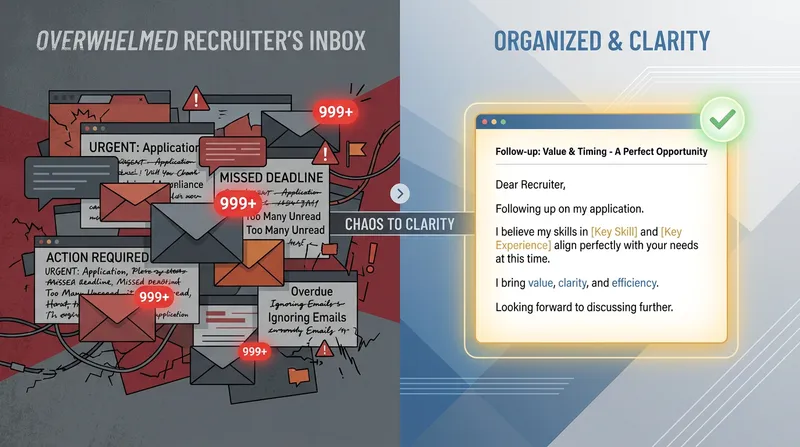
Before you send a post-application follow-up email, it helps to understand why the delay happens in the first place. Recruiters do not ignore you on purpose. The delay is entirely structural.
When you apply, your resume enters an Applicant Tracking System (ATS). Recruiters rarely look at applications one by one as they arrive. Instead, they batch-process them. They might wait until they have 50 or 100 applications before they sit down to review the entire pool.
After the recruiter selects the top candidates, they must send those resumes to the hiring manager for approval. The hiring manager is usually juggling their actual full-time job alongside recruitment duties. This internal back-and-forth takes days, if not weeks.
Understanding this process is vital. Silence does not equal rejection. It usually just means the internal gears are turning slowly.
How long to wait before following up on a job application
Timing is everything. Send an email too soon, and you look impatient. Wait too long, and they might have already scheduled interviews with other candidates.
So, exactly how long to wait to follow up on a job application? The optimal window is generally one to two weeks.
According to guidelines from American University, the initial Applicant Tracking System and recruiter review process typically takes one to three weeks. Reaching out before this window closes interrupts their workflow and can hurt your chances.
Similarly, industry data from Indeed confirms that job seekers should wait one to two weeks to follow up on an initial application, though the timeline shortens to three to five days if you are following up after a formal interview.
Take control of your timeline: See how JobSparrow's application tracker tells you exactly when to follow up and keeps your job search organized. Start your free diagnosis today.
Cultural nuances and seniority: AU/NZ vs. US expectations
Cultural context heavily influences how your follow-up is received. In the United States, a highly assertive follow-up after five days might be praised as a "go-getter" attitude.
However, in Australia and New Zealand, employers strongly favor a more humble, direct approach. Pushing too hard or too early can trigger a negative reaction. Give AU/NZ employers a full 10 to 14 days before sending a polite, low-pressure note.
Your experience level also dictates your approach. Senior professionals often have more leverage to follow up earlier or reference competing offers. Conversely, recent graduates should lean toward a more patient, humble approach, regardless of the market.
How to find the hiring manager's contact information
Sending your follow-up to a generic "info@" or "careers@" address rarely works. These inboxes are often unmonitored or overflowing with spam. You need to find the specific person reviewing your application.
Here is how to track them down:
- Check the Job Listing: Sometimes the recruiter or hiring manager is listed at the very bottom of the description.
- Search LinkedIn: Look for the company name alongside titles like "Talent Acquisition", "Technical Recruiter", or the manager of the specific department you are applying to.
- Verify the Email Format: Most companies use a standard email format, such as firstname.lastname@company.com. You can use free email verification tools online to test your guess before hitting send.
If you are sending cold emails directly to hiring managers, you should also read our guide on What to Write in an Email When Sending Your Resume (7 AU/NZ Templates) | Blog | JobSparrow.
What to include in your follow-up email (the value-add strategy)
When writing your message, you must avoid the trap of simply asking for an update. You need to employ the Value-Add Strategy.
Instead of saying, "I am just checking in on my application," you should offer a new piece of information that makes you a more attractive candidate. This could be a link to a recently published article you wrote, a new certification you just completed, or a brief observation about a recent company product launch.
To see the difference, look at this comparison:
- Before (Generic): "Hi, I am just checking in on my application for the Marketing Manager role. Please let me know if you have any updates."
- After (Value-Add): "Hi, I am following up on my Marketing Manager application. I noticed your recent product launch and attached a brief one-page summary of how I drove a 20 percent increase in engagement for a similar campaign at my previous company."
Research highlighted by the University of Wyoming shows that a well-crafted follow-up email does more than remind the employer of your existence. It actively demonstrates persistence, attention to detail, and genuine interest, helping candidates cut through the noise of crowded inboxes.
Best subject lines for a job application follow-up
Your job application follow-up subject line determines whether your email gets opened or deleted. Keep it clear, professional, and highly specific. Do not try to be overly clever.
Do not use vague subject lines like "Following up" or "Checking in". Instead, state exactly who you are and what role you applied for.
Here are five highly effective subject lines:
- Application Follow-Up: [Your Name] for [Job Title]
- Update Request: [Job Title] Application - [Your Name]
- [Your Name] - Additional Information for [Job Title] Role
- Following Up: [Job Title] Position - [Your Name]
- [Job Title] Application Status - [Your Name]
Job application follow-up email templates
When deciding what to say when following up on a job application, you want to sound confident but respectful of their time. These templates are designed to bypass the anxiety of a blank page. Simply customize the bracketed information to fit your situation.
Template 1: The standard professional follow-up (AU/NZ friendly)
This template is perfect for the Australian and New Zealand markets, where a polite, direct tone is expected. It is professional and does not apply unnecessary pressure.
Subject: Application Follow-Up: [Your Name] for [Job Title]
Hi [Hiring Manager Name],
I am writing to follow up on my application for the [Job Title] position submitted on [Date]. I remain very interested in joining [Company Name].
With my background in [Key Skill 1] and [Key Skill 2], I am confident I could bring immediate value to your team. Please let me know if you need any additional information from me, such as work samples or professional references.
Thank you for your time, and I look forward to hearing about the next steps.
Best regards,
[Your Name] [Link to your LinkedIn Profile]
Template 2: The value-add follow-up
Use this template when you want to stand out by offering a unique insight or update. This proves you are actively engaged with their industry.
Note: If you do not have a specific metric to share, you can easily substitute the achievement below with a link to a relevant article you wrote, a new certification, or a brief industry observation.
Subject: [Your Name] - Application for [Job Title] + Quick Resource
Hi [Hiring Manager Name],
I recently applied for the [Job Title] role and wanted to reiterate my enthusiasm for the position.
While researching [Company Name]'s recent launch of [Product or Campaign], I noticed your team is focusing heavily on [Specific Area]. I recently completed a similar project that increased our team's efficiency by 20 percent, and I have attached a brief one-page summary of how I approached it.
I would love to bring this same strategic thinking to your team. Let me know if you have any questions about my application.
Best regards,
[Your Name] [Phone Number]
Template 3: Follow-up email to recruiter after application (LinkedIn approach)
If you cannot find a direct email address, reaching out via a professional network is your next best option. However, as noted by the University of Arizona, candidates should wait two weeks before messaging a recruiter on LinkedIn or Handshake to ensure the application has had adequate time to be reviewed.
Message:
Hi [Recruiter Name],
I submitted my application for the [Job Title] role two weeks ago.
I know your team is incredibly busy reviewing candidates, but I wanted to quickly express my strong interest in the position. My experience in [Key Skill] aligns perfectly with the job description.
I look forward to any updates.
Best, [Your Name]
Template 4: Second follow-up email after no response
If you have already sent one follow-up and heard nothing for another full week, you can send one final message. After this, you must move on and focus your energy elsewhere.
Subject: Final Follow-Up: [Your Name] for [Job Title]
Hi [Hiring Manager Name],
I am following up one last time regarding my application for the [Job Title] position. I am still very interested in the opportunity to work with [Company Name].
If the role has already been filled, I completely understand. If you are still reviewing applications, please let me know if there are any further details I can provide to assist in your decision.
Thank you again for your time and consideration.
Best regards,
[Your Name]
Template 5: Post-application follow-up email (with a competing offer)
If you have received an offer from another company but would prefer to work for this one, you can use that leverage to speed up their timeline.
Subject: Update on Application: [Your Name] for [Job Title]
Hi [Hiring Manager Name],
I am writing to follow up on my application for the [Job Title] role. I remain very interested in joining your team.
I wanted to transparently share that I have recently received a competitive job offer from another organization. They have asked for my decision by [Date]. Because [Company Name] is my top choice, I wanted to check if there might be an update on my application status before I make my final decision.
Thank you for your time and understanding.
Best regards,
[Your Name]
Mistakes to avoid when following up
When learning how to follow up with a hiring manager, knowing what not to do is just as important as knowing what to say. Avoid these critical errors:
- The Multi-Channel Barrage: Do not follow up across multiple channels at the exact same time. If you send an email, do not instantly send a LinkedIn message and call their office. This is overwhelming and highly annoying.
- The Guilt Trip: Do not express frustration. Even if you have been waiting a month, your tone must remain flawlessly polite. Complaining about their slow process will guarantee a rejection.
- The Premature Follow-Up: Reaching out after 48 hours makes you look desperate and unaware of standard business practices.
- Ignoring "No Contact" Rules: If the job posting explicitly says "No calls or emails," you must respect their process. Following instructions is your first test as a candidate.
- Attaching Massive Files: Do not attach a 50MB portfolio PDF to a follow-up email unless they specifically asked for it. It clogs their inbox and creates frustration.
How to check on a job application status (the smart way)
Avoiding these mistakes is easier when you are not trying to manage your entire job search in your head or on a cluttered spreadsheet. Managing a job search across multiple platforms (like LinkedIn, Seek, and Indeed) is fragmented and exhausting. It is easy to forget when you applied and when you should follow up.
This is where a dedicated job application tracker becomes essential.
With JobSparrow's Job Application Tracking & Analysis dashboard, you get a command center for your entire search. You can fetch job details instantly from a URL, see a "Match Score" based on your Master Career Profile, and keep all your tailored documents in one place. You will always know exactly when it is time to send that follow-up email.
Furthermore, our AI Gap Filler analyzes your profile before you even apply, identifying missing metrics or vague descriptions. A stronger application reduces the need for aggressive follow-ups because your resume will speak for itself. If you are tired of generic applications, learn more about our approach here: CV Writing Service, or an AI Career Advisor for the Whole Hunt? | JobSparrow.
Are you struggling to find relevant roles in the first place? You might be trapped by platform algorithms. Check out our guide on Why You Keep Seeing the Same 10 Jobs (And How to Beat the LinkedIn & Seek Algorithms) | Blog | JobSparrow.
Conclusion: Navigating the offer path
Following up on a job application does not have to be a source of anxiety. By waiting the appropriate amount of time, finding the right contact person, and using a value-add strategy, you can demonstrate your professionalism without crossing the line into desperation.
At JobSparrow, we believe that every step of your job hunt should be strategic. We do not just fix your resume; we coach you through the entire Offer Path, from your initial diagnosis to your final salary negotiation.
Ready to land more interviews and take the guesswork out of your job search? Start with a free diagnosis today. You will see your recruiter-lens score and identify the exact gaps costing you interviews in minutes. Your success story starts here.
Frequently asked questions
How long should I wait to follow up on a job application?
You should wait exactly one to two weeks after submitting your application. This gives the Applicant Tracking System (ATS) and the human recruiters enough time to process the initial batch of candidates without feeling rushed. Reaching out any earlier can make you appear impatient or unaware of standard corporate hiring timelines.
What is the best subject line for a job application follow-up email?
The most effective subject line is direct, professional, and factual. Use "Application Follow-Up: [Your Name] for [Job Title]" to ensure the recruiter knows exactly what the email is about before they even open it. Avoid vague phrases like "Checking in" or "Hello," which are easily mistaken for spam and ignored.
Should I follow up if the job posting explicitly says "no calls or emails"?
No, you should never follow up if the employer explicitly requests no contact. Following instructions is your very first test as a candidate. If they ask you not to reach out, you must respect their boundaries. Violating this rule will almost certainly result in your application being immediately discarded by the hiring manager.
How do I follow up if I do not have the hiring manager's email address?
If you cannot find a direct email address after checking the job listing and searching the company directory, you can send a polite, brief message to the recruiter or hiring manager via LinkedIn. Ensure your LinkedIn profile is fully updated before you reach out, and wait at least two weeks before sending the connection request or InMail.
Is it okay to follow up on LinkedIn instead of email?
Yes, LinkedIn is a highly acceptable alternative to email, provided you keep the message professional and brief. It is especially useful for reaching out to modern tech companies, startups, or recruiters who are highly active on the platform. However, do not send multiple messages if they do not reply to your first attempt.
How many times should I follow up after applying for a job?
You should follow up a maximum of two times. Send your first email after two weeks. If there is no response, wait one more full week and send a final, polite message. If you still hear nothing after the second attempt, assume they have moved forward with other candidates and focus your energy on new opportunities.
Tags
Keep reading
Recommended articles.
job application · follow up email
How to Follow Up on a Job Application: Email Templates
Learn how to follow up on a job application professionally. Get free email templates and timing tips to boost your interview chances with Job Sparrow.
job application · resume tips
What to Write in an Email When Sending Your Resume (7 AU/NZ Templates)
Learn what to write in an email when sending your resume with 7 AU/NZ templates from JobSparrow. Discover the Shadow ATS strategy and land more interviews.
interview follow-up · new zealand job market
Thank You Email After Interview NZ: 2026 Templates & Follow-Up Guide
Send the perfect thank you email after your NZ interview. Get free 2026 templates and learn Kiwi etiquette to land the job without sounding pushy.