
job application
How to Follow Up on a Job Application: Email Templates
By Job Sparrow Team

You've done the hard work. You perfected your resume, wrote a compelling cover letter, and sent your application into the digital void. Now comes the hardest part: the wait. The silence can be nerve-wracking, leaving you to wonder if your application was even seen. But what if you could turn this passive waiting period into a proactive opportunity?
This guide will demystify the post-application process. We'll provide a clear, professional framework for how to follow up on a job application, complete with expert-backed advice and templates. A strategic follow-up doesn't make you a nuisance; it shows you're an engaged, organized, and enthusiastic candidate. It can be the very thing that moves your application from the 'maybe' pile to the 'interview' list.
By systematically tracking your applications and follow-ups, you transform your job search into a manageable project. Ready to take control? Start tracking your applications with JobSparrow today.
Why Following Up on a Job Application Is Worth Your Time
In a competitive job market, recruiters are often inundated with hundreds of applications for a single role. A polite and professional follow-up is a powerful way to cut through the noise. Far from being pushy, it's a sign of initiative.
According to the career experts at iHire, a well-timed follow-up accomplishes four key goals:
- It confirms receipt: You get peace of mind knowing your application didn't get lost in a spam filter.
- It shows genuine interest: It reiterates your enthusiasm for the specific role, beyond just firing off another application.
- It keeps you top-of-mind: Your name reappears in the hiring manager's inbox at a crucial time.
- It provides a status update: It can give you a better sense of the hiring timeline.
Ultimately, following up is about demonstrating your professionalism and taking control of your job search.
The Follow-Up Timeline: How Long to Wait Before You Reach Out
Timing is everything. Reaching out too soon can seem impatient, while waiting too long can mean the opportunity has already passed. Before doing anything, carefully re-read the job description. Many companies, like the global staffing firm Robert Half, advise that if the posting explicitly says "no calls" or "do not follow up," you must respect their request. It's often the first test of your ability to follow directions.
If the posting doesn't provide instructions, here is a simple timeline to follow.
After Submitting Your Initial Application
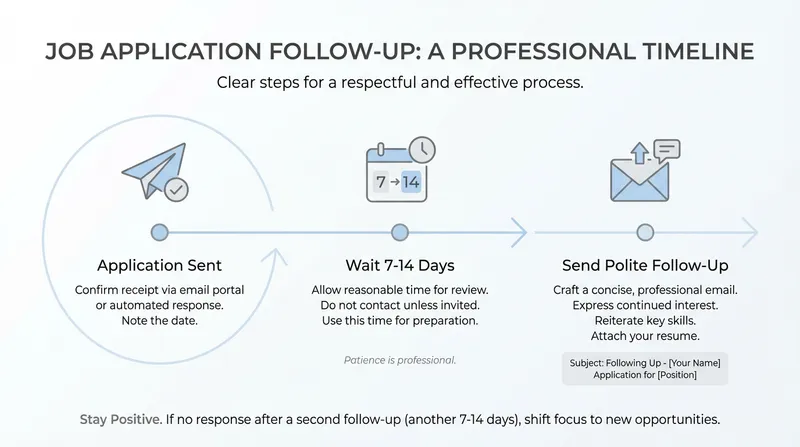
Wait one to two weeks. This is the golden rule recommended by career platforms like FlexJobs. This window gives the hiring team enough time to review the initial wave of applications. If the job posting included an application deadline, wait at least a few days after that date before reaching out.
After a Phone Screen or Interview
Send a thank-you note within 24 hours. This is non-negotiable. According to TopResume, a vast majority of hiring managers find thank-you notes impactful. It's a chance to reiterate your interest and mention something specific you enjoyed discussing. To build confidence for your next interview, practice with JobSparrow's AI Mock Interviews to sharpen your answers.
If the interviewer gave you a timeline (e.g., "We'll be in touch by the end of next week"), wait a couple of business days after that deadline passes before following up. If no timeline was given, wait about one week after sending your thank-you note before checking in.
How to Follow Up: Email, Phone, and LinkedIn
While email is the standard, a multi-channel approach can be effective if done correctly. As noted by the educational platform Coursera, the best method depends on the company culture and any instructions you've been given.
- Email (The Standard): This is the safest and most professional method. It's non-intrusive, provides a written record for both you and the employer, and allows the hiring manager to respond on their own schedule.
- Phone Call (Use with Caution): A phone call can be effective in some industries but can also be seen as overly aggressive. Only consider this if you have a direct contact number for the recruiter or hiring manager and the job posting doesn't forbid it. Always have a short, professional script ready.
- LinkedIn (The Modern Touch): A 'soft' follow-up on LinkedIn can be very effective. You can send a connection request to the recruiter with a brief, personalized note mentioning your application. You can also engage with the company's recent posts to stay on their radar.
Professional Follow-Up Email Templates That Get Replies
A great follow-up email is concise, polite, and professional. It should include:
- A Clear Subject Line: Make it easy for the recipient to know who you are and what the email is about.
- A Polite Greeting: Use the hiring manager's name if you have it.
- A Brief Reminder: State the job title you applied for and when you applied.
- A Reiteration of Interest: Briefly state why you are excited about the role.
- A Clear Closing: End with a polite closing and your name.
Here are several templates you can adapt for your own use.
Follow-Up Email Subject Lines That Get Opened
- Following Up: [Job Title] Application
- Checking in on [Job Title] Role - [Your Name]
- Question about the [Job Title] Application (Use this only if you have a genuine, specific question that isn't answered in the job description.)
- Following Up on my Interview for [Job Title]
Template 1: The First Follow-Up After Applying (No Response)
Subject: Following Up: [Job Title] Application
Dear [Mr./Ms./Mx. Last Name],
I hope this email finds you well.
I am writing to politely follow up on my application for the [Job Title] position, which I submitted on [Date of Application]. I was very excited to learn about this opportunity, as my experience in [mention 1-2 key skills or experiences] aligns well with the requirements you outlined in the job description.
Could you please let me know if there is any additional information I can provide? I remain very interested in this role and am eager to learn more about the next steps in the hiring process.
Thank you for your time and consideration.
Best regards,
[Your Name]
Template 2: The Second Follow-Up Email (After No Response)
Use this template about a week or two after your first follow-up if you still haven't heard anything. The tone remains positive and professional, not demanding.
Subject: Checking in on [Job Title] Role - [Your Name]
Dear [Mr./Ms./Mx. Last Name],
I hope you are having a productive week.
I am writing to briefly check in on the status of the [Job Title] position I applied for on [Date of Application]. I remain interested in the possibility of joining your team and contributing my skills in [mention a different skill or achievement].
I understand you are likely very busy. If the position has been filled or is no longer available, I would appreciate a quick note to that effect. Otherwise, I look forward to hearing from you at your convenience.
Thank you again,
[Your Name]
Template 3: Following Up with a Recruiter
Recruiters are busy, so keep your follow-up with them extra concise.
Subject: Following Up: [Job Title] Application
Hi [Recruiter's First Name],
I hope you're having a great week. I'm just checking in on my application for the [Job Title] role at [Company Name].
I'm still very interested in the opportunity and confident I can bring value to the team. Please let me know if there's anything else you need from my end.
Thanks so much,
[Your Name]
Template 4: Following Up When You Have Another Offer
This can be a powerful move, as it creates a sense of urgency. It can also help you prepare for what comes next. If you do get an offer from this role, you'll need to know how to respond, and having a salary negotiation email template ready can be a huge advantage.
Subject: Checking in on [Job Title] Role - [Your Name]
Dear [Mr./Ms./Mx. Last Name],
I hope this email finds you well.
I am writing to follow up on my candidacy for the [Job Title] position. I greatly enjoyed our conversation on [Date of Interview] and remain very excited about this opportunity.
I am writing because I have received another job offer. While I am grateful for the offer, my strong preference is to join the team at [Company Name]. I would be grateful to know the status of your hiring timeline so I can make an informed decision.
Thank you for your time and consideration.
Best regards,
[Your Name]
Your Secret Weapon: How to Use a Job Application Tracker for Flawless Follow-Ups
After sending your tailored resume and cover letter (generated with JobSparrow's AI), managing follow-ups for multiple applications can quickly become overwhelming. This is where a dedicated tool becomes your most valuable asset.
Instead of relying on messy spreadsheets or scattered notes, JobSparrow's Job Application Tracker centralizes your entire job search. Here's how it empowers you to follow up flawlessly:
- Log Everything in One Place: When you apply for a job, you can instantly save the application date, the job description, and the hiring manager's contact information. This eliminates the frantic search for details when it's time to follow up.
- Set AI-Powered Reminders: Did you apply on December 1st? Log it in JobSparrow. Our system uses smart, AI-powered reminders to prompt you to send your first follow-up email at the optimal time. You'll never miss a follow-up window again.
- Keep Communication Records: Add a note every time you send a follow-up or speak with a recruiter. This log ensures you never send a redundant email or forget a key detail from a conversation.
By using a tool like this, you transform your job search from a chaotic process into a structured, manageable project. To learn more, check out our guide on how a Job Application Tracker with Skill Gap Analysis Boosts Your Success.
Special Considerations for Career Changers and Migraters
If you are changing careers or are new to the job market in a particular country, your resume may not tell the whole story. The follow-up email is a perfect, subtle opportunity to add crucial context.
- For Career Changers: Your follow-up can briefly bridge the gap between your past experience and the new role. For example: "As a career changer from the finance sector, I'm particularly excited to apply my analytical skills to this marketing role." For more on this, explore our guide to writing a career change resume.
- For Migraters: A follow-up can be a place to proactively and positively address potential questions. You might add a line that shows your understanding of the local market, such as: "Having recently relocated, I have been closely following industry trends in [Country/City] and am eager to contribute my global experience to a local leader like [Company Name]."
Follow-Up Fails: 6 Common Mistakes to Avoid
How you follow up is just as important as when. Avoid these common pitfalls that can hurt your chances:
- Following Up Too Soon or Too Often: This is the quickest way to be perceived as impatient and unprofessional.
- Being Vague: An email that just says "checking in" is a missed opportunity. Always mention the specific role.
- Sounding Demanding or Frustrated: Even if you're anxious, your tone must remain positive and polite.
- Ignoring Instructions: As noted by experts at Robert Half, ignoring a "no calls" policy is a major red flag.
- Sending Sloppy Emails: Typos and grammatical errors suggest a lack of attention to detail. Always proofread before hitting send.
- Not Knowing When to Stop: A polite follow-up is good; endless pestering is not. If you've sent two follow-ups over several weeks with no response, it's a strong signal to move on and focus your energy elsewhere.
Take Control of Your Job Search
Waiting to hear back from a job application is a universal experience, but it doesn't have to be a passive one. A patient, professional, and organized follow-up strategy demonstrates your commitment and sets you apart from the competition.
By following a clear timeline, using professional templates, and staying organized with JobSparrow, you can navigate this crucial stage with confidence. Ready to turn your application data into your career roadmap? Start Your Free Trial with JobSparrow and see how our AI-powered tools can help you land your dream job faster. Our unique "Pay for Result" model means you only pay if our tools help you land a job—it's a risk-free investment in your career.
Frequently Asked Questions
What if the job posting says 'no calls' or 'do not follow up'?
Always respect the instructions in the job posting. Recruiters often include this to test whether candidates can follow directions. Not following up is the correct and most professional action in this scenario, and failing to adhere to this request could get your application disqualified.
How soon is too soon to follow up on an application?
Following up less than one full week after submitting your application is generally too soon. The standard professional etiquette is to wait one to two weeks. This gives the hiring team adequate time to review the initial pool of candidates without feeling pressured.
Is it okay to follow up more than once?
Yes, it is acceptable to send a second follow-up email. Wait another one to two weeks after your first message. However, if you still don't receive a response after your second attempt, it's best to take that as a sign to focus your energy on other opportunities. Continuing to send messages beyond this point can appear unprofessional.
What are some creative ways to follow up that stand out?
Instead of simply asking for an update, add value. You could share a link to a recent, insightful article related to the company's industry, or briefly mention a new skill you've acquired that is relevant to the role. This shows your continued engagement and passion for the field without being pushy.
Should I follow up on every single job application I submit?
It's more strategic to focus on quality over quantity. Prioritize following up on the roles that you are most qualified for and genuinely excited about. Using a job application tracker can help you manage and prioritize these high-value follow-ups without getting overwhelmed.
Tags
Keep reading
Recommended articles.
job application · job search
How to Follow Up on a Job Application: The Ultimate 2026 AU & NZ Guide
Master job application follow-ups in AU & NZ with our 2026 guide. Get email templates, phone scripts, and LinkedIn strategies to land your next interview.
job application · follow up email
How to Follow Up on a Job Application by Email (Without Being Annoying) + 5 Templates
Learn exactly when and how to follow up on a job application without annoying recruiters. Free templates included to secure your interview. JobSparrow.
job application · resume tips
What to Write in an Email When Sending Your Resume (7 AU/NZ Templates)
Learn what to write in an email when sending your resume with 7 AU/NZ templates from JobSparrow. Discover the Shadow ATS strategy and land more interviews.