
resume tips
How to Explain an Employment Gap on Your Resume: A 2026 AU & NZ Guide
By Job Sparrow Team

That blank space on your resume feels like a spotlight, doesn't it? Every time you look at it, a wave of anxiety hits. You worry that recruiters will see the gap, toss your application aside, and move on. This fear, that an employment gap makes you unemployable, is the single biggest hurdle job seekers in Australia and New Zealand face when updating their CV.
But here's the truth: career breaks are a normal and increasingly common part of modern professional life. As the nature of work evolves towards 2026, with portfolio careers and project-based roles on the rise, a perfectly linear career path is becoming the exception. The key isn't to hide the gap, but to own it. You don't just need to know what to write. You need a strategy to confidently frame your time off as a period of growth, resilience, and readiness. This guide will provide that strategy.
We'll move beyond generic advice and give you a complete playbook tailored for the AU & NZ job markets. You will learn how to transform your career gap from a perceived weakness into a compelling story across your resume, cover letter, and interview, proving to employers that you are the right candidate for the job, not despite your break, but because of the perspective you gained during it.
What Is an Employment Gap (and Why Are They So Common in AU & NZ)?
An employment gap is any period of time when you were not formally employed. In today's dynamic job market, they are far from unusual. Economic shifts, personal priorities, and global events mean that a non-linear career journey is standard.
Just look at the official data. Even in a relatively stable market, a percentage of the workforce is always in transition. According to the Australian Bureau of Statistics (ABS), thousands of Australians are actively looking for work at any given time. Similarly, data from Stats NZ Tatauranga Aotearoa shows that unemployment is a standard economic feature in New Zealand. These aren't just numbers. They represent people on a journey between roles, a journey that might include a gap for many valid reasons:
- Redundancy or layoff
- Parental leave
- Taking a planned career break for travel
- Caring for a family member or dealing with a personal illness
- Pursuing further education or upskilling
- Migrating to Australia or New Zealand and navigating the visa and settlement process
- Starting a business or pursuing freelance projects
Should I Hide an Employment Gap on My Resume?
In a word: no. While it's tempting to fudge dates or omit a period of unemployment, recruiters and hiring managers are trained to spot inconsistencies. As recruitment experts advise, honesty is crucial. Getting caught being deceptive is far more damaging than the gap itself.
Furthermore, the perception of career breaks is changing. Progressive organisations now recognize that gaps can foster valuable skills like resilience, diverse perspectives, and a renewed work ethic. Your goal isn't to hide the gap, but to strategically frame it.
There is one formatting trick, however, that can de-emphasize short gaps. Research has found that listing employment dates by year (e.g., "2023 - 2025") instead of month and year increased interview callbacks by 15%. This can effectively smooth over gaps of a few months.
Note on Transparency: While this method can smooth over short gaps without being deceptive, always ensure the years align with your LinkedIn profile and other application materials to maintain consistency and honesty.
The Confidence Comeback: Owning Your Career Narrative
Before you write a single word, you need to change your mindset. Your career gap is not a liability. It's a chapter in your professional story. The key is to shift your focus from what you weren't doing (working for an employer) to what you were doing.
This is where many job seekers get stuck. It's hard to translate life experience into professional language. JobSparrow's Gap Filler feature is designed to solve this. It acts as your personal career coach, analyzing your profile to identify gaps and then asking targeted questions like:
- "What online courses or certifications did you complete during this time?"
- "Did you manage any significant household projects that required budgeting or planning?"
- "Did you volunteer or engage in any community activities?"
Based on your answers, it helps you articulate your experience with professional, impactful language, building both your resume and your confidence.
How to Format Employment Gaps on Your CV: Three Proven Strategies
How you present the gap on your CV matters. You need a format that is honest, professional, and keeps the focus on your value. Here are three strategies for the AU & NZ market.
Strategy 1: The Simple, Single-Line Explanation
Best for short, straightforward gaps (e.g., under six months). Simply insert a single, italicized line between your roles. It's clean, honest, and doesn't draw unnecessary attention.
Example: Senior Marketing Manager, A Leading Retail Group, Sydney, NSW (2021 - 2024)
Planned career break for travel and professional development (Jan 2025 - Jun 2025)
Marketing Manager, A Global Software Provider, Melbourne, VIC (2018 - 2021)
Strategy 2: The Positively Framed "Role"
Best for longer gaps (six months or more) where you undertook significant activities like parental leave, study, or a major project. You format the gap like a job role, allowing you to include bullet points that highlight transferable skills.
Example: Full-Time Parent & Household Manager, Auckland, NZ (2023 - 2025)
- Managed complex scheduling, budgeting, and logistical planning for a family of four.
- Honed skills in negotiation, time management, and conflict resolution.
- Maintained industry knowledge through online webinars and professional networking.
Strategy 3: The Chronological-Functional Hybrid CV
Best for career changers or those returning after a very long break. This format starts with a powerful "Professional Summary" and "Key Skills" section at the top. This forces the recruiter to focus on what you can do before they even look at your chronological work history. For more on this, check out our guide on resume formats for a career change.
To ensure your formatting choices are effective, it's crucial to build an ATS-friendly resume. JobSparrow's Job-Specific Resume Tailoring automatically structures your experience into professionally designed, ATS-compliant templates, taking the guesswork out of formatting.
CV Examples for Common Career Gaps in Australia & New Zealand
Let's get practical. Here is how to phrase different gaps on your CV, tailored for local context.
Scenario: Redundancy
- What to write: "Position was made redundant following a company-wide restructure."
- Pro Tip: Immediately follow this with a bullet point about what you did next. For example: "Proactively completed a certification in Project Management (PMP) to enhance skills for my next role."
Scenario: Parental Leave
- What to write: "Parental Leave (2024 - 2025)"
- Pro Tip: Add one or two bullet points that translate parenting into professional skills. For example: "Oversaw household project management, including budget allocation and scheduling, strengthening organisational capabilities." For more on this, see our guide to showcasing transferable skills.
Scenario: Career Break for Travel
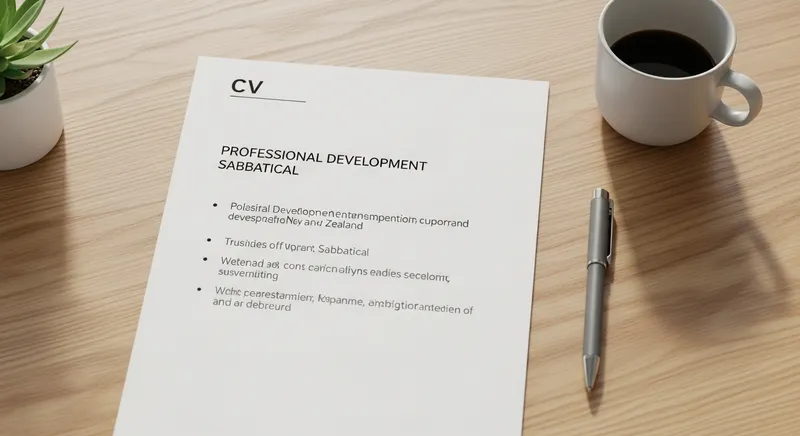
- What to write: "Self-Funded Sabbatical: International Travel (2024)"
- Pro Tip: Focus on skills gained. For example: "Developed cross-cultural communication and adaptability skills while navigating 10 countries across Southeast Asia. Managed a strict budget over a 12-month period."
Scenario: Illness or Caring for Family
- What to write: "Planned career break for personal health reasons (2024). Now fully recovered and eager to return to the workforce."
- Pro Tip: Keep it brief and professional. You are not required to disclose details. The focus should be on your readiness to return to work now. Be prepared for potentially illegal interview questions and know your rights.
Scenario: Migration to AU/NZ
- What to write: "Relocation to Australia & Visa Processing (2024 - 2025)"
- Pro Tip: This is a perfect explanation that recruiters in AU/NZ understand well. It shows commitment to your new location. For example: "Successfully managed the end-to-end process of relocating from the UK to Sydney, including navigating complex visa requirements and establishing a local network." If you're struggling with this, our guide for migrants on landing a job with no local experience is a must-read.
Beyond the CV: Addressing Your Career Gap in the Cover Letter
Your cover letter is your chance to add context and personality. While your CV states the what, your cover letter explains the why and connects it to the future. Dedicate one short paragraph to addressing the gap, framing it positively before pivoting back to the value you bring.
See how a simple statement can be transformed into a powerful pitch:
-
Before: "I was unemployed for six months last year after my role was made redundant. I am now ready to return to work."
-
After (with JobSparrow): "After a successful tenure at my previous company, I took a planned six-month break to earn a certification in digital marketing. This experience deepened my expertise in SEO and content strategy, skills I am excited to bring to the [Job Title] role at [Company Name]."
Writing a unique cover letter for every application is draining. JobSparrow's Intelligent Cover Letter Generator can create a tailored letter for you in seconds, intelligently weaving your career gap explanation into a compelling narrative that matches the job description.
How to Explain an Unemployment Gap in an Interview
This is the moment of truth. If you've framed the gap well on your CV, the interview question will be less of an interrogation and more of a conversation. Use the simple and effective "PAST - PRESENT - FUTURE" framework.
-
PAST (The Reason): State the reason briefly, honestly, and without apology.
*"My role was made redundant during a company merger." -
PRESENT (The Activities): Immediately pivot to what you did during your time off. This is where you showcase your proactivity.
*"I used that time to upskill in an area I'm passionate about, completing an advanced diploma in UX Design. I also volunteered with a local non-profit to keep my project management skills sharp." -
FUTURE (The Pivot): Connect everything back to the job you are interviewing for.
*"That experience directly prepared me for this role, as your team is focused on developing user-centric products. I'm eager to apply my new UX skills and proven project management background to help you achieve your goals."
Confidence is everything here. The best way to build it is to practice. JobSparrow's AI Mock Interviews create a safe space to rehearse your answer. You can practice responding to the "tell me about this gap" question until your delivery is smooth, confident, and natural. Get real-time feedback and master the STAR method for all your answers.
Your 5-Step Action Plan
Feeling overwhelmed? Here's a quick checklist to turn your gap into an advantage.
- Audit Your Break: List all activities (courses, travel, projects, caregiving) and translate them into professional skills (e.g., budgeting, logistics, new software proficiency).
- Choose Your Strategy: Select the best CV format for your situation: the single line, the framed "role," or the hybrid model.
- Craft Your Narrative: Write a clear, positive, one-to-two-line explanation for your CV and a short paragraph for your cover letter.
- Prepare Your Story: Structure your interview answer using the PAST-PRESENT-FUTURE framework.
- Practice with Confidence: Rehearse your explanation until it feels natural. Use tools like JobSparrow's AI mock interviews to get comfortable.
Your Gap is Not a Weakness
An employment gap is only a negative if you allow it to be. By reframing your experience, owning your narrative, and preparing a confident explanation, you can turn a potential red flag into a testament to your resilience, proactivity, and unique journey.
Your career is more than a linear progression of job titles. It's a story of growth, learning, and adaptation. Your career break is a valid and valuable part of that story.
Ready to turn your career gap into a competitive advantage? Upload your CV to JobSparrow today. Our AI-powered tools will help you craft the perfect narrative, tailor your applications, and practice your interview answers, giving you the confidence to land your next great role in Australia or New Zealand.
Frequently Asked Questions
Should I mention parental leave on my resume in Australia?
Yes, absolutely. Transparency is valued, and parental leave is a respected reason for a career break. Frame it positively like a role, for example, "Parental Leave & Household Management (2024-2025)," and list one or two skills you honed, like budgeting or project management.
How do I explain a gap due to redundancy on my NZ resume?
Be direct and professional. On your CV, a simple line like "Position made redundant due to organisational restructure" is sufficient. In your cover letter and interview, the key is to immediately explain how you used the time productively, such as upskilling or volunteering, to show resilience.
Is a three-month gap on a resume a red flag in Australia?
Generally, no. Recruiters in Australia typically view gaps of up to six months as a normal part of a career. For very short gaps, you can use the year-only date format (e.g., 2024-2025) on your resume, but for anything longer, a simple, one-line explanation is the best approach.
Can I use a skills-based CV to hide an employment gap?
It is not recommended. Recruiters often view a purely functional (skills-based) resume with suspicion, as it can look like you are hiding job-hopping or a long gap. A hybrid format is a much better strategy. It leads with your key skills but still provides the chronological work history employers expect.
What's the best way to explain a gap year for travel on my CV?
Frame it as a "Self-Funded Sabbatical" or "Planned Career Break for International Travel." Crucially, add bullet points that translate your experience into soft skills, such as cross-cultural communication, logistical planning, budgeting, and adaptability. This shows it was a period of growth.
Tags
Keep reading
Recommended articles.
job search · resume tips
Job Application Black Hole AU/NZ: 8 Reasons You're Not Hearing Back & How to Fix It
Getting ghosted by jobs in AU/NZ? We reveal 8 reasons your application is ignored and a framework to get seen. Get your free resume match score now.
redundancy · job search
Made Redundant? Your 90-Day Action Plan for a Better Job in AU/NZ
Made redundant in AU/NZ? This 90-day action plan helps you land a better job faster. From mental health to AI-powered applications, regain control today.
job search · automation
The Anti-Burnout Job Search: An AU/NZ Guide to Automating Your Applications in 2026
Beat job search burnout in AU/NZ. Automate applications, tailor resumes with AI, and manage your search in one place. Start free.