
resume format
The Ultimate Guide to Resume Formats for a Career Change in Australia (2026)
By Job Sparrow Team

Changing careers in Australia? Your old resume might not work
You have years of valuable experience. You've managed teams, delivered complex projects, and solved difficult problems. But now, as you look to change careers, it feels like none of that matters.
You're staring at your old resume, and a sense of dread washes over you. The job titles seem irrelevant and the industry jargon is all wrong. You're terrified that recruiters will take one look and toss it in the 'no' pile.
Let's be clear: you are not the problem. Your experience is incredibly valuable. The problem is your resume format. A traditional chronological resume is designed to show a linear career path, which is the exact opposite of what you have. It highlights your past, not your potential.
Success in a career change depends on showcasing your transferable skills, not just your job history. This guide provides a clear, step-by-step plan to help you choose and write the right resume format for the Australian job market in 2026, so your potential can finally shine through.
5-Minute Action: Feeling short on time? Download our combination resume template and transfer your top three achievements from your current CV to get a head start.
The 3 resume formats: Chronological vs. functional vs. combination
Choosing the right format is the single most important decision for your career change resume. It dictates what the recruiter sees first and frames their entire perception of your candidacy. Let's break down the three main options.
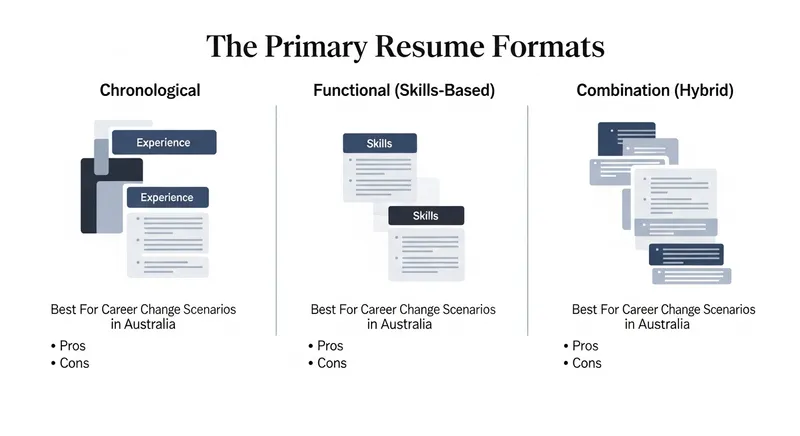
The reverse-chronological: The default (and why it often fails career changers)
This is the format everyone knows. You list your work history starting with your most recent job. It's simple, straightforward, and what most recruiters expect to see.
However, for a career changer, it's a trap. It immediately draws attention to a non-linear path and job titles that seem irrelevant to the new role. A recruiter looking for a 'Marketing Coordinator' might instantly dismiss a 'Senior Hospitality Manager' without reading any further.
Actionable Tip: As a career changer, you should generally avoid this format. It forces you to lead with your least relevant information. The only exception is if your career change is very minor, like moving from one type of sales to another.
The functional (skills-based) resume: A tempting but risky choice
This format downplays your work history and focuses almost entirely on your skills. It groups them into categories like 'Project Management' or 'Stakeholder Communication'. It's tempting because it seems like the perfect way to hide employment gaps or an unconventional career path.
But be warned: it's a risky choice in the Australian market. According to leading recruitment firm Hays Australia, recruiters are often suspicious of the functional format. It can be a red flag that the candidate is trying to hide something, like job-hopping or a lack of concrete achievements.
Actionable Tip: Avoid this format unless you have a very specific reason, such as returning to the workforce after a very long break. A safer, more effective strategy is to use the combination format. You can learn how to confidently explain an employment gap in Australia & NZ if needed.
The combination (hybrid) resume: Your secret weapon for a career change
This is the ideal solution for the vast majority of career changers. It combines the best elements of the chronological and functional formats, leading with your skills but backing them up with a solid work history.
Leading institutions like Wharton Executive Education recommend this approach because it puts equal emphasis on skills and experience. It allows you to immediately show the recruiter that you have the relevant capabilities they're looking for, while also providing the chronological context they need to see your career progression.
Actionable Tip: The combination format is your secret weapon. It starts with a powerful professional summary and a detailed skills section, followed by a concise work history. This 'best of both worlds' approach builds credibility and effectively showcases your potential for the new role.
How to write a winning career change resume (step-by-step)
Ready to build your combination resume? This is where we move from theory to action, constructing a resume that reframes your past for your future. This process can feel daunting, but using tools like the AI co-pilot in JobSparrow can streamline these steps. It helps you build a targeted resume from your 'Master Career Profile' in minutes.
Step 1: Write a powerful professional summary for your new career
This is the first thing a recruiter reads. It's a 3-4 line pitch at the top of your resume that replaces the outdated 'Objective' statement. It must immediately connect your past experience to their future needs.
Use this simple formula:
- Who you are becoming: A concise label that bridges your past and future.
- Your key offering: Highlight 2-3 of your most powerful transferable skills relevant to the new role.
- Your goal (for them): State what you aim to do for the employer.
Actionable Tip:
- Before Summary: "Experienced manager with 10+ years in hospitality looking for a new challenge in a different industry."
- After Summary: "A results-driven hospitality leader with 10+ years of experience in team management and P&L oversight. Now seeking to apply strategic planning and operational excellence skills to a logistics and supply chain management role. Eager to optimise processes and enhance efficiency for a leading national distributor."
Step 2: Identify and showcase your transferable skills
Transferable skills are the currency of a career change. These are abilities like project management, data analysis, stakeholder communication, or budgeting that are valuable in any industry.
Actionable Tip: Don't guess what skills are important. Open 3-5 job descriptions for your target role and make a list of the skills and keywords that appear most frequently. This is your new skills checklist. Your resume must reflect this language. An AI resume builder can automate this analysis, but you can do it manually.
Common examples include:
- Leadership & Team Management
- Project & Time Management
- Financial Acumen (Budgeting, P&L)
- Data Analysis & Reporting
- Stakeholder Engagement & Communication
- Problem-Solving & Critical Thinking
- Software Proficiency (e.g., Microsoft 365, Salesforce, Xero)
Step 3: Frame your experience with achievements, not duties
Your old resume probably lists your duties—the tasks you were responsible for. A career change resume must focus on your achievements—the results you delivered.
- Responsibility: "Managed the store's inventory."
- Achievement: "Implemented a new inventory management system that reduced stock discrepancies by 25% and saved $15k annually."
Actionable Tip: The best way to write powerful achievement statements is to use the STAR method. This stands for Situation, Task, Action, and Result. For every bullet point in your work history, ask yourself: what was the measurable outcome? Quantify your success with numbers, percentages, and dollar amounts wherever possible. To master this, read our complete guide on using the STAR Method with AI for achievement-oriented resumes.
Pro Tip: Want to see how AI can identify your transferable skills and rephrase your duties into achievements automatically? Upload your CV for a free analysis.
What Australian recruiters and AI are looking for in 2026
Writing for the Australian market has its own set of rules, and technology is playing an even bigger role as we head towards 2026.
First, the basics. According to official government advice from Workforce Australia, a resume should be 2-4 pages long and must exclude personal details like your age, marital status, or a photograph.
Second, you need to write for two audiences: the human recruiter and the Applicant Tracking System (ATS). The ATS is software that scans your resume for keywords from the job description. If your resume doesn't have enough keyword matches, a human may never see it. This is why tailoring your resume is non-negotiable.
ATS Optimization: To pass the ATS scan, ensure your 'Key Skills' section and work history bullet points mirror the language used in the job description. JobSparrow's AI can help you analyse a job ad and suggest the most important keywords to include.
Looking ahead, insights from publications like Human Resources Director (HRD) Australia show that AI is shifting recruitment from focusing on job titles to focusing on proven outcomes. This is fantastic news for career changers, as it means your demonstrated skills are becoming more important than your previous job titles. Deciding between a human vs. an AI resume writer is now a key strategic choice.
Tailoring your resume for specific situations
Your story is unique. Let's tackle some specific challenges career changers face.
Your experience is your advantage: Showcasing leadership and reliability
For mature-age career changers, your decades of experience represent wisdom, reliability, and proven leadership. These are qualities employers actively seek. The goal is to frame this experience as a significant asset.
Guidance from organisations like the National Council on Aging (NCOA) suggests simple ways to ensure your strengths shine through.
Actionable Tips:
- Remove graduation dates for university degrees.
- Limit your work history to the most recent 10-15 years. You can summarise earlier experience in a single line: "Prior experience includes senior roles in marketing and administration."
- Use your professional summary to focus on high-level achievements, leadership, and mentorship capabilities.
- Be prepared for interviews by knowing your rights around illegal interview questions in Australia & NZ.
For migrants and newcomers: Formatting for the Australian market
Navigating a new country's job market can be challenging, as resume conventions vary globally. To make a positive first impression, it's crucial to adopt the Australian standard.
Actionable Tips:
- Do not include: A photo, your date of birth, marital status, or nationality. This is standard practice based on guidelines from sources like SEEK and government bodies.
- Clarify your work rights: Add a simple, clear line to your contact information, such as "Full Australian Working Rights" or "Permanent Resident."
- Explain your qualifications: If your qualifications are from overseas, briefly explain the Australian equivalent if you know it (e.g., "Master of Science, assessed as equivalent to Australian Qualifications Framework Level 9").
- Simplify your references: You don't need to list referees on your resume. A simple "References available upon request" is all you need. For more detail, see our complete modern guide to resume references in Australia.
Conclusion: You have the skills, now you have the format
Your years of experience are not worthless; they are a treasure trove of transferable skills waiting to be discovered. The anxiety you felt about your old resume came from trying to fit your dynamic story into a rigid, outdated format. That ends today.
By adopting a combination resume, you are taking control of your narrative. You are leading with your strengths, contextualising your past, and showing Australian recruiters not just what you have done, but what you are capable of doing for them.
You have the skills. Now you have the format. It's time to build the resume that will launch your next chapter.
Join over 10,000 successful career changers who have used JobSparrow to land their dream role. JobSparrow's integrated resume and cover letter builder uses AI to help you craft the perfect application every time. Upload your CV to get started for free.
Frequently asked questions
What is the best resume format for a career change in Australia?
For most career changers in Australia, the Combination (or Hybrid) resume format is the best choice. It blends the best features of the functional and chronological formats. It allows you to lead with a powerful Professional Summary and a 'Transferable Skills' section, immediately showing your value. This is then followed by a concise, achievement-focused work history that provides necessary context.
Should I use a functional resume to hide my employment gaps?
Using a purely functional resume to obscure employment gaps is a risky strategy in the Australian market. Many recruiters view this format with suspicion. A better approach is to use the Combination format. Address the gap honestly in your cover letter or interview. Framing the gap positively, such as time taken for professional development or family, is more effective than trying to hide it.
How long should my Australian career change resume be?
Unlike the strict one-page rule in the US, the accepted length for a professional resume in Australia is two to three pages. For senior professionals, four pages can be acceptable if the content is relevant. Use this flexibility to detail your skills section and explain how your past achievements translate to the new role.
How do I show transferable skills if I have no direct experience?
This is the key challenge for a career changer. The solution is to reframe your past roles through the lens of your future career.
- Create a 'Key Skills' section at the top of your resume.
- Analyse job descriptions for your target role to identify the top 5-7 required skills. These are your keywords.
- Translate your past achievements. Instead of listing duties, write achievement-oriented bullet points that prove you have those skills. For example, change "Served customers in a cafe" to "Managed up to 100 customer interactions per hour, demonstrating exceptional communication to maintain a 98% satisfaction rating."
Do I need to mention my visa status on my resume in Australia?
Yes, if you are not an Australian citizen or Permanent Resident, it is crucial to clarify your working rights. Ambiguity can cause your application to be discarded. Add a simple line in your contact details section, such as:
- "Full Australian Working Rights"
- "Permanent Resident"
- "Partner Visa (Subclass 820) with unrestricted work rights"
This transparency helps recruiters quickly assess your eligibility.
Tags
Keep reading
Recommended articles.
career change · resume format
The Best Career Change Resume Format for 2026 (Section-by-Section Guide & Templates)
Discover the best career change resume format for 2026. Learn how to highlight transferable skills, beat ATS bots, and confidently land your new dream job.
resume summary · career change
Career Change Resume Summary: 10+ AU/NZ Examples & Guide
Craft a winning career change resume summary for the AU/NZ market. Get 10+ examples and a step-by-step formula to land your dream role.
career change · transferable skills
Career Change Australia: Your 10-Step Guide to Highlighting Transferable Skills (2026)
Discover how to identify and showcase your transferable skills for a successful career change in Australia. Follow our 10-step guide to land interviews faster.