
resume writing
Transferable Skills for Career Change Resume (AU/NZ Guide)
By Job Sparrow Team

Introduction: Your Experience is Valuable, Your Resume is Holding You Back
You have years of valuable experience. You've led teams, managed complex projects, and solved difficult problems. Yet, as you try to pivot to a new industry in Australia or New Zealand, your resume gets lost in a sea of applications.
The response is either silence or a polite rejection. It's a deeply frustrating experience that can make you feel undervalued and stuck.
Here's the truth: the problem isn't your experience. The problem is that your traditional resume, focused on past job titles, isn't translating your value to a new industry. Hiring managers and the Applicant Tracking Systems (ATS) they use are looking for specific skills and keywords that your old titles don't provide.
This guide will empower you to fix that. We will show you how to identify your most valuable transferable skills and strategically rewrite your resume to attract Australian and New Zealand hiring managers. You'll learn to build a skills-focused resume that proves your worth, no matter your previous industry.
What Are Transferable Skills (and Why They Are Your Secret Weapon)
Transferable skills, also known as 'portable skills', are the competencies you've developed that are valuable across different jobs and industries. Career advice from Indeed Australia highlights that instead of just listing duties, you should focus on the skills you used to achieve your results. They are the bridge between your past experience and your future career.
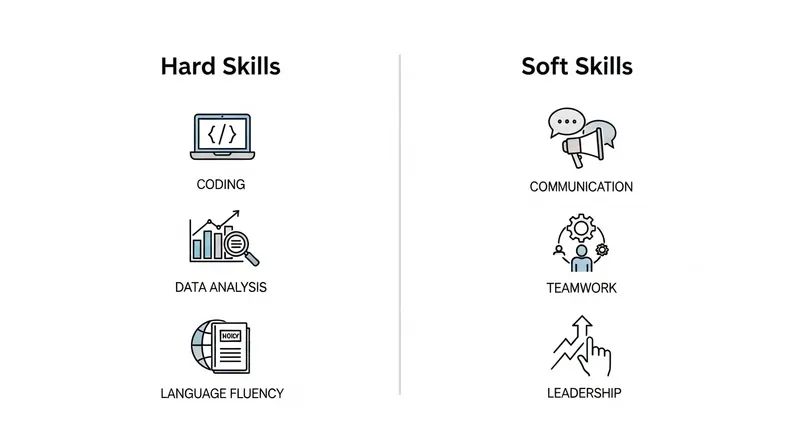
There are generally two types of skills:
- Hard Skills: These are specific, teachable abilities that can be easily measured. Think of things like proficiency in a software program (e.g., Salesforce, Xero), data analysis, or speaking a foreign language.
- Soft Skills: These are the interpersonal attributes that determine how you work and interact with others. Examples include communication, leadership, problem-solving, and adaptability.
For a career changer, your soft skills and adaptable hard skills are your secret weapon. As AI and automation handle more technical tasks, a recent LinkedIn report notes that uniquely human skills like communication and collaboration are becoming more critical than ever.
Want to see which of your skills are most valuable? Upload your CV to JobSparrow for an instant skills analysis and see how you stack up for your target role.
Step 1: How to Identify Your Key Transferable Skills
Before you can showcase your skills, you need to know what they are. Many professionals undervalue their own abilities because they're simply part of their daily routine. It's time to conduct a skills audit.
Forget your job titles for a moment and think about how you accomplished your work. JobSparrow's Master Career Profile can make this process easier by analyzing your existing CV and suggesting skills you may have overlooked, but you can also do it manually with this exercise:
- List Your Roles: Write down your last 2-3 major roles, including any significant volunteer positions or large-scale personal projects.
- Brainstorm Your Actions: For each role, list 5-10 key responsibilities or major projects. Don't just write 'managed the team'; think about what that actually involved. Did you hire, train, mediate conflicts, or conduct performance reviews?
- Translate Actions into Skills: Now, translate those actions into marketable skills. The New Zealand government's Careers NZ service encourages job seekers to identify skills from all areas of life, not just paid work.
Here are some examples of translating duties into skills:
- Your Duty: Handled customer complaints.
- Your Skills: Conflict Resolution, Customer Relationship Management (CRM), Problem-Solving, Empathy, Communication.
- Your Duty: Organised the annual company conference.
- Your Skills: Project Management, Budgeting, Vendor Negotiation, Event Planning, Stakeholder Management.
- Your Duty: Created weekly sales reports.
- Your Skills: Data Analysis, Reporting, Attention to Detail, Microsoft Excel, Business Intelligence.
Step 2: Choose the Right Resume Format for a Career Pivot
For a career changer, the format of your resume is just as important as the content. There are three main options, but one stands out as the clear winner for a career pivot.
- Reverse-Chronological: The standard format that lists your work history from most to least recent. This is great for those on a traditional career path but can be a disadvantage for career changers as it highlights irrelevant job titles.
- Functional: This format focuses almost entirely on skills, with a very brief work history section. It is often viewed with suspicion by recruiters in Australia and New Zealand as it can look like you're hiding something.
- Combination: This is the gold standard for career changers. It combines the best of both worlds, leading with a powerful summary and skills section that grabs the recruiter's attention before presenting a streamlined chronological work history.
As leading Australian job board SEEK recommends, this approach allows you to frame your experience in the context of the new role you're targeting. JobSparrow automatically structures your resume in the combination format, leading with your strongest transferable skills while maintaining your work history. For a more detailed breakdown, check out The ultimate guide to resume formats for a career change in Australia.
Step 3: Strategically Showcase Your Skills on Your Resume
Once you've identified your skills and chosen the combination format, it's time to rebuild your resume. You will strategically place your transferable skills in three key sections to create a powerful and cohesive narrative.
The Career Change Resume Summary: Your 30-Second Pitch
Forget the outdated 'Resume Objective'. Modern resumes use a Professional Summary or Career Profile to provide a 30-second pitch at the top of the page. This is your first and best chance to frame your story for the hiring manager.
Follow this simple formula:
A [Your Current Role/Field] with [X] years of experience, making a strategic career transition into [New Industry]. Highly skilled in [Skill 1], [Skill 2], and [Skill 3] demonstrated through a history of [mention a key achievement type]. Seeking to leverage this expertise to drive [Goal/Value] at [Company Name or type of company].
Before:
"Experienced Retail Manager with 10 years in the fast-fashion industry. Looking for a new challenge in a corporate environment."
After:
"An accomplished commercial leader with a decade of experience in team management and operations, now making a strategic career transition into Project Coordination. Highly skilled in stakeholder management, budget oversight, and process optimisation, demonstrated through a history of launching successful new stores on time and under budget. Seeking to leverage this expertise to drive efficient project delivery in the technology sector."
This 'after' example, recommended by career advisors at institutions like The University of Sydney, immediately tells the recruiter why your retail experience is relevant to a project coordination role.
The 'Core Competencies' Section: Your Keyword Goldmine
Directly below your Professional Summary, you need a section titled Key Skills or Core Competencies. This section is a bulleted list of 9-12 of your most powerful and relevant skills. Its primary purpose is to get your resume past the automated Applicant Tracking Systems (ATS).
Most large companies in Australia and New Zealand use ATS to filter the hundreds of applications they receive. This software scans your resume for keywords that match the job description. If you don't have enough matches, your resume is rejected before a human ever sees it.
Actionable Tip: Open the job description for your target role and identify the key skills and requirements they list. Ensure your Core Competencies section includes the most important of these, using the exact same phrasing where possible. JobSparrow's AI Co-Pilot automates this by analyzing the job description and suggesting the best keywords from your profile. This is a crucial step to creating an ATS-friendly resume that gets noticed.
Your Work History: Translating Duties into Achievements
In the work history section of a career change resume, your job titles are less important than your accomplishments. Your goal here is to prove the skills you listed in your summary and competencies sections.
For each role, focus on 2-3 powerful, quantified bullet points that showcase transferable skills. A great way to structure these points is by using the STAR method (Situation, Task, Action, Result). For a complete guide, see how you can master The STAR Method & AI: A Guide to Achievement-Oriented Resumes for the AU & NZ Market.
As recommended by career experts at Auckland University of Technology (AUT), use strong action verbs and quantify your results whenever possible.
Instead of:
- Responsible for staff training.
Write:
- Developed and implemented a new onboarding program that reduced new-hire training time by 25% and increased 90-day staff retention by 15%.
This bullet point proves skills in Training & Development, Process Improvement, and Efficiency, all while demonstrating measurable impact.
Essential Tips for the Australian & New Zealand Job Market
Pivoting your career is one challenge; doing so in a new country adds another layer. Here are some specific tips for the AU & NZ markets.
- For ATS Friendliness: Keep your formatting clean and simple. Use a standard font like Arial, Calibri, or Times New Roman. Avoid tables, columns, and graphics, as many ATS systems cannot parse them correctly. JobSparrow handles all this automatically, but if you're formatting manually, this is critical.
- For Migrant Job Seekers: Ensure your resume is localised. Use Australian/New Zealand spelling (e.g., 'organise', 'labour'). If you have the right to work, you can mention it briefly in a cover letter, but it's often best addressed in an initial screening call. Be aware of questions that may be considered illegal in an Australian or NZ interview and be prepared to steer the conversation back to your skills. For those targeting New Zealand, aligning your skills with the occupations on the official Green List from Immigration New Zealand can significantly improve your prospects.
Future-Proof Your Career: Top Transferable Skills for Today and Tomorrow
To give yourself a long-term advantage, focus on developing the transferable skills that are in high demand now and will be in the future. The Australian government's Jobs and Skills Australia report highlights that Gen AI is accelerating the need for digital literacy and distinctly 'human' capabilities.
The transferable skills that make you attractive today are the same ones that will future-proof your career. Focus on cultivating these skills:
- Adaptability and Flexibility: The ability to pivot and learn quickly in a changing environment.
- Complex Problem-Solving: Moving beyond simple fixes to diagnose and solve deep, systemic issues.
- Leadership and Social Influence: Inspiring and guiding teams, even without direct authority.
- Digital Literacy and AI Collaboration: Working effectively alongside automated systems and AI tools.
- Communication and Empathy: Building relationships and collaborating effectively with diverse stakeholders.
Investing in these areas will not only help your current career change but will make you a more resilient professional. JobSparrow's Gap Analysis can identify which of these high-demand skills you already possess and which to focus on developing. For more on this, explore the difference between Human vs. AI for your Australian resume.
Conclusion: Turn Your Past Experience into Your Future Opportunity
Your experience is not redundant; it's the foundation of your future success. By shifting your resume's focus from job titles to transferable skills, you can translate your past achievements into a compelling case for your future potential.
Remember the key steps: audit your experience to identify your core competencies, choose a combination resume format, and strategically rewrite your summary, skills section, and work history to prove your value. This approach transforms your resume from a historical document into a powerful marketing tool for your career pivot.
Ready to Transform Your Resume?
While you can do all this manually, the process of identifying keywords and tailoring your resume for every single application is time-consuming. JobSparrow's AI Co-Pilot is designed to do the heavy lifting for you. It helps you build a Master Career Profile, then analyzes job descriptions to automatically create tailored, ATS-friendly resumes and cover letters in seconds.
Your CV diagnosis is free. The full Offer Path is part of the Land the Job membership, billed monthly or every three months, and you can cancel anytime.
Ready to build a career change resume that gets results? Upload your CV to JobSparrow and let our AI tailor it for your dream role in minutes.
Frequently Asked Questions
Should I use a functional or combination resume for a career change in Australia?
For a career change in the Australian or New Zealand market, the combination resume is almost always the best choice. While a purely functional resume (which focuses only on skills) can seem tempting, recruiters often view it with suspicion, as it can suggest you're hiding an inconsistent work history. A combination resume offers the perfect balance: it leads with a strong Professional Summary and a Core Competencies section to immediately highlight your transferable skills, while still providing the chronological work history that recruiters expect to see.
How do I show transferable skills on my resume if I have no experience in the new industry?
This is where you must focus on how you performed your previous jobs, not just what you did. For example, a teacher wanting to move into corporate event management doesn't have 'Event Manager' on their resume. However, they can highlight relevant achievements:
Instead of: "Organised the annual school fair."
Translate it to: "Project-managed the annual school fundraising fair for 300+ attendees, overseeing a $10,000 budget, coordinating 15+ parent volunteers, and negotiating with external vendors, resulting in a 20% increase in funds raised year-over-year."
This single bullet point proves skills in Project Management, Budgeting, Team Coordination, and Negotiation without ever needing the official title.
What are the top 5 transferable skills employers in NZ are looking for?
While specific technical skills vary by role, there is a consistent set of transferable skills that New Zealand employers value highly across all industries. Based on insights from government bodies like Careers NZ and major job platforms, the top 5 are:
- Communication: Written, verbal, and interpersonal.
- Problem-Solving: The ability to identify issues and implement effective solutions.
- Teamwork and Collaboration: Working effectively with diverse groups of people.
- Digital Literacy: Confidence in using a range of digital tools and adapting to new technologies.
- Adaptability: The flexibility to handle change and learn new things quickly.
How do I make my resume ATS-friendly for Australian jobs?
To ensure your resume passes the initial screening by an Applicant Tracking System (ATS), follow these critical rules:
- Use a Clean Format: Stick to a simple, single-column layout. Avoid tables, text boxes, headers, and footers.
- Choose a Standard Font: Use a universally readable font like Arial, Calibri, or Times New Roman.
- Mirror Keywords: Integrate keywords and phrases directly from the job description into your 'Key Skills' section and work history.
- Use Standard Headings: Use common headings like "Professional Experience," "Education," and "Key Skills."
- Avoid Graphics and Images: Don't include photos, charts, or icons, as the ATS cannot read them.
Pro Tip: AI resume builders like JobSparrow handle all of this automatically, ensuring your resume is perfectly formatted for both ATS and human recruiters.
Is an objective statement necessary on a career change resume?
No, the objective statement is outdated and should be avoided. It focuses on what you want, whereas a modern resume should focus on what you can offer the employer. Replace it with a Professional Summary or Career Profile. This is a 3-4 sentence paragraph at the top of your resume that summarises your most relevant skills, explains your career pivot, and powerfully positions you as the solution to the employer's needs.
Tags
Keep reading
Recommended articles.
ats · resume writing
Beat the Bots: An AU/NZ Guide to ATS-Friendly Resumes with Keyword and Formatting Secrets
Tired of the resume black hole? Our expert AU/NZ guide reveals the exact formatting rules and keyword secrets for an ATS-friendly resume that beats the bots.
resume writing · career change
How to Write a Career Change Resume: The Ultimate 2026 AU & NZ Guide
Master your AU/NZ career change. Our 2026 guide shows you how to reframe skills, write a resume that beats the bots, and land interviews. Start here.
career change · job search
Career Change AU/NZ 2026: From Doubting to In-Demand – How to Prove Your Value
Feeling stuck? Our 2026 career change strategy for AU/NZ helps you beat imposter syndrome and prove your value. Turn doubt into demand today.