
resume writing
How to Write a Career Change Resume: The Ultimate 2026 AU & NZ Guide
By Job Sparrow Team

Staring at your resume can be daunting, especially when you're planning a career change. You have years of valuable experience, but it feels like it's from another world. The biggest fear is that a recruiter will take one look, see a history that doesn't match the job title, and move your application straight to the 'no' pile. You're not alone in this feeling. In fact, data from the Australian Bureau of Statistics shows that in the year to February 2023 (the latest available data), 9.5% of employed people changed their job, and this trend has only accelerated with the rise of AI-driven hiring and a dynamic economy.
This isn't just another generic guide. This is your comprehensive, step-by-step plan for writing a powerful career change resume specifically for the Australian and New Zealand job markets. We'll show you how to turn your seemingly 'irrelevant' experience into your greatest asset and build a document that gets you noticed for the right reasons.
Why Your Standard Resume Won't Work for a Career Change
Submitting your old, standard resume for a new career is like using a map of Sydney to navigate Melbourne. It's filled with information that, while accurate, is completely wrong for your current goal. A traditional chronological resume simply lists your work history. For a career changer, this immediately highlights what you haven't done, rather than what you can do.
Recruiters and the Applicant Tracking Systems (ATS) they use are trained to scan for relevance. They look for keywords, skills, and experiences that directly match the job description. When your resume is filled with jargon from your old industry, it fails this critical first test.
"But will recruiters think I'm unqualified?" It's the biggest fear for any career changer. The truth is, modern employers increasingly value a fresh perspective. Your unique background isn't a weakness; it's a competitive advantage that brings diverse problem-solving skills to the table. The key is framing it correctly.
The mindset shift is crucial: your new resume is not a history of your past duties. It's a strategic marketing document that showcases your portfolio of skills and quantifiable achievements, proving you are the best candidate for the future role.
If you're unsure how your current resume stacks up against ATS, getting a professional opinion can be a game-changer. Consider using a free resume review service to get expert feedback and beat the bots.
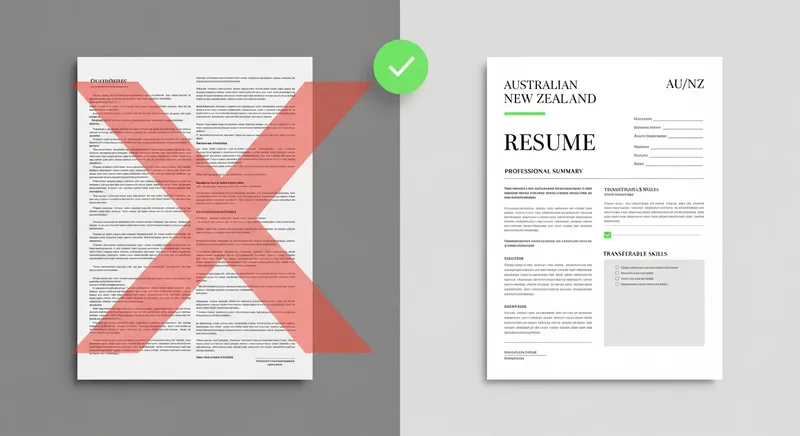
Step 1: Uncover Your Hidden Assets with a Transferable Skills Audit
Your skills are the bridge from your old career to your new one. The problem is, you're so used to them that you might not even see them as valuable. It's time to conduct an audit to uncover these hidden assets.
Start by categorizing your skills. Think beyond your technical abilities and consider broader competencies that are valuable in any industry:
- Project Management & Leadership: Did you lead a team, manage a budget, or see a project through from start to finish?
- Communication & Stakeholder Relations: Have you presented to clients, written reports, negotiated contracts, or managed difficult customers?
- Data Analysis & Problem Solving: Have you analyzed performance metrics, identified trends, or developed a solution to a recurring problem?
- Technical & Software Proficiency: Are you skilled in specific software (like Salesforce, Xero, or Adobe Creative Suite) that is used in your target industry?
Actionable Task: Open three job descriptions for your ideal new role. Copy and paste the top 5-7 skills and requirements listed in each into a separate document. Now, look for patterns. What words appear over and over? This is the language you need to speak. For each required skill, write down a specific example of when you demonstrated it in a previous role, even if the context was different.
As guidance from Deakin University suggests, employers look for relevance and transferable skills. It's crucial to translate your experience. For example, a teacher's 'classroom management' becomes 'training and development for 30+ individuals and stakeholder management with parents and administrators'. For a deeper dive into this process, explore this 10-step guide to highlighting transferable skills.
Step 2: Choose the Right Resume Format: Combination vs. Functional
There are three main resume formats, but for a career changer, one stands out as the clear winner.
- Chronological: Lists your work history from most recent to oldest. This is the worst format for a career change as it highlights your non-linear path.
- Functional: Focuses almost entirely on skills, with a very brief work history section. While this approach can be useful for career changers, many recruiters in Australia and NZ are suspicious of them, as they can obscure employment gaps or a lack of progress.
- Combination (Recommended): This is the gold standard for career changers. It combines the best of both worlds. It leads with a powerful summary and a detailed skills section to immediately showcase your value, followed by a condensed chronological work history that provides the context recruiters need.
By using a combination format, you control the narrative. You tell the recruiter what's most important upfront, proving your capability before they even look at your past job titles.
Step 3: How to Write Each Section of Your Career Change Resume
With the right format chosen, it's time to craft the content. Each section must be written with your new career goal in mind.
The Career Change Resume Summary: Your 3-Sentence Elevator Pitch
This is the most important part of your resume. Your summary is crucial for a career changer. It must quickly explain the 'what' and 'why' of your pivot. Forget vague objectives; use this simple three-sentence formula:
- Sentence 1 (Your Professional Identity): Start with your years of experience in a broad professional function (e.g., 'A customer-focused professional with 8+ years of experience in team leadership and client relations.').
- Sentence 2 (The Pivot): Connect your top 2-3 transferable skills directly to the needs of the new role (e.g., 'Proven ability to drive customer satisfaction and team performance, now seeking to apply these skills to a Customer Success Manager role in the SaaS industry.').
- Sentence 3 (Your Goal): State what you aim to achieve for the employer (e.g., 'Eager to contribute to building long-term client loyalty and reducing churn.').
Example: Retail Manager to Marketing Coordinator
A results-driven professional with over 7 years of experience in visual merchandising, campaign execution, and team leadership. Seeking to leverage a deep understanding of consumer behaviour and promotional strategy to drive successful campaigns as a Marketing Coordinator. Passionate about using data-driven insights to create engaging brand experiences and contribute to market growth.
For more specific examples, check out this guide on transitioning from a teacher to a corporate trainer.
The 'Areas of Expertise' or 'Key Skills' Section
Directly below your summary, create a bulleted list of your 9-12 most relevant skills. This section is perfect for keyword optimization. Pull the most important skills you identified during your audit and list them here. Group them into logical categories for easy scanning.
Example:
- Leadership & Management: Team Training & Development, Performance Management, Operations Management
- Marketing & Communication: Campaign Execution, Social Media Strategy, Copywriting, Stakeholder Engagement
- Technical Skills: Salesforce, Google Analytics, Mailchimp, Hootsuite
Reframing Your 'Professional Experience'
Even in a combination resume, you need a work history section. The key is to focus every bullet point on a quantifiable achievement, not a passive duty. Use the STAR method (Situation, Task, Action, Result) to structure your points.
Example: Retail Manager to Marketing Coordinator
- Before (Duty-focused): Responsible for managing the store's social media accounts and weekly promotions.
- After (Achievement-focused): Grew local store's Instagram following by 40% in six months by developing and executing a content strategy focused on user-generated content and community engagement, contributing to a 15% uplift in foot traffic during promotional periods.
Step 4: Nailing the Details for the AU & NZ Market
Generic advice won't cut it. Your resume must be tailored to local expectations to be taken seriously.
Crucial Advice for Migrant Career Changers
If you are new to the Australian or New Zealand job market, certain conventions are non-negotiable. As the Victorian Government's career advice for skilled migrants makes clear, your resume should be tailored and should not include a photo, your age, or your marital status. This is standard practice to prevent bias.
- Visa Status: If you have full, unrestricted working rights, state this clearly and simply at the top of your resume (e.g., 'Australian Citizen' or 'Full Australian Working Rights').
- Localize Terminology: Change 'Resume' to 'CV' for many New Zealand applications, switch to Australian/NZ English spelling (e.g., 'organise' instead of 'organize'), and explain any company or qualification that might be unknown locally.
How to Address Employment Gaps on Your Resume
Career gaps for travel, study, or family reasons are increasingly common and not the red flag they once were. The key is to address them confidently. As research from Harvard Business Review discusses, there are practical ways to navigate this. Instead of leaving a blank space, frame it positively.
For example, a gap for upskilling could be listed as 'Professional Development Sabbatical' with bullet points of the courses you completed. Tools like JobSparrow's Gap Filler can guide you through this process, asking targeted questions to help you articulate the skills you gained during these periods, turning them into growth phases rather than empty space. For a comprehensive strategy, read our complete guide on how to explain career gaps on your resume.
Tips for Mature-Age Career Changers
If you have decades of experience, your biggest challenge is avoiding ageism and keeping your resume focused. You do not need to list every job you've ever had.
- Curate Your Experience: Limit your detailed work history to the last 10-15 years. This keeps the document relevant and concise.
- Frame Experience as a Strength: Position your extensive history as a source of wisdom, stability, and mentorship capabilities that less experienced candidates can't offer.
Step 5: The Career Change Cover Letter (The Essential Bridge)
For a career changer, the cover letter is arguably more important than the resume. The resume shows what you can do; the cover letter explains why you want to do it and why your unique background is a perfect fit. Keep it concise and structured in three paragraphs:
- Introduction: State the role you're applying for and express genuine enthusiasm for the company's mission or a specific project they've worked on.
- The Bridge: This is the most important paragraph. Select your top two transferable skills and directly connect them to the biggest challenges or requirements of the role. Tell the story of your pivot.
- Conclusion: Reiterate your interest and confidently state your belief that your unique background will bring a fresh perspective. Include a call to action, such as 'I am eager to discuss how my experience in [Your Old Field] can bring value to [Their Team]'.
Your cover letter is where you connect the dots for the recruiter. For a complete walkthrough with templates, read our dedicated guide on writing a career change cover letter that gets interviews.
The JobSparrow Advantage: A Smarter Way to Change Careers
Going through this process for every single job application is time-consuming and prone to error. This is where JobSparrow's AI-powered platform transforms your job search.
Our AI analyzes thousands of successful career change resumes to understand what works. We don't just offer a template; we provide an intelligent system designed for the challenges career changers face.
- Build Your Master Profile: Instead of starting from scratch, use your Master Career Profile as a single source of truth. It holds every skill, achievement, and project from your entire career, ready to be deployed.
- Uncover Hidden Value: Our Gap Filler tool analyzes your profile and asks targeted questions to help you add the quantifiable achievements that recruiters demand. It helps you reframe your experience and fill in the blanks.
- Create Tailored Resumes Instantly: Once your Master Profile is strong, JobSparrow's AI generates a perfectly tailored combination resume for any job description in seconds. It intelligently selects the most relevant skills and achievements, ensuring you pass the ATS while staying authentic.
- Practice Your Pitch: Build confidence with our AI Mock Interview tool. It generates role-specific questions to help you practice explaining your career pivot and articulating your value before the real interview.
Ready to stop staring at a blank page and start building a resume that opens doors? Upload your old resume to JobSparrow and see how our AI can instantly reframe it for your new career. Start your free trial today.
Frequently Asked Questions
What is the best resume format for a career change in Australia?
The combination resume format is by far the best choice for a career changer in Australia and New Zealand. It leads with a powerful professional summary and a detailed skills section, which immediately shows a recruiter your value and relevance. This is followed by a condensed chronological work history for context. This approach is superior to a purely functional resume, which recruiters often find suspicious, and a chronological resume, which would highlight your non-linear career path.
How do I show a complete career change on my resume?
To effectively show a complete career change, you need a multi-pronged strategy. First, write a powerful career change summary at the top of your resume that explicitly states your intention to pivot and connects your past experience to your future goals. Second, create a comprehensive transferable skills section that is rich with keywords from your new industry. Finally, rewrite your professional experience bullet points to focus on quantifiable achievements and results (e.g., 'reduced costs by 15%') rather than duties from your old job.
Should I include a photo on my CV in Australia or New Zealand?
No, you should absolutely not include a photo on your CV in Australia or New Zealand. It is a firm professional standard in both countries to omit photographs, as well as other personal information like your age, date of birth, and marital status. This practice helps to ensure a fair hiring process and prevent unconscious bias from influencing a recruiter's decision.
How do I write a resume if I'm migrating to Australia or New Zealand?
When migrating, your primary goal is to localize your resume. Use Australian or New Zealand English spelling and terminology. Crucially, remove personal details like photos and age. Translate your international experience and qualifications into terms a local employer will understand, focusing on universal achievements. If you have full, unrestricted working rights, it is highly recommended to state this clearly at the top of your resume (e.g., 'Full Australian Working Rights').
How far back should my resume go if I'm a mature-age career changer?
For a mature-age career changer, a good rule of thumb is to focus on the last 10 to 15 years of your most relevant experience. This keeps your resume concise, targeted, and focused on your modern skills, which helps to mitigate potential age bias. For example, if you are pivoting from finance to consulting at age 52, feature your last 12 years of strategic work in detail, then add a single line like: "Prior experience includes 8 years in financial analysis and audit roles."
Tags
Keep reading
Recommended articles.
resume writing · job search
The Master Resume: Your Secret Weapon for a Faster, Smarter Job Search
Stop rewriting your resume. Learn how to build a master resume profile to create tailored, ATS-friendly applications in minutes. Get organized and land more interviews.
resume writing · career change
Transferable Skills for Career Change Resume (AU/NZ Guide)
Master your career change with Job Sparrow. Use AI to identify and showcase transferable skills on your CV. Beat the ATS in Australia & NZ. Start for free!
ai tools · job search
AI Resume & Cover Letter Generator for AU & NZ (2026)
Create a perfectly matched, ATS-optimized resume & cover letter for AU & NZ jobs. Our AI ensures consistency to help you land interviews. Pay only when you get an offer.