
interview tips
Illegal Interview Questions in Australia & NZ: Your Guide to Answering with Confidence
By Job Sparrow Team

Illegal Interview Questions in Australia & NZ: Your Guide to Answering with Confidence
The interview is going well. You've built a good rapport, your answers are landing, and you feel a surge of confidence. Then, it happens. The interviewer leans in and asks, "So, are you planning on starting a family soon?"
Suddenly, the air freezes. Your mind races. Is that an illegal interview question? How do I answer without ruining my chances? If I refuse, will they think I'm difficult? This single moment of panic can derail your performance and leave you feeling powerless.
You are not alone in this experience, and you don't have to be powerless. This guide is designed to give you clarity on your rights under Australian and New Zealand law. More importantly, it will equip you with professional, actionable strategies to handle inappropriate questions with confidence, ensuring the focus remains where it should be: on your skills and qualifications for the job.
What Makes an Interview Question Illegal?
An interview question crosses the line from curious to unlawful when the answer could be used to discriminate against you. In both Australia and New Zealand, laws are in place to ensure you are judged on your ability to do the job, not on your personal background or life choices.
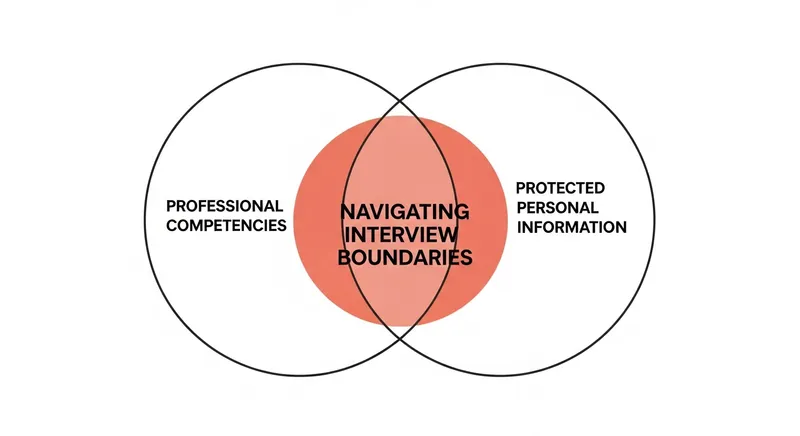
These laws protect you based on specific "protected attributes" or "prohibited grounds of discrimination." A question becomes illegal if it asks about these attributes and is not directly relevant to the "inherent requirements" of the job. According to the Fair Work Ombudsman, this means an employer cannot take "adverse action"—like deciding not to hire you—based on your personal characteristics.
The core principle is simple: a fair interview focuses on what you can bring to the role, not who you are outside of work.
Your Rights in Australia: The Fair Work Act & Anti-Discrimination Laws
In Australia, the Fair Work Act 2009 is the primary legislation that makes it unlawful for an employer to discriminate against a potential employee. The Australian Human Rights Commission outlines that recruitment must be based on merit, not personal attributes.
Under the Fair Work Act, your protected attributes include:
- Race, colour, national extraction, or social origin
- Sex, sexual orientation, or gender identity
- Age (either young or old)
- Physical or mental disability
- Marital status
- Family or carer's responsibilities
- Pregnancy
- Religion
- Political opinion
Furthermore, individual states have their own laws that add another layer of protection. For instance, the Victorian Equal Opportunity and Human Rights Commission clarifies that under Victoria's Equal Opportunity Act, employers are prohibited from asking for information that could be used to discriminate against you.
Your Rights in New Zealand: The Human Rights Act
In New Zealand, the Human Rights Act 1993 provides similar, robust protections for job seekers. The New Zealand Human Rights Commission offers a detailed guide on what employers can and cannot ask.
The prohibited grounds for discrimination in New Zealand include:
- Sex (including pregnancy and childbirth)
- Marital status or family status
- Religious belief or ethical belief
- Colour, race, or ethnic or national origins
- Disability
- Age
- Political opinion
- Employment status (e.g., being unemployed)
- Sexual orientation
As the New Zealand Government's official website states, these protections apply to every aspect of the employment process, starting from the moment you apply.
Know your worth and present it confidently. JobSparrow's AI helps you craft responses that showcase your qualifications while maintaining professional boundaries. Build your profile now.
Common Illegal Interview Questions (And What's Legal Instead)
Understanding the law is the first step. The next is recognizing an illegal question in the wild. Here are some of the most common unlawful questions and their legal, skill-focused alternatives.
Age
- Illegal: "How old are you?" or "What year did you graduate?"
- Legal: "Are you over the minimum legal age to work here?" or "The role requires a minimum of five years of project management experience. Can you walk me through your experience in that area?"
Family & Marital Status
- Illegal: "Are you married?" "Do you have children?" or "Who is your emergency contact?" (before hiring).
- Legal: "This role requires occasional overtime and travel. Are you able to meet the schedule requirements of this position?"
Nationality & Race
- Illegal: "Where were you born?" or "You have an interesting accent, where is it from?"
- Legal: "Are you legally authorised to work in Australia/New Zealand?"
Health & Disability
- Illegal: "Do you have any disabilities or medical conditions?" or "Have you taken many sick days in your past role?"
- Legal: "Are you able to perform the essential duties of this role, which include [e.g., lifting 20kg boxes or standing for long periods], with or without reasonable accommodation?" If you have an employment gap on your resume, it's better to address it proactively. You can learn more about how to confidently explain an employment gap in Australia & NZ.
Religion & Political Opinion
- Illegal: "What church do you go to?" or "What are your political views?"
- Legal: There is almost never a legal equivalent, as this is rarely a genuine requirement for a job. The exception might be for a role within a political or religious organisation.
Pregnancy & Future Family Plans
- Illegal: "Are you pregnant or planning to become pregnant?"
- Legal: "What are your long-term career goals?" or "Where do you see yourself in five years with our company?"
How to Respond: A 3-Step Strategy for Answering with Confidence
Knowing a question is illegal is one thing; knowing how to respond in the moment is another. The key is to remain professional and composed. According to career experts at SEEK, your delivery is just as important as your words.
Here is a simple 3-step strategy to take back control of the conversation.
- Pause and Assess. Don't feel pressured to answer immediately. Take a breath. Ask yourself: Is the question clearly illegal, or just a clumsy attempt at small talk? Assume good intent first, as many interviewers are simply untrained. The key is to avoid becoming angry or confrontational.
- Choose Your Strategy. Based on your assessment, decide on one of three approaches: politely redirect the underlying concern, clarify the relevance of the question, or (in rare cases) directly and politely refuse to answer.
- Respond and Redirect. Deliver your chosen response calmly and confidently. The most critical part is to immediately pivot the conversation back to your professional skills and the value you bring to the role.
Your ability to handle this gracefully can actually be impressive to an employer. For more tips on delivery, review our guide on perfecting your interview tone for AU/NZ roles with AI.
Practice makes perfect. JobSparrow's AI Mock Interviews let you rehearse responses to unexpected questions in a safe environment. Try role-specific scenarios that prepare you for any curveball. Start practicing now.
Actionable Scripts: Word-for-Word Examples for Any Situation
Having a few pre-prepared scripts in your back pocket can make all the difference. As guidance from Yale University Office of Career Strategy suggests, the goal is often to answer the question the interviewer should have asked. Building a comprehensive Master Career Profile in JobSparrow helps you quickly recall achievements and examples when redirecting questions, so you're never caught off-guard.
The 'Clarify & Redirect' Method
This approach is perfect for questions about family or availability.
- Question: "Do you have children?"
- Your Response: "I can see why you'd want to ensure your new hire is committed. To clarify, are you asking about my ability to meet the schedule and travel requirements of the role? I can confirm I am fully able to meet all responsibilities outlined in the job description and am excited about the opportunity."
The 'Bridge to Skills' Method
This is a graceful way to handle questions about your background or personal life.
- Question: "Where are you from originally?"
- Your Response: "That's an interesting question! My background is quite diverse, and I've had the opportunity to work with teams from all over the world. This has really strengthened my cross-cultural communication skills, which I see as a great asset for this role, especially for [mention a specific duty from the job description]."
The 'Polite Refusal' Method
Reserve this for questions that are blatantly inappropriate and have no connection to the job.
- Question: "What are your political views?"
- Your Response: "I'd prefer to keep the focus on my professional qualifications and how my experience in [mention a key skill] makes me a great fit for this position. I'm particularly interested in learning more about the team's approach to [mention a project or goal]."
Mastering these responses requires practice. A great way to prepare is by structuring your answers using proven frameworks like The STAR Method & AI.
A Special Note for Migrants and Visa Holders
If you are a migrant or on a visa, navigating questions about your background can be especially stressful. It's crucial to understand the one question an employer can and must ask: whether you are legally entitled to work in the country.
The Australian Human Rights Commission makes a clear distinction:
- Illegal: "Are you an Australian citizen?" or "What country are you from?"
- Legal and Necessary: "Do you have the legal right to work in Australia?" or "Are you authorised to work in New Zealand?"
Be prepared with a clear, confident answer.
- Your Script: "Yes, I am legally authorised to work full-time in [Australia/New Zealand]. My visa status has no restrictions that would prevent me from fulfilling all the duties of this role."
Beyond Illegal Questions: Other Interview Red Flags to Watch For
Unlawful questions are a major red flag, but they aren't the only ones. An interview is a two-way street. You are also evaluating the company. Keep an eye out for these other warning signs:
- Disorganization: The interviewer is late, unprepared, or hasn't read your CV.
- Negativity: They speak poorly about the company, their boss, or the person who previously held the role.
- Vagueness: They can't give you clear answers about the role's day-to-day responsibilities, key performance indicators, or career progression.
- High Turnover: They mention that people "don't last long" in the role or that the team has been rebuilt multiple times.
- Excessive Pressure: They push for an on-the-spot decision or make an offer that explodes within 24 hours.
JobSparrow's Job Application Tracking includes company notes and interview feedback logs. Document red flags as you spot them, and use our tools to evaluate if a company culture aligns with your values before investing more time. Learn more about how to move beyond the spreadsheet to land a role faster in Australia & NZ.
What to Do If You Believe You've Been Discriminated Against
If you leave an interview feeling you were treated unfairly because of an illegal question, you have recourse. As legal experts at Lander & Rogers advise, the first step is to document everything.
- Write it down immediately. While it's fresh in your mind, note the exact question asked, who asked it, the date and time of the interview, and how you responded.
- Understand your rights. You have the right to lodge a formal complaint if you believe you were not hired due to discrimination.
- Contact the appropriate body.
- In Australia, you can lodge a complaint with the Australian Human Rights Commission or the Fair Work Ombudsman.
- In New Zealand, you can contact the Human Rights Commission.
Conclusion: Turn Awkward Moments into Opportunities
Facing an illegal interview question can be jarring, but it doesn't have to be a career roadblock. By understanding your rights and preparing your responses, you can turn a moment of potential panic into a demonstration of your professionalism, confidence, and grace under pressure.
Remember, a great employer will respect your boundaries and focus on your skills. Your ability to navigate these conversations is a testament to your strength as a candidate.
JobSparrow's AI Co-Pilot includes role-specific mock interviews where you can practice these exact scenarios—from handling illegal questions to perfecting your tone. Build unshakable confidence with instant feedback on your responses. Start with a free diagnosis today.
Frequently Asked Questions
Can an interviewer ask if I am vaccinated against COVID-19?
This is a nuanced issue that depends heavily on the specific role and any government health orders that may be in effect. Generally, if being vaccinated is a genuine and reasonable requirement to perform the job safely (for example, in healthcare, aged care, or other frontline roles), an employer may be permitted to ask. However, if vaccination status is not an inherent requirement for the job, asking the question could be considered discriminatory if it relates to a protected attribute, such as a physical disability that prevents vaccination or a political belief.
Is it illegal to ask about my current salary?
In Australia and New Zealand, it is not currently illegal for an employer to ask about your salary history. However, the practice is widely criticized for perpetuating wage gaps. You are not obligated to answer. A professional strategy is to deflect and pivot to your expectations. You can say: "Based on my research of the market rate for this type of role and the value I can bring, I am seeking a salary in the range of [your desired range]." JobSparrow's tailored resumes can help you highlight quantified achievements, giving you concrete data to justify your expectations based on value, not past compensation.
What if the illegal question is phrased as a casual 'icebreaker'?
An interviewer's intent does not change the potentially discriminatory nature of a question. The 'Bridge to Skills' method is perfect here. Respond warmly but pivot immediately to a professional attribute. For example, if asked about kids, you could say: "My home life keeps me on my toes! That ability to manage a busy schedule is something I bring to my work, especially when juggling multiple high-priority projects." Having your key skills and accomplishments stored in your JobSparrow Master Career Profile makes it easy to recall these professional pivots on the spot.
Can I sue a company just for asking an illegal question?
While asking an illegal question is a significant red flag, a successful legal claim is typically based on "adverse action." This means you would need to show you were not hired because of your protected attribute (e.g., your age, race, or family status). The first step is not to sue. Instead, lodge a formal complaint with the appropriate government body—the Australian Human Rights Commission or the Human Rights Commission in New Zealand. They will investigate and facilitate a resolution.
Are questions about my social media profiles legal?
Employers are increasingly likely to review your public social media profiles (especially LinkedIn) as part of their screening process. This is generally legal. However, the questions they ask about what they find must still comply with anti-discrimination laws. For instance, if they see a photo of you at a political protest and ask about it in the interview, that could be just as unlawful as asking about your political opinions directly. The same rules apply: the information must be relevant to the inherent requirements of the job.
Tags
Keep reading
Recommended articles.
job search · interview tips
Thank You Email After an Interview in Australia & NZ: 2026 Guide + 5 Winning Templates
Nail your post-interview thank you email in AU & NZ with our 2026 guide. Get 5 winning templates and cultural tips to stand out. Apply smarter with JobSparrow.
job search · interview tips
How to Follow Up After an Interview & Job Application in AU & NZ (+ Templates)
Master the art of the follow-up in Australia & New Zealand. Get professional templates, exact timelines, and expert tips to stay top-of-mind without being pushy.
interview tips · star method
Master the STAR Method: A Step-by-Step Interview Guide with AU & NZ Examples
Master the STAR method with our step-by-step guide. Get AU & NZ examples to ace your next behavioural interview. Boost your confidence and land the job!