
ai
Ethical AI for Interviews: How to Prepare and Build Confidence Without Cheating
By Job Sparrow Team

Ethical AI for Interviews: How to Prepare and Build Confidence Without Cheating
Introduction: The AI Job Seeker's Dilemma
This guide provides a clear, practical framework for using AI in your job search the right way-building genuine skills and confidence without crossing ethical lines. We'll show you exactly what hiring managers consider cheating, how to practice ethically, and how tools like JobSparrow can become your personal career coach.
You've seen the posts on Reddit and LinkedIn. A hiring manager shares a story about a candidate whose interview answers sounded suspiciously perfect, a little too polished, a little… robotic. The manager's conclusion? The candidate was using AI to cheat in real-time. The comment section explodes with debate, and a wave of anxiety hits you.
In today's job market, the pressure to use AI tools is immense. You feel like you're falling behind if you don't. But at the same time, you're terrified of being disqualified or judged for it. This is the core conflict for the modern job seeker: how do you leverage powerful technology without crossing the ethical line into cheating?
At JobSparrow, we believe AI should be your personal career coach, an assistant that empowers you to present the best, most authentic version of yourself-especially under pressure.
Why Hiring Managers Are Suspicious (And What They Really Want)
First, let's step into the recruiter's shoes. Their suspicion doesn't come from a hatred of technology. In fact, a Harvard Business Review article notes that nine out of ten companies use AI in their own hiring processes. The issue isn't the tool, but how it's used.
When a candidate provides a perfectly-structured, generic answer, it raises a red flag. For example, when an applicant says, "I leverage synergistic cross-functional collaboration to drive stakeholder alignment," the hiring manager knows something is off. Real people don't talk like that. AI-generated scripts do.
Hiring managers are looking for three things AI can't fake:
- Authenticity: They want to know who you are, what motivates you, and if your personality fits the team culture.
- Problem-Solving: They want to see how you think on your feet when faced with an unexpected question.
- Genuine Interest: They want to feel your passion for the role and the company.
The Society for Human Resource Management (SHRM) emphasizes that AI should augment, not replace, human oversight. Recruiters want to connect with a person, not a script.
Actionable Tip: Shift your mindset. An interview is not a test to be passed. It's a professional conversation to determine if there is a mutual fit. Your goal is to showcase your true self, not to deliver a flawless performance.
The Ethical Line: A Clear Framework for Using AI
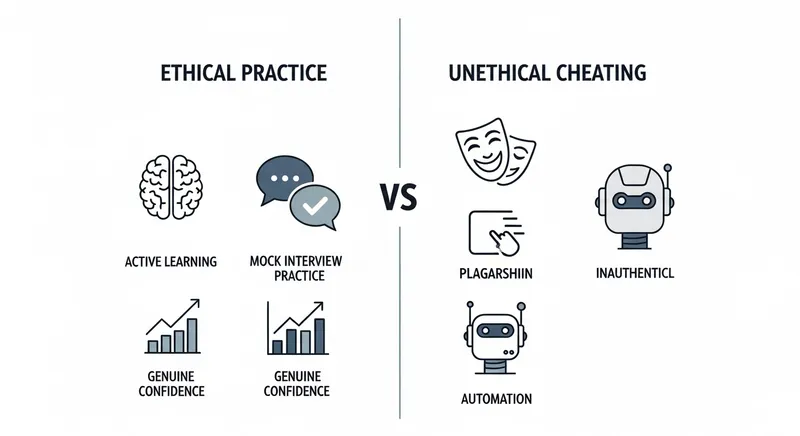
To eliminate the fear and confusion, you need a simple set of rules. Here is a clear framework that separates ethical preparation from unethical cheating.
DO: Use AI as Your Personal Interview Coach
Think of AI as your tireless practice partner. It's a safe space to build muscle memory for answering questions confidently. Here is what you should be doing:
- Brainstorm Ideas: Use AI to help you remember past achievements or structure your thoughts for common questions like, "Tell me about yourself."
- Simulate the Interview: Ask an AI to act as an interviewer for a specific role and generate a wide variety of behavioral questions. This prevents you from being caught off guard.
- Refine Your STAR Stories: Practice telling your stories (Situation, Task, Action, Result) and ask the AI to critique them for clarity, impact, and completeness.
- Get Delivery Feedback: Record yourself speaking and use AI tools to analyze the transcript for filler words ("um," "like"), pacing, and tone.
💡 PROMPT TO COPY: After finding a job you like, record yourself answering the question, "Why are you interested in this role?" Then, paste the transcript into an AI and use this prompt: "Please analyze this answer for clarity, confidence, and impact. Suggest ways I can make it more specific and compelling without changing my personal story."
For targeted practice, check out our guide on preparing for an AI Mock Interview for a Digital Marketing Manager in Australia.
DON'T: Use AI to Deceive or Misrepresent Yourself
Crossing the ethical line happens when AI is used to create a false impression of your abilities or experience. To maintain your integrity, never do the following:
- Use Real-Time Assistance: Never have an AI chatbot open during a live video or phone interview to generate answers on the fly. This is the definition of cheating.
- Directly Copy and Paste: Do not take AI-generated text for your resume or cover letter and submit it without heavy editing. It must be personalized with your unique voice and specific examples. A generic, AI-written document is easy to spot.
- Invent or Exaggerate: Never use AI suggestions to create experiences, skills, or metrics that aren't true. The U.S. Equal Employment Opportunity Commission holds candidates and employers accountable for the information presented, and lying will get you disqualified.
As the Services Australia guidelines state, you must be honest about your capabilities and represent yourself genuinely. Using AI to gain an unfair advantage is a direct path to rejection.
How to Use AI for Interview Practice (The Right Way)
Ready to put this into practice? Here is a step-by-step guide to an ethical and highly effective AI-powered preparation session.
-
Feed the Job Description to the AI: Start by giving your AI coach the context it needs. In your JobSparrow dashboard, add the job you are applying for. Our AI will instantly analyze the role, company, and required skills.
-
Launch a Tailored Mock Interview: Start an AI Mock Interview for that specific role. JobSparrow will generate questions that a real hiring manager for that exact position would ask, covering screening, culture fit, and even technical topics.
-
Practice Your STAR Stories: As the AI asks behavioral questions like, "Tell me about a time you handled a difficult stakeholder," use the STAR method to structure your response. Record your answer. The goal is to articulate your real experience clearly.
-
From AI Suggestion to Authentic Answer: After you finish, JobSparrow provides instant feedback on your answer's quality and clarity. This is where the real learning happens. Academic research shows that the "lack of humanity" is a key source of anxiety for applicants. Your job is to inject that humanity back in.
- Raw AI Idea: "Demonstrated project management skills by leading a team to deliver a project on time."
- Your Authentic Answer: "In my role at Acme Corp, I led a five-person team on the 'Phoenix Project.' It was a high-stakes initiative with a tight deadline. I implemented a daily stand-up and a shared risk register, which helped us identify a critical dependency early on. As a result, we delivered the project two days ahead of schedule and 5% under budget."
Ready to get started? Sign up for JobSparrow and see how tailored AI practice can transform your interview preparation.
💡 PROMPT TO COPY: Use this powerful prompt in a general AI tool: "I am a [Your Role] preparing for an interview at [Company Name] for a [Job Title] position. Based on the job description below, act as my interview coach. Ask me ten likely behavioral questions, and for each of my answers, critique it using the STAR method."
Answering the Call: A Guide for Migrants & Career Changers in AU & NZ
For migrants and career changers in Australia and New Zealand, AI can be an incredibly powerful tool for bridging gaps in context and experience.
For Migrants: Landing a job in a new country involves learning unspoken cultural rules. AI can help you understand the tone and priorities of local employers. For instance, you can ask it to analyze an Australian job description for clues about workplace culture (e.g., emphasis on teamwork, flat hierarchies).
This approach aligns with work being done at MIT Solve, where researchers are developing AI coaches to help immigrants overcome communication barriers. The Australian government itself is committed to the responsible use of AI, as outlined by Jobs and Skills Australia, so leveraging it for preparation is a smart move.
For Career Changers: Your challenge is articulating transferable skills. AI can be your translator. If you are moving from one field to another, you need to show how your past experience is relevant. For more on this, see our complete guide on how to write a career change resume.
💡 PROMPT TO COPY: "I am a former high school teacher applying for a Corporate Trainer role in New Zealand. Here is the job description. Help me reframe my experience in classroom management, curriculum development, and parent communication into skills that are relevant for a corporate audience."
Beyond the Interview: Ethical AI for Your Entire Job Application
Ethical AI use extends beyond just interview prep. Here's how to apply the same principles to your resume and cover letter.
-
Beating Applicant Tracking Systems (ATS) Ethically: The goal of using AI for your resume is translation, not fabrication. Use AI to scan your resume against a job description to find legitimate skills and experiences you already have but may have forgotten to include. It helps you speak the language of the recruiter; it does not help you lie. For a deep dive, learn how to beat the bots with our AU/NZ guide to ATS-friendly resumes.
-
AI in Cover Letters: Can recruiters detect AI in cover letters? They can't detect the tool, but they can easily detect generic, impersonal content. Use AI to create a first draft, but then you must inject your personal story, your specific reasons for wanting the job, and your genuine enthusiasm.
Actionable Tip: Use a tool like JobSparrow's Gap Analysis to automatically compare your resume to a job description. It will give you a "match score" and a list of keywords and skills you possess but haven't highlighted. This is an ethical way to optimize your application.
Conclusion: AI Is Your Coach, Not Your Cheat Sheet
Ultimately, the ethical use of AI in your job search comes down to intent. If your goal is to practice, learn, and build real confidence, AI is one of the most powerful tools at your disposal. If your goal is to deceive, it will almost certainly backfire.
Authenticity is what lands jobs. A hiring manager will always be more impressed by a candidate who can think on their feet and speak from genuine experience-even if imperfectly-than one who delivers a flawless but hollow script. Use AI to discover and refine your authentic self, not to hide it.
Ready to build real confidence for your next interview? Start your free JobSparrow trial and practice with AI mock interviews tailored to your target role. You've got this.
Frequently Asked Questions
Are AI interview tools worth it?
Yes, they are absolutely worth it when used correctly for preparation, not deception. They provide a safe, private space to practice answering tough questions, which directly builds confidence. The value comes from getting objective feedback on your communication style, clarity, and use of filler words-insights that are hard to get from practicing in front of a mirror. They are not worth it if you expect them to be a magic bullet that gives you fake answers during a live interview.
How can I get free AI interview feedback?
Many platforms, including JobSparrow, offer free trials or limited free versions of their AI mock interview tools. For a completely free option, you can use general AI chatbots like ChatGPT or Google Gemini. Record yourself answering an interview question, transcribe the audio to text, and then paste that text into the AI with a prompt like, "Act as a career coach and give me feedback on this interview answer."
Is it cheating to use AI to write my cover letter?
It is not cheating to use AI as a brainstorming partner or a writing assistant. It crosses the line into being counterproductive and unethical if you submit a 100% AI-generated letter without significant personalization. Recruiters can easily spot generic, impersonal letters that lack genuine enthusiasm. The best practice is to use AI for a first draft and then heavily edit it to include your personal story, your specific motivations for applying, and your authentic voice.
Will using AI for practice make me sound robotic?
This is a common and valid fear, but it only becomes a reality if you simply memorize and regurgitate the AI's suggestions. The purpose of AI practice is not to create a perfect script, but to explore different ways of phrasing your own experiences. Use the AI to brainstorm key points and structure your thoughts. Then, practice delivering those points in your own words. The AI is the script editor; you are the actor who brings the role to life with genuine emotion and personality.
What are the most important ethical guidelines for using AI in job applications?
The core ethical guidelines are straightforward and centered on honesty:
- Be Truthful: Never use AI to invent or exaggerate skills, qualifications, or past experiences.
- Be Authentic: Always personalize AI-generated content. Your resume, cover letter, and interview answers should reflect your true voice and personality.
- Be Honest in the Moment: Do not use any real-time AI assistance during a live or recorded interview. The answers must come from you alone.
- Be Responsible: As authorities like the EEOC and Services Australia make clear, you are ultimately accountable for everything you submit. If you get caught misrepresenting yourself, the fault is yours, not the AI's.
For more help ensuring your documents are both authentic and effective, consider getting a free resume and CV review.
Tags
Keep reading
Recommended articles.
job search · automation
The Anti-Burnout Job Search: An AU/NZ Guide to Automating Your Applications in 2026
Beat job search burnout in AU/NZ. Automate applications, tailor resumes with AI, and manage your search in one place. Start free.
ai · cover letter
How to Use an AI Cover Letter Generator Without Sounding Like a Robot (AU/NZ Guide)
Tired of sounding like a robot? Learn how to use an AI cover letter generator to create human-sounding applications that land interviews in Australia & NZ.
job search · resume tips
Job Application Black Hole AU/NZ: 8 Reasons You're Not Hearing Back & How to Fix It
Getting ghosted by jobs in AU/NZ? We reveal 8 reasons your application is ignored and a framework to get seen. Get your free resume match score now.