
resume format
Australian Resume Format 2026: The Ultimate ATS-Friendly Checklist & Guide
By Job Sparrow Team
Writing a resume for the Australian job market can feel like navigating a maze in the dark. If you're a recent migrant, a career changer, or even a local professional, you're likely asking the same questions: Am I doing this right? Will a robot reject my application before a human even sees it? Is there a secret cultural rule I'm breaking?
This anxiety is one of the biggest hurdles in a job search. You have the skills and the experience, but with research showing that over 75% of resumes are rejected by automated systems before a human sees them, that fear is justified. Generic advice won't build the confidence you need to overcome this digital gatekeeper.
This is not another generic guide. This is your definitive, 2026-ready playbook for creating a powerful, ATS-beating Australian resume. We'll provide specific, actionable strategies for everyone—from seasoned professionals to those with international experience or those changing careers. With a job market that's constantly evolving, having a future-proof resume is your most critical career asset. Let's build one that gets you noticed.
Why Your Old Resume Won't Cut It in 2026
The Australian job market is more dynamic than ever. Data from the Australian Bureau of Statistics (ABS) shows that in the year ending February 2024, 1.1 million people—or 8% of all employed individuals—changed jobs. To compete in this active market, your resume needs to do more than just list your history; it must be a strategic marketing document optimized for both robots and humans.
Applicant Tracking Systems (ATS) are now the primary gatekeepers for most roles. These systems scan your resume for keywords, skills, and specific formatting before a recruiter ever sees it. A document that isn't ATS-friendly is a document that won't get read. Furthermore, recruiters are spending less time on initial scans, meaning your value must be communicated instantly.
A 2026-ready resume is tailored, keyword-rich, and strategically structured to make an immediate impact.
Australian Resume Format vs. US & Global Standards: The Key Differences
One of the first hurdles for many job seekers is understanding that an Australian resume has its own distinct conventions. What works in the US or Europe can get your application immediately discarded here.
- Length: Forget the strict one-page rule common in the US. The standard for an Australian resume is two to three pages. According to global recruitment firm Hays, this length is expected for most professionals as it provides the necessary space to detail experience and quantifiable achievements.
- Terminology: The terms 'resume' and 'CV' are often used interchangeably in Australia. While 'CV' is more common in academia and medicine, 'resume' is the standard for most professional industries.
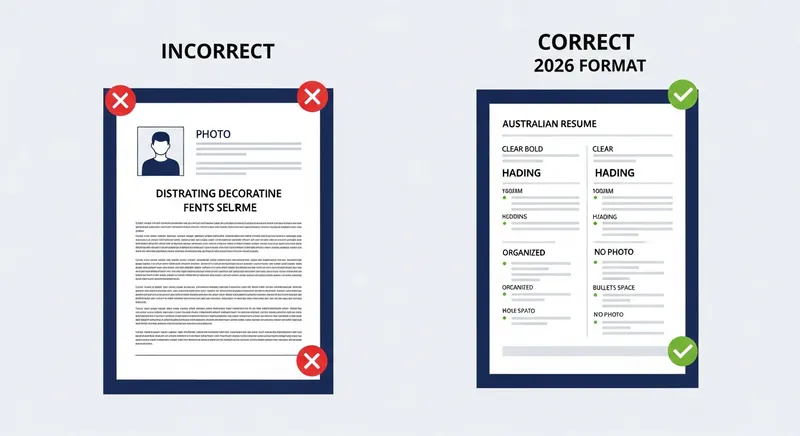
- Photo: Do not include a photograph. Australian hiring practices are governed by anti-discrimination laws, and including a photo is seen as unprofessional and can lead to unconscious bias.
- Personal Details: Omit personal information such as your age, date of birth, marital status, or religion. This information is irrelevant to your ability to do the job.
The Ultimate Australian Resume Structure for 2026 (Reverse-Chronological)
The gold standard for Australian resumes is the reverse-chronological format. As recommended by Australia's top job board, SEEK, this structure is preferred by recruiters and ATS because it clearly presents your most recent experience first. Here's how to build it, section by section.
1. Contact Information
Keep it clean and professional. This section should be at the very top of your resume.
- Include: Full Name, Phone Number, Professional Email Address, LinkedIn Profile URL, and your general location (e.g., "Sydney, NSW" or "Melbourne, VIC"). You do not need to include your full street address.
2. Professional Summary
Replace the outdated 'Career Objective' with a powerful Professional Summary. This is a 3-4 line elevator pitch that sits right below your contact details. It should summarize who you are, what you offer, and what you're aiming for.
- For an Experienced Professional: "Senior Project Manager with 10+ years of experience delivering complex, multi-million dollar infrastructure projects on time and under budget. Expert in Agile methodologies and stakeholder management, seeking to leverage extensive leadership skills to drive large-scale digital transformations."
- For a Career Changer: "Accomplished retail manager with 8 years of experience leading high-performing teams and exceeding sales targets. Now leveraging proven skills in client relationship management, data analysis, and strategic planning to transition into a Business Development role in the tech sector."
- For a Recent Graduate: "Enthusiastic and motivated recent Commerce graduate from the University of Sydney with a major in Finance. Possesses strong analytical skills, a foundational knowledge of financial modelling, and internship experience in a fast-paced fintech environment. Eager to contribute to a dynamic financial analysis team."
3. Key Skills
This is a critical section for ATS optimization. Create a bulleted list of 8-12 of your most relevant skills. Use a mix of technical (hard skills) and interpersonal (soft skills).
- Example:
- Technical Skills: Agile & Scrum Methodologies, JIRA, Budget Management, Contract Negotiation, Risk Analysis, Power BI
- Interpersonal Skills: Stakeholder Engagement, Team Leadership, Conflict Resolution, Strategic Planning, Cross-Functional Communication
4. Professional Experience
This is the heart of your resume. List your roles in reverse-chronological order. For each role, include your title, the company, its location, and the dates you worked there. Underneath, use 3-5 bullet points to describe your achievements, not just your duties.
To streamline this process, think of your resume as being built from a central Master Career Profile—a comprehensive record of all your roles, achievements, and skills. Tools like JobSparrow use this profile as a single source of truth, allowing you to instantly generate tailored resumes for different roles without rewriting everything from scratch.
The Secret to Quantifying Achievements (with Australian Examples)
Recruitment experts at Robert Half advise using action verbs and data to prove your impact. Instead of saying what you did, show what you achieved.
-
Before (Duty-focused): "Responsible for managing social media accounts."
-
After (Achievement-focused): "Grew Instagram follower base by 45% over 12 months and increased engagement by 25% through a targeted content strategy, resulting in a 15% uplift in web traffic from social channels."
-
Before (Mining Industry): "Involved in site safety procedures."
-
After (Mining Industry): "Implemented a new pre-start safety checklist that contributed to a 30% reduction in minor on-site incidents over two consecutive quarters."
-
Before (Healthcare): "Handled patient scheduling and administration."
-
After (Healthcare): "Streamlined the patient booking system by implementing a new digital platform, reducing administrative errors by 50% and cutting patient wait times by an average of 15 minutes."
5. Education
Your education section's placement depends on your experience. If you are a recent graduate, place it before your Professional Experience, as advised by institutions like James Cook University. If you have more than a few years of experience, place it after.
- Include: Your qualification, the institution, and the year of completion.
6. References
Simply state: "Professional references are available upon request." There is no need to list your referees' contact details on the resume itself. Prepare a separate document to provide when asked.
The Migrant's Bible: How to Frame Your International Experience
Navigating the Australian job market as a migrant presents unique challenges. Navigating visa status disclosure can feel vulnerable, but transparency builds trust. Your resume needs to bridge the gap between your international experience and the expectations of a local employer.
How to List Your Visa Status on a Resume
Be upfront and clear about your right to work. Recruiters appreciate knowing this information upfront. The best place to put this is in your contact section or at the end of your professional summary.
- If you have permanent residency: "Australian Permanent Resident"
- If you have full working rights: "Full, Unrestricted Australian Working Rights"
- If you are on a specific visa (e.g., 485): "Temporary Graduate Visa (Subclass 485) with full-time work rights until [Date]"
Translating International Titles and Qualifications
Don't assume an Australian recruiter will understand the scale of your previous company or the specifics of your role. If your job title isn't standard in Australia, consider using a more common equivalent with the original title in parentheses. For example: "Area Sales Manager (originally Responsabile Commerciale)". Add a brief, one-line description of your previous employer if they are not a well-known multinational (e.g., "a leading European logistics provider with an annual turnover of €500M").
This is where AI can be a powerful ally. JobSparrow's Gap Filler feature, for example, asks targeted questions about your international roles to help you uncover and articulate achievements in a way that resonates with Australian employers, bridging the cultural context gap.
The Career Changer's Playbook: Proving Your Value
Changing careers is about proving your past skills are relevant to your future goals. Your resume must connect the dots for the hiring manager.
- Harness Your Professional Summary: This is your most powerful tool. Explicitly state your intention to pivot and highlight 2-3 key transferable skills that are critical for the new role.
- Create a "Relevant Skills" Section: Group your transferable skills under headings that align with the target job. For example, if moving from marketing to product management, you might have sub-sections like "Product & Market Analysis" and "Stakeholder Communication."
- Reframe Your Experience: For each bullet point in your work history, ask: "How does this achievement prove I can succeed in the new role?" Focus on process and outcomes, not just industry-specific tasks. To make this easier, JobSparrow's Gap Filler can analyze your past roles against your target career, asking insightful questions to help you identify the transferable skills you might have overlooked.
For more tips, check out our guide on how to manage a career change in Australia.
The Definitive ATS-Friendly Checklist for Australia (2026)
Getting past the bots is the first—and most critical—step. Follow this checklist to ensure your resume is optimized for Australian ATS.
- ☑️ Use a Clean Format: Avoid tables, columns, headers, and footers. These can confuse older ATS software. While modern layouts can work, a simple, single-column format is the safest bet.
- ☑️ Stick to Standard Fonts: Use common fonts like Arial, Calibri, or Times New Roman in a readable size (10-12pt).
- ☑️ Use Standard Section Headings: Don't get creative. Use headings like "Professional Experience," "Skills," and "Education."
- ☑️ Optimize for Keywords: Scour the job description for key skills and qualifications. Ensure these exact keywords appear naturally throughout your resume, especially in your Skills section and work experience.
- ☑️ Save as the Right File Type: Unless specified otherwise, submit your resume as a PDF. It preserves formatting across all devices. Name the file logically:
FirstName-LastName-Role-Resume.pdf.
How to Automate ATS Optimization
Manually tailoring your resume for every single job is exhausting. This is where dedicated AI tools offer a smarter workflow. Instead of starting from scratch or wrestling with prompts in a generic tool like ChatGPT, a platform like JobSparrow automates the process:
- You build a 'Master Career Profile' with all your experience.
- The AI analyzes the specific job description you're targeting.
- It automatically generates a tailored resume, optimizing keywords and highlighting the most relevant achievements in seconds.
While AI provides the optimization, we always recommend a final human review to add your personal touch and ensure authenticity.
Bonus Section: A Guide to the New Zealand CV Format
For those looking across the Tasman, the New Zealand job market has very similar expectations. According to the official Careers New Zealand government website, the core principles are almost identical to Australia's.
- Length: Two to three pages is standard.
- Photo & Personal Info: Do not include a photo, age, or marital status.
- Structure: A reverse-chronological format is preferred.
- Key Difference: While the principles are nearly identical, the terminology is a key cultural difference. In New Zealand, 'CV' is the standard term across almost all professions, whereas 'resume' is less common. Using the correct term shows you've done your homework.
Your Path to a Winning Resume
Your resume is more than a document; it's your personal marketing tool in a competitive job market. By following this 2026-focused guide, you can create a resume that is not only compliant with Australian standards but is also strategically designed to beat the ATS and capture a recruiter's attention.
Remember, the key principles are: tailor your content, prove your value with numbers, and ensure the format is clean and professional. Once your resume is polished, you'll need a compelling cover letter and sharp interview skills. JobSparrow can help you prepare for common interview questions and craft the perfect AI-generated cover letter.
Ready to build your 2026-ready Australian resume in minutes? Upload your current resume to JobSparrow and let our AI transform it into a powerful, tailored document that gets results. Only pay when you land an offer—no upfront costs and no subscriptions.
Frequently Asked Questions
What is the correct resume format for Australia in 2026?
The most accepted format is the reverse-chronological resume. This format lists your most recent work experience first and is preferred by both recruiters and Applicant Tracking Systems (ATS). Key sections to include are Contact Information, a Professional Summary, a Skills section, Professional Experience with quantified achievements, and Education.
How long should a resume be in Australia?
Unlike the strict one-page rule in the US, the standard length for a professional resume in Australia is two to three pages. This allows enough space to provide detailed, evidence-based examples of your accomplishments. For recent graduates with limited experience, one to two pages is acceptable. Government job applications can sometimes be even longer.
Should I put my visa status on my resume in Australia?
Yes, absolutely. For employers, knowing you have the right to work is a non-negotiable requirement. Be clear and upfront by stating your work rights (e.g., "Australian Citizen," "Permanent Resident," or "Full, Unrestricted Working Rights") in your contact section or professional summary. This removes any doubt and prevents you from being screened out.
How is JobSparrow different from using ChatGPT for my resume?
While ChatGPT is a powerful general tool, it requires you to manually copy, paste, and prompt it for every single job application. JobSparrow is a specialized platform built for this exact purpose. It maintains your Master Career Profile and automates the tailoring process in seconds. Our Gap Filler feature also asks targeted questions to uncover achievements and skills that a generic AI wouldn't know to ask about, ensuring your resume is as strong as possible.
What should I NOT include on an Australian resume?
To comply with Australian hiring standards and anti-discrimination laws, you should never include a photo, your age or date of birth, marital status, religion, or any other personal information not directly relevant to your ability to perform the job. Also, avoid using complex graphics, tables, or non-standard fonts that can be difficult for ATS to read.
Tags
Keep reading
Recommended articles.
ai resume builder · chatgpt
AI Resume Builder vs. ChatGPT: The 2026 Guide for the Australian Job Market
AI Resume Builder vs ChatGPT for Australian jobs? Get the winning 2026 strategy. Combine both to create perfect, ATS-friendly resumes that land interviews.
resume writing · career change
Transferable Skills for Career Change Resume (AU/NZ Guide)
Master your career change with Job Sparrow. Use AI to identify and showcase transferable skills on your CV. Beat the ATS in Australia & NZ. Start for free!
resume format · career change
The Ultimate Guide to Resume Formats for a Career Change in Australia (2026)
Use AI to rewrite your resume for an Australian career change. Master 2026 formats and highlight transferable skills with Job Sparrow’s AI rewriter today!