
resume writing
How to Write a Resume With No Experience in Australia & NZ (2026 Template + Examples)
By Job Sparrow Team

Introduction: Your First Job Resume Starts Here
You're staring at a blank page. The cursor blinks mockingly under the heading "Work Experience," and a wave of anxiety hits. How are you supposed to write a resume with no experience? It's a classic chicken-and-egg problem: you need experience to get a job, but you need a job to get experience. This feeling is the single biggest hurdle for graduates, school leavers, and career changers across Australia and New Zealand.
But here's the truth: you have more experience than you think. You just need to learn how to frame it.
This guide will show you exactly how to write a compelling resume for your first job in 2026. We'll provide actionable steps, concrete examples, and a template designed to showcase your potential, skills, and unique personality—the very things entry-level employers are looking for.
Why 'No Experience' is Your Hidden Advantage in 2026
Let's reframe the narrative. When a company hires for an entry-level position, they aren't expecting a candidate with a decade of corporate experience. They are looking for raw potential, a willingness to learn, and a fresh perspective. Your lack of formal work history isn't a weakness; it's a blank canvas.
In 2026, this is more true than ever. Many companies use AI-driven tools to scan resumes not just for past job titles, but for skills, potential, and adaptability. This shift towards skill-based hiring means your resume can focus 100% on your strengths: your education, your proven skills, your passion, and your trainability. You aren't defined by past roles, giving you the freedom to align your story perfectly with the job you want. You've got this, and we're here to help you prove it.
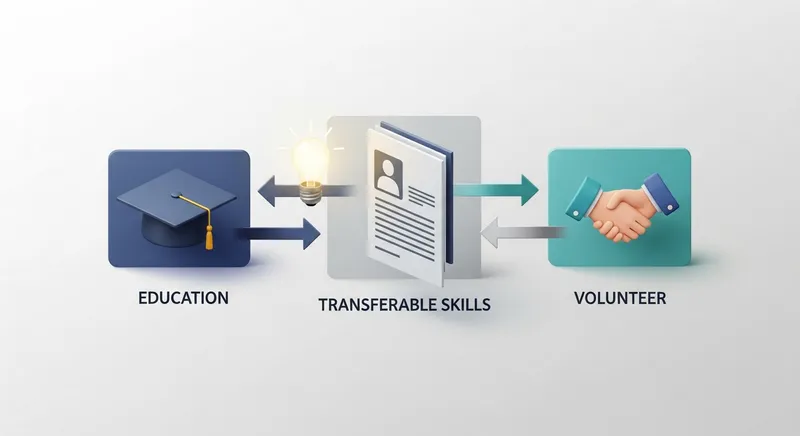
The Anatomy of a Winning 2026 No-Experience Resume
A powerful no-experience resume strategically highlights your potential. It's not about filling a template; it's about telling a story. Here are the essential sections that will form the backbone of your document.
Contact Information: Make It Professional and Easy
This section is simple but critical. Get it wrong, and a recruiter can't contact you. Get it right, and you look professional from the first line. According to guidelines from government bodies like the Queensland Government, your resume should be clear and easy to follow, starting with your contact details.
Your contact section should include:
- Full Name: (e.g., Olivia Chen)
- Phone Number: (e.g., 0400 123 456)
- Professional Email: (e.g., Olivia.Chen2026@email.com, not livvy_chen98@email.com)
- Location: (e.g., Sydney, NSW or Auckland, NZ – no need for your full street address)
- LinkedIn Profile URL: A must-have in 2026.
Actionable Tip: Customise your LinkedIn profile URL. Instead of the default URL with random numbers, change it to
linkedin.com/in/your-full-name. It looks cleaner and is easier for recruiters to find.
Resume Objective or Summary: Your 3-Second Pitch
With no formal work history, a Career Objective is often more effective than a summary. It focuses on your future ambitions and how you intend to add value, rather than summarising past roles. It should be a concise, 2-3 sentence pitch tailored to the specific job.
Here are a few examples:
- For a University Graduate (Marketing): "A recent Bachelor of Commerce graduate with a major in Marketing, eager to apply theoretical knowledge of digital campaign analysis and content strategy to an entry-level Marketing Assistant role. Seeking to contribute fresh ideas and a strong work ethic to the team at [Company Name]."
- For a School Leaver (Retail): "A highly motivated and reliable 2025 high school graduate with demonstrated teamwork and communication skills from school projects and sports. Seeking a casual retail position to deliver excellent customer service and develop practical skills."
- For a Career Changer (IT): "A dedicated professional with 5+ years of experience in customer service, now seeking to pivot into the IT industry after completing a Certificate IV in Cyber Security. Aims to leverage proven problem-solving and client management skills to excel in a Junior IT Support role."
Actionable Tip: Use keywords directly from the job description in your objective. If the ad mentions "data analysis" or "client engagement," weave those terms in. This shows you've read the ad carefully and helps your resume pass through Applicant Tracking Systems (ATS). A well-crafted objective sets the stage, much like you'd learn when using an AI cover letter generator.
Education: Your Most Important Asset (For Now)
For now, your education is your work experience. Present it with the detail and professionalism it deserves. List it in reverse chronological order (your most recent qualification first).
Here's what to include:
- Name of Qualification: e.g., Bachelor of Science (Computer Science)
- Institution Name: e.g., University of Melbourne
- Location: e.g., Melbourne, VIC
- Dates Attended: e.g., Feb 2023 – Expected Dec 2026
Actionable Tip: Don't just list your degree. Add a subsection for "Relevant Academic Projects" or "Key Achievements." Describe 1-2 significant projects using bullet points. As experts at Harvard University advise, use active, fact-based language to quantify your achievements. For example:
- Instead of: "Worked on a group project about app development."
- Write: "Led a four-person team to design and prototype a mobile application for event management, achieving a 95% grade for functionality and user interface design."
Skills: Show, Don't Just Tell
This section is your opportunity to directly match your abilities to the job requirements. Break it down into two categories:
- Technical/Hard Skills: These are specific, teachable abilities. Examples include: Microsoft Office Suite (Word, Excel, PowerPoint), Python, Google Analytics, Adobe Creative Suite (Photoshop, InDesign), HubSpot (CRM), or fluency in another language.
- Transferable/Soft Skills: These are personal attributes that apply to any job. They are highly valued by employers. Examples include:
- Communication (Written & Verbal)
- Teamwork & Collaboration
- Problem-Solving
- Time Management
- Adaptability
- Leadership
To give your resume an edge, focus on skills that are in high demand. According to a report from Jobs and Skills Australia, roles in digital, healthcare, and engineering are experiencing shortages, making skills in these areas particularly valuable.
Actionable Tip: Don't just list a skill like "Teamwork." Prove it with context. A bullet point under a project that says, "Collaborated with a team of 10 to organise a successful fundraising event," is far more powerful. This is a core principle when you're looking to highlight transferable skills for a career change.
Relevant Experience: Think Beyond Paid Work
This is where you reframe "no experience." Rename the section from "Work Experience" to "Relevant Experience" or "Projects & Volunteer Work." This immediately signals to the recruiter that you understand how to connect your background to their needs. According to Volunteering Australia, volunteer work can be listed alongside paid work if it's directly relevant to the role.
Here's what counts as experience:
- Volunteer Roles
- Internships or Work Placements
- University or School Projects
- Freelance Gigs
- Leadership roles in clubs or societies
- Part-time jobs (even if they seem irrelevant)
Actionable Tip: Use action verbs and quantify your impact. Transform your descriptions from passive duties to active achievements.
- Before: "Helped out at a local charity event."
- After: "Coordinated with a team of 5 volunteers to register 150+ attendees for a community fundraising event, contributing to a 20% increase in donations over the previous year."
How to Uncover Your Hidden Experience with AI
The biggest challenge is often remembering and articulating your achievements. You might not realize that managing the budget for your university club or organizing a study group demonstrates valuable financial literacy and leadership skills. This is where AI can be a powerful ally.
Tools like JobSparrow's Master Career Profile and Gap Filler are designed specifically for this. Here's how they work:
- You build a Master Career Profile: This is your central hub for every skill, project, award, and piece of experience you have—even things you think are irrelevant.
- The AI 'Gap Filler' asks targeted questions: It prompts you about your school projects, hobbies, and volunteer work to help you uncover achievements you've overlooked. For example, it might ask, "Did you ever lead a team project? How many people were on the team? What was the outcome?"
- It translates your input into professional bullet points: The AI then reframes your experiences using powerful action verbs and quantifiable results, automatically building out the 'Relevant Experience' section of your resume.
This process turns vague memories into concrete, impressive evidence of your capabilities, solving the 'blank page' problem for good.
Resume Nuances: Australia vs. New Zealand
While similar, the Australian and New Zealand job markets have subtle differences in resume conventions. Acknowledging these shows you've done your homework.
-
In Australia:
- The term "resume" is standard.
- A length of two pages is common for experienced professionals. However, for a graduate or someone with no experience, a powerful one-page resume is the gold standard.
- It is standard practice to include your visa status and work rights (e.g., "Australian Permanent Resident" or "Full Working Rights"). For a deep dive, check out our complete guide to the Australian resume format in 2026.
-
In New Zealand:
- The term "CV" (Curriculum Vitae) is more common.
- A length of one to two pages is typical, but again, one page is strongest for a first job application.
- The official Careers New Zealand website advises including skills from school projects, volunteer work, and personal interests that show relevant qualities.
Special Advice for New Migrants
Arriving in a new country with no local work experience can be daunting. Your international experience is valuable, but it needs to be framed correctly.
- State Your Work Rights: Clearly and upfront in your contact section, state your visa status (e.g., "Permanent Resident," "Skilled Migrant Category Resident Visa"). This immediately answers a key question for recruiters.
- Localise Your Language: Avoid jargon or acronyms from your home country. Tailor your resume using keywords from local job ads. As settlement guides note, a 'one size fits all' approach rarely works.
- Explain Your Qualifications: If your university or qualification is not well-known in AU/NZ, you can add a brief, one-line explanation (e.g., "Equivalent to an Australian Bachelor of Science").
The 2026 No-Experience Resume: Before & After AI
Instead of a blank template, let's see how AI transforms basic information into a compelling narrative. The key is turning passive statements into quantified achievements.
[Your Name] [Phone Number] | [Professional Email] | [City, State/Region] | [LinkedIn Profile URL] [Work Rights/Visa Status - for migrants]
Career Objective A highly motivated and detail-oriented graduate with a Bachelor of Science (Computer Science), seeking to apply knowledge of Python, Java, and agile methodologies to a Junior Developer role. Eager to contribute to innovative software solutions and grow with a forward-thinking team at [Company Name].
Education Bachelor of Science (Computer Science) | University of Melbourne | Feb 2023 – Dec 2026
- Key Achievement: Achieved a High Distinction average (87%) across all programming-related subjects.
- Relevant Coursework: Data Structures & Algorithms, Software Engineering, Web Development, Database Systems.
Skills
- Technical Skills: Python, Java, JavaScript (React), SQL, Git, Jira, Microsoft Excel (Pivot Tables, VLOOKUPs).
- Transferable Skills: Agile Methodologies, Problem-Solving, Team Collaboration, Public Speaking, Time Management.
Relevant Projects
Capstone Project: Event Management Mobile App | University of Melbourne | 2026
- Before AI: Worked in a team to build an app for my final year project.
- After AI Enhancement: Led a 4-person team in an agile environment to design, develop, and prototype a full-stack mobile application, achieving a 95% grade for functionality and UI/UX design.
Volunteer Role: Event Coordinator | Local Community Fundraiser | 2025
- Before AI: Helped out with event registration.
- After AI Enhancement: Coordinated with a team of 5 volunteers to manage check-in for 150+ attendees, implementing a new digital registration system that reduced wait times by 30%.
Awards and Achievements (Optional)
- Dean's List for Academic Excellence, 2025
- Winner, University of Melbourne Code-a-thon, 2024
References Available upon request.
Manually building and tailoring this for every job is time-consuming. To see how you can create dozens of optimised versions automatically, it's worth understanding the difference between an AI resume builder vs. ChatGPT.
Conclusion: You Have More Experience Than You Think
Writing a resume with no formal work history isn't about making things up—it's about uncovering the valuable experience you already have and presenting it in a way that employers understand. Your education, your projects, your volunteer work, and your skills are all proof of your potential.
By following this guide, you can transform a blank page into a powerful document that opens doors. You have a compelling story to tell. Now, go tell it.
Ready to build a resume that gets interviews? Upload your draft for a free, instant AI review. JobSparrow will identify gaps, suggest improvements, and help you create tailored versions for every application—all free until you land an offer. You only pay when you succeed.
Frequently Asked Questions
What if I literally have zero experience, not even volunteering?
If you have no volunteer work, internships, or part-time jobs, your resume should be a sharp, focused showcase of your academic life. Shift the entire focus to your Education section. Instead of just listing your degree, expand it with subsections like 'Key Projects,' 'Relevant Coursework,' and 'Skills Acquired.' Detail a major research paper or a complex project you excelled at. Use a strong Career Objective to express your enthusiasm, your career goals, and your eagerness to learn on the job. A resume in this situation will be short—and that's perfectly fine. It's a concise statement of your academic achievements and future potential.
Should I include my high school results on my resume?
Yes, but only in specific situations. If you are a recent high school leaver or in your first year of university, including your ATAR (in Australia) or NCEA results (in New Zealand) is a good idea, especially if they are strong. However, once you complete your university degree or gain 1-2 years of relevant experience, you should remove these details. Your resume real estate is precious and should be dedicated to your most recent and relevant achievements.
How long should my resume be if I have no experience?
Strictly one page. For a student, a recent graduate, or anyone with limited professional experience, a one-page resume is the professional standard in both Australia and New Zealand. Recruiters spend only seconds on an initial scan, and a concise document shows that you can prioritise information and communicate effectively. While some experienced professionals in Australia use two pages, for your first job hunt, one page is the rule.
Do I need to include references on my resume in Australia or NZ?
No, you should not list the contact details of your referees directly on your resume. This is an outdated practice. Simply add the line "References available upon request" at the end of your document. Have a separate document ready with contact details for two to three people (like professors, coaches, or supervisors) who have agreed to be your referee.
Is it okay to include hobbies and interests?
Yes, a small 'Hobbies & Interests' section can be a great way to show personality, especially if you lack formal work experience. The key is to be strategic. Choose interests that hint at positive professional traits. For example, 'Captain of a local sports team' shows leadership. 'Contributing to open-source projects on GitHub' demonstrates passion and initiative for a tech role. 'Long-distance running' can suggest discipline. Keep it short and professional.
I have the experience on my resume, but how do I talk about it in an interview?
This is a crucial step. The best way to translate your project or volunteer experience into compelling interview answers is by using the STAR method (Situation, Task, Action, Result). For a university project, you would describe the project brief (Situation), your specific role (Task), the steps you took (Action), and the grade or outcome (Result). You can use an AI mock interview tool to practice this. JobSparrow's AI, for example, can take your resume points and ask you behavioural questions about them, giving you a safe space to practice turning your academic work into professional stories.
Tags
Keep reading
Recommended articles.
resume summary · resume writing
How to Write a Powerful Resume Summary in Australia & NZ (2026 Guide + Examples for Career Changers, Graduates & Migrants)
Write resume summaries that pass the 10-second recruiter test. 2026 guide with examples for career changers, grads & migrants in AU/NZ.
resume summary · career change
Career Change Resume Summary: 10+ AU/NZ Examples & Guide
Craft a winning career change resume summary for the AU/NZ market. Get 10+ examples and a step-by-step formula to land your dream role.
career change · mature workers
Career Change at 40 & 50 in Australia & NZ: The 2026 Guide to Your Second Act
Career change at 40-50 in AU/NZ? Get an actionable 2026 guide: financial planning, ageism strategies, and AI tools for your second act. Start now.