
job search
How to Follow Up After an Interview & Job Application in AU & NZ (+ Templates)
By Job Sparrow Team

Introduction: From Anxious Waiting to Confident Action
The silence is deafening. You've submitted the perfect application or nailed the interview, and now you're left staring at your inbox, re-reading every word you wrote, and fighting the urge to refresh your email for the tenth time in an hour. This period of waiting is one of the most stressful parts of the job search, filled with anxiety and self-doubt.
What if you could trade that feeling of powerlessness for one of confident, professional control? Following up is not about pestering a busy hiring manager. It's a proactive, strategic step that reinforces your interest, demonstrates your professionalism, and keeps you top-of-mind.
This guide provides a clear roadmap for how and when to follow up in the Australian and New Zealand job markets. We'll give you the exact timelines, templates, and scripts you need to navigate this tricky phase with confidence. Because with the right strategy, you can turn anxious waiting into proactive winning.
Why Following Up is Non-Negotiable in the AU & NZ Job Market
In a competitive job market, the smallest details can make the biggest difference. A thoughtful follow-up email is more than just good manners; it's a powerful tool in your job-seeking arsenal. It signals to employers that you are genuinely interested, organized, and professional—qualities that help you stand out from the crowd.
Consider the landscape: even in a market where many employers are recruiting, a significant portion report difficulty finding the right people. According to Jobs and Skills Australia, while 51% of employers were recruiting in late 2023, 45% of them faced hiring difficulty. This means that while jobs are available, companies are looking for candidates who truly stand out. A well-timed follow-up can be the very thing that brings your application back to the top of the pile.
Many job seekers worry about appearing 'pushy'. Let's reframe that fear. A polite, professional follow-up is not an annoyance; it's a helpful act of communication that shows you respect the hiring manager's time while advocating for your own candidacy. It proves you're the kind of proactive and communicative person they'd want on their team.
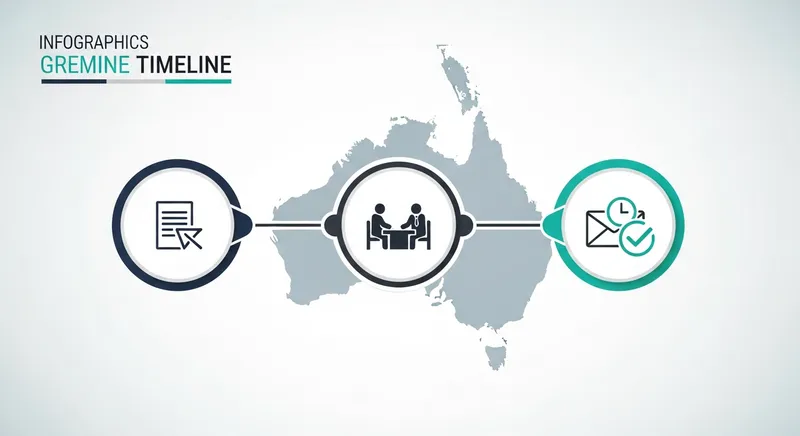
The Golden Rules: When to Follow Up in Australia & New Zealand
Timing is everything. Follow up too soon, and you risk appearing impatient. Wait too long, and you might seem disinterested. Here is a clear, actionable timeline to follow for every scenario.
-
The Thank-You Note: Send this within 24 hours of any interview (phone, video, or in-person). Leading recruitment firm Robert Half Australia confirms this is the best practice to show you are engaged and interested.
-
The First Follow-Up (After an Interview): If the hiring manager gave you a timeline (e.g., "We'll be in touch by Friday"), wait 1-2 business days after that deadline has passed. If no timeline was given, a week is the standard waiting period before sending a polite check-in.
-
The Application Follow-Up (No Interview Yet): Wait 1-2 weeks after the application closing date before inquiring about the status. If no closing date was listed, give it 2-3 weeks from the day you applied.
A Note on AU & NZ Timelines: Be mindful of local customs and holidays. Recruitment can slow down significantly around major public holidays like Anzac Day, and especially during the extended Christmas, New Year, and summer holiday period (mid-December to late January). Factor in these potential delays before sending your follow-up.
Part 1: Following Up After the Interview
You've done the hard work in the interview room. Now it's time to secure that positive impression with professional and timely communication.
Pre-Send Checklist: Before you hit 'send' on any follow-up, do a quick 3-point check:
- Spelling: Double-check the spelling of the interviewer's name and the company name.
- Clarity: Is your subject line clear and professional? (e.g., "Thank you - Interview for [Job Title]").
- Context: Are you replying in the correct email thread to keep the conversation history intact?
The Immediate Thank-You Email (Within 24 Hours)
This is your first and best opportunity to follow up. The goal is simple: express gratitude, reiterate your strong interest, and briefly reconnect to a positive point from your conversation. It shows you were paying attention and are genuinely excited about the role.
According to advice from Australia's top job board, SEEK, your thank-you email should be concise and to the point. For group interviews, career advisors at Harvard University recommend sending a separate, personalized note to each interviewer to make a stronger impact.
Thank-You Email Template (Video or In-Person Interview):
Subject: Thank you - Interview for [Job Title]
Hi [Interviewer's Name],
Thank you again for your time today. I truly enjoyed our conversation and learning more about the [Job Title] position and the team at [Company Name].
I was particularly interested in [mention something specific you discussed, e.g., the upcoming project you talked about, the team's collaborative approach]. My experience in [mention a relevant skill/experience] aligns perfectly with this, and I am even more confident that my skills would be a great asset to your team.
I am very enthusiastic about this opportunity and look forward to hearing from you regarding the next steps.
Best regards,
[Your Name]
Why This Works: Mentioning a specific detail from your conversation (e.g., a project, a company value) proves you were an active listener, not just sending a generic template. It re-engages the interviewer's memory of your specific discussion, making you more memorable.
Template for a Thank-You Email After a Phone Interview (NZ Focus):
Subject: Thank you - [Job Title] phone interview
Hi [Interviewer's Name],
Thanks for taking the time to chat with me on the phone today about the [Job Title] role. It was great to get a better understanding of the position and the direction of [Company Name].
Our discussion about [mention a specific point] has confirmed my interest in this opportunity, and I believe my background in [mention a relevant skill] would allow me to hit the ground running.
I appreciate you considering my application and look forward to the possibility of discussing this further.
Kind regards,
[Your Name]
After you've sent your thank-you note, use the time to continue your preparation. Reviewing common questions can keep you sharp for the next round. Practice your answers with an AI Mock Interview tool or use our guide to the STAR method for Australian behavioural interviews to structure your answers effectively.
The Follow-Up Email After No Response
It's the scenario every job seeker dreads: you had a great interview, sent a thank-you note, and then... silence. Being 'ghosted' is disheartening, but it doesn't always mean you're out of the running. Hiring priorities shift, and internal processes can be slow. A polite follow-up is perfectly acceptable.
As recommended by recruitment experts at Hays, if a timeframe was provided, wait a day or two after it has passed. If not, one week is the right amount of time to wait.
Follow-Up Email After No Response Template (Australia):
Subject: Following up on the [Job Title] Interview
Hi [Interviewer's Name],
I hope you're having a productive week.
I'm writing to politely follow up on my interview for the [Job Title] position on [Date of Interview]. I truly enjoyed our conversation and remain very interested in the opportunity to join the team at [Company Name].
Could you please let me know if there is an updated timeline for the hiring process? I'm happy to provide any additional information you might need.
Thank you for your time and consideration.
Best regards,
[Your Name]
Pro Tip: Always reply within the same email thread as your previous correspondence. This keeps the context of your conversation easily accessible for the hiring manager.
The 'Second Follow-Up' Email: The Gentle Nudge
If another week goes by after your first follow-up with no response, you can send one final, gentle nudge. The key here is to add value rather than just ask for an update again. As career experts at Northeastern University suggest, sharing a relevant article or congratulating the company on a recent achievement can be a great way to stay top-of-mind positively.
This shows you're still engaged with the company's journey, not just your application status. After this attempt, it's generally best to mentally move on and focus your energy on other opportunities. If they do get back to you, it's a bonus.
Second Follow-Up Email Sample:
Subject: Re: Following up on the [Job Title] Interview
Hi [Interviewer's Name],
Just a brief and final follow-up on my application for the [Job Title] role.
I saw the recent news about [mention a company achievement, e.g., your new product launch, a recent award] – congratulations to the team! It's exciting to see the impact [Company Name] is making.
I remain very enthusiastic about the possibility of contributing. Please let me know if the role is still open.
Best regards,
[Your Name]
Part 2: Following Up After the Initial Job Application
What if you haven't even secured an interview yet? The waiting game starts the moment you hit 'submit'. Here's how to follow up on your application without crossing any lines.
Quick Win Tip: The moment you apply for a job, log it in a tracker like JobSparrow. You can set an automatic reminder for 2 weeks after the closing date, so you know exactly when to send your follow-up without having to remember.
How to Politely Inquire About Your Application Status
If the application deadline has passed by a week or two and you haven't heard anything, it's appropriate to send a brief email to inquire about the status. This shows you're still interested and helps you get a sense of whether the position has been filled.
Sample Email to Check on Application Status:
Subject: Following up on Application for [Job Title]
Dear [Hiring Manager Name or 'Hiring Team'],
I am writing to follow up on my application for the [Job Title] position, which I submitted on [Date of Application].
I am very interested in this role and believe my experience in [mention 1-2 key skills from the job description] would make me a strong contributor to your team.
Could you please provide a brief update on the status of my application and the general timeline for the hiring process?
Thank you for your time and consideration.
Sincerely,
[Your Name]
To increase your chances of getting noticed in the first place, ensure your resume is optimized. Learn how to create a resume that can beat the bots with our ATS resume guide for Australia.
Beyond Email: How to Follow Up via Phone or LinkedIn
Email isn't your only option. In some cases, a different approach can help you stand out. However, these methods require a bit more finesse.
LinkedIn: A great low-pressure way to follow up is to connect with the recruiter or hiring manager on LinkedIn after you've applied. When you send the connection request, add a personalized note.
LinkedIn Connection Note Template: "Hi [Name], I recently applied for the [Job Title] role at [Company Name] and was very impressed by the company's work in [mention their industry/a recent project]. I'd be delighted to connect and follow your updates. Best, [Your Name]"
Phone Call: A phone call is the most direct method and should be used sparingly. It's best reserved for situations where you've already had some interaction with the recruiter. Keep the call extremely brief and respectful of their time.
Job Application Follow-Up Phone Call Script: "Hi [Recruiter's Name], this is [Your Name] calling. I know you're very busy, so I'll be brief. I recently applied for the [Job Title] position and just wanted to quickly reiterate my strong interest in the role. Is now still a good time to briefly chat, or would you prefer I send a quick email?"
A strong LinkedIn presence is crucial for these interactions. Make sure your profile is polished and professional with Your Ultimate LinkedIn Profile Checklist.
Special Considerations for Migrants and Career Changers
If you're new to the AU/NZ job market or changing industries, your follow-up is a powerful chance to bridge any perceived gaps and build confidence with the hiring manager.
- For Migrants: Following up demonstrates your understanding of local professional etiquette and showcases your excellent communication skills. Be patient, as some companies may have extra steps when considering candidates who require visa sponsorship. Use your follow-up to politely address this.
Template for Migrants: "...I remain very excited about this opportunity. For your reference, my current visa status is [e.g., 'a Permanent Resident', 'on a Temporary Skill Shortage visa with transfer rights', 'seeking sponsorship'], and I am confident we can navigate any necessary administrative processes smoothly. I look forward to hearing from you."
- For Career Changers: Use your follow-up email to subtly reinforce a key transferable skill. This helps the hiring manager connect the dots between your past experience and their current needs.
Template for Career Changers: "...Our conversation about data-driven decision making was particularly exciting. It's a skill I honed while managing budgets in my previous career in finance, and I'm eager for the opportunity to apply it to the challenges in the [New Industry] sector."
For more tailored advice, see our migrant's guide to landing a job in Australia & New Zealand.
Never Lose Track: Perfect Your Follow-Up Strategy
The average job seeker applies to dozens of roles. That's dozens of different timelines, contacts, and follow-up dates to remember. Forgetting when you applied or who you spoke to makes following up effectively almost impossible. This is where a system becomes your secret weapon.
The advice in this guide is powerful, but it relies on one thing: organization. The JobSparrow Job Application Tracker is designed to solve this exact problem. Instead of relying on messy spreadsheets or scattered notes, you can manage your entire job search from a single, smart dashboard.
Here's how it eliminates the stress:
- Log Everything: Instantly save job details, application dates, interview schedules, and contact information for every role.
- Set Reminders: The system knows when you applied and when your interview was. It can remind you when it's the perfect time to send the thank-you note or the follow-up email from our templates.
- Stay Confident: By removing the mental load of tracking everything, you can focus on what matters: preparing for interviews and writing thoughtful messages. You'll never again have to wonder, "Is it too soon to follow up?"
Frequently Asked Questions
What if a recruiter says 'we'll keep your CV on file'?
While this can sometimes feel like a polite dismissal, it's best to treat it as a potential future opportunity. The most professional response is to send a brief thank-you note. Express your appreciation for their time and reiterate your interest in the company. You can add, "I would be grateful if you would keep me in mind for future [Job Title or Field, e.g., 'Marketing Manager'] roles that may arise." This keeps the door open and shows you're focused. Consider setting a reminder to send a very brief, friendly check-in email in 3-6 months to stay on their radar.
How do I follow up after a verbal job offer in Australia?
Congratulations! Speed and professionalism are key here. Within a few hours of the call, send a polite and enthusiastic email to the person who made the offer. In the email, you should:
- Thank them for the offer and express your excitement.
- Formally confirm your acceptance of the verbal offer (if you are indeed accepting).
- Politely request the written offer of employment or contract so you can review the terms in detail. This creates a clear paper trail and officially moves the process forward.
Is it okay to follow up twice after an interview?
Yes, it is generally acceptable to follow up twice. Your first follow-up is the mandatory thank-you email sent within 24 hours. If the decision deadline passes and you've heard nothing, a second follow-up (the 'polite check-in' email detailed in this guide) is perfectly reasonable. However, any further follow-ups beyond that can start to seem pushy. After the second follow-up, it's usually best to shift your focus to other opportunities while leaving the door open.
Should I follow up if the job ad says 'no contact' or 'only successful applicants will be contacted'?
This is a critical distinction. You should always respect these instructions regarding your initial application. Companies use this language to manage a high volume of submissions, and contacting them against their wishes can make you look like you can't follow directions. However, the rules change after you have an interview. At that point, you are an active candidate, not just an application in a database. Sending a thank-you note is not only appropriate but highly recommended and considered standard professional courtesy.
Is using 'checking in' or 'just following up' a bad look?
Not at all. These are standard, widely used phrases in professional communication. As highlighted by career experts at Indeed, there is nothing inherently wrong with using them. The effectiveness of your email depends on the overall tone, not a single phrase. As long as your message is polite, concise, professional, and respectful of the hiring manager's time, using a common opening like "I'm just checking in" is perfectly fine and understood.
Take Control of Your Job Search Today
Following up is more than just a task—it's a strategy. By being organized, professional, and timely, you transform anxious waiting into confident action. You show employers that you are the proactive, engaged, and detail-oriented candidate they've been searching for.
Stop losing track of your applications and missing key follow-up windows. Take the guesswork out of your job search.
Upload your CV to JobSparrow and start tracking your applications for free today.
Tags
Keep reading
Recommended articles.
job search · interview tips
Thank You Email After an Interview in Australia & NZ: 2026 Guide + 5 Winning Templates
Nail your post-interview thank you email in AU & NZ with our 2026 guide. Get 5 winning templates and cultural tips to stand out. Apply smarter with JobSparrow.
interview tips · job search
Illegal Interview Questions in Australia & NZ: Your Guide to Answering with Confidence
Know your rights. Learn how to answer illegal interview questions in Australia & NZ with confidence. Get scripts to protect yourself and land the job.
interview tips · star method
Master the STAR Method: A Step-by-Step Interview Guide with AU & NZ Examples
Master the STAR method with our step-by-step guide. Get AU & NZ examples to ace your next behavioural interview. Boost your confidence and land the job!