
Your Ultimate LinkedIn Profile Checklist for the Australian Job Market (2026)
By Job Sparrow Team

You've sent 50 applications across SEEK and Indeed this month. The result? Three automated rejections and a deafening silence. If this sounds familiar, the problem isn't your experience—it's how you're presenting it on the world's largest professional network.
A generic LinkedIn profile is a missed opportunity, especially in the competitive Australian job market. Recruiters here aren't just looking for a list of past jobs; they're searching for specific signals that you are a low-risk, high-value candidate who understands the local work culture. This is the core challenge for so many talented professionals—especially career changers and new migrants. How do you translate your unique background into a compelling narrative that resonates with Australian hiring managers and gets past the increasingly sophisticated automated filters of 2026?
Time Investment: Implementing this checklist will take 2-3 hours. The ROI: A significant increase in recruiter views, connection requests, and interview opportunities.
This is not just another list of tips. This is your strategic playbook. With over 18 million members in Australia, representing 84.7% of the adult population, LinkedIn is the primary hunting ground for recruiters. This guide will walk you through, step-by-step, how to transform your profile from a passive resume into a powerful magnet for job opportunities in Australia and New Zealand for 2026.
1. Your Profile Picture & Background: The First Impression
Before a recruiter reads a single word, they see your photo. It's your digital handshake. According to advice from The University of Sydney, profiles with a photo receive up to 21 times more views. But in Australia, the style of that photo matters.
Actionable Tips:
- Get a Professional Headshot: This doesn't mean spending hundreds. A clean, high-resolution photo taken with a modern smartphone against a neutral background works perfectly. Face forward, smile genuinely, and dress as you would for an interview in your target industry.
- Aim for 'Approachable Professionalism': Avoid overly stiff, corporate-style photos. Australian work culture often values approachability. Your photo should say you're competent and easy to work with.
- Optimise Your Background Photo: The wide banner behind your profile picture is prime real estate. Instead of the default blue graphic, use an image that reflects your profession or ambition. This could be a cityscape for someone in finance, a clean image of code for a developer, or a branded banner with your personal tagline.
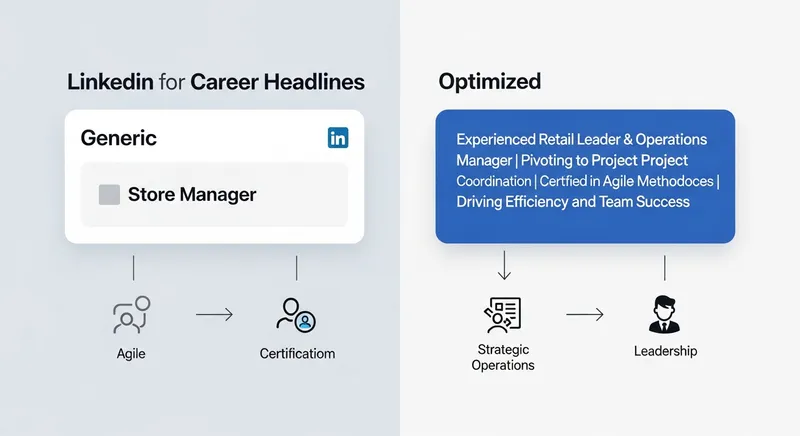
2. Your Headline: More Than a Job Title, It's Your Pitch
Your headline is the most critical piece of text on your profile. It follows you everywhere on LinkedIn—in search results, comments, and connection requests. It is not just your job title; it is your 220-character professional pitch.
This is especially crucial for career changers and new migrants. It's your chance to tell recruiters where you're going, not just where you've been.
Actionable Tips:
-
Use a Keyword-Rich Formula: A great formula is
Role | Specialisation/Skill | Value Proposition. Think about the terms a recruiter would search for. -
Headline Examples for the Australian Market:
-
For Career Changers:
- Common Mistake: "Marketing Manager at XYZ Corp"
- Optimized: "Marketing Leader pivoting to Data Analytics | Certified in Power BI & SQL | Turning insights into business growth" This immediately reframes your past experience for your future goals. For more on this, check out our guide on how to prove your value during a career change.
-
For New Migrants:
- Common Mistake: "Mechanical Engineer"
- Optimized: "Experienced Mechanical Engineer (Subclass 189 Visa Holder) | Specialising in Australian resource projects | Available for immediate start in Perth"
-
For Graduates:
- Common Mistake: "Student at University of Melbourne"
- Optimized: "Recent Bachelor of Commerce (Marketing) Graduate | High Distinction Average | Seeking Graduate Marketing role in FMCG"
-
3. The 'About' Section: Your Professional Story, Australian Style
If your headline is the hook, your 'About' section is the story. This is your opportunity to expand on your value proposition and demonstrate your personality. In Australia, a story of collaboration often resonates more than one of solitary genius.
Actionable Tips:
- Structure for Impact:
- The Hook (1 sentence): Start with a powerful summary of who you are and what you do.
- The Body (2-3 paragraphs): Detail your key areas of expertise and your proudest achievements (quantify them!). Frame accomplishments around teamwork where possible.
- The Future (1-2 sentences): State what you are looking for next.
- The Call to Action: End with your specialisations and an invitation to connect. E.g., "Specialising in: Digital Marketing | SEO | Content Strategy. Open to discussing opportunities in the SaaS sector."
- Embrace the 'Fair Go' Vibe: Write with confidence but avoid arrogance. Use phrases like "I contributed to a team that..." or "I had the opportunity to lead a project that resulted in..." This shows you're a team player.
- Include Keywords Naturally: Weave in keywords from job descriptions without sounding robotic. If you're struggling to frame your international experience, our guide for migrants on tackling the 'no local experience' challenge can help.
4. Detail Your Experience (But Tell a Story)
Don't just copy and paste your resume duties. Each role in your 'Experience' section should be a mini-story of achievement. Recruiters scan this section to validate the claims in your headline and summary.
Actionable Tips:
- Use Bullet Points with Quantified Results: Instead of "Managed social media accounts," try "Grew Instagram followers by 200% (from 5k to 15k) in 12 months, leading to a 15% increase in web traffic."
- Focus on Achievements, Not Duties: For each role, list 3-5 of your most impressive and relevant accomplishments.
- Align with Your Resume: As leading recruiters at Hays Australia point out, any discrepancies between your LinkedIn and resume are a major red flag. Consistency is key.
Keeping this level of detail consistent across every application is exhausting—and it's where many job seekers lose momentum. This is the exact challenge AI can help you solve. For example, JobSparrow's Master Career Profile lets you store all your achievements in one place. Then, when you find a job, our Job-Specific Resume Tailoring analyzes the description and pulls the most relevant bullet points, ensuring you always stand out from the crowd.
5. The Skills Section: Your Keyword Goldmine
The 'Skills' section is a primary tool for recruiters using LinkedIn's search filters. By 2026, LinkedIn's AI-powered search will be even more sophisticated, making keyword precision vital for discovery.
Actionable Tips:
- Be Strategic, Not Exhaustive: Pin your top three most relevant skills. Aim for a list of 15-30 skills that are highly relevant to your target roles.
- Find Keywords from Job Ads: The best way to find relevant skills is to analyze 5-10 Australian job descriptions for your target role. Note the most frequently mentioned skills and add them to your profile.
- Focus on Transferable Skills: For career changers, this section is vital. Transferable skills are essential for job mobility. Highlight skills like Project Management, Stakeholder Engagement, and Data Analysis. Explore our guide to showcasing transferable skills for more ideas.
6. The 'Open to Work' Feature: A Strategic Decision
This feature can be a powerful signal, but it requires a strategic approach.
Actionable Tips:
- Use the 'Recruiters Only' Setting: If you are currently employed, the safest and most effective option is to set your status to be visible only to recruiters. This activates your profile in recruiter searches without alerting your entire network (and current boss).
- Be Specific in Your Preferences: Take the time to fill out the job titles, locations (e.g., "Melbourne, Victoria, Australia"), and workplace types (remote, hybrid, on-site) you are interested in. This helps LinkedIn's algorithm bring you more relevant opportunities.
7. Getting Recommendations: Australian Social Proof
Recommendations act as testimonials. A glowing review from a former manager or senior colleague can significantly boost your credibility.
Actionable Tips:
- Personalise Your Request: Don't use the generic template. Send a personal message reminding your contact of a specific project you worked on together and gently suggest the key skills you'd love for them to highlight. This makes it easier for them to write a powerful and specific endorsement.
- Give to Get: One of the best ways to receive recommendations is to write them for others you've genuinely enjoyed working with.
8. Customise Your URL: A Simple, Professional Win
A default LinkedIn URL filled with random numbers looks untidy. Customising it is a small detail that signals professionalism.
Actionable Tip:
- Change your URL to
linkedin.com/in/yournameorlinkedin.com/in/yourname-field. You can do this by going to your profile, clicking "Edit public profile & URL" in the top right, and then editing your custom URL.
9. Be Active, Not Annoying: Strategic Networking
An active profile is a visible profile. Why does this matter? Recruiters are up to 3x more likely to engage with candidates who are active on the platform. More importantly, LinkedIn's algorithm prioritizes content and profiles from engaged users in search results and news feeds, as noted by experts at Hays. Your activity shows you're passionate and knowledgeable about your field.
Actionable Tips:
- Share with Insight: Don't just share an article. Add 2-3 sentences with your own perspective or a key takeaway. This demonstrates thought leadership.
- Engage Meaningfully: Follow companies you admire and people in roles you aspire to. Leave thoughtful comments on their posts.
- Personalise Connection Requests: When connecting with recruiters or industry contacts, always add a note. Mention a mutual connection, a post they wrote, or why you'd like to connect. A simple, "Hi [Name], I'm a [Your Role] in the [Your Industry] space in Sydney and would love to connect and follow your work," is far more effective than the default.
10. Special Considerations for Your Situation
Generic advice only goes so far. Here's how to tailor your profile for your specific circumstances in the Australian market.
For New Migrants
Your primary challenge is translating your international experience into a local context. You need to build trust and show you're ready to hit the ground running.
- Address Your Visa Status: Be upfront. Add your work rights to your headline or the first line of your summary (e.g., "Permanent Resident," "Holder of a Subclass 189 Skilled Independent visa"). This answers a recruiter's first question.
- Australianise Your Experience: If you worked for a company that isn't well-known in Australia, add context. For example, "Worked for XYZ Corp, a leading European fintech firm with a business model similar to Afterpay."
- Highlight Relevant Certifications: If you have qualifications recognised in Australia (e.g., local certifications, chartered status), feature them prominently.
For Career Changers
Your profile must tell a story of your future, not just your past. Every section should be re-framed to support your pivot.
- Lead with Your New Goal: As mentioned, your Headline and the first line of your 'About' section must state your new career direction.
- Use the 'Featured' Section: Use LinkedIn's 'Featured' section (the portfolio showcase near the top of your profile) to pin links to your portfolio, GitHub, personal projects, or certifications that are directly relevant to your new career. This provides tangible proof of your new skills.
- Re-write Your Experience: Under past roles, focus on the achievements and responsibilities that are transferable. For example, if moving from sales to project management, highlight your experience managing client timelines, coordinating with multiple departments, and delivering on revenue targets. For more on this, check out our guide on resume formats for a career change.
For Graduates
With limited professional experience, you need to sell your potential and skills.
- Leverage University Projects: Don't just list your degree. In your 'Experience' or 'Projects' section, detail major university projects. For example, instead of "Completed marketing strategy project," create a project entry titled "Developed Go-to-Market Strategy for a Fictional SaaS Product." In the description, use bullet points:
- Conducted market analysis of the Australian tech landscape.
- Collaborated with a team of 4 to create a multi-channel digital marketing plan.
- Presented final strategy to a panel, achieving a High Distinction.
- Showcase Soft Skills: Highlight skills like communication, problem-solving, and adaptability, backing them up with examples from part-time work, volunteering, or university group assignments.
- Get Active: As an international student or recent graduate, an active profile is critical. Being active and using keywords is key to increasing visibility to Australian employers.
The Ultimate Checklist Summary
- Profile & Banner Photos: Professional, approachable, and industry-relevant.
- Headline: A keyword-rich pitch, not just a job title.
- 'About' Section: A compelling story structured with a hook, body, and call to action.
- 'Experience' Section: Focus on 3-5 quantified achievements per role, not just duties.
- 'Skills' Section: List 15-30 relevant skills, with your top 3 pinned.
- 'Open to Work': Use the 'Recruiters Only' setting if currently employed.
- Recommendations: Get 2-3 quality testimonials from former managers or senior colleagues.
- Custom URL: Create a clean, professional URL (
/in/yourname). - Activity: Share insightful content and engage meaningfully with your network.
- Tailoring: Customise your profile for your specific situation (migrant, career changer, graduate).
Your Next Move
Your LinkedIn profile is your digital first impression and a cornerstone of your job search strategy. By implementing these tailored tips, you move beyond a generic, passive profile and create a strategic document that speaks directly to the needs of the Australian job market.
It's not just about what you've done, but how you frame it for what you want to do next. It's about building a narrative that is authentic, compelling, and optimised for the recruiters you need to impress.
Feeling overwhelmed by all the details? JobSparrow is designed to be your personal AI career assistant. You can build your Master Career Profile by simply uploading your current resume, and our AI will help you identify gaps and enhance your descriptions. From there, you can tailor your application materials for every job and even practice for the interview with our AI Mock Interviews.
Start with a free diagnosis from JobSparrow today and turn your LinkedIn profile into your most powerful career asset.
Frequently Asked Questions
How do I show my visa status on my LinkedIn profile for Australia?
Be direct and professional. The best place is in your headline or the first sentence of your 'About' section. This immediately answers a key question for recruiters. Examples include: "(Permanent Resident)", "(Subclass 189 Visa Holder)", or "(Full working rights in Australia)". This transparency builds trust and saves recruiters time.
Should I put 'Open to Work' on my LinkedIn profile in Australia?
Yes, but strategically. If you are unemployed, using the public green banner is fine. However, if you are currently employed, it is highly recommended to use the 'Recruiters only' setting. This makes you visible in recruiter searches without alerting your current employer or network, allowing you to explore opportunities discreetly.
What's the best way to write a LinkedIn headline if I'm changing careers?
Your headline must focus on your future direction, not your past role. Use a formula like: [Target Role/Field] | [Key Transferable Skill] | [Certification or Value Proposition]. For example: "Aspiring Project Manager | Experienced in Team Leadership & Operations | Certified in PRINCE2®". This tells recruiters your goal and gives them keywords to find you with.
Are LinkedIn recommendations important in the Australian job market?
Yes, they are valuable social proof. While not as critical as a well-written experience section, a few quality recommendations from former managers or senior colleagues can significantly boost your credibility. They act as references that recruiters can see upfront. Quality is more important than quantity; two detailed, positive recommendations are better than ten generic ones.
How do I find the right keywords for my industry in Australia?
Analyse 5-10 Australian job descriptions on SEEK or LinkedIn for your target role. Copy the text from the 'Requirements' or 'Skills' section into a word cloud generator. The words that appear largest are the most important keywords. Sprinkle these terms naturally throughout your headline, 'About' section, and 'Skills' section to align with what Australian recruiters are searching for.
Tags
Keep reading
Recommended articles.
resume writing · career change
How to Write a Career Change Resume: The Ultimate 2026 AU & NZ Guide
Master your AU/NZ career change. Our 2026 guide shows you how to reframe skills, write a resume that beats the bots, and land interviews. Start here.
job application tracker · job search
Job Application Tracker: How to Manage Your Search Across SEEK, Indeed & LinkedIn in AU/NZ
Ditch the spreadsheet. Our guide to a smart job application tracker helps you manage SEEK, Indeed & LinkedIn searches in AU/NZ. Land your next role faster.
career change · job search
Career Change AU/NZ 2026: From Doubting to In-Demand – How to Prove Your Value
Feeling stuck? Our 2026 career change strategy for AU/NZ helps you beat imposter syndrome and prove your value. Turn doubt into demand today.