
interview tips
Master the STAR Method: A Step-by-Step Interview Guide with AU & NZ Examples
By Job Sparrow Team

Introduction: Why Your Interview Answers Aren't Landing Jobs in AU & NZ
You have the skills. Your CV got you through the door. But in the interview, when the hiring manager says, "Tell me about a time when…," the right words escape you. You know you've handled complex projects and difficult clients, but your answer feels unstructured and falls flat.
This is a common frustration for even the most qualified job seekers. In Australia and New Zealand, where workplace culture often values evidence over assertion, behavioural interviews are the standard. The problem isn't your experience; it's how you communicate it. Success requires a strategy to prove your capabilities with clear, compelling stories.
This is where the STAR method comes in. It's a simple, powerful framework for structuring your answers to provide the concrete evidence that AU & NZ recruiters are looking for. This guide will walk you through the technique step-by-step, providing clear examples tailored for the local market, and show you how to perfect your delivery before you ever step into the interview room.
What is the STAR Method and Why Do Recruiters Prefer It?
The STAR method is an acronym that stands for Situation, Task, Action, and Result. It's a structured technique for responding to behavioural interview questions—the kind that ask for specific examples of how you've handled work situations in the past.
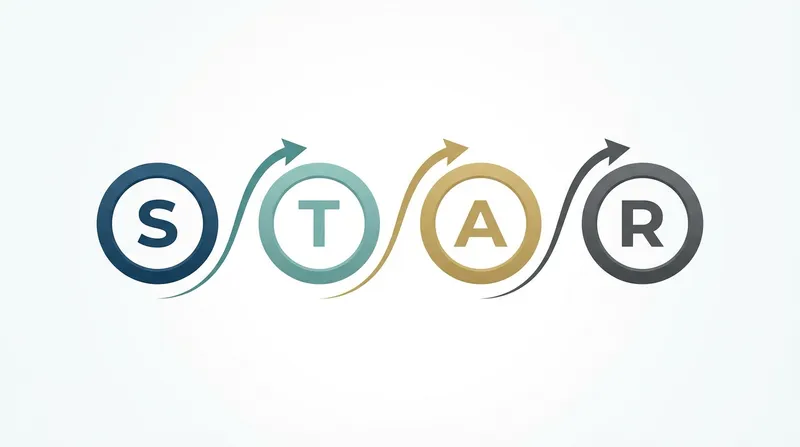
Recruiters and hiring managers in Australia and New Zealand prefer this method because it moves beyond vague claims ("I'm a good problem-solver") to provide concrete proof. The core belief, as explained by career services at Auckland University of Technology (AUT), is that past performance is the strongest predictor of future behaviour.
Unlike simpler frameworks like CAR (Context, Action, Result), the STAR method encourages you to separate the broader Situation from your specific Task. This small distinction adds crucial clarity and detail, allowing you to frame complex scenarios more effectively and demonstrate a higher level of professional awareness.
The STAR Method Breakdown: Your 4-Step Formula for Success
Mastering the STAR method means understanding the role of each component. Think of it as building a mini-story with a clear beginning, middle, and end. Here's how to construct each part of your answer.
S: Situation - Set the Scene
Start by providing concise context. What was the scenario? Who was involved? This is the background for your story. Your goal is to give the interviewer just enough information to understand the circumstances. Keep this part brief—one or two sentences is ideal.
- Actionable Tip: Focus purely on the background context. For example, "In my previous role at a digital agency, our team was approaching a major client deadline for a website launch during a peak holiday period."
T: Task - Define Your Goal
Next, explain your specific responsibility or the objective you were tasked with achieving. What was your personal mandate? How was success going to be measured? This clarifies your direct involvement in the broader situation.
- Actionable Tip: Clearly state your individual objective. For example, "My specific task was to coordinate the final QA process and resolve all critical bugs to ensure the site went live by the agreed-upon date, without requiring the team to work overtime."
A: Action - Detail Your Contribution
This is the most critical part of your answer. Describe the specific, individual steps you took to address the task. This is where you showcase your skills, initiative, and problem-solving abilities. As experts from institutions like the University of California, Berkeley advise, it is crucial to use "I" statements, not "we." The interviewer needs to know what you did.
- Actionable Tip: Detail 2-3 key steps you personally took. For example, "First, I organized a triage meeting to prioritize bugs by client impact. Next, I created a shared tracking document for real-time visibility. Finally, I communicated daily progress updates to the client to manage their expectations proactively."
R: Result - Quantify Your Impact
Conclude by explaining the outcome of your actions. Whenever possible, quantify your success with numbers, percentages, or concrete data to provide undeniable proof of your effectiveness. If a number isn't available, describe the positive qualitative outcome.
- Actionable Tip: Connect your actions directly to the positive result. For example, "As a result, we resolved all 15 critical bugs and launched the website on schedule. The client praised our transparent communication and signed a new 12-month retainer, representing a 20% increase in business from that account."
STAR Method Examples for the AU & NZ Job Market
Generic examples only get you so far. Here are practical STAR answers for common roles and situations in the Australian and New Zealand job markets.
Example 1: For Executive & Senior Leadership (Strategic Impact)
Question: "Tell me about a time you led a significant organisational change."
According to global recruitment firm Robert Walters, leadership answers must demonstrate clear, strategic decision-making under pressure.
- Situation: "As Head of Operations, I identified that our legacy supply chain software was causing an average of 15% order fulfilment delays, directly impacting customer satisfaction and putting us at a competitive disadvantage."
- Task: "My goal was to lead the selection and implementation of a new, integrated logistics platform across three distribution centres in Australia and New Zealand, with a mandate from the board to reduce fulfilment errors by 50% and achieve a positive ROI within 24 months."
- Action: "I assembled a cross-functional project team and conducted a thorough needs analysis. I personally led the vendor negotiations, securing a contract that was 10% under budget. I then designed and oversaw a phased rollout and training plan, starting with the highest-volume centre to mitigate risk."
- Result: "The new platform was fully implemented one month ahead of schedule. Within the first year, we reduced fulfilment errors by 70%, far exceeding the target. This contributed to a 25% decrease in customer service complaints and achieved a positive ROI in just 18 months."
Example 2: For Customer Service Roles (Handling Difficult Situations)
Question: "Describe a time you dealt with a difficult customer."
As Australia's top job board SEEK highlights, customer service answers must show empathy and a focus on resolution.
- Situation: "While working as a Customer Service Rep for a major telco, a customer called who was very upset because their internet had been down for 48 hours, impacting their work-from-home business."
- Task: "My goal was to de-escalate their frustration, diagnose the technical issue, and find an immediate solution to restore their connectivity."
- Action: "I began by actively listening and empathising with their situation, assuring them I would take personal ownership. I quickly identified the problem was part of a wider network outage in their suburb. I then offered to hotspot their mobile data for free for 72 hours and arranged a 50% credit on their next bill for the inconvenience."
- Result: "The customer calmed down immediately and was grateful for the proactive solution. They left a 5-star review mentioning my name, and the immediate data access prevented a major disruption to their business."
Example 3: For Career Changers & Migrants (Demonstrating Transferable Skills)
Question: "Tell me about a time you had to learn a new skill quickly."
For career changers, it's vital to show how past experience is relevant. Structuring your answer this way makes your transferable skills impossible to ignore.
- Situation: "In my previous role as a high school teacher, our school adopted a new digital learning management system (LMS) with only one month of training before the new term."
- Task: "My task was to become proficient in the new system myself and also develop a plan to integrate it into my lesson planning for five different subjects."
- Action: "I dedicated two hours each evening to complete all the optional advanced training modules. I then created a pilot program with one class to test different features. I also volunteered to run a workshop for other teachers in my department who were struggling."
- Result: "By the start of term, I was one of the most proficient users on staff. My pilot program helped identify best practices that the wider school adopted, and student engagement in my classes increased by 15% according to feedback surveys. This experience proves I can master new software and processes quickly."
Example 4: For Graduates (Using Academic Experience)
Question: "Describe a complex project you worked on as part of a team."
Graduates can effectively use university projects to demonstrate professional skills.
- Situation: "For my final-year marketing degree, I was in a four-person team tasked with creating a full marketing strategy for a local startup."
- Task: "My specific role was to conduct all market and competitor research and use that data to develop the campaign's core messaging and target audience profile."
- Action: "I designed and distributed a survey that gathered 200 responses from the target demographic. I then analyzed three key competitors to identify a gap in their positioning. Using this data, I proposed a unique value proposition focused on sustainability, which became the cornerstone of our campaign."
- Result: "Our team's final presentation received a High Distinction. The startup was so impressed with the research that they implemented our core campaign idea, which contributed to a 30% increase in their website traffic the following quarter."
Store Your STAR Stories for Instant Recall
Once you've crafted 3-5 powerful STAR examples, don't leave them in a forgotten document. The smartest way to prepare is to save them directly in your JobSparrow Master Career Profile.
By storing your stories in your profile, our AI can:
- Match stories to jobs: Automatically identify which of your examples is most relevant to a specific job description.
- Adapt and tailor: Help you tweak your stories to highlight the exact skills and keywords an employer is looking for.
- Ensure consistency: Keep your best achievements top-of-mind for your CV, cover letter, and interview answers.
This turns your preparation into a reusable asset, ensuring you always have the perfect, evidence-based example ready to go.
From Theory to Confident Delivery: Practice with AI
Knowing the STAR method is one thing; delivering a smooth, confident answer under pressure is another. This is where you move beyond theory and into practice.
JobSparrow's AI Mock Interview feature is the perfect tool to bridge this gap. It simulates a real interview environment, allowing you to rehearse your answers and receive instant, targeted feedback.
Here's how it builds your confidence:
- Role-Specific Questions: Get asked the behavioural questions most relevant to the role you're targeting.
- Targeted STAR Feedback: Our AI analyzes your answers specifically for STAR structure. It checks if you included all four components, used powerful "I" statements, and included a quantified result.
- Safe Practice Environment: Record and review your answers without the pressure of a live interview, as many times as you need.
Don't wait until the real interview to discover the weak spots in your stories. Practice your STAR answers, refine your examples, and build unshakable confidence before it counts.
Practice Your STAR Answers Now with JobSparrow's AI Mock Interview
Free Resource: Download Your STAR Method Worksheet
To help you get started, we've created a powerful STAR Method Worksheet. This guided template includes prompts for each component, example phrases for quantifying results, and space to prepare 5 role-specific stories. It's the perfect tool to build your library of compelling interview answers.
Download your free worksheet from our Career Resources hub today.
Frequently Asked Questions
How long should a STAR method answer be?
Aim for 90 seconds to two minutes. This provides enough time to cover all four points in sufficient detail without losing the interviewer's attention. The 'Action' section should be the most detailed, while the 'Situation' should be brief.
Can I use the STAR method for any interview question?
The STAR method is specifically for behavioural questions, which usually start with phrases like, "Tell me about a time when…," "Describe a situation where…," or "Give me an example of…" It is not designed for technical, hypothetical, or opinion-based questions.
What if I don't have a quantifiable 'Result'?
If a specific number isn't available, focus on qualitative results. These are just as valuable. Examples include receiving positive feedback from your manager, improving a team process, strengthening a client relationship, or a key lesson you learned and applied later. The goal is to show a clear, positive outcome from your actions.
How is the STAR method different from CAR or PAR?
The CAR (Context, Action, Result) and PAR (Problem, Action, Result) methods are slightly simplified versions. STAR's advantage is separating the 'Situation' (the broad context) from the 'Task' (your specific goal). This separation provides a clearer, more detailed narrative, which is especially useful for describing complex scenarios.
Is it okay to use an example where the result wasn't a success?
Yes, this can be a powerful strategy for questions about failure or mistakes. The key is to be honest about the unsuccessful outcome and then pivot to what you learned from the experience and how you applied that lesson later. This demonstrates self-awareness, resilience, and a commitment to growth—all highly valued traits.
How many STAR stories should I prepare for an interview?
Prepare three to five versatile, detailed STAR stories. Choose examples that highlight different key skills relevant to the job, such as leadership, teamwork, problem-solving, and adaptability. Having these core stories ready allows you to adapt them to a wide range of questions on the spot.
Tags
Keep reading
Recommended articles.
job search · interview tips
Thank You Email After an Interview in Australia & NZ: 2026 Guide + 5 Winning Templates
Nail your post-interview thank you email in AU & NZ with our 2026 guide. Get 5 winning templates and cultural tips to stand out. Apply smarter with JobSparrow.
job search · interview tips
How to Follow Up After an Interview & Job Application in AU & NZ (+ Templates)
Master the art of the follow-up in Australia & New Zealand. Get professional templates, exact timelines, and expert tips to stay top-of-mind without being pushy.
interview tips · job search
Illegal Interview Questions in Australia & NZ: Your Guide to Answering with Confidence
Know your rights. Learn how to answer illegal interview questions in Australia & NZ with confidence. Get scripts to protect yourself and land the job.