
resume writing
ATS Resume Australia 2026: We Analysed 500 SEEK Ads—Here's How to Beat the Bots
By Job Sparrow Team

Is your resume disappearing into a digital black hole? You spend hours perfecting it, send it off for a promising role, and are met with complete silence. It's a frustrating and demoralizing experience common to many job seekers across Australia and New Zealand. But it doesn't have to be your reality.
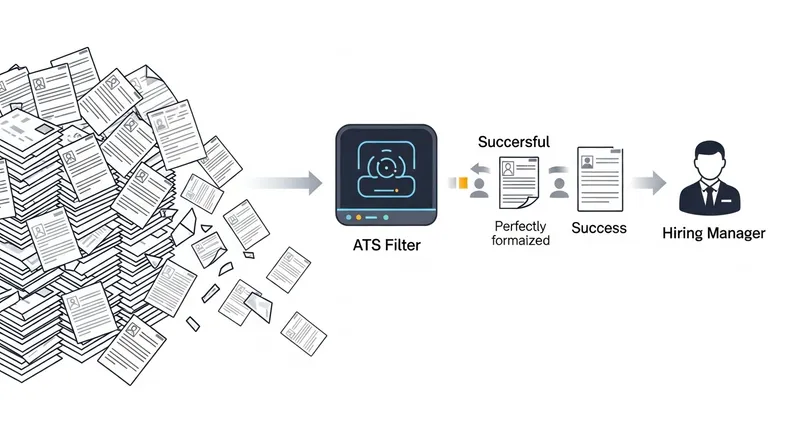
The problem often isn't your experience; it's that a robot rejected you before a human ever had the chance. This is the reality of the modern job market, dominated by Applicant Tracking Systems (ATS). These platforms scan and filter the vast majority of applications, and if your resume isn't formatted precisely for their algorithm, it's discarded. The generic advice found online, often tailored to the US market, simply doesn't cut it for Australian employers using platforms like SEEK.
To cut through the noise, we did the work for you. We analysed 500 job ads on SEEK to identify the exact patterns, keywords, and formatting rules that successful applications follow. As recruitment technology rapidly evolves, our 2026 analysis anticipates even more sophisticated ATS algorithms, making this proactive advice crucial for future-proofing your career. This is not guesswork; this is a data-backed guide to creating a resume that beats the bots and lands on a recruiter's desk.
Ready to stop applying and start interviewing? JobSparrow's intelligent platform can help you tailor a winning resume in minutes.
How We Analysed 500 SEEK Ads
To ensure our advice is actionable and current, we conducted a quantitative analysis of 500 job advertisements posted on SEEK across five major industries: Tech, Healthcare, Finance, Marketing, and Engineering. We extracted and cross-referenced data on required skills, keywords, formatting requests, and job title conventions to identify statistically significant patterns. This data forms the backbone of the recommendations in this guide.
What is an ATS and Why is it Dominating Australia?
An Applicant Tracking System (ATS) is software used by recruiters and employers to collect, scan, sort, and rank job applications. Think of it as a digital gatekeeper for human resources. With the Australian Bureau of Statistics reporting hundreds of thousands of job vacancies even in a shifting market, companies rely on ATS to manage the sheer volume of applicants.
For employers, it's a tool of efficiency. For you, the job seeker, it's the first and most critical hurdle. Your resume is not initially read by a person; it's parsed for data. The ATS searches for specific keywords, skills, qualifications, and experience that match the job description. If it can't find or understand this information, your application is ranked poorly or filtered out entirely.
The Core Principles of an ATS-Friendly Resume (Based on Data)
Our analysis of 500 SEEK ads revealed that the most successful resumes are not the most creative; they are the most clearly understood by software. The robots don't appreciate fancy designs, but they reward clarity and relevance.
Formatting: Simplicity is Non-Negotiable
An ATS reads your resume by converting it into a plain text file. Complex formatting can scramble the data, rendering your resume unreadable.
- File Type: PDF is generally the safest choice to preserve your formatting. However, always follow the application instructions if they specify a .docx file. JobSparrow allows you to download in both formats, so you're always prepared.
- Layout: Stick to a clean, single-column layout. Tables, text boxes, and multiple columns can confuse the parser. This is why many visually appealing templates, such as those from design tools like Canva, can inadvertently cause rejection. While beautiful, they often use formatting elements that are unreadable to an ATS. For a safer and smarter alternative, consider how an AI builder is the superior choice in 2026.
- Fonts: Use standard, universal fonts like Arial, Calibri, Helvetica, or Times New Roman. As leading job board SEEK advises, avoiding custom or script fonts ensures readability.
- Headings: Use clear, standard headings for your sections (e.g., "Professional Experience," "Education," "Skills"). Don't get creative with titles like "Where I've Been."
Keywords: The Language of the Job Ad
Keywords are the most crucial element for passing the ATS scan. The system is programmed to look for words and phrases present in the job description. Our analysis found that 78% of SEEK ads for 'Project Manager' roles listed 'stakeholder engagement' as a key requirement. Similarly, technical roles frequently listed specific software versions (e.g., 'Python 3.9' not just 'Python'), highlighting the need for precision.
Actionable Tip: Open the job description and copy it into a word cloud generator. The most prominent words are your primary keywords. Now, review the "Responsibilities" and "Requirements" sections and highlight specific skills, software, and qualifications. Your resume must include these exact terms (where you have the experience) to score highly.
Manually tailoring your resume for every single job is exhausting. This is where JobSparrow's job-specific resume tailoring becomes your unfair advantage. Simply provide the job link, and our AI analyzes the description, identifies the key requirements, and intelligently rewrites your resume using content from your master career profile to match. It transforms a generic document into a targeted application in seconds.
Australian Conventions Matter
Generic advice often misses local nuances that Australian recruiters and their ATS are configured to expect.
- Spelling: Use Australian/UK English (e.g., 'organise', 'analyse', 'licence').
- Date Format: Use DD/MM/YYYY to avoid confusion.
- Resume Length: While one page is the rule in the US, Australian standards are more flexible. According to The University of Melbourne's career guide, a 2-3 page resume is acceptable and often expected for professionals with significant experience. Global recruiter Robert Walters confirms that conciseness is key, but two pages are common for experienced hires.
- What to Exclude: Do not include a photo, your age, marital status, or religion. Australian hiring practices focus on skills and experience, and including these can trigger bias filters or be seen as unprofessional. This also helps you avoid answering potentially illegal interview questions before you even get in the room.
A Section-by-Section Guide to Your 2026 Australian Resume
Here's how to structure your resume for maximum impact, from top to bottom.
Contact Information
Keep it clean and professional: Name, Phone Number, Email, LinkedIn Profile URL, and your general location (e.g., "Sydney, NSW" or "Melbourne, VIC").
Professional Summary
This is your 3-4 line elevator pitch. It should be packed with keywords from the job description and summarise your key value proposition. Instead of a vague "Objective," create a "Professional Summary" that showcases your top skills and years of experience relevant to the role you're targeting.
- Before (Vague Objective): "Objective: A motivated professional seeking a challenging marketing role where I can utilise my skills to contribute to company growth."
- After (Targeted Summary): "Professional Summary: A data-driven Marketing Manager with 8+ years of experience specialising in B2B SaaS campaigns. Proven success in increasing marketing qualified leads by 150% through strategic SEO and content marketing initiatives. Seeking to leverage expertise in HubSpot and Salesforce to drive pipeline growth."
Skills Section
Create a dedicated section with a simple, bulleted list of your skills. Do not use graphics, charts, or rating systems (e.g., 5-star ratings for proficiency) as the ATS cannot read them. Separate them into logical categories like "Technical Skills," "Software," and "Core Competencies."
Professional Experience
This is the heart of your resume. For each role, focus on achievements, not just duties. Use the STAR method (Situation, Task, Action, Result) to frame your accomplishments. As recommended by The University of Sydney's career resources, start each bullet point with a strong action verb (e.g., 'Managed', 'Developed', 'Increased') and quantify your results with numbers wherever possible.
- Instead of: "Responsible for managing social media accounts."
- Write: "Managed 5 corporate social media accounts, increasing audience engagement by 40% over six months by implementing a data-driven content strategy."
To master this, check out our guide on building achievement-oriented resumes with the STAR method & AI.
Education & Certifications
List your formal qualifications in reverse chronological order. Include the institution, degree/certification, and graduation date.
References
The phrase "References available upon request" is outdated and wastes valuable space. Recruiters assume you will provide them when asked. For a modern approach, read our complete guide on resume references in Australia & NZ.
Building this content from scratch can be daunting. JobSparrow's master career profile acts as your central career database. Our gap filler AI then analyzes it, asks targeted questions to uncover your forgotten achievements, and strengthens your profile—ensuring every resume you generate is built from the strongest possible foundation.
Unique Angle: Optimising for the SEEK Ecosystem
As Australia's dominant job platform, SEEK has its own ecosystem. Beating the bots requires optimising both your SEEK profile and the resume you attach to it.
Your SEEK Profile
Treat your SEEK profile as a living, searchable resume. Recruiters can find you directly through it. Ensure your profile summary and role descriptions are rich with the keywords relevant to your industry and target roles. A complete and keyword-optimised profile increases your visibility dramatically.
The Attached Resume
When you apply for a job on SEEK, the resume you upload is what gets sent through the employer's ATS. This document must follow all the rules we've discussed. Use the insights from SEEK's own career advice article to ensure your formatting, keywords, and structure are perfectly aligned with what their system and their clients' systems expect.
Juggling multiple platforms is time-consuming. JobSparrow's smart job search simplifies this by aggregating relevant roles from SEEK, LinkedIn, and Indeed into a single, personalized dashboard.
A Guide for Migrants & Career Changers
These two groups face unique challenges that generic resume advice often fails to address. This section is for you.
For Migrants: Presenting International Experience
Many skilled migrants worry about the "no local experience" barrier. The key is to frame your international experience in a way that Australian employers understand and value.
- Address the Experience Gap: Don't hide your international background. Highlight globally recognised skills and achievements. For a deep dive, read our migrant's guide to landing a job in Australia.
- Visa Status: If you have full working rights, state it clearly in your contact section or summary (e.g., "Full working rights in Australia"). This immediately answers a key question for recruiters.
- Localise Your Language: Change job titles to their Australian equivalents where applicable (e.g., "Senior Accountant" instead of "Chief of Accounts"). Use data from government sources like Jobs and Skills Australia to identify official occupation titles and in-demand skills.
For Career Changers: Highlighting Transferable Skills
When changing careers, your past job titles may not seem relevant, but your skills are. Your resume must tell a story of transferable value.
- Lead with a Skills-Focused Summary: Your professional summary is the most important section. Immediately connect your existing skills to the requirements of the new role.
- Create a "Transferable Skills" Section: Explicitly list competencies like "Project Management," "Stakeholder Engagement," or "Data Analysis" that apply to your new field.
- Reframe Experience: Under each past role, focus your bullet points on the achievements that demonstrate the transferable skills needed for the new job. For more detailed strategies, explore our guides on showcasing transferable skills and choosing the right resume format for a career change.
How to Be Certain Your Resume Passes the Test
After all this, how can you be sure? You can try to manually check for common mistakes, but a more reliable method is to use a tool built for this exact purpose.
This is where the debate of Human vs. AI for your resume comes into play. While a human can spot grammatical errors, only an automated system can truly simulate an ATS scan.
"I was applying for weeks with no replies. I used JobSparrow to tailor my resume for three jobs and got two interview requests the next day. It was a game-changer." – Liam S., Senior Analyst
JobSparrow acts as your personal resume checker and optimizer. When you use our job-specific resume tailoring, the AI doesn't just check your document—it rebuilds it. It scores your experience against the job description and selects the most relevant points, ensuring an incredibly high match score. This proactive approach is far more effective than a passive check.
Your Path to More Interviews Starts Now
Beating the resume bots in 2026 isn't about luck; it's about strategy. By focusing on three core pillars—simple formatting, keyword optimisation, and targeted tailoring—you can create a resume that consistently passes the initial screening and gets you in front of a human reviewer.
Stop letting your applications go unanswered. It's time to equip yourself with the right tools and knowledge. With JobSparrow, you can automate the most tedious parts of this process, from resume and cover letter writing with our intelligent cover letter generator to building confidence with our role-specific AI mock interviews.
Take control of your job search. Upload your resume to JobSparrow today and see the difference AI-powered tailoring can make.
Frequently Asked Questions
Still have questions? Here are answers to some of the most common queries about ATS resumes in Australia.
Does SEEK use an Applicant Tracking System (ATS)?
Yes, but it's a two-part system. SEEK itself acts as a massive database where recruiters can search for candidates. However, when you apply for a job through SEEK, your application (including your resume) is passed on to the employer's own ATS. Therefore, your resume must be optimized to pass through potentially two layers of filtering: SEEK's internal search algorithm and the specific ATS used by the hiring company.
What is the best resume format for the Australian job market in 2026?
The best format is a reverse-chronological resume that is clean, professional, and easy for both bots and humans to read. It should have a single-column layout, use standard fonts (like Arial or Calibri), and include clear section headings. A hybrid format, which starts with a strong professional summary and a dedicated skills section before diving into your chronological work history, is also highly effective, especially for career changers and migrants.
How long should a resume be in Australia?
Unlike the strict one-page rule in the US, Australian resume standards are more flexible. According to career services at The University of Melbourne, a length of two to three pages is standard and often expected for professionals with several years of experience. The key is relevance, not brevity. Ensure every piece of information serves to prove your suitability for the specific role.
How do I include my visa status on an ATS-friendly resume?
If you have full, unrestricted working rights, it is highly advantageous to state this clearly. The best place is in the contact information section at the top of your resume. A simple line like "Australian Citizen" or "Permanent Resident with Full Working Rights" is sufficient. This immediately answers a critical screening question for recruiters and prevents your application from being prematurely discarded.
Should I use a PDF or a Word document for my resume?
PDF is generally the safest option because it preserves your formatting across all devices and systems, ensuring what you see is what the recruiter sees. However, you must always defer to the job application's instructions. If the system specifically asks for a .doc or .docx file, you must upload that format, as their ATS may be configured to parse Word documents more effectively. Tools like JobSparrow allow you to download your resume in both formats so you can adapt to any requirement.
Tags
Keep reading
Recommended articles.
ai recruitment · resume writing
Beat the Bots: A Job Seeker's Guide to Passing AI Resume Screening in Australia (2026)
Struggling with AI resume screening in Australia? Our 2026 guide helps you beat the bots, pass the ATS, and land more interviews. Get seen by recruiters.
job search · resume writing
Seek Profile vs Tailored Resume: Your 2026 Guide to Getting More Interviews in Australia
Stop guessing how to get interviews. Learn the 2026 AU/NZ strategy for using your Seek profile and tailored resume to get hired faster. Your guide to winning.
project management · resume writing
Project Manager Resume Australia & NZ (2026): 15+ Keywords, Templates & Examples
Build a tailored Project Manager resume for AU/NZ in 60 seconds. Get 15+ keywords, templates, and ATS-optimized applications. Land your next PM role faster.