
competency-based interview
How to Pass a Competency-Based Interview: Scoring Rubrics, Examples & AI Practice (UK, AU & NZ) | JobSparrow
By Job Sparrow Team

You walk out of the interview feeling great. The conversation flowed naturally, the panel smiled, and you got along well with the hiring manager. Two days later, the rejection email lands in your inbox: "While we were impressed with your background, other candidates demonstrated stronger evidence against the selection criteria."
If this has happened to you, the problem usually isn't your experience. It is that you treated a strict competency based interview scoring system like an informal chat.
At JobSparrow, our team and advisors have reviewed 100,000+ resumes and hired across four markets (Australia/NZ, the United States, Singapore, and Hong Kong). Having sat on both sides of the hiring table, we know the exact gap between what candidates think matters and what interviewers actually grade. While you are trying to build rapport, the panel is silently matching your spoken words against a 1-to-5 checklist of behavioral indicators. If you say "we" instead of "I," spend two minutes on background context, or forget to state a measurable outcome, the panel cannot award you the points.
In this guide, we will pull back the curtain on how structured panels score your answers across the United Kingdom, Australia, New Zealand, and the United States. You will see the exact 1-to-5 scoring rubric assessors use, side-by-side examples of failing versus top-scoring answers, and how to practice with voice AI before walking into the room.
Not sure if your resume or CV even has the right evidence to get you to the interview stage? Start with a free diagnosis to see your recruiter-lens score out of 100 and the specific gaps costing you interviews.
What is a competency-based interview (and how it works as an open-book exam)
A competency-based interview (also called a structured behavioral or criterion-based interview) is a formal assessment where every question tests a specific skill required for the role. It operates on one core premise: past behavior is the most reliable predictor of future performance.
Unlike an unstructured interview where a manager might ask casual questions about your resume, a competency interview follows strict rules. According to the U.S. Office of Personnel Management (OPM), in a structured interview all candidates are asked the same job-related questions, and interviewers rate every candidate against the same detailed rating scales.
This rigid format can feel intimidating, especially for career changers or skilled migrants adjusting to new local hiring norms. However, once you understand the rules, this structured approach works in your favor. Think of it as an open-book exam where the employer hands you the marking sheet (the Person Specification or Selection Criteria) weeks in advance.
What to do right now:
- Shift your mindset from "rapport" to "evidence": Politeness matters, but panels are trained to score only the evidence you give. They can only score what you explicitly state out loud.
- Stop assuming they will rely on your resume: Even if a project is listed on your resume, you get zero points for it in the interview unless you verbally walk the panel through your specific actions.
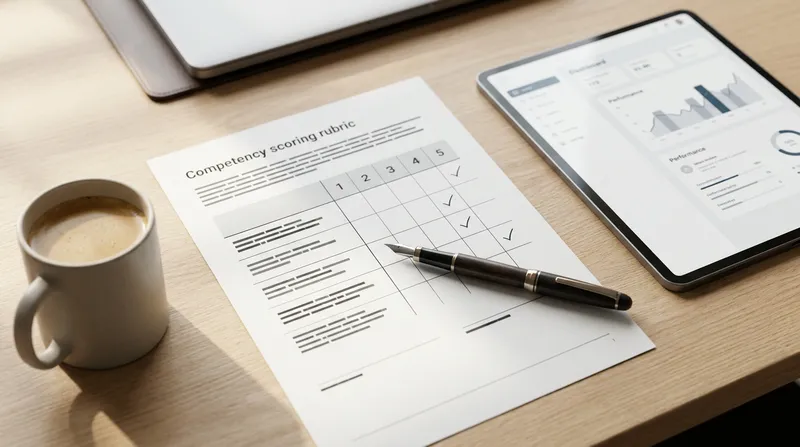
How are competency interviews scored 1 to 5? The assessor's rubric revealed
Candidates often wonder how are competency interviews scored 1 to 5 behind closed doors. While some organizations use a 1-to-7 scale (such as the UK Civil Service), many panels use a 5-point structured behavioural interview scoring rubric.
Before interviewing a single candidate, the hiring panel sits down with HR to define "Positive Indicators" (behaviors that earn points) and "Negative Indicators" (behaviors that lose points) for each competency. During your answer, the panelists write down verbatim quotes of what you say and match them to this grid:
| Score | Rating Level | What the Candidate Demonstrated | Positive vs. Negative Indicators |
|---|---|---|---|
| 1 | No Evidence / Unsatisfactory | Failed to answer the question, gave a purely hypothetical response ("I would do X"), or admitted having no relevant experience. | Negative: Talked in theory, blamed others, or couldn't recall a single specific event. |
| 2 | Limited / Below Threshold | Described a general situation or what the team did, but failed to explain personal actions or achieved a poor outcome. | Negative: Heavy use of "We," spent 80% of the time on backstory, required constant prompting from the panel. |
| 3 | Acceptable / Pass | Provided a clear, real past example using the STAR structure. Showed competent personal action and a positive result. | Positive: Clear "I" ownership, logical actions, met the baseline standard for the role's grade. |
| 4 | Strong / Above Threshold | Handled a complex or ambiguous situation. Explained how and why specific actions were taken, backed by quantified outcomes. | Positive: Proactive problem-solving, stakeholder management, clear metrics, zero prompting needed. |
| 5 | Role Model / Exceptional | Delivered a high-impact example with strategic depth, measurable business results, and proactive reflection on lessons learned. | Positive: Changed a wider process, anticipated future risks, shared self-aware reflections (STAR+R). |
Many panels set a minimum score for each competency (often 3 on a 5-point scale), and the threshold is set by the employer. If an interview tests five competencies and you score 5, 5, 4, 4, and 2, you will typically not be considered "appointable" if you fail to meet the baseline on the final criterion.
What to do right now:
- Ban the word "would" from your answers: Starting a sentence with "Normally I would..." or "In that situation, I usually..." is likely to score low. Always anchor your response in a single, dated past event: "In March last year, when I was leading the migration project..."
- Explain the "How" and the "Why": A Score 3 candidate says, "I communicated with the angry client to calm them down." A Score 5 candidate says, "I scheduled a 15-minute video call with the client within the hour, listened without interrupting to validate their frustration over the delayed shipment, and presented two expedited courier options so they felt back in control."
Regional frameworks: UK, Australia, New Zealand, and the US
Whether you are applying locally or relocating internationally as a skilled migrant, you need to know the exact framework your target employer uses. Here is how competency assessments break down across four key markets.
1. United Kingdom: Civil Service Success Profiles and NHS Values
In the UK, competency interviews play a major role across the public sector.
- UK Civil Service: If you are doing civil service success profiles interview prep, you must know that the UK Government's Civil Service Success Profiles framework evaluates candidates across five elements: Behaviours, Strengths, Ability, Experience, and Technical. The nine core Behaviours (such as Seeing the Big Picture, Making Effective Decisions, and Delivering at Pace) are graded on a strict 1-to-7 scale, where 4 is the standard pass mark. The expected indicators change depending on whether you are applying for an Administrative Officer (AO), Executive Officer (EO), or Grade 7 role. Note: in July 2026 the Cabinet Office announced that Success Profiles will be replaced by a new skills-focused recruitment model. Until that happens, Success Profiles remains in use, so always check the elements and scoring listed in your job advert.
- The NHS: When preparing for NHS competency based interview questions, remember that healthcare trusts combine behavioral evidence with NHS Values-Based Interviewing (VBI). Panels assess your clinical or operational actions alongside the six core NHS values (such as compassion, respect and dignity, and commitment to quality of care). (If you are still at the application stage, read our guide on how to write NHS supporting information for Trac.)
2. Australia: APS Integrated Leadership System (ILS)
In Australia, federal, state, and large enterprise recruiters rely heavily on structured behavioral criteria.
- Australian Public Service (APS): Federal roles are assessed against the Australian Public Service Commission's Integrated Leadership System (ILS) and Work Level Standards (from APS 1-6 up to Executive Level EL1 and EL2). The ILS describes five capability clusters, with names that change by level. At APS 1-6 they are Supports strategic direction, Achieves results, Supports productive working relationships, Displays personal drive and integrity, and Communicates with influence. At EL level they become Shapes strategic thinking, Achieves results, Cultivates productive working relationships, Exemplifies personal drive and integrity, and Communicates with influence. Check which capabilities your job ad lists. Whether you find roles via APSJobs or commercial boards (see our breakdown of SEEK vs LinkedIn Australia), your verbal examples must match the autonomy expected at your specific classification level.
3. New Zealand: Public Service Capability and Migrant Alignment
If you are preparing for public sector competency interview questions nz, many public sector agencies reference the Te Kawa Mataaho Leadership Success Profile (LSP), a leadership framework with twelve capabilities and four leadership character traits, in position descriptions and recruitment.
- Tip for NZ Migrants: New Zealand panels value humility paired with clear personal accountability, alongside cultural responsiveness and Te Tiriti o Waitangi (Treaty of Waitangi) partnership principles in public-facing roles. If you are moving to New Zealand, make sure your initial application aligns with local standards by checking our New Zealand Green List CV format guide.
4. United States: OPM Structured Interviews and Big Tech Rubrics
In the US, the term "behavioral interview" is more common, but the underlying scoring mechanics in government and enterprise tech are very similar.
- US Federal Government & Enterprise: Under OPM's Merit Hiring Plan, federal agencies must use at least one validated assessment (such as a structured interview, skills test, or work sample) to rate candidates, and many add an executive interview. Some large employers, such as Amazon with its Bar Raiser process and Leadership Principles, also grade answers against structured criteria.
What to do right now:
- Download the level-specific indicator PDF: Before preparing a single story, look up the exact grade or band in the job ad (for example, UK Civil Service HEO, NHS Band 6, or Australian APS 6). Print the behavioral indicators for that specific level and highlight the action verbs.
How to decode the person specification and predict every question
As career advisors at Prospects.ac.uk note, competency-based interviews test specific skills directly from the job's Person Specification by matching your spoken evidence against pre-determined marking criteria. That means you can predict most of the person specification interview questions and answers before you ever join the call.
Look at the "Essential Criteria" or "Key Competencies" section of the job description. Every bullet point marked "Tested at Interview" (often labeled "I" or "A/I" on UK and AU job specs) is likely to become one of your core interview questions.
Here is how to translate a Person Specification bullet directly into the question the panel will ask:
- Person Spec Bullet: "Proven ability to manage conflicting priorities and deliver projects under tight deadlines."
Predicted Question: "Tell me about a time when you had to juggle multiple competing deadlines. How did you prioritize your workload, and what was the outcome?" - Person Spec Bullet: "Experience influencing senior stakeholders who initially disagreed with a proposed course of action."
Predicted Question: "Describe a situation where you had to persuade a reluctant stakeholder or colleague to change their mind. What approach did you take?" - Person Spec Bullet: "Commitment to continuous improvement and learning from operational setbacks."
Predicted Question: "Give me an example of a time when a project or process you managed did not go according to plan. How did you handle it, and what did you change afterward?"
What to do right now:
- Build a 2-Story Matrix: For every Essential Criterion on the job spec, prepare two distinct stories: one primary example and one backup example. Why two? Because panels often ask a follow-up question probing a different angle of the same competency, or an earlier question might force you to use your primary story sooner than planned.
- Use JobSparrow's gap filler to surface forgotten wins: Most candidates struggle to think of strong examples because they forget their own past achievements. Inside JobSparrow (part of our five-stage Offer Path: Diagnose -> Position -> Execute -> Prepare -> Close), our Master Career Profile and gap filler act as an interactive AI coach. The tool analyzes your work history, spots missing metrics or vague descriptions, and asks targeted questions to pull out the exact quantified stories you need for both your tailored resume and your interview.
Upgrading STAR to STAR+R (and the 10-10-60-20 time rule)
Almost every career blog tells you to use the STAR method (Situation, Task, Action, Result). Yet thousands of candidates use STAR every day and still fail with a Score 2.
Why? Because of poor time allocation and zero reflection.
When nervous candidates start a STAR story, they often spend 90 seconds explaining the company background, the team politics, and why the software was broken (Situation and Task). By the time they get to their Actions, two minutes have passed, the interviewer's pen is still hovering over the page with nothing scored, and the candidate rushes through the actions in 15 seconds.
To hit a Score 4 or 5 on a competency based interview scoring system, upgrade your framework to STAR+R and follow the 10-10-60-20 Time Allocation Rule across a standard 2.5-to-3-minute answer:
- Situation (10% - ~15 seconds): Set the scene in two sentences. State your role, the organization, and the specific context.
- Task (10% - ~15 seconds): State the exact problem, target, or responsibility you were given, and why it was challenging or important.
- Action (60% - ~90 seconds): Walk through 3 to 4 specific steps you personally took. Explain what you did, how you did it, and why you chose that approach over alternatives. This is where the bulk of your rubric points live.
- Result (15% - ~20 seconds): State the concrete outcome. Use numbers, percentages, time saved, revenue protected, or stakeholder feedback.
- Reflection (+R) (5% - ~15 seconds): State what you learned from the experience and how you applied that lesson to a later process or project.
Why does that final Reflection (+R) matter so much? According to Cornell University's behavioral interviewing guidelines, structured interviewers are trained to ask targeted follow-up probes such as "What was your specific role?" and "What would you do differently next time?" to test self-awareness and growth mindset. When you volunteer your reflection unprompted at the end of your answer, you show the self-awareness that interviewers often probe for.
What to do right now:
- Time yourself with a stopwatch: Record yourself answering a question on your phone. Look at the timestamp when you say your first "I did..." action verb. If that timestamp is past the 35-second mark, cut your Situation and Task in half.
Core competencies interview examples: Score 2 vs. Score 5 makeovers
Most guides only show you a single generic sample answer. To help you see through an assessor's eyes, here are three STAR method competency interview examples comparing a failing Score 2 response against an exceptional Score 5 response.
Example 1: Delivering at Pace / Managing Competing Priorities
Question: "Tell me about a time when you had to handle a sudden change in priorities while working toward a strict deadline."
❌ Score 2 Answer (Fails the Rubric):
"At my last company, our marketing team was launching a major Q4 campaign, and two days before launch, compliance told us we had to change all the claims on our landing pages. Everyone was really stressed because we also had our regular weekly deliverables. We got together as a team, divided up the pages, worked late that evening, and made sure everything got updated on time. In the end, the campaign launched on schedule and went really well."
- Assessor's Critique (Score: 2/5): The candidate used "we" throughout the entire Action section. I have no idea what this specific person did versus their manager or teammates. The result ("went really well") has no evidence or metrics.
✅ Score 5 Answer (STAR+R):
Situation & Task (25 sec): "In my previous role as a Senior Campaign Executive, I was leading a product launch scheduled to go live on Friday morning. On Wednesday afternoon, our legal team updated regulatory guidance, requiring substantive copy changes across 14 regional landing pages while I was simultaneously finalizing our quarterly board report due Thursday."
Action (85 sec): "First, I assessed the risk and impact of both deadlines. I contacted the Marketing Director to negotiate a 24-hour extension on the internal board report, explaining that the external product launch carried direct revenue impact. Once approved, I audited all 14 landing pages and grouped the legal edits into three repeatable templates so I wouldn't have to rewrite every page from scratch. Next, I briefed two junior copywriters on the templates, assigning them four low-traffic pages while I personally rewrote the 10 high-traffic pages and coordinated real-time sign-off with our legal counsel via a shared Slack channel rather than slow email threads."
Result & Reflection (30 sec): "As a result, all 14 pages passed legal review by Thursday at 4:00 PM, the campaign launched on time Friday morning, and it generated $140,000 in pipeline during its first week. Looking back, I realized legal reviews were happening too late in our workflow, so I introduced a mandatory 15-minute legal check-in at the wireframe stage, which cut last-minute revision requests by 70% over the next two quarters."
- Assessor's Critique (Score: 5/5): Clear "I" ownership, logical prioritization, proactive stakeholder negotiation, smart delegation, quantified business results, and a process improvement reflection.
Example 2: Influencing Stakeholders & Communicating with Impact
Question: "Describe a situation where you had to persuade a skeptical colleague or stakeholder to support a change you proposed."
❌ Score 2 Answer (Fails the Rubric):
"When I worked as a Ward Manager, we needed to switch from paper handover sheets to a new digital tablet system. Several senior nurses were against it because they thought it would slow them down during shift changes. I explained to them in our staff meeting that the hospital trust required it and that it would actually save time once everyone got used to it. Eventually, they agreed to try it, and now the whole ward uses the tablets."
- Assessor's Critique (Score: 2/5): Telling staff "management requires it" is compliance, not influencing. The candidate didn't explore why the stakeholders were resistant or adapt their communication style.
✅ Score 5 Answer (STAR+R):
Situation & Task (25 sec): "As an Operations Lead at a regional healthcare clinic, I was tasked with rolling out a new digital patient intake system. During the pilot phase, two of our longest-serving reception leads refused to use the software, reverting to paper clipboards because they felt the digital screens disrupted eye contact and empathy with anxious patients."
Action (85 sec): "Instead of enforcing a top-down mandate, I booked a 20-minute one-on-one listening session with both leads during a quiet afternoon shift to understand their specific concerns. They showed me that the new form required 12 mandatory fields before booking an appointment, which caused queues at the front desk. I took their feedback to our IT vendor and reconfigured the workflow so only four core safety fields were required at check-in, moving the remaining eight fields to an automated SMS pre-arrival link. I then invited the two skeptical leads to co-design a quick-reference cheat sheet for the rest of the team, positioning them as safety champions rather than blockers."
Result & Reflection (30 sec): "Within two weeks, front-desk digital adoption rose from 45% to 100%, average patient check-in time dropped from four minutes to 90 seconds, and patient satisfaction scores on reception warmth increased by 12%. This taught me that resistance to tech is often disguised concern for service quality, so I now always include frontline staff in software sandbox testing before rollout."
- Assessor's Critique (Score: 5/5): Demonstrates empathy, active listening, practical problem-solving, co-design to win buy-in, and outstanding metrics aligned with both operational efficiency and care values.
Example 3: Making Effective Decisions / Analytical Problem Solving
Question: "Give me an example of a time when you had to make a difficult decision without having all the data you needed."
❌ Score 2 Answer (Fails the Rubric):
"Last year, a key supplier for our packaging went into administration right before our peak season. We didn't have time to run a full tender process to vet new vendors properly. My manager and I looked at three alternative suppliers online, picked the one that looked most reliable based on their website and pricing, and placed an emergency order. Thankfully, the stock arrived on time."
- Assessor's Critique (Score: 2/5): Relying on luck and "my manager and I" does not show structured risk mitigation or independent decision-making criteria.
✅ Score 5 Answer (STAR+R):
Situation & Task (25 sec): "While working as a Supply Chain Coordinator for an e-commerce retailer, our primary packaging vendor halted operations with 48 hours' notice due to a factory fire, leaving us three weeks short of inventory ahead of Black Friday. A standard vendor audit takes four weeks, so I had to recommend a replacement supplier within 24 hours using incomplete operational data."
Action (85 sec): "To de-risk the decision, I built a rapid three-point scoring matrix focusing on existing stock capacity, geographic proximity, and financial stability. I shortlisted three domestic vendors and, since I couldn't conduct an on-site audit, I requested live video walkthroughs of their warehouse floors that afternoon and called two supply chain peers in my network for informal reference checks on delivery reliability. Rather than placing 100% of our volume with one untested vendor, I decided to split the order 70/30 between the top-scoring local supplier and a slightly more expensive secondary vendor. Paying a 6% premium on the 30% buffer guaranteed that even if the primary vendor slipped, our warehouse packing lines wouldn't stop."
Result & Reflection (30 sec): "Both vendors delivered within five business days, protecting $480,000 in Black Friday orders with zero fulfillment delays, while keeping emergency freight costs within 4% of our original budget. Following this incident, I established a pre-vetted backup supplier registry for our top five SKU categories so the business never faces a single point of failure again."
- Assessor's Critique (Score: 5/5): Clear decision criteria under pressure, creative verification (video walkthroughs + peer checks), calculated commercial risk mitigation (70/30 split), and quantified revenue protection.
The "I vs. We" ownership trap (especially for career changers and migrants)
One of the most frequent reasons highly capable candidates fail is the competency interview i vs we ownership trap.
In many workplace cultures (including across Asia-Pacific, New Zealand's collaborative environments, healthcare teams, and agile engineering squads), professionals are taught that saying "I" sounds arrogant. Humble, team-oriented candidates naturally say: "We analyzed the data, we presented the findings to the client, and we reduced churn by 15%."
Here is what happens on the other side of the table: An assessor cannot give you points for what we did.
If you say "We designed the strategy," the interviewer has to assume you might have just sat in the room taking notes while someone else did the heavy lifting. You do not need to take false credit for your team's work to use "I." You simply need to isolate your specific slice of the contribution.
- Instead of: "We ran a workshop to fix the onboarding bottleneck."
- Say: "While the wider project team attended the workshop, my specific responsibility was facilitating the root-cause analysis session, where I mapped out the 14 steps of the customer journey and I identified the two manual approval stages causing the delay."
If you are pivoting industries or explaining a non-linear career path (for example, if you need to know how to explain taking a step back in your career), owning your transferable actions with clear "I" statements is what convinces a panel you can operate at their grade.
Competency vs. strength-based interview UK: How to spot the hybrid trend
If you are interviewing in the UK (particularly for the Civil Service, NHS trusts, local councils, or major graduate schemes), you will likely encounter a hybrid format blending competency vs strength based interview uk questions.
How do they differ, and how do you tell them apart in real time?
| Feature | Competency-Based Question | Strength-Based Question |
|---|---|---|
| What it tests | What you can do (past evidence against a skill rubric). | What you love doing (natural energy, motivation, and cultural fit). |
| Question style | Slow, multi-part, asks for a specific past example ("Tell me about a time when..."). | Rapid-fire, conversational, asks how you feel or react ("Do you prefer starting tasks or finishing them?"). |
| Ideal length | 2.5 to 3 minutes (using STAR+R). | 45 to 60 seconds (punchy, authentic, enthusiastic). |
| What assessors grade | Spoken actions, complexity, and results on a 1-to-5 or 1-to-7 scale. | Vocal tone, body language, speed of response, and genuine enthusiasm. |
In a UK Civil Service interview, for example, the panel will ask deep Competency (Behaviour) questions where they probe your answers in detail. Then, they will switch gears and ask Strengths questions (such as "What does a successful day look like to you?" or "How do you feel when deadlines change at the last minute?") where they typically ask no follow-up questions and expect brief, direct responses.
What to do right now:
- Do not force a 3-minute STAR story into a Strength question: If the interviewer asks, "What energizes you about working with data?", do not launch into a slow 3-minute story from 2023. Smile, let your natural vocal energy come through, explain why you enjoy spotting patterns in messy spreadsheets, and back it up with a quick 20-second micro-example.
Why written prep fails (and how voice AI mock interview practice fixes it)
Most candidates prepare for competency interviews by typing out pages of bullet points or full scripts in a Word document. Then, when the live interview starts, one of two things happens:
- On video calls: You try to secretly read your notes off your screen. Your eyes dart back and forth, your vocal tone flattens into a robotic monotone, and when the panel asks an unexpected probing question that isn't on your screen, you freeze.
- In person: Without your script in front of you, you lose track of time, ramble for four minutes on the Situation, and forget to state the Result.
Typing an answer and speaking an answer under pressure use completely different cognitive muscles. That is why voice ai mock interview practice has become the secret weapon for top-scoring candidates.
How to practice with JobSparrow's AI mock interviews
While a human career consultant charges around US$300 for a single resume and around US$2,000 for a coaching program (see our full comparison of a human career coach vs. AI career advisor), JobSparrow gives you an AI career advisor across the entire Offer Path.
Inside the Prepare stage of JobSparrow, our AI mock interviews simulate the real panel experience using live audio recording and AI analysis:
- Tailored to the exact role: Start directly from a saved job application in your dashboard, or launch an instant interview by pasting any job description or URL (whether it is a UK Civil Service EO role, an NHS Band 7 post, an Australian APS6 listing, or a US corporate role).
- Instant feedback on your recorded answers: You speak your answers out loud, and our AI gives instant insights on answer quality, clarity, and delivery tone.
- Covers every round: Practice Screening, Culture Fit, and Technical rounds in a safe environment.
Once you pass the panel and receive your call from HR, we also coach you through the final Close stage so you don't leave money on the table. Before signing your contract, check out our recruiter-approved salary negotiation scripts and our regional guide on how to negotiate a salary offer in the UK & US.
Frequently asked questions (FAQs)
How are competency-based interviews scored from 1 to 5?
Each panelist grades your spoken answer against pre-agreed behavioral indicators on a 1-to-5 scale: 1 means No Evidence (hypothetical or off-topic), 2 is Limited (too much "we" or missing actions), 3 is Acceptable/Pass (clear STAR example meeting the role standard), 4 is Strong (complex actions with quantified results), and 5 is Role Model (strategic impact plus self-reflection).
What is a passing score in a UK Civil Service or NHS competency interview?
Many panels set a minimum score for each competency (often 3 on a 5-point scale), and the threshold is set by the employer. In the UK Civil Service, which currently uses a 1-to-7 scale under the Success Profiles framework, 4 out of 7 is the standard minimum pass mark for each Behaviour and Strength (note that the Cabinet Office announced in July 2026 that Success Profiles will be replaced by a new skills-focused model, so always check your job advert).
Should I say 'I' or 'We' in a competency-based interview?
As a general rule of thumb, focus heavily on "I" throughout your answer, especially during the Action phase of the STAR method. While acknowledging your team in the Situation is fine (e.g., "As part of a five-person clinical team..."), hiring panels cannot award individual rubric points for collective statements like "We solved the issue." Always isolate your exact personal contribution by stating what you analyzed, decided, communicated, and delivered.
What is the difference between a competency-based and a strength-based interview?
A competency-based interview evaluates what you can do by grading detailed 2.5-to-3-minute past examples (using the STAR+R method) against a 1-to-5 or 1-to-7 behavioral rubric. A strength-based interview evaluates what you love doing and what naturally energizes you through rapid-fire, 45-to-60-second questions where assessors grade your genuine enthusiasm, vocal tone, and speed of response rather than probing for deep historical detail.
Why do interviewers keep interrupting or asking probing questions during my answer?
Do not panic if a panelist interrupts you or asks follow-up probes like "What did YOU specifically do there?" or "How did you measure that success?" In a structured interview, panelists are often trying to help you earn points you missed in your initial story, or they are managing strict time limits so you have enough minutes left to answer the remaining questions on the rubric.
How many STAR examples should I prepare for a competency interview?
As a rule of thumb, prepare 8 to 10 versatile STAR+R stories before the interview, since competency interviews commonly cover around 4 to 6 core behavioral questions. Having two examples mapped to each Essential Criterion on the Person Specification ensures you never run out of material if a panelist asks for an alternative situation.
Can I reuse the same STAR example from my written application in the interview?
Yes, you can reuse an example from your resume, CV, or written supporting statement, provided it is your strongest piece of evidence for that competency. However, you must expand it with deeper operational detail (the how and why behind your actions) and never assume the panel remembers reading it. Also, always prepare a second backup example in case the panel asks for a fresh scenario.
How old can my STAR examples be in a competency interview?
As a rule of thumb, aim to keep most of your STAR+R examples within the last two to three years. Recent examples prove that your skills are current and that you are operating at the required seniority level today. If you are returning from a career break or pivoting industries, you can draw on slightly older examples, but try to anchor the majority of your answers in recent work, volunteer, or project experience.
What happens if I don't have a direct work example for a competency question?
Never say "I haven't done that before" and stop talking, as that forces the panel to score you a 1. Instead, ask to take 10 seconds to think, and draw on a transferable example from a different industry, a volunteer leadership role, an academic project, or a community initiative. As long as the behavioral steps you took match the competency indicators, panels can score it.
What if I realize halfway through my answer that I am going off-topic?
Do not keep rambling out of embarrassment. Pause, smile, and transparently course-correct in real time. You can say to the panel: "I realize I am getting too deep into the technical background here. Let me bring this back to the specific actions I took to resolve the stakeholder conflict." Assessors respect self-awareness, and only the evidence you provide before time runs out counts toward your score.
Can I bring written notes into a competency-based interview?
In many virtual and in-person panels across the UK, Australia, New Zealand, and the US, bringing a neat one-page prompt sheet with 3-word bullet triggers (for example, "Q4 Launch - Legal Delay - $140k") is often acceptable, but check with the recruiter first. Never read full sentences verbatim. Glance down for two seconds to jog your memory, then look directly at the panel (or camera) to tell your story naturally.
How do panel interviewers agree on a final competency score?
In a formal structured interview, each panelist typically grades your answer right after you finish speaking, without discussing it with the other interviewers first. Once the interview concludes, the panel compares their individual scores for each question, reviews their verbatim notes of your spoken evidence, and moderates their marks to reach a single consensus score for each competency.
Ready to turn your next interview into a job offer?
Passing a competency-based interview isn't about being the smoothest talker in the room. It is about knowing the rubric, owning your personal actions with the STAR+R method, and practicing your delivery out loud before the real panel starts taking notes.
Whether you are still trying to get past the shortlisting stage or you have a panel interview coming up next week, JobSparrow coaches you through every step of the Offer Path:
- Start with a free CV diagnosis: Upload your resume or CV to see your recruiter-lens score out of 100, uncover the specific evidence gaps costing you interviews, and map your Offer Path in minutes.
- Practice with AI mock interviews: Ready to unlock unlimited tailored resumes, cover letters, and voice AI mock interviews? Try the full Offer Path for 7 days for US$5.99, then US$45 a month (or £4.99 today then £35/month in the UK, A$8.99 today then A$59/month in Australia, and NZ$9.99 today then NZ$59/month in New Zealand). Cancel anytime in one click.
Tags
Keep reading
Recommended articles.
nhs supporting information · trac jobs application
How to Write NHS Supporting Information: Trac Examples & Shortlisting Guide
Match the NHS person specification essential and desirable criteria on Trac. Get Band 2, 3, and 5 supporting statement examples and 0-3 scoring tips.
ai mock interview · big tech interviews
AI Mock Interview: Simulate Big Tech Interviews | JobSparrow
Master Big Tech interviews with JobSparrow's AI mock interview simulator. Learn the Googleyness rubric, practice STAR answers, and get real-time feedback.
ai mock interview · interview preparation
The 'Instant Interview' Shortcut: How to Generate an AI Mock Interview from Any SEEK or LinkedIn URL
Stop freezing on recruiter calls. Turn any SEEK or LinkedIn URL into instant voice practice with our AI mock interview generator. Try it for free today.