
new zealand cv format
New Zealand Green List CV Format: How to Match ANZSCO Codes & Pass INZ Scrutiny
By Job Sparrow Team

You have spent months preparing for your move to New Zealand. You have paid the application fees, gathered your documents, and started dreaming of your new life. But a single generic document could shatter those relocation dreams and result in a devastating visa rejection: your resume.
For migrants applying for Tier 1 or Tier 2 Green List roles, or standard visa sponsorships, generic resumes fail almost immediately. Why? Because an Immigration New Zealand (INZ) case officer reviews your application through a completely different lens than a standard corporate recruiter. They do not just want to see that you are a good culture fit. They need explicit proof that your career history matches a rigid legal framework.
This guide breaks down exactly how to format your New Zealand CV, map your career history to ANZSCO codes, and pass INZ scrutiny with flying colors. Built by a team that has reviewed 100,000+ resumes and tuned with two of New Zealand's award-winning HR leaders, JobSparrow understands local compliance.
Start with a free diagnosis to get your recruiter-lens score and see the exact gaps that could cost you your visa approval.
The high stakes of a New Zealand immigration CV
Applying for a job overseas carries immense emotional and financial weight. A single mistake on your New Zealand visa sponsorship CV can lead to delayed processing times, a rejected visa, or a lost job offer.
Most job seekers make the critical error of sending the exact same resume to an employer and to Immigration New Zealand. However, an INZ case officer is a legal evaluator, not a hiring manager. While a corporate recruiter might be impressed by your generic leadership skills or a flashy design, an immigration officer is looking for specific, highly regulated criteria.
If your resume does not explicitly map your past duties to the legal definition of your occupation, your application will be flagged. Generic resumes fail INZ scrutiny because they leave too much to interpretation. You cannot assume the officer knows what a "Growth Hacker" or "Client Success Lead" does. You must translate your experience into their language.
What is an ANZSCO code and why does INZ scrutinize it?
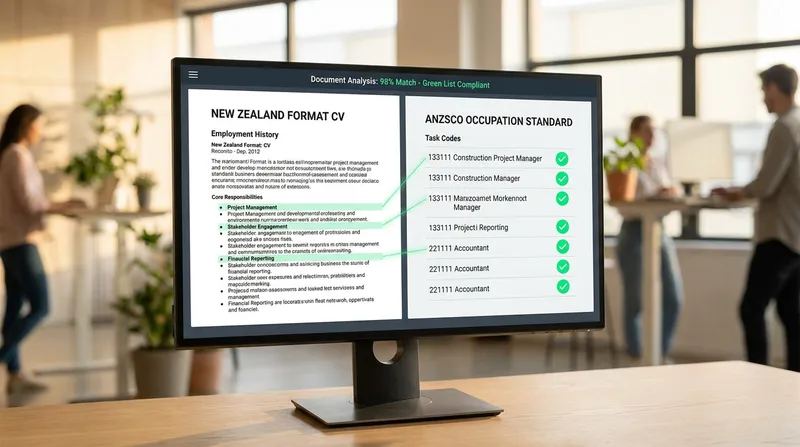
To understand the New Zealand CV format, you first have to understand the Australian and New Zealand Standard Classification of Occupations (ANZSCO).
According to the Australian Bureau of Statistics, ANZSCO provides an integrated framework for storing, organizing, and reporting occupation-related information. In simpler terms, it is a giant dictionary of every recognized job in Australia and New Zealand. It details exactly what tasks a person in that role must perform and what qualifications they must hold.
Immigration New Zealand uses these codes to group jobs and determine skill levels, which range from skill level 1 (most skilled, usually requiring a bachelor's degree or higher) to skill level 5 (less skilled). Your ANZSCO code dictates your eligibility for the Green List and the Skilled Migrant Category. Note that since 9 March 2026, the Accredited Employer Work Visa (AEWV) uses New Zealand's new National Occupation List (NOL) instead of ANZSCO, so check your occupation against the NOL for the work visa itself.
When an INZ officer reviews your ANZSCO code CV New Zealand, they open the official ANZSCO dictionary and compare your resume bullet points directly against the official task list. If your bullet points do not reflect the core tasks outlined in that dictionary, the officer cannot legally verify that you have the required experience.
Never assume your overseas job title automatically matches the New Zealand equivalent. A "Project Manager" in the United States might fall under a completely different ANZSCO code depending on whether they manage IT projects, construction sites, or marketing campaigns.
ATS-friendly CV vs. INZ-compliant resume: understanding the difference
When learning how to write a CV for New Zealand immigration, you must understand the difference between an ATS-friendly CV and an INZ-compliant CV.
An ATS-friendly CV New Zealand is designed to pass through corporate keyword scanners (Applicant Tracking Systems). These systems look for specific industry jargon, software skills, and action verbs to ensure you are a match for the employer's job description.
An INZ-compliant resume, however, is designed for a human immigration officer assessing legal requirements. As noted by Immigration New Zealand, they use ANZSCO to group jobs together based on similar tasks and responsibilities. The officer is not looking for "culture fit" or "synergy." They are looking for strict adherence to ANZSCO task lists and minimum experience thresholds.
To succeed, you must balance both. Your resume must be compelling enough to win the job offer from the employer, but structured and detailed enough to pass the visa check from the government. If you are tired of manually tweaking documents for different systems, you might be falling into the trap of over-optimizing. Learn more about balancing these systems in our guide on ATS Scanners vs Job Trackers: The $100/Month Trap (And Why You Are Still Rewriting Resumes at Midnight).
New Zealand CV format requirements for 2026
Before diving into the exact phrasing of your bullet points, you must ensure your document meets the baseline formatting expectations of the region.
First, let us clarify the terminology. According to Princeton University, in New Zealand, the term "CV" is used to mean the same as a "resume" in the United States. It is a formal document expressing an individual's career background and skills, not a 10-page academic dossier.
When building your NZ CV template, adhere to these strict inclusion and omission rules:
What to include at the top:
- Your full legal name (matching your passport).
- Your current location (city and country).
- Contact details (professional email and phone number with international dialling code).
- Explicit visa status or work rights (e.g., "Require Visa Sponsorship" or "Eligible for Accredited Employer Work Visa").
Strict omissions (what to leave off):
- No photos: New Zealand has strict anti-discrimination laws. A photo will often get your CV discarded immediately.
- No marital status or number of dependents.
- No date of birth or age.
- No religious or political affiliations.
Structure and length: Your CV should follow a reverse-chronological format. For immigration purposes, a length of 2 to 3 pages is entirely acceptable, as you need the space to detail your specific ANZSCO duties. If you are unsure about page limits across different regions, read our complete How Long Should a Resume or CV Be? 2026 Guide for AU, NZ, US & UK.
How to match your experience to ANZSCO skill levels (step-by-step)
The most critical part of your New Zealand visa sponsorship CV is the ANZSCO skill level matching. You cannot leave this to chance. Follow these precise steps to map your experience:
Step 1: Locate your exact occupation and skill level. Go to the official ANZSCO search tool and type in your job title. Read the "Lead Statement" for the matching codes. Choose the code that accurately reflects at least 80% of your daily duties, not just the one with the best-sounding title.
Step 2: Translate your overseas job title. If your official title in the UK was "Digital Evangelist," change it on your CV to "Marketing Specialist (ANZSCO 225113) - Digital Evangelist." This immediately tells the INZ officer exactly what category you fall into while retaining your true job title for reference.
Step 3: Map your daily duties directly to the task list. Read the bulleted tasks under your chosen ANZSCO code. You must rewrite your resume bullet points to reflect these exact duties. Do not copy and paste them word-for-word, as this looks like plagiarism. Instead, use similar phrasing and attach your real-world metrics to prove you actually did the work.
Before and after example:
- Generic ATS bullet: "Spearheaded a massive software migration project that increased company revenue and synergy across all departments."
- INZ-compliant bullet (ANZSCO 261313 Software Engineer): "Researched, consulted, and analyzed system program needs to execute a cloud software migration, reducing system downtime by 22%."
The second bullet explicitly uses the ANZSCO verbs ("researched," "consulted," "analyzed") while still proving impact. If you struggle to attach numbers to your duties, check out our guide on How to Quantify Resume Achievements Without Exact Numbers (With Examples).
Use JobSparrow's Gap Analysis tool to see exactly which ANZSCO tasks your current CV is missing before you submit. Managing the complexity of a dual employer-and-immigration application is much easier when you know exactly what is lacking.
Common mistakes to avoid
When tailoring your CV for Immigration New Zealand, even minor errors can cause significant delays. One common mistake is using the wrong ANZSCO code for your industry vertical. Always verify that the code matches your actual daily tasks, not just your job title.
Another critical error is copying the ANZSCO task list verbatim. INZ officers recognize this immediately, and it creates a plagiarism risk that undermines your credibility. Instead, blend the required keywords with your own specific achievements.
Finally, do not omit exact employment dates or weekly hours. Failing to include the specific month and year, along with stating whether the role was full-time, forces the officer to guess your total experience. Be explicitly clear to ensure your work history is calculated correctly.
Navigating Green List and Accredited Employer Work Visa (AEWV) requirements
If you are targeting a role on the New Zealand Green List, the scrutiny is even higher. The Green List is designed to fast-track highly skilled migrants into roles with critical worker shortages.
Your Green List occupation resume NZ must clearly differentiate whether you are applying for a Tier 1 or Tier 2 pathway, as the evidence required varies slightly.
Tier 1 (Straight to Residence): These roles, such as specialized engineers, medical practitioners, and IT professionals, offer a direct pathway to residency. Your New Zealand Tier 1 visa resume must explicitly list your formal qualifications (degrees, diplomas) and any mandatory New Zealand registrations right at the top of your document. If the Green List requires a Washington Accord accredited engineering degree, name the accord directly in your education section.
Tier 2 (Work to Residence): These roles, such as teachers and registered trades workers, require you to work in New Zealand for a set period before applying for residency. Your Accredited Employer Work Visa CV must clearly prove you meet the minimum years of experience required.
Do this by listing the exact month and year for every job (e.g., "March 2019 to August 2023"). You must also explicitly state your weekly hours (e.g., "Full-time, 40 hours/week") so the INZ officer can calculate your total years of experience without guessing.
This level of strict formatting is not unique to New Zealand. Australia requires similar adherence for its skills assessments. You can see the parallels in our VETASSESS Resume Format 2026: Guide, Templates & ANZSCO Matching.
Pass INZ scrutiny with JobSparrow AI tailoring
Manually cross-referencing your career history with ANZSCO dictionaries, removing forbidden personal details, and rewriting every bullet point to pass an INZ case officer's legal review is exhausting. It takes hours of meticulous work, and a single phrasing error can result in a visa delay.
JobSparrow solves this problem as a comprehensive AI career advisor. We guide you through the entire Offer Path (Diagnose, Position, Execute, Prepare, Close). Our Job-Specific Resume Tailoring tool analyzes the specific job description and intelligently selects the most relevant experience from your Master Profile. It then rewrites your bullet points to match the exact phrasing and requirements expected by both the employer and immigration authorities.
Always review the output to ensure it accurately reflects your real experience before submitting to INZ. What used to take hours of manual editing now happens automatically in under 60 seconds. Our Gap Filler and Job Application Tracking features further help you manage complex documentation across multiple visa and job applications.
If you are an experienced professional trying to translate complex overseas titles into standard New Zealand formats, our AI ensures your seniority and skill level are perfectly positioned. For more on handling complex career histories, read Translating Seniority: The Expat's Guide to Australian Executive & Board Resumes.
Do not risk your relocation dreams on a generic document. Start with a free diagnosis to see exactly what gaps are costing you interviews. When you are ready to automate your tailoring, try the full Offer Path for NZ$9.99 for 7 days, then NZ$59 a month. Cancel anytime.
Upload your CV to JobSparrow today and secure your future in New Zealand.
Frequently asked questions
How long should a New Zealand CV be for immigration purposes?
A length of 2 to 3 pages is standard in New Zealand. It must be long enough to thoroughly cover your specific ANZSCO task requirements and detail your exact dates of employment, but concise enough to remain readable for a busy case officer.
Do I need to include a photo on my New Zealand visa resume?
No. Photos should never be included on a New Zealand CV due to strict anti-discrimination laws and professional norms. Including a photo can lead to your application being immediately discarded by an employer.
What is the difference between Tier 1 and Tier 2 Green List roles on a CV?
Tier 1 roles offer a straight-to-residence pathway, while Tier 2 roles offer a work-to-residence pathway. For both, your CV must explicitly map your qualifications, exact years of experience, and daily tasks to the specific Green List and ANZSCO requirements.
How do I show my overseas experience matches a New Zealand ANZSCO code?
You must read the official ANZSCO lead statement for your specific role and rewrite your resume bullet points to reflect those exact duties. Using AI tools like JobSparrow can help you seamlessly blend your real-world metrics with the required ANZSCO phrasing without plagiarizing.
Can I use the exact same CV for job applications and my visa application?
While the core content is similar, a visa CV often requires more exhaustive detail regarding exact dates of employment, weekly hours worked, and specific ANZSCO duties than a standard corporate CV. It is best to tailor the document specifically for the INZ case officer once you have secured the job offer.
Tags
Keep reading
Recommended articles.
tra skills assessment · australian migration
TRA Skills Assessment Resume Guide: 2026 CV Format & Checklist for Migrant Tradies
Write a compliant TRA skills assessment resume for 2026. Get the OSAP document checklist and ANZSCO tips for migrant tradies. Start with a free CV diagnosis.
engineers australia · cdr resume format
Engineers Australia CDR Resume Format: 2026 ANZSCO Guide for Skills Assessment
Master the 2026 Engineers Australia CDR Resume Format. Align with ANZSCO codes, pass your skills assessment, and get a free diagnosis at JobSparrow.
new zealand cv format · ats resume optimization
Careers Govt NZ CV PDF: How to Optimize the Standard New Zealand Format for 2026 ATS
Create an ATS-friendly Careers Govt NZ CV PDF format for 2026. Learn how to beat local parsers, highlight your visa status, and land more Kiwi interviews.