
tra skills assessment
TRA Skills Assessment Resume Guide: 2026 CV Format & Checklist for Migrant Tradies
By Job Sparrow Team
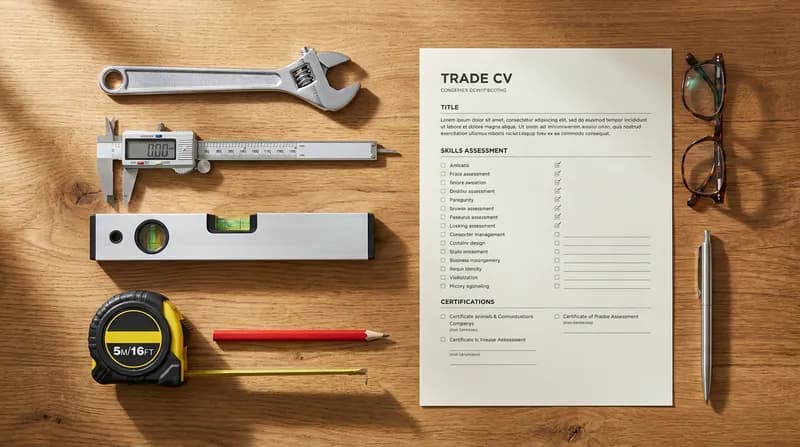
You have paid thousands of dollars in visa fees, spent years mastering your trade, and gathered endless stacks of paperwork. But right now, you are terrified of failing your Trades Recognition Australia (TRA) skills assessment because of one simple document: your resume.
Who this guide is for: Migrant tradies (including carpenters, electricians, motor mechanics, chefs, and plumbers) applying for Australian skilled migration visas (subclasses 482, 189, and 190).
Migrant tradies face a unique and stressful problem. Most online resume builders and generic career advice platforms treat a CV as a marketing tool designed to catch a recruiter's eye. However, for an Australian skilled migration trade assessment, your resume is not a marketing pitch. It is a strict legal document. If your CV fails to align perfectly with your Statement of Service, misses mandatory safety documentation, or lacks exact working hours, your visa application could be rejected.
At JobSparrow, our team and advisors have collectively reviewed over 100,000 resumes and helped candidates navigate the strict compliance requirements of international migration. In this comprehensive 2026 guide, we will walk you through the exact TRA skills assessment document checklist, how to format your Offshore Skills Assessment Program (OSAP) CV, and how to prove your trade qualification recognition in Australia.
What is a TRA skills assessment and why does your resume matter?
Trades Recognition Australia (TRA) is the designated assessing authority for trade occupations in Australia. Whether you are a carpenter, electrician, motor mechanic, or chef, you must prove to the Australian government that your skills meet their strict industry standards before you can secure a skilled migration visa.
Your resume acts as the central map for your entire application. The assessor will read your CV first and then cross-reference every single bullet point with your employer references, pay slips, and tax records. If there is a discrepancy between your resume and your official evidence, your application will be flagged.
This is why standard resume advice fails migrant tradies. A generic AI tool might tell you to keep your resume to one page and focus on "leadership skills." But a TRA assessor needs to see a detailed, multi-page document that lists the exact tools you use, the safety protocols you follow, and the precise tasks you perform daily. If you are wondering about general length guidelines across different regions, you can read our guide on How Long Should a Resume or CV Be? 2026 Guide for AU, NZ, US & UK, but remember that migration CVs often require more detail.

Standard tradie CV vs. TRA-compliant resume: the fatal difference
To understand how to write a successful TRA resume, you must understand how it differs from a standard job search CV.
Standard tradie CV:
- Focuses on getting a job interview quickly.
- Uses bullet points to highlight major achievements (e.g., "Finished project ahead of schedule").
- Often omits exact working hours or employment status (full-time vs. part-time).
- Rarely lists specific hand tools or power tools used.
- Usually fits on one or two pages.
TRA-compliant migration resume:
- Focuses on proving legal compliance and technical competency.
- Uses bullet points to map directly to the Australian and New Zealand Standard Classification of Occupations (ANZSCO) code.
- Must state exact working hours per week, employment status, and precise start and end dates (Day/Month/Year).
- Must include a comprehensive list of tools, machinery, and safety documents used.
- Can be three to four pages long to accommodate all required evidence.
If you use a generic resume builder that deletes your detailed tool lists to save space, you are actively sabotaging your visa chances. You need a system that captures every detail, which is why JobSparrow's Master Career Profile is designed to hold your entire work history without arbitrary length limits.
The ultimate TRA skills assessment document checklist for 2026
Before you submit your application, you must gather specific evidence. Each Trades Recognition Australia (TRA) program, such as OSAP or the Job Ready Program, sets its own minimum employment period and evidence requirements, so read the official guideline for your pathway before you finalise your CV.
To ensure your resume matches your evidence, prepare the following checklist:
- Personal and identity evidence:
- Copy of your current passport.
- Passport-sized photographs.
- Evidence of name changes (if applicable).
- Qualification evidence:
- Trade certificates and diplomas.
- Academic transcripts showing subjects studied.
- Apprenticeship completion certificates.
- Employment evidence (This must match your resume exactly):
- Statements of Service from every employer listed on your CV.
- Pay slips covering the beginning, middle, and end of each employment period.
- Tax records (e.g., W-2s, P60s, or local equivalents) for each year claimed.
- Bank statements showing salary deposits.
- Technical evidence:
- Photographs of you working on-site (wearing appropriate Personal Protective Equipment).
- Floor plans, schematics, or technical drawings you have created or followed.
- Copies of Safe Work Method Statements (SWMS) or Job Safety Analyses (JSAs) you have completed.
Not sure if your current CV covers all of these points? Start with a free CV diagnosis to get a recruiter-lens score and see the exact gaps before you submit your TRA application.
How to format your Offshore Skills Assessment Program (OSAP) CV
If you are applying from outside Australia, you will likely go through the Offshore Skills Assessment Program. This pathway is heavily scrutinized.
According to VETASSESS, one of the registered training organisations that delivers OSAP, a suitable OSAP outcome confirms that a candidate's trade skills align with Australian industry expectations and may award an Australian Certificate III or IV qualification relevant to the trade. To pass this, your CV must clearly demonstrate that your overseas experience is equivalent to Australian standards.
Your OSAP CV format should include:
- Header: Full legal name, date of birth, contact details, and your specific target ANZSCO occupation and code.
- Professional summary: A brief paragraph stating your total years of experience, your highest qualification, and your intent to migrate.
- Work experience (Reverse Chronological): For every role, you must include the company name, company address, company contact details, your exact job title, start and end dates (DD/MM/YYYY), employment type (Full-time or Part-time), and hours worked per week.
- Detailed task list: 10 to 15 bullet points describing your daily duties. These must not be copied and pasted from the internet. They must be written in your own words but reflect the ANZSCO requirements.
- Tools and equipment: A dedicated sub-section under each job listing the specific tools you operated.
- Safety compliance: A sub-section detailing the safety regulations you followed.
Mock OSAP CV Example:
John Doe 123 Builder Lane, London, UK | +44 123 456 789 | john.doe@email.com Target ANZSCO: Carpenter (331212)
Professional Summary Fully qualified Carpenter with 8 years of post-apprenticeship experience in residential framing and structural timberwork, seeking to migrate to Australia.
Work Experience Lead Carpenter ABC Construction Ltd | 456 Trade Road, London, UK | +44 987 654 321 14 March 2021 to 22 November 2023 Employment Type: Full-time (40 hours per week)
Key Duties:
- Interpreted architectural blueprints and technical schematics to calculate timber requirements.
- Conducted daily Job Safety Analyses (JSAs) to mitigate site hazards.
- Operated Makita 18V impact drivers and Hilti rotary hammers for structural alignment.
Time is of the essence when applying. Official data regarding Trades Recognition Australia (TRA) processing updates indicates that processing times can vary, so always check the current TRA website for the latest estimates. Any mistake in your resume will delay this process further.
Matching your resume to the Statement of Service and employer template
The most common reason for a TRA rejection is a mismatch between the candidate's resume and their Statement of Service. A Statement of Service is an official letter from your employer confirming your duties, dates of employment, and hours worked.
If your resume says you were a "Lead Carpenter" but your Statement of Service says you were a "Trade Assistant", the assessor will reject the experience.
Actionable Tip: Write your resume first, using JobSparrow's gap analysis (our AI tool that identifies missing evidence and technical details in your profile) to ensure you hit all the required technical points. Then, share your exact dates, hours and job title with each former employer so they can check them against their own records. The Statement of Service itself must be written by your employer on company letterhead, in their own words, and must reflect what you actually did. Never ask an employer to sign a statement that is not accurate, and do not copy your CV wording into it word for word. For more insights on formatting migration documents, see our VETASSESS Resume Format 2026: Guide, Templates & ANZSCO Matching.
Integrating ANZSCO codes into your tradie resume
Every trade in Australia has a specific ANZSCO code. For example, a Carpenter is 331212, and a Motor Mechanic is 321211. The Australian Bureau of Statistics defines the exact tasks expected of each code.
Your resume must prove you perform these specific tasks, but you cannot just copy the definitions word for word. Assessors are trained to spot duty statements copied straight from ANZSCO. Instead, you must weave the ANZSCO keywords into your real-world experience.
Bad Example (Plagiarized from ANZSCO):
- "Studied drawings and specifications to determine materials required, dimensions and installation procedures."
Good Example (Real-world application):
- "Interpreted architectural blueprints and technical schematics to calculate timber requirements and structural dimensions for residential framing projects across London."
By adding specific details like "residential framing" and "London", you prove the experience is authentic while still hitting the required keywords.
Writing safety documents (SWMS and JSAs) and tool lists into your CV
Australia has some of the strictest Occupational Health and Safety (OHS) laws in the world. A major content gap we see in competitor resume builders is the complete omission of safety documentation. If you do not explicitly state that you understand safety protocols, the assessor will assume you do not.
In your resume, you must mention Safe Work Method Statements (SWMS) and Job Safety Analyses (JSAs). Even if your home country uses different terms (like Risk Assessments or OSHA compliance in the United States), you should translate these concepts into Australian terminology for the assessor.
How to list safety in your resume:
- "Conducted daily Job Safety Analyses (JSAs) before operating heavy machinery to identify and mitigate site hazards."
- "Adhered to strict Safe Work Method Statements (SWMS) while performing high-voltage electrical installations, ensuring zero workplace accidents over a four-year period."
Additionally, you must list your tools. Do not just say "used power tools." Be specific. List items like "operated Makita 18V impact drivers, Hilti rotary hammers, and laser levels for precise structural alignment." If you struggle to quantify your work without exact metrics, check out our guide on How to Quantify Resume Achievements Without Exact Numbers (With Examples).
Recognition of Prior Learning (RPL) resume formatting
Many highly skilled tradies learned on the job rather than through formal apprenticeships. If you are applying through a Recognition of Prior Learning (RPL) pathway, your resume must work twice as hard to prove your competency.
For an RPL resume, you must break down complex projects to show your depth of knowledge. Instead of just listing your daily duties, include a "Key Projects" section under each job. Describe a complex problem you faced on site, the technical steps you took to solve it, and the final outcome. This proves to the assessor that you possess the theoretical knowledge normally taught in a classroom, applied in a practical setting.
Common mistakes that cause TRA rejections in 2026
Avoid these critical errors that frequently lead to assessment failures:
- Vague employment dates: Writing "2021 to 2023" will cause the assessor to flag your application as insufficient. Always write the full date: "14 March 2021 to 22 November 2023".
- Missing working hours: You must state "Full-time, 40 hours per week". If you worked part-time, calculate the exact average weekly hours.
- Using generic templates: Using an aesthetic, heavily designed template from a standard builder often strips out the space needed for technical details. Stick to clean, professional, text-based formats.
- Unexplained career gaps: Assessors look closely at gaps. If you took six months off to travel or recover from an injury, state it clearly. Do not leave the assessor guessing.
- Relying on basic ATS checkers: Standard job trackers look for marketing buzzwords, not migration compliance. Read our breakdown on ATS Scanners vs Job Trackers: The $100/Month Trap to understand why specialized analysis is necessary.
How JobSparrow helps you build a migration-ready CV
Preparing for a TRA skills assessment is stressful enough without fighting with generic resume builders that do not understand migration requirements. JobSparrow is your AI career advisor, built by professionals who understand exactly what assessors and recruiters are looking for.
We know this checklist can feel daunting, especially when your visa and your future are on the line. That is exactly why JobSparrow was built: to make sure no detail falls through the cracks.
Our process follows a proven five-stage Offer Path:
- Diagnose: See your CV gaps before you submit.
- Position: Align your skills with strict ANZSCO standards using your Master Career Profile.
- Execute: Generate your compliant, highly detailed TRA resume.
- Prepare: Practice tailored AI mock interviews for roles with Australian employers.
- Close: Negotiate your first Australian job offer.
Instead of starting with a blank page, you begin by building your Master Career Profile. This acts as your single source of truth, storing every tool you have used, every safety protocol you have followed, and every project you have completed. Our AI Gap Filler will actively interview you, asking targeted questions to pull out the specific technical details you might have forgotten, ensuring your profile is rich with the exact evidence a TRA assessor needs to see.
Ready to see where your current CV stands? Start with a free CV diagnosis today. Upload your current resume to get a recruiter-lens score out of 100 and see the exact gaps you need to fix before submitting your TRA application. Try the full Offer Path for 7 days for A$8.99, then A$59 a month. Cancel anytime.
Frequently asked questions
What is the correct resume format for a TRA skills assessment?
The correct format for a TRA skills assessment is a highly detailed, reverse-chronological CV. Unlike standard job search resumes, it must include exact dates (day, month, and year), specific weekly working hours, comprehensive tool lists, safety protocols, and tasks that align directly with your target ANZSCO code. It should prioritize factual compliance over aesthetic design.
How do I match my resume to the TRA employer template?
You must ensure total consistency between your resume and the TRA Employer Template (Statement of Service). Write your comprehensive resume first, ensuring all technical skills, dates, and hours are accurate. Then, give your previous employers your dates, hours and job title so they can confirm them against their own records. The Statement of Service must be written by the employer on company letterhead and must accurately describe your real duties.
What evidence do I need for the Offshore Skills Assessment Program (OSAP)?
For the OSAP, you need verified identity documents, formal trade qualifications, detailed Statements of Service from employers, pay slips, tax records, and a highly detailed CV. This evidence must collectively prove that your overseas experience meets strict Australian industry standards without any gaps or discrepancies.
How long does a TRA skills assessment take in 2026?
Processing times for the OSAP can vary. Check the official TRA website for the most up-to-date processing timeframes. Keep in mind that any discrepancies or missing information in your resume or evidence will cause significant delays or potential rejection.
Do I need to include tool lists and safety documents in my Australian tradie CV?
Yes, it is strongly recommended. Australian assessors need concrete proof that you can operate industry-standard equipment safely. Explicitly mentioning Safe Work Method Statements (SWMS) and Job Safety Analyses (JSAs) shows you understand and comply with strict Australian workplace safety culture.
Tags
Keep reading
Recommended articles.
acs skills assessment · anzsco codes
ACS Skills Assessment Resume Guide: Prove ANZSCO Alignment & Avoid Rejection (2026)
Master the 2026 ACS CV format. Map ANZSCO codes, avoid rejection, and secure your migration points. Start free at JobSparrow.
vetassess · anzsco
VETASSESS Resume Format 2026: Guide, Templates & ANZSCO Matching
Master the 2026 VETASSESS resume format. Avoid rejections with our document checklist and ANZSCO matching tips. See your recruiter-lens score free.
nursing resume · ahpra cv
Nursing Resume for Australian Migration: 2026 AHPRA CV & ANMAC Reference Guide
Pass ANMAC and AHPRA with the right CV format. JobSparrow's 2026 guide shows nurses the exact structure, declaration and references required.