
resume review
How to Review Your Resume (or CV): The 10-Second Recruiter Diagnosis Checklist (+ Free Online Checker)
By Job Sparrow Team

You ran your document through a free ATS resume checker, stuffed in every missing skill until your score hit 88%, and clicked submit on 40 applications. Yet your inbox is still full of automated rejections or complete silence. If you are asking yourself, "Why am I not getting interviews with a high resume score?", you have discovered the biggest blind spot in modern job hunting.
Most automated scanners only measure mechanical keyword matching. They do not tell you how your resume or Curriculum Vitae (CV) actually reads to the human being who decides who gets interviewed. A resume that pleases an algorithm by repeating phrases from the job description often fails the 10-second human recruiter scan because it buries your impact, obscures your seniority level, or sounds like generic AI-generated filler.
At JobSparrow, our team and advisors have collectively reviewed over 100,000 resumes and bring more than 10 years of hands-on recruiting and hiring experience across the United States, Australia, New Zealand, Singapore, and Hong Kong, tuned alongside award-winning HR leaders. In this guide, we will walk you through the exact two-pass resume review checklist we use from both sides of the hiring table: passing the 10-second human diagnosis first, and clearing the technical Applicant Tracking System (ATS) check second.
Want to see how a hiring manager views your document right now? Start with a free CV diagnosis to get an instant recruiter-lens score out of 100 and see the exact gaps costing you interviews.
Why a high ATS score still gets you rejected (scanner vs. recruiter)
To fix your interview conversion rate, you have to understand the difference between a resume keyword scanner vs. recruiter evaluation.
According to landmark research from the Harvard Business School Project on Managing the Future of Work, over 90% of employers use automated recruiting and tracking systems to initially filter or rank middle-skill (94%) and high-skill (92%) candidates. The same report estimates that more than 27 million people in the US are "hidden workers" who want work but are screened out by hiring practices, including rigid automated filters that reject candidates for gaps or missing credentials.
However, passing that initial software filter only puts you into a recruiter's review queue. Once a human opens your file, a completely different test begins.
Standard online resume graders fail job seekers in three specific ways:
- They reward keyword stuffing over evidence: Many free scanners give you points simply for pasting the words "stakeholder management" or "Python" into a skills grid. A human recruiter ignores isolated skill lists and scans your work history to see how and where you used those skills.
- They encourage robotic AI phrasing: If you use one-click bullet generators or mass auto-apply platforms, your resume begins to look identical to hundreds of other applicants. As we explain in our breakdown of why autopilot apps get you ghosted, hiring managers immediately spot and reject generic "AI slop" that lacks real operational context.
- They use bait-and-switch paywalls: Many tools advertised as an online CV checker free of charge will scan your file, flash a scary red warning score, and lock the actual feedback behind a costly auto-renewing trial or only allow you to download an unusable plain-text file.
A real diagnosis requires evaluating both the machine layer and the human layer. Let us start with how a human reads your page.
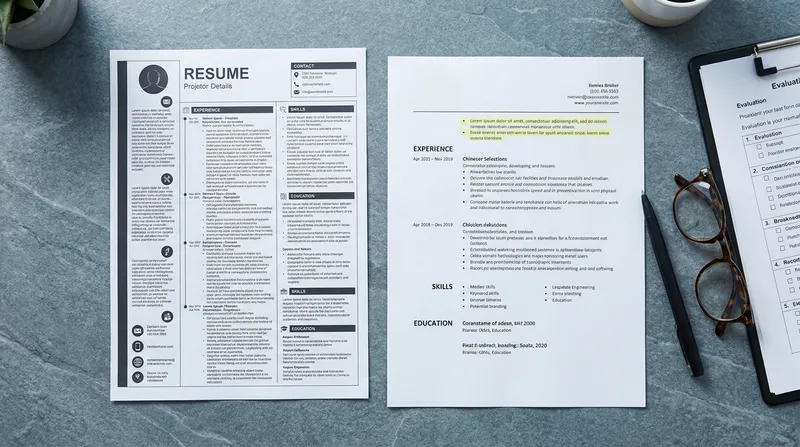
What recruiters look for in the first 10 seconds (the human scan)
When a recruiter opens your resume, they do not read it from top to bottom like a novel. They perform a rapid diagnostic scan to verify whether you match the seniority, domain, and impact level of the role.
Empirical eye-tracking research from the Ladders, Inc. Eye-Tracking Study (via HR Dive) reveals that recruiters spend an average of just 7.4 seconds on an initial resume screen. During those few seconds, their eyes follow a predictable "F-pattern" or "E-pattern" across the page:
- The Top Horizontal Bar: They read your name, location, target headline, and executive summary at the top third of the first page.
- The Left Vertical Spine: Their eyes drop down the left margin, scanning your bolded job titles and employer names.
- The Right Margin Check: They flick their eyes to the right margin to check employment dates, tenure length, and career progression.
- The First Bullet Anchor: If the titles and dates make sense, they read the very first bullet point under your most recent role.
Your 10-second resume test (do this right now)
Before changing a single word on your resume, run this physical 10-second resume test:
- Export your resume as a PDF and view it at 100% zoom on a laptop screen (or print the first page).
- Set a timer on your phone for 10 seconds.
- Look only at the top third of page one, your bolded job titles, and the first bullet point of your current job.
- When the timer stops, close the file and answer three questions:
- Is it immediately obvious what exact role and seniority level you are targeting next?
- Does your very first bullet point contain a measurable outcome or business result?
- Can your eyes easily find the dates and titles without squinting through walls of text?
If the answer to any of those questions is no, your resume is failing the recruiter resume scan, regardless of how high it scores on an automated keyword grader.
Complete resume review and critique checklist (the 7-point audit)
Once you see how fast the initial screen happens, you can use this 7-point resume critique checklist to fix the exact areas where candidates lose interviews.
1. Top-third positioning and target title alignment
The top third of page one is your highest-value real estate. Do not waste it on a vague objective statement like "Hardworking professional seeking a challenging role."
- Actionable fix: Place the exact title of the target job directly beneath your name as a professional headline (for example, Senior Product Manager | B2B SaaS & Payments). Follow it with a three-line summary that anchors your years of experience, core specialization, and one standout career metric.
2. Visual breathability and the 3-line bullet rule
Recruiters screen dozens of resumes in a single sitting. When they encounter a seven-line paragraph under a job title, their eyes skip right over it.
- Actionable fix: Audit every bullet point in your work history. Keep each bullet to one or two lines maximum (never more than three). Limit your current role to five or six high-impact bullets, and trim older roles from five+ years ago down to three bullets.
3. Seniority calibration and scope signals
One of the most common reasons candidates get rejected is a seniority mismatch. You might have the right keywords, but the recruiter cannot tell if you worked on a US$5,000 project or a US$5 million regional rollout.
- Actionable fix: Inject "scope signals" into the first bullet of every job. State the size of the budget you managed, the number of direct or cross-functional reports, the volume of customer accounts, or the geographic reach of your work.
4. Reverse-chronological momentum and gap framing
When recruiters flick their eyes to the right margin to read your dates, they are looking for logical progression and unexplained gaps. Career breaks for caregiving, relocation, layoffs, or study are completely normal, provided you do not leave the reader guessing.
- Actionable fix: Use consistent Month/Year formatting (such as Mar 2023 - Present). If you have a gap longer than three months, add a single, transparent one-line entry explaining the period (for example, Planned Career Break: International Relocation to Auckland, NZ or Professional Upskilling & Cloud Certification).
5. Contextual keyword substantiation
Many candidates create a massive block of 30 skills at the top of the page. As career advisors at the University of Illinois Chicago (UIC) and Ohio Northern University (ONU) emphasize, every skill or keyword listed on your resume must be substantiated inside your contextual achievement bullets rather than used to "trick" the scanner. You can learn more about how semantic scoring works in our guide on how to pass Eightfold AI screening.
- Actionable fix: Pick the top five must-have hard skills from the job description and make sure each one appears by name inside a work experience bullet showing what you achieved with that tool or methodology.
6. Defensibility against AI screening and live interviews
Because so many applicants now use generative AI to inflate their resumes with exaggerated percentages, recruiters actively scan for suspicious, unverified claims. If your resume claims you "increased company efficiency by 400%," a hiring manager will either dismiss it as an AI hallucination or immediately test you on it in the first five minutes of a screening call.
- Actionable fix: Run the "Walk Me Through That Number" check on every metric on your page. If an interviewer asks, "How exactly did you calculate that 32% reduction?", you must be able to explain the baseline, the action, and the result without hesitation.
7. Contact clarity and hyperlink hygiene
Broken links or missing location cues create unnecessary friction when a recruiter wants to shortlist you.
- Actionable fix: Include your city and state/region, a local phone number, a professional email address, and a clean, customized LinkedIn URL (remove the random string of numbers at the end of your public profile link).
How to turn responsibilities into quantified achievements (the 3-pass makeover)
When we diagnose resumes at JobSparrow, the number one substantive flaw we see is listing daily duties instead of quantified resume achievements. A job description tells you what the role is responsible for. Your resume must prove how well you performed those duties.
In accordance with guidance from Massachusetts Institute of Technology (MIT) Career Advising & Professional Development, you should begin every bullet point with a specific, skill-signaling action verb (such as Accelerated, Analyzed, or Built) and place your three to four most notable, role-relevant achievements at the top of each section so they leap off the page during a quick scan.
Here is our "One Bullet, Three Passes" framework to transform a weak responsibility statement into a shortlist-worthy achievement:
- Pass 1 (Replace the passive verb): Strip out phrases like Responsible for, Helped with, Assisted in, or Worked on. Replace them with an ownership verb.
- Pass 2 (Add the before-and-after metric): Quantify the frequency, volume, dollar figure, time saved, or error reduction.
- Pass 3 (Anchor the business outcome and defensibility): State why that work mattered to the team, client, or bottom line.
Real-world bullet makeovers across three candidate profiles
1. Standard Corporate Candidate (Operations / Marketing)
- Before (Duty-focused): Responsible for managing client onboarding emails and updating the CRM database.
- After (3-Pass Makeover): Redesigned the automated HubSpot onboarding sequence for 120+ new B2B accounts per quarter, cutting average client activation time from 14 days to 6 days.
2. Career Changer (Hospitality Management to Corporate Project Management)
- Before (Industry-trapped): Managed front-of-house restaurant staff, shift rosters, and Friday night inventory orders.
- After (3-Pass Makeover): Directed daily operations and scheduling for a 22-person team in a high-volume venue generating US$1.8M annually, reducing weekly labor overtime costs by 15% through demand forecasting.
3. International Migrant Candidate (Overseas Employer to Local Market)
- Before (Lacks local context): Led software QA testing at PT Maju Tech for banking mobile app releases.
- After (3-Pass Makeover): Spearheaded automated QA testing at PT Maju Tech (a 400-person FinTech provider serving 2M+ retail banking users), reducing post-release critical bugs by 28% across 12 bi-weekly sprints.
If you stare at your bullet points and cannot remember your exact numbers, you do not have to guess. Inside JobSparrow, our interactive gap filler analyzes your master career profile, flags vague descriptions or missing metrics, and walks you through targeted Q&A prompts to draw out your real accomplishments.
Special audit rules for career changers and international migrants
Standard resume checkers treat every candidate as if they are applying for the exact same job they held yesterday in the exact same city. If you are pivoting industries or moving across borders, standard formatting advice can actually get you rejected during the 10-second scan.
The career change resume audit: fixing the "title mismatch" trap
Remember the eye-tracking study: recruiters scan down the left margin reading your bolded job titles. If you are applying for a Corporate Customer Success Manager role, and the bolded titles jumping off your page say Shift Supervisor, Bartender, or Postdoctoral Research Fellow, a rushed recruiter may reject you in five seconds without reading your bullets.
Here is how to pass a career change resume audit:
- Use functional parenthetical bridges on your job titles: Never lie about your official title, as background checks verify exact employment titles. Instead, add a functional equivalent in parentheses right next to it, or bold the company and functional focus so the eye catches the transferable skill. For example: Operations & Team Lead (Store Manager) or Quantitative Researcher (Postdoctoral Fellow). For deep-dive examples, read our guides on translating a hospitality and retail background to a corporate resume or converting an academic CV to an industry resume.
- Add a "Relevant Transferable Experience" or "Selected Projects" section at the top: Before listing your full chronology, create a dedicated top section that groups three to four major accomplishments that directly mirror the target job description.
- Purge industry-specific insider acronyms: Replace internal jargon from your old industry with universal corporate terminology (for example, change "guest recovery" to "client retention and escalation resolution," or "curriculum pedagogy" to "instructional design and stakeholder training").
The migrant and international candidate resume audit
When recruiters in the US, UK, Australia, or New Zealand scan a resume with international work history, two silent questions pop into their minds in the first 10 seconds: "Do I need to sponsor a visa for this person?" and "How big or reputable was the company they worked for overseas?"
If your resume leaves either question unanswered, cautious hiring managers often pass on your application. Fix this with three simple adjustments:
- State your work rights in the top header: Put your visa status and work eligibility right next to your location on line two of your header (for example, Sydney, NSW | Full Australian Work Rights (Subclass 189 PR) or London, UK | Graduate Visa (valid to [month/year]), no sponsorship required during this period). Note that the UK Graduate visa cannot be extended. Applications made from 1 January 2027 receive 18 months (PhD holders three years), so employers may need to sponsor you later. See our complete guide on how to list visa status and work rights on your resume or CV for country-specific templates.
- Add a one-line company descriptor for overseas employers: A recruiter in Chicago or Wellington may not recognize a leading bank in Mumbai or a major telecom company in Manila. Right underneath your employer's name, add a brief italicized descriptor in brackets: [Leading Southeast Asian logistics provider with 1,500+ employees and US$120M annual revenue]. In one second, the recruiter understands the caliber of your experience.
- Translate degree grades and occupation titles to local standards: Convert unfamiliar GPA scales (such as a 10-point CGPA) to local equivalents (like First-Class Honours equivalent in the UK/AU/NZ or 3.8/4.0 GPA equivalent in the US). If you are applying for visa-linked roles in New Zealand or Australia, ensure your terminology aligns with official occupation lists, as detailed in our NZ NOL vs. ANZSCO CV tailoring guide.
US vs. UK vs. Australia & New Zealand: regional CV format checker
A resume format that lands interviews in New York can get you ignored in London, Sydney, or Auckland. Many online checkers apply strict American rules (like forcing a one-page limit) to UK, Australian, and New Zealand candidates, causing them to delete crucial career history.
Official government career bodies set very specific regional standards:
- United Kingdom: According to the National Careers Service (GOV.UK), the National Careers Service advises leaving age, date of birth, marital status, and nationality off a UK CV, and using size 11+ Arial, Calibri, or Times New Roman. Furthermore, UK graduate authority Prospects.ac.uk advises never titling your document "Curriculum Vitae" or "CV" (use your full name as the title instead), keeping 2.5 cm margins for white space, excluding photographs, and matching keywords from both the job description and the UK "person specification."
- Australia & New Zealand: Guidelines from the Australian Government's Department of Employment and Workplace Relations (Workforce Australia) recommend explicitly stating your state or territory, listing relevant regulatory "tickets" or clearances (such as a driver's licence class, Working with Vulnerable People clearance, or White Card), and including your contact details on every page of a multi-page document. Additionally, if you are applying through SEEK in Australia or New Zealand, aligning your CV credentials with verified badges can help your profile and CV tell a consistent, verifiable story. See our guide on SEEK Pass and verified credentials.
Use this regional comparison matrix as your CV format checker UK, US, AU, and NZ reference:
| Feature | United States (Resume) | United Kingdom (CV) | Australia & New Zealand (CV / Resume) |
|---|---|---|---|
| Standard Length | 1 page (early to mid-career); 2 pages (10+ years or senior/tech roles) | Usually no more than 2 pages (1 page only for school leavers/recent grads) | 2 to 3 pages is common |
| Spelling & Dictionary | US English (optimize, analyze, program) | UK English (optimise, analyse, programme) | UK/AU/NZ English (optimise, analyse, programme, licence as noun) |
| Opening Section | 3-line Executive Summary + Core Competencies | Personal Profile / Career Summary tailored to the Person Specification | Career Profile + Key Achievements list on page one |
| Licences & Clearances | Professional certifications only (CPA, PMP, RN) | Driving licence (if role-relevant) & DBS check status | Dedicated section for regulatory tickets, clearances, & SEEK Pass credentials |
| References / Referees | Omit entirely (do not even write "Available upon request") | Usually omitted (referee details are provided when requested) | Either "Referees available upon request" or 2 listed referees (common in government/public sector) |
| Paper Size Setting | US Letter (8.5 x 11 inches) | A4 (210 x 297 mm) | A4 (210 x 297 mm) |
How to check if your resume is ATS-friendly (the technical parse checklist)
Once your resume passes the 10-second human scan and meets regional formatting standards, your second pass is the technical ATS compatibility check. Even the best-written accomplishments will fail if the software parser scrambles your text into unreadable code.
According to official guidance from the U.S. Social Security Administration (Choose Work), you should avoid pictures, tables, multi-column text boxes, or graphics because they confuse ATS parsing software, and stick to standard 10- to 12-point fonts (such as Calibri, Arial, or Georgia) saved in DOCX or text-based PDF format.
Additionally, university career advisers commonly warn of several technical glitches that can trip up older parsers:
- Never put contact info inside the Word Document Header/Footer tool: Many ATS parsers ignore embedded document headers and footers completely. Place your name, email, and phone number in the main body of the page.
- Keep credentials off your name line in the parser: If your top line reads Jane Doe, MBA, PMP, some parsers misclassify "MBA" as your middle or last name in the recruiter database. Put your credentials in your headline on the line directly below your name, or separate them clearly.
- Avoid accented characters in section titles: Some legacy parsers misread accented letters, turning the word "Résumé" into "R?sum?". Use standard headings like Work Experience, Education, and Skills.
- Spell out acronyms alongside their abbreviations: Because some recruiters search the ATS for "Search Engine Optimization" while others type "SEO," include both on first mention: Search Engine Optimization (SEO).
The 30-second DIY Notepad test
You can test your file's raw machine readability right now without paying a cent:
- Open your resume PDF or Word document, press
Ctrl+A(orCmd+Aon Mac) to select all text, and copy it. - Paste the text into a plain-text editor like Notepad (Windows) or TextEdit in plain-text mode (Mac).
- Read through the pasted text. If your work history appears jumbled, if columns merged horizontally across each other, or if your contact information disappeared completely, an ATS parser will experience the exact same error.
What is a good resume score? (and how to diagnose yours for free)
Job seekers constantly search "check my resume score" and wonder whether they need an 80%, 90%, or 100% match to land an interview.
Here is the honest truth from the hiring side of the table: chasing a 95% or 100% keyword score on a mechanical resume grader online will make your resume worse, not better. To hit 95%+ on a basic keyword counter, you have to awkwardly force every single noun and adjective from the job posting into your file. When a human recruiter reads that document, it looks unnatural and desperate.
Instead of chasing a raw keyword count, we recommend following two practical rules of thumb:
- Focus on contextual keyword alignment: Naturally weave the core "must-have" hard skills and relevant "nice-to-have" skills into real achievement bullets rather than stuffing a skills grid.
- Prioritize a strong recruiter-lens diagnosis: Ensure your positioning is crystal clear in the top third, your seniority scope matches the role, your metrics are concrete and defensible, and your regional formatting matches local US, UK, AU, or NZ expectations.
How JobSparrow guides you from diagnosis to offer
Most resume sites want to sell you a template and leave you on your own. JobSparrow is your AI career advisor across the entire five-stage Offer Path: Diagnose, Position, Execute, Prepare, and Close.
- Diagnose (Free CV Diagnosis): Upload your current resume or CV at https://jobsparrow.ai/free-cv-review (or right as you start at https://app.jobsparrow.ai/welcome/step-1). On the very same screen, with no demo and no waitlist, you get a recruiter-lens score out of 100, a clear breakdown of the exact substantive gaps costing you interviews (vague impact, seniority mismatch, missing evidence), and your personalized Offer Path map.
- Position (Master Profile, Gap Filler & Instant Resume): Import your CV into your centralized master career profile, let the gap filler ask targeted questions to uncover your missing metrics, and generate a sharp positioning and instant resume aimed at a shortlist of best-fit roles.
- Execute (Job-Specific Tailoring & Smart Job Search): Discover high-match roles across LinkedIn, Indeed, and SEEK in one dashboard. For every application, generate a job-specific tailored resume and intelligent cover letter formatted cleanly in one of five templates (Professional, Two Column, Elegant, Colorful, or Contemporary), or run the entire workflow inside Claude Desktop, Claude Code, OpenClaw, Codex, or Gemini CLI using our AI Agent Skill & API. Once you submit, follow our follow-up email templates and timing rules to stay top of mind.
- Prepare (AI Mock Interviews): Fixing your resume gets you the interview, while preparation gets you the offer. Practice role-specific questions with real-time audio recording and instant AI feedback on answer quality, clarity, and delivery so you can defend every metric on your CV, whether you are facing a HireVue AI video screen or live behavioral interview questions.
- Close (Offer & Negotiation Coaching): Evaluate your compensation package and negotiate with confidence so you finish with a signed offer.
A traditional career consultant charges around US$300 to rewrite a single resume and around US$2,000 for a full coaching program. With JobSparrow, your initial CV diagnosis is completely free. When you are ready to unlock the full Offer Path (including unlimited tailored resumes and cover letters, unlimited mock interviews, positioning, and negotiation coaching), you can try the full Offer Path for 7 days for US$5.99, then US$45 a month (or £4.99 today then £35/month in the UK, A$8.99 today then A$59/month in Australia, and NZ$9.99 today then NZ$59/month in New Zealand), with three-monthly plans also available and one-click cancellation anytime.
Frequently asked questions about resume and CV checkers
Why am I not getting interviews even with a high ATS resume score?
A high ATS score from a basic scanner only confirms that the words from the job posting appear somewhere on your document. If those keywords sit inside an unsubstantiated skills block, if your job titles signal the wrong seniority level, or if your bullets describe routine duties instead of measurable outcomes, a human recruiter will still reject your resume during their 7- to 10-second scan.
What is the 10-second resume test and what do recruiters look at first?
The 10-second resume test simulates a recruiter's initial eye-tracking scan. In those first seconds, recruiters look at the top third of page one (your headline and summary), scan down the left margin to read your bolded job titles and companies, glance at the right margin to verify employment dates and tenure, and read the first bullet point of your most recent job to check for quantified impact.
How can I check if my resume is ATS-friendly for free without a paid subscription?
You can perform a technical parse check yourself in 30 seconds by copying all the text from your PDF or Word resume and pasting it into a plain-text editor like Notepad or TextEdit. If the text flows in logical top-to-bottom order without missing headers or scrambled columns, an ATS can parse it cleanly. For a free substantive critique of your content and positioning, use JobSparrow's free CV diagnosis.
What is the difference between a US resume review and a UK, Australian, or NZ CV check?
US resumes are typically one page (up to two pages for experienced professionals), use US spelling and Letter paper size, and omit references completely. UK CVs are usually no more than two pages on A4 paper, use British spelling, and align with a role's "person specification." Australian and New Zealand CVs commonly run two to three pages on A4 paper, use British/Commonwealth spelling, explicitly list state/territory locations and regulatory licences or tickets, and often reference two referees.
How do I pass the 10-second recruiter scan if I am changing careers or moving countries?
If you are changing careers, bridge your past job titles by adding functional corporate equivalents in parentheses and spotlighting transferable achievements in the top third of page one. If you are an international migrant, state your visa and work rights status in the top header next to your location, and add a one-line bracketed description under unfamiliar overseas employers to explain their industry, headcount, and scale.
Can recruiters and ATS scanners detect AI-written resumes?
Human recruiters recognize raw, unedited AI resumes immediately. Overused buzzwords (such as spearheaded, testament, delved, or dynamic tapestry) paired with vague, unsubstantiated claims signal that a candidate used an autopilot tool. Always ground AI-assisted tailoring in your real metrics and operational details from your master profile.
Should I submit my resume as a PDF or Word (.docx) file to pass an ATS check?
Both text-based PDFs and Word (.docx) files parse cleanly in modern Applicant Tracking Systems like Greenhouse, Lever, Workday, and iCIMS. However, if an application portal specifically requests a .docx file, follow that instruction. Never upload an image-based PDF (such as a scanned printout or a flattened graphic design export from Canva or Photoshop), because ATS scanners cannot read text trapped inside flattened image layers.
Are two-column resume templates bad for ATS scanners in 2026?
Historically, multi-column tables and floating text boxes caused older ATS parsers to read straight across the page horizontally, jumbling your dates and skills together. Today, modern parsers can handle a properly coded two-column layout, provided the underlying document structure separates the columns into distinct reading blocks rather than nested HTML tables or floating graphics. You can verify any two-column resume in 30 seconds using the plain-text Notepad copy-and-paste test, and check any JobSparrow template the same way before you submit.
How many bullet points should I include per job on my resume or CV?
For your current or most recent role, include five to six high-impact bullet points, with your strongest quantified achievement placed in the very first bullet. For previous relevant roles from the last five to seven years, use three to four bullet points per position. For older roles held more than seven to 10 years ago, limit yourself to two bullets focused purely on major outcomes, or group very early career roles under a brief "Earlier Career History" summary line.
What should I do if I do not have exact numbers or metrics for my resume achievements?
You do not need direct revenue responsibility to quantify your impact. If you cannot share exact dollar figures, measure your work using four alternative dimensions: volume and scale (number of client accounts handled, tickets resolved per week, or size of the cross-functional team), time and frequency (hours saved per month, turnaround speed reduced from five days to two), quality and accuracy (error rates lowered, SLA compliance percentage, customer satisfaction scores), or comparative rankings (selected as one of three team leads to pilot a new CRM rollout).
How often should I tailor my resume and check my score before applying?
You should maintain one comprehensive master career profile containing your full work history, and generate a tailored version for every high-priority application. Sending an identical, generic resume to 50 openings tends to perform poorly, because each hiring manager prioritizes slightly different hard skills and seniority signals in the top third of page one. JobSparrow generates a tailored resume from your master profile for each application, so you can focus on reviewing and personalizing it rather than rebuilding it from scratch.
Stop guessing why your applications are going unanswered
You do not need to send another 50 applications into the void to find out what is holding your resume back. Start with a free diagnosis at JobSparrow right now to see your recruiter-lens score out of 100, uncover the exact gaps costing you interviews, and map your path to the job offer.
Tags
Keep reading
Recommended articles.
expression of interest · cover letter
How to Write an Expression of Interest (EOI) Letter: 2026 Guide, Templates & Examples
Write a winning Expression of Interest (EOI) letter in 2026. Get 4 templates for unadvertised jobs, internal promotions, and APS government roles.
ai cover letter generator · australian job market
7 Best AI Cover Letter Generators for the Australian Job Market (2026 Guide)
Compare the best AI cover letter generator Australia tools for SEEK in 2026. Write in AU English, pass ATS, and avoid robotic fluff.
ats resume scanner · semantic ai
Why ATS Resume Scanners Give Different Scores (And How Semantic AI Works) | JobSparrow
Wondering why ATS resume scanners give different scores? Learn how Semantic AI works and get a free recruiter-lens diagnosis at JobSparrow.