
resume writing
How to Write a Resume With No Experience: A Step-by-Step Guide
By Job Sparrow Team

How to Write a Resume With No Experience: A Step-by-Step Guide
It's the classic career paradox: you can't get a job without experience, but you can't get experience without a job. If you're a student, recent graduate, or career changer, that blank page can feel incredibly intimidating. But here's the truth: you have more experience than you think. Your potential, projects, education, and unique skills are your experience.
This guide will teach you how to frame those assets to create a powerful resume that gets noticed. We'll walk you through every section, step-by-step, to build a foundational document for your career. Think of this as the first version of your story—a document you can build upon with tools like JobSparrow's Master Career Profile to land your first, or next, great role.
Why Your First Resume Is About Potential, Not Past Jobs
For entry-level roles, recruiters aren't just looking at what you've done; they're investing in what you can do. Your resume needs to shift the narrative from "I have no work history" to "Here's my potential and what I'm capable of achieving."
According to career experts at Indeed, a resume without a work history should highlight your eagerness to learn, strong interpersonal skills, and a solid work ethic. These are demonstrated through your transferable skills, academic performance, and extracurricular activities.
It's also crucial to understand that before a human even sees your resume, it will likely be scanned by an Applicant Tracking System (ATS). These systems filter candidates based on keywords and formatting. This is why building a properly structured resume is critical from day one, helping you conquer any 'Algorithm Anxiety' in Your Job Search.
Choosing the Right Format: Functional vs. Combination Resume
A traditional chronological resume, which lists work history from most to least recent, isn't effective when you don't have that history. Instead, you have two much better options:
-
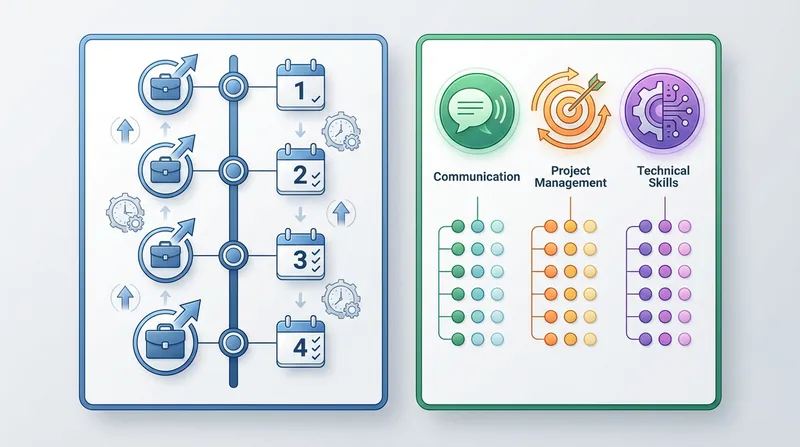
The Functional Resume: This format minimizes work history and focuses almost entirely on your skills. As recommended by Coursera, a functional resume is ideal because it promotes your skills at the top of the page. You group your accomplishments under skill-based categories like "Project Management" or "Data Analysis."
-
The Combination (or Hybrid) Resume: This is often the best choice. It leads with a strong skills summary section but also includes a section for your relevant experience, such as projects, internships, and volunteer work, listed in reverse-chronological order. It gives you the best of both worlds.
Whichever you choose, remember that clean design is key. A visually appealing resume that's easy for human eyes to read is just as important as beating the bots. Learn more about how to design a visually stunning resume for human eyes.
Your Step-by-Step Guide to Building a No-Experience Resume
Ready to build your resume? Let's break down every essential section. We'll provide clear examples to guide you through the process, turning that blank page into a compelling career document.
Step 1: Contact Information
This section is straightforward but must be flawless. Any mistake here can prevent a recruiter from contacting you. Place it at the very top of your resume.
Include the following:
- Full Name (in a slightly larger, bold font)
- Phone Number
- Professional Email Address (e.g.,
firstname.lastname@email.com, notskaterboi99@email.com) - Location (City, State is sufficient)
- LinkedIn Profile URL (Customize your URL to be professional, e.g.,
linkedin.com/in/yourname)
According to the U.S. Bureau of Labor Statistics, this basic information should be clear and easy to find.
Step 2: A Compelling Resume Objective
Instead of a resume summary (which focuses on past accomplishments), a resume objective is perfect for entry-level candidates. It focuses on your career goals and what you hope to bring to the role. Keep it short—two to three sentences—and tailor it to the specific job.
Use this simple formula:
A [Adjective] and [Adjective] [Student/Graduate/Professional] with a passion for [Industry/Field] seeking an opportunity to leverage [Skill 1] and [Skill 2] to contribute to [Company's Goal].
Example for a College Freshman:
A motivated and detail-oriented Computer Science student with a passion for mobile development. Seeking an internship opportunity to apply skills in Java and Python to contribute to the creation of user-centric applications.
Example for a Career Changer:
A customer-focused retail associate transitioning into a corporate client support role. Eager to leverage strong interpersonal, problem-solving, and organizational skills to contribute to [Company Name]'s reputation for excellent customer service.
Step 3: How to List Education on Your Resume
For a resume with no experience, your education is your most valuable asset. Place this section right after your objective. Make it detailed and impactful.
Here's what to include:
- University/School Name and Location
- Degree/Diploma (e.g., Bachelor of Science in Business Administration)
- Graduation Date (or Expected Graduation Date, e.g., May 2027)
- GPA (only include if it is 3.5 or higher)
- Relevant Coursework: The U.S. Bureau of Labor Statistics advises listing four to eight relevant courses. This directly connects your academic training to the job's requirements.
- Honors and Awards: Dean's List, scholarships, or academic society memberships.
Step 4: Showcasing 'Experience' Through Projects and Activities
This is where you reframe what 'experience' means. Create a section titled "Projects," "Relevant Experience," or "Academic & Leadership Experience." This is your chance to shine by detailing practical applications of your skills. The U.S. Department of Labor emphasizes detailing all relevant experiences, including academic and volunteer work.
Describe your projects just as you would a job:
- Academic Projects: Detail a significant research paper, case study, or group project. Describe the project's goal, your role, the skills you used, and the outcome.
- Personal Projects: Did you build a website, create a mobile app, or start a blog? This shows initiative and passion beyond the classroom.
- Volunteer Work & Internships: Frame your responsibilities using action verbs and quantify your impact whenever possible.
To ensure you never forget a key project or achievement, it's a great idea to start building a comprehensive career portfolio early. Learn how to Never Forget an Accomplishment: Build Your Master Career Profile with AI.
Step 5: Highlighting Your Most Valuable Skills
Create a dedicated "Skills" section and divide it into two categories. Guidance from the Oxford University Careers Service notes that a skills-based approach is useful for highlighting transferable abilities.
- Transferable Skills (Soft Skills): These are abilities applicable to any job. Think of examples from your projects or education where you demonstrated them.
- Examples: Communication, Teamwork, Leadership, Problem-Solving, Adaptability, Time Management.
- Technical Skills (Hard Skills): These are specific, measurable abilities.
- Examples: Programming Languages (Python, Java), Software (Microsoft Office Suite, Adobe Creative Cloud), Foreign Languages, Lab Techniques, Data Analysis Tools (Tableau, SQL).
To know which skills to prioritize, you need to analyze the job description. This is where a Gap Analysis Fuels Your Career Growth by showing you exactly what employers are looking for.
Step 6: Using Action Verbs and Quantifying Achievements
Strong resumes "show" rather than "tell." Replace passive phrases like "was responsible for" with powerful action verbs that describe what you actually did. To make your accomplishments even more impressive, quantify them with numbers.
-
Instead of: "Wrote a research paper on market trends."
-
Try: "Analyzed over 50 data sets to identify key market trends for a 15-page research paper."
-
Instead of: "Helped organize a campus event."
-
Try: "Coordinated with a team of 5 to organize a campus fundraising event that attracted 200+ attendees and raised over $1,500 for charity."
From a Static Resume to a Dynamic Career Profile
Congratulations! You now have a strong, foundational resume. But the single biggest mistake job seekers make is sending the same resume to every employer. To truly stand out, you need to tailor your resume for every single application.
Manually editing your resume is exhausting. This is where JobSparrow's Master Career Profile transforms your job search. You upload the resume you just built to create a central database of all your skills, projects, and experiences.
Then, for every job you want to apply for, JobSparrow's AI does the heavy lifting:
- It analyzes the job description to identify key requirements and skills gaps.
- It intelligently selects and enhances the most relevant bullet points from your profile.
- It generates a perfectly tailored, ATS-optimized resume in a professional PDF, all managed from a central dashboard.
With JobSparrow, you can try the platform risk-free. Our unique model means you only pay a voluntary success fee if you land a job offer—no offer, no payment.
Frequently Asked Questions
What is the best resume template for a student with no experience?
The best template is one that is clean, professional, and easy to read. A Functional or Combination format is ideal, as it emphasizes your skills and education over a non-existent work history. Prioritize readability and clear section headings over flashy graphics, which can confuse Applicant Tracking Systems (ATS). JobSparrow provides a range of professionally designed, ATS-friendly templates to ensure your resume is both visually appealing and machine-readable.
Should I put my high school on my resume if I'm in college?
If you are a college freshman or sophomore, it is acceptable to include your high school information, especially if you have significant achievements from that time. However, once you become a junior or senior, you should remove your high school details to make room for more relevant university-level coursework, projects, and internships.
How long should my resume be if I have no experience?
Your resume should be exactly one page. This is a firm rule for students, recent graduates, and anyone with less than a decade of experience. Career services at top institutions like the University of Pennsylvania confirm that a one-page resume demonstrates your ability to be concise and prioritize information. Recruiters spend only seconds scanning each resume, so a single, well-organized page is most effective.
Is it okay to have a resume with only projects and no work experience?
Yes, it is more than okay—it's expected! For entry-level roles, hiring managers are looking for potential, initiative, and the ability to apply knowledge in practical ways. A detailed project section showcasing your skills in action is far more valuable than a resume with large empty spaces. It proves you are proactive and passionate about your field.
What should I include in my entry-level cover letter?
Your cover letter is your opportunity to tell a story that your resume cannot. Use it to connect the dots between your passion, skills, and experiences and the specific needs of the company. Instead of restating your resume, explain why you are excited about this company and how your background makes you a great fit. To make this process faster, JobSparrow's AI can generate a personalized cover letter in seconds. You can then use the confidence from your strong application to ace your technical interview using AI-powered mock interviews.
Your Resume is Ready. Now Get Hired.
You've learned how to reframe your potential and build a powerful foundational resume. The next step is to make it work for you. Stop manually editing your resume for every application and let AI do the heavy lifting.
Ready to turn your resume into interviews? Start your free trial with JobSparrow and create your first tailored resume in under two minutes. You only pay if you land an offer.
Tags
Keep reading
Recommended articles.
job search · resume writing
Seek Profile vs Tailored Resume: Your 2026 Guide to Getting More Interviews in Australia
Stop guessing how to get interviews. Learn the 2026 AU/NZ strategy for using your Seek profile and tailored resume to get hired faster. Your guide to winning.
project management · resume writing
Project Manager Resume Australia & NZ (2026): 15+ Keywords, Templates & Examples
Build a tailored Project Manager resume for AU/NZ in 60 seconds. Get 15+ keywords, templates, and ATS-optimized applications. Land your next PM role faster.
ai recruitment · resume writing
Beat the Bots: A Job Seeker's Guide to Passing AI Resume Screening in Australia (2026)
Struggling with AI resume screening in Australia? Our 2026 guide helps you beat the bots, pass the ATS, and land more interviews. Get seen by recruiters.