
job search
Job Application Black Hole AU/NZ: 8 Reasons You're Not Hearing Back & How to Fix It
By Job Sparrow Team

Job Application Black Hole AU/NZ: 8 Reasons You're Not Hearing Back & How to Fix It
You've done everything right. You polished your resume, found the perfect job, and sent off your application with a surge of optimism. And then… nothing. The silence is deafening. If you've ever found yourself scrolling through Reddit forums, nodding along with tales of the "job application black hole," you know this feeling of powerlessness all too well.
The usual advice to 'tailor your resume' feels hollow when you don't know what you're doing wrong. It's not your experience that's the problem; it's the process. The game has changed, but no one has told you the new rules.
This post introduces a new, actionable strategy: The Feedback Loop Framework. It's a system designed to turn the frustrating, black-box process of job hunting into a cycle of continuous improvement, helping you escape the anti-burnout job search and land the role you deserve.
Why You're Not Hearing Back: 8 Reasons Behind the Silence
First, let's be clear: the silence is rarely personal. The Australian and New Zealand job markets have become incredibly competitive. A perfect storm of economic shifts and new technology has created an environment where even highly qualified applicants can get lost in the noise.
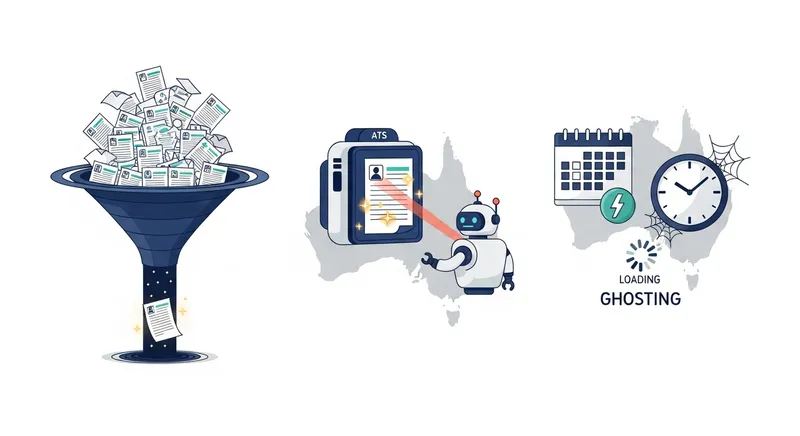
The sheer numbers are staggering. Open roles now receive an average of more than 300 applications, and according to research from HR Dive, it's become 50% harder for a candidate to even reach the interview stage since 2021. Compounding this, the average time-to-hire across industries has stretched to 44 days, as noted by Business.com.
Here are the eight key reasons your application is falling into the void.
Reason 1: Unprecedented Application Volume
Your application isn't going to one person; it's landing in a pile of hundreds. In Australia, recent data from SEEK shows a significant jump in applications per job advertisement. Recruiters are overwhelmed and simply do not have the time to personally respond to every single applicant.
Actionable Tip: Don't take the silence personally. Focus on making your application stand out from the pile and use a system like the ultimate job application tracker to manage your efforts without getting overwhelming.
Reason 2: The ATS Is Your First Hurdle
Before a human ever sees your resume, it's almost certainly screened by an Applicant Tracking System (ATS). According to research cited by industry sources, the vast majority of organizations use this technology. The ATS isn't 'auto-rejecting' you; it's 'auto-filtering'. If it can't read your resume, you don't get through. As guidance from UNSW Careers points out, things like tables, columns, images, or even the wrong file type can make your resume unreadable to the software.
Actionable Tip: Always submit your resume as a .docx or PDF file with a clean, single-column layout. Avoid graphics, tables, and fancy fonts to ensure the ATS can parse your information correctly.
Reason 3: Your Resume Lacks Keyword Match
The ATS and the human recruiter are both scanning for keywords and phrases that match the job description. If the ad asks for "stakeholder engagement" and "project management," and your resume only talks about "talking to people" and "organizing tasks," you'll be filtered out.
Actionable Tip: Before applying, identify the core skills and nouns (e.g., "financial modeling," "Salesforce," "agile methodology") from the job description and ensure those exact phrases appear in your resume. This is crucial for a tailored resume that gets interviews.
Reason 4: You Applied Too Late
Many companies review applications on a rolling basis. The job might be open for three weeks, but if they find five perfect candidates in the first five days, they may stop looking at new applications. Your perfect application, sent on day ten, might never even be opened.
Actionable Tip: Set up job alerts on platforms like LinkedIn and SEEK. Aim to apply within the first 48 hours of a role being posted. You can even build an AI job search agent to find and flag roles for you automatically.
Reason 5: Your Resume Lacks Quantifiable Achievements
A resume that says "Managed social media channels" is forgettable. A resume that says "Grew organic Instagram engagement by 45% in 6 months by implementing a new content strategy" gets you an interview. Recruiters want to see the impact you made, not just the tasks you performed.
Actionable Tip: Review every bullet point on your resume. Ask yourself: "How can I add a number to this?" Use percentages, dollar figures, or time saved to prove your value. This is especially vital for career changers, who can use quantified results to show how their skills transfer (e.g., "Managed a teaching budget of $15,000, achieving 10% cost savings").
Reason 6: Your Online Presence is a Red Flag (or Non-Existent)
Recruiters will Google you. A sparse or unprofessional LinkedIn profile, inconsistent work histories between your resume and your profile, or publicly visible unprofessional social media content can all lead to a silent rejection. No online presence at all can also be a disadvantage, as it offers no way to validate your identity and professionalism.
Actionable Tip: Ensure your LinkedIn profile is complete, professional, and matches the information on your resume. Customize your LinkedIn URL and include it in your resume's contact section.
Reason 7: You're Invisible to the "Hidden Job Market"
Many roles are filled before they are ever advertised publicly. They are filled by internal candidates, referrals, or people in the company's network. If you are only applying to publicly posted jobs, you are missing a huge portion of opportunities.
Actionable Tip: Focus 20% of your job search time on networking. Connect with people at companies you admire on LinkedIn, attend industry events (even virtual ones), and let your professional circle know you are looking. A referral is the most powerful way to bypass the ATS and land directly in the 'yes' pile.
Reason 8: Your Salary Expectations are Misaligned
Many application forms now include a mandatory "salary expectations" field. If your number is significantly higher than the allocated budget for the role, the system or recruiter may filter you out immediately to save everyone's time. Conversely, a number that is too low might signal a lack of experience or confidence.
Actionable Tip: Before applying, research the average salary for the role in your city using sites like SEEK or Payscale. Provide a realistic range rather than a single number if possible, showing flexibility and an understanding of the market.
The Fix: Turn Rejection into Direction with the Feedback Loop Framework
Knowing why you're not hearing back is only half the battle. The fix is to stop thinking of your job search as a series of disconnected applications and start treating it like a strategic, iterative process.
We call this The Feedback Loop Framework: Measure -> Apply -> Learn -> Improve.
[Image description: A visual diagram showing the Feedback Loop Framework as a circular process to emphasize continuous improvement.]
Instead of the old, broken model of "apply and pray," this framework puts you in control. Every application becomes a data point. Every period of silence becomes an opportunity to learn and refine your approach.
Pre-Application Feedback: Get a 'Yes' Before You Even Apply
The most effective way to escape the black hole is to prevent your application from falling in. This means getting feedback before you hit "submit."
JobSparrow is built on this principle. For example, when Sarah, a marketing professional, uploaded her resume for a Digital Marketing Manager role, her initial Match Score was 62%. The Gap Analysis revealed she was missing keywords like 'marketing automation,' 'lead nurturing,' and 'HubSpot.' After using the Gap Filler AI coach to weave these skills from her actual experience into her resume, her score jumped to 89%, and she landed an interview the following week.
This is the power of pre-application feedback:
- Match Score: Instantly quantifies how well your resume aligns with the job's requirements. A low score isn't a rejection; it's data telling you exactly where the gaps are.
- Gap Analysis & Gap Filler: The AI shows you the specific skills and keywords missing from your resume and then helps you integrate them. It turns an hour of guesswork into 60 seconds of strategic improvement and helps you write a genuine AI cover letter that reflects this deep alignment.
Post-Application Feedback: Turn Waiting Time into Prep Time
You've used the Match Score, tailored your resume, and sent a brilliant application. Instead of anxiously refreshing your inbox, the Feedback Loop Framework turns this waiting period into productive preparation. Assume you will get the interview.
Use this time to prepare. JobSparrow's AI Mock Interview tool is designed for this exact moment. You can practice answering common questions, culture-fit questions, and even technical questions specific to the role you just applied for, getting instant feedback on your answers, clarity, and delivery.
Of course, sometimes you still need to follow up. A polite follow-up can show you're keen, but an annoying one can backfire. A professional follow-up helps you stand out.
Follow-Up Email Template (7-10 Business Days After Closing Date)
Subject: Following up on [Job Title] Application
Dear [Hiring Manager Name, if known, otherwise "Hiring Team"],
I am writing to politely follow up on my application for the [Job Title] position, which I submitted on [Date].
My experience in [mention 1-2 key skills from the job description] aligns well with the requirements you outlined, and I remain very enthusiastic about the opportunity to contribute to your team.
I understand you are likely reviewing many applications, but I wanted to reiterate my strong interest in this role.
Thank you for your time and consideration.
Sincerely, [Your Name]
Conclusion: Escape the Black Hole for Good
The job application black hole is real, but it is not a life sentence. The feeling of powerlessness it creates comes from a broken process, not a personal failing.
By adopting the Feedback Loop Framework, you can stop throwing applications into the void and take back control of your career. It's a simple but powerful shift:
- Measure: Use a Match Score to see where you stand before you apply.
- Apply: Submit a perfectly tailored, keyword-optimized resume that gets past the filters.
- Learn: Use the waiting time for AI Mock Interviews to prepare for success.
- Improve: Use the data from every application to get better with the next one.
You have the skills and the experience. It's time to use a system that ensures they get seen.
Ready to turn rejection into direction? Get your free Match Score and see exactly what recruiters see.
Frequently Asked Questions
How long should I wait before following up on a job application in Australia?
The professional standard is to wait 7-10 business days after the application closing date. If a closing date isn't provided, a good rule of thumb is to wait two weeks from the day you applied. This provides the hiring team enough time to complete their initial screening without you appearing impatient.
Is it rude to follow up on a job application?
Not at all, provided it is done correctly. A single, polite follow-up email is a sign of professionalism and shows your continued interest. It becomes annoying only when it's done too soon, too frequently, or with a demanding tone. One email is professional; multiple calls and emails are pestering.
Does every company in Australia and NZ use an ATS?
While not every single company does, a vast majority of medium-to-large organizations in Australia and New Zealand have integrated an Applicant Tracking System (ATS) into their hiring process. Because it's nearly impossible to know for sure, your best strategy is to always assume an ATS is the first reader of your resume and prepare your documents accordingly.
Why am I getting rejected even with the right experience?
This is the core of the 'black hole' problem. If you are confident you have the right qualifications, the rejection is almost certainly happening at the screening stage. Your resume is likely being filtered out by an ATS because its formatting is unreadable or it's missing the exact keywords the system is programmed to find. It's not a judgement on your experience; the system simply can't 'see' it. This is exactly why a tool that provides a Match Score is so valuable.
How can this framework help me as a migrant or career changer?
This framework is especially powerful for you. For migrants, the Gap Analysis helps you replace international jargon with the exact local terminology AU/NZ recruiters look for, overcoming the "no local experience" barrier. For career changers, achieving a high Match Score provides data-driven proof that your transferable skills are relevant to the new role, making a much stronger case than a generic resume.
Tags
Keep reading
Recommended articles.
resume tips · career advice
How to Explain an Employment Gap on Your Resume: A 2026 AU & NZ Guide
Turn your resume gap into a strength. Our 2026 guide for Australia & NZ shows you how to explain career breaks and impress recruiters. Land your next job.
redundancy · job search
Made Redundant? Your 90-Day Action Plan for a Better Job in AU/NZ
Made redundant in AU/NZ? This 90-day action plan helps you land a better job faster. From mental health to AI-powered applications, regain control today.
job search · automation
The Anti-Burnout Job Search: An AU/NZ Guide to Automating Your Applications in 2026
Beat job search burnout in AU/NZ. Automate applications, tailor resumes with AI, and manage your search in one place. Start free.