
cover letter
From Generic to Genuine: How to Make an AI Cover Letter Sound Like You (2026 Guide)
By Job Sparrow Team

You've done everything right. You found the perfect job opening, your resume is polished, and you're ready to apply. Then you hit the wall: the cover letter. You turn to an AI generator for a quick solution, but the output is… robotic. It's filled with phrases like "keen interest" and "uniquely qualified," but it lacks your voice, your story, and your personality. You know you should personalize it, but the advice to simply "add your voice" feels vague and unhelpful. You're left staring at a generic draft, worried recruiters will see right through it, and unsure how to transform it into something that truly represents you.
This is the core challenge for job seekers today. The secret isn't to abandon AI, but to use it as a brainstorming partner, not a ghostwriter. This guide provides a concrete, step-by-step framework to move beyond generic drafts. You will learn how to use AI to generate a strong foundation and then infuse it with your unique experiences and personality, creating a genuine letter that connects with a human recruiter, even if you're changing careers or navigating the Australian and New Zealand job markets as a migrant.
The Double-Edged Sword: Pros and Cons of AI Cover Letter Generators
AI cover letter generators are powerful tools, but it's crucial to understand their strengths and weaknesses. On one hand, they offer incredible speed, helping you overcome writer's block and providing a solid structure in seconds. This efficiency allows you to focus your energy on tailoring and personalization rather than starting from a blank page.
On the other hand, the risks are significant. The biggest drawback is producing generic, impersonal content that sounds robotic. Hiring managers are becoming adept at spotting the tell-tale signs of unedited AI. In fact, according to insights from the Society for Human Resource Management (SHRM), many hiring managers report rejecting candidates when they suspect application materials were written by AI without sufficient personalization. The goal is to use AI as an assistant, not a crutch.
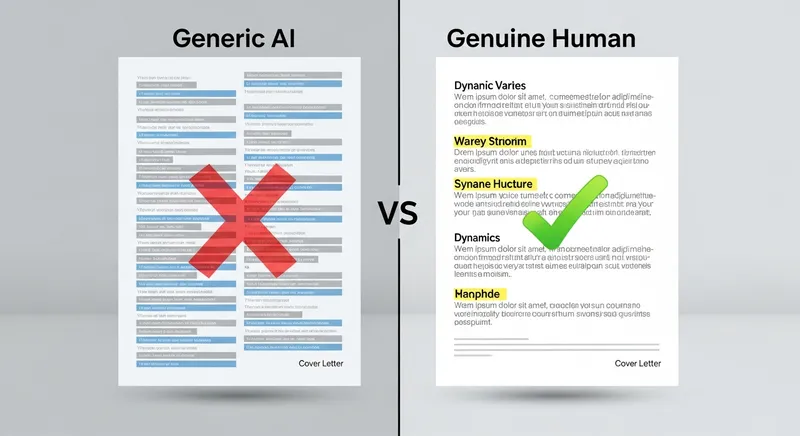
Beyond the Basics: The 'Human-in-the-Loop' Method
To avoid the pitfalls of AI, adopt a 'Human-in-the-Loop' approach. This framework ensures you remain the editor-in-chief of your career story, using AI as a capable first-draft writer. This method transforms the process from a simple generation task into a strategic collaboration between you and the technology.
Here's how to do it in three actionable steps:
-
Foundation (Your Career Database): Quality output requires quality input. Instead of hunting through old documents for every application, a modern approach uses a single source of truth. Platforms like JobSparrow use a Master Career Profile to store all your achievements, skills, and project details in one place. This becomes the rich, high-quality foundation for every document you create.
-
Generation (AI's Draft): With a strong foundation, the AI can generate a highly relevant first draft. Instead of a simple "Write me a cover letter," a smart system automatically analyzes the job description against your profile. It pulls your specific metrics and project details to create a draft that's already context-aware and tailored.
-
Humanization (Your Edit): This is the most critical step. The AI's draft is not the final product; it's the raw material. Now, you edit for tone, add personal anecdotes, and ensure every sentence serves your unique story. Career experts at the Oak Ridge Institute for Science and Education (ORISE) emphasize that a cover letter must be a unique personal story, and this is where you make that happen.
From Prompt to Personality: Advanced AI Prompting Techniques
Great AI output starts with a great prompt. To get a cover letter that is 80% of the way there, you need to be specific. Use a layered approach to build your letter section by section.
Actionable Tip: The Layered Prompting Method
Start with a comprehensive base prompt, then use follow-up prompts to refine and personalize.
Base Prompt Example: "Act as a professional career writer. Using my attached resume and the job description below, write a professional cover letter for the [Job Title] role at [Company Name].
- Tone: Enthusiastic but professional.
- Structure: An attention-grabbing intro, two body paragraphs connecting my achievements to key requirements ([Requirement 1], [Requirement 2]), and a confident conclusion.
- Content: My resume highlights my experience in [Your Key Skill 1] and [Your Key Skill 2]. The job description emphasizes their need for [Company's Need]. Weave these elements into a compelling narrative."
After the AI generates the first draft, use these follow-up prompts to inject your personality:
- To Add an Anecdote: "In the second body paragraph, replace the sentence about my project management skills with this short story: 'In my previous role at XYZ Corp, I led a project that was falling behind schedule. I implemented a new agile workflow that not only got us back on track but delivered the project 10% under budget. This experience taught me the importance of proactive problem-solving.' Re-write the paragraph to flow naturally with this new story."
- To Align with Company Values: "The company's website mentions a core value of 'sustainability.' Please review my draft and suggest a place where I can connect one of my achievements to this value."
- To Refine the Tone: "This draft sounds a bit too formal. Please rewrite it to be more conversational and confident, while still remaining professional."
The Migrant & Career Changer's AI Playbook for AU & NZ
Changing careers or moving to a new country presents unique challenges. Your cover letter is the perfect place to bridge these gaps, and AI can help you frame your story effectively.
For Career Changers
Your primary goal is to connect your past experience to your future role. As career advice site Prospects.ac.uk notes, you must explain your motivation for the change and highlight transferable skills. If you are exploring a Career Change at 40 & 50 in Australia & NZ, this is even more critical. A smart AI tool can help identify which transferable skills to emphasize for a specific role.
Career Changer Prompt Add-on:
"I am a career changer moving from [Your Old Industry] to [Your New Industry]. Add a section that briefly and positively explains my motivation for this change, focusing on my passion for [New Industry's Aspect]. Then, ensure the body paragraphs emphasize my transferable skills in [Skill 1] and [Skill 2] as they relate to the new role's requirements."
For Migrants to Australia & New Zealand
When applying for jobs in a new country, you need to build trust and demonstrate you understand the local context. Your cover letter should align with local standards, such as those provided by Australia's official Workforce Australia portal and New Zealand's Careers NZ. An AI platform built for the AU & NZ market can automatically incorporate these nuances.
Migrant-Specific Prompt Add-ons:
- Addressing Qualifications: "My qualifications are from [Your Home Country]. Please add a sentence that expresses my confidence that my skills and experience align with Australian/New Zealand standards and mention that I am in the process of getting my Skills Assessment Australia if applicable."
- Explaining Visa Status (Optional): "Please add a brief, professional sentence stating my work authorization, such as: 'I hold a valid work visa for Australia/New Zealand with full working rights.'"
- Showing Local Interest: "In the closing paragraph, add a sentence that shows my long-term commitment to living and working in [City/Country] and my enthusiasm for contributing to the local [Industry]." For more insights, review The Unwritten Rules of the AU & NZ Workplace.
How to Make Your AI Cover Letter ATS-Friendly and Recruiter-Ready
Your cover letter needs to please two audiences: the Applicant Tracking System (ATS) and the human recruiter. AI is excellent at the first part, but you are essential for the second. First, ensure your letter is ATS-friendly by instructing the AI to incorporate keywords from the job description, a critical step confirmed by government resources like Workforce Australia. A well-tailored letter can increase employer response rates by over 40%.
However, don't just stuff keywords. The real magic is in replacing generic AI phrases with compelling, human language. This is about showing, not just telling. As career advisors emphasize, you must provide evidence for your skills. Use this 'AI-to-Human' translation guide during your editing phase:
-
Instead of: "I am a highly motivated and results-oriented professional."
-
Write: "My motivation is best seen in my work, such as when I initiated a new sales strategy that increased team revenue by 15% in six months."
-
Instead of: "I possess excellent communication skills."
-
Write: "I enjoy translating complex technical data into clear, actionable insights for stakeholders, a skill I honed while presenting weekly progress reports to executive leadership."
-
Instead of: "I am confident I would be a valuable asset to your team."
-
Write: "I am excited by the prospect of bringing my experience in agile project management to your team to help you achieve your goal of launching three new products this year."
Is It Ethical to Use AI for Your Cover Letter?
This is a common concern, and the answer lies in your intent. It is unethical to use AI to misrepresent your skills or lie about your experience. However, it is entirely ethical and smart to use AI as a writing assistant to help you overcome writer's block, structure your thoughts, and articulate your genuine qualifications more effectively.
Think of it like using a spell checker, grammar tool, or asking a friend for feedback. The ideas, experiences, and stories are yours. The AI is simply helping you present them in a clear and compelling format. As long as the final product is a true reflection of who you are, you are using the tool ethically.
Generic AI vs. The JobSparrow Method
Not all AI tools are created equal. A generic chatbot gives you a generic starting point, leaving 90% of the work to you. A 'Human-in-the-Loop' platform like JobSparrow does the heavy lifting first, so you can focus on the final, humanizing touches.
| Feature | Generic AI Tool (e.g., ChatGPT) | The JobSparrow Method |
|---|---|---|
| Input Quality | Manual copy-paste of resume & job description | Pulls from a rich Master Career Profile |
| Personalization | Generates text based on prompt only | Auto-injects your specific metrics & projects |
| Humanization | You must find where to add stories | Gap Filler flags where to add personal stories |
| Time to Genuine | 1-2 hours of heavy editing | 90% personalized in under 60 seconds |
| Next Steps | Ends with a text document | Connects to Resume Tailoring & AI Mock Interviews |
JobSparrow: Your Partner in Crafting Genuine Career Stories
Navigating the line between AI efficiency and human authenticity is challenging. That's where JobSparrow comes in. Our platform is built on the 'Human-in-the-Loop' philosophy, automating the tedious parts of job applications so you can focus on what matters: telling your story.
Our Intelligent Cover Letter Generator doesn't just create generic text. It starts with your Master Career Profile, your single source of truth for every skill and achievement. It then automatically weaves your unique metrics and project details into a narrative that's already 90% personalized for the specific job, saving you hours of manual work. Our built-in Gap Filler then intelligently prompts you to add the personal anecdotes that make your story unforgettable.
This integrated approach means you go from a job description to a genuine, recruiter-ready cover letter in minutes, not hours. Once your cover letter lands you the interview, our AI Mock Interview tool helps you prepare to tell those same stories with confidence.
Ready to stop staring at a blank page and start creating cover letters that get you noticed? Tailor your first cover letter in minutes with JobSparrow and see how our AI can help you sound more like you.
Frequently Asked Questions
What are the biggest mistakes to avoid when using an AI cover letter generator?
The biggest mistake is treating the AI-generated draft as the final product. Other errors include using a generic prompt, failing to fact-check the AI's output, and leaving in common AI phrases. Actionable step: Always run a final check by reading your letter aloud. If a sentence feels awkward or not like you, rewrite it in your own words.
How do I make my AI cover letter not sound like AI?
To humanize your letter, inject personal anecdotes and specific, quantifiable achievements (e.g., "increased efficiency by 20%"). Use our 'AI-to-Human' translation guide above to replace generic claims with powerful, evidence-based statements. Actionable step: Before you start, identify the top two achievements you are most proud of and make sure their stories are included in the final draft.
Can recruiters detect AI-generated cover letters?
Yes, experienced recruiters can often spot unedited AI letters by their lack of personal insight and clichéd language. A heavily personalized letter, however, is indistinguishable from one written from scratch because it contains your unique voice. Actionable step: Use a tool like JobSparrow's Gap Filler, which actively prompts you to add the personal details that prevent your letter from sounding generic.
Is it unethical to use AI for my cover letter?
No, it is not unethical to use AI as a writing assistant, just as you would use a grammar checker. The ethics depend on your honesty. As long as you are accurately representing your own skills and experiences, you are using the tool ethically to present your best self. Actionable step: Treat the AI as your co-pilot. You set the destination (your authentic story), and the AI helps you get there more efficiently.
Should I mention my visa status in a cover letter in Australia or NZ?
If you have full, unrestricted working rights, it is beneficial to state it clearly. A simple sentence like, "I hold full working rights in Australia," removes any ambiguity for the employer. Actionable step: Add this sentence to the final paragraph of your cover letter, just before your closing statement, for any roles where your residency status might be a question.
What's the best ChatGPT prompt for a career change cover letter?
The best prompt is highly detailed, including your old and new industries, the job description, and your resume. Instruct the AI to "act as a career strategist" and build a narrative that focuses on transferable skills. Actionable step: For a more streamlined process, use a dedicated platform where your profile information is already stored, allowing the AI to automatically highlight transferable skills relevant to the new role.
Tags
Keep reading
Recommended articles.
ai tools · job search
AI Resume & Cover Letter Generator for AU & NZ (2026)
Create a perfectly matched, ATS-optimized resume & cover letter for AU & NZ jobs. Our AI ensures consistency to help you land interviews. Pay only when you get an offer.
cover letter · internal promotion
How to Write a Cover Letter for an Internal Promotion: 2026 AU/NZ Guide + Examples
Write a cover letter for an internal promotion that gets you hired in AU/NZ. Our 2026 guide has insider tips, examples, and strategies to land your next role.
cover letter · internal application
Internal Cover Letter Guide: Examples & Templates for AU/NZ
Land your next internal role in AU/NZ. Our guide provides expert tips, templates for promotion or career change, and examples to write a compelling cover letter.