
skills assessment australia
Skills Assessment Australia (2026): Your Guide to VETASSESS, TRA & ACS
By Job Sparrow Team
Skills Assessment Australia (2026): Your Guide to VETASSESS, TRA & ACS
For skilled professionals dreaming of a life in Australia, the path often begins with a significant, and frankly, intimidating hurdle: the skills assessment. You've likely spent hours searching, only to find a confusing maze of acronyms, conflicting advice, and the lingering fear that one mistake could cost you thousands of dollars and months of waiting, only to receive a negative outcome. Your entire migration plan hangs in the balance.
We understand the anxiety. A positive skills assessment is the non-negotiable first step for your Australian dream. The process is complex, the costs are high, and the information is scattered across dozens of official websites and forums. But you've got this - with the right preparation, a positive outcome is well within reach.
This comprehensive guide is here to change that. We will demystify the entire process for 2026, focusing on the three main assessing bodies: VETASSESS, Trades Recognition Australia (TRA), and the Australian Computer Society (ACS). We'll break down the timelines, costs, and exact documents you need, giving you the clarity and confidence to move forward. We will also show you how to tackle the most challenging part, preparing your work experience evidence, with powerful tools like JobSparrow.
What is a Skills Assessment and Why Do You Need One for Australian Migration?
A skills assessment is a formal evaluation to confirm that your qualifications and work experience are equivalent to Australian standards for a specific occupation. It's the Australian government's way of ensuring that skilled migrants have the expertise the country needs.
For most skilled migration visas, including the popular Subclass 189 (Skilled Independent), Subclass 190 (Skilled Nominated), and Subclass 491 (Skilled Work Regional), a positive skills assessment is a mandatory prerequisite. According to the Department of Home Affairs, you must have your skills assessed by the relevant authority before you can even submit an Expression of Interest (EOI).
Your journey starts with the Skilled Occupation List (SOL). This list determines which occupations are in demand and, crucially, dictates which assessing authority you must apply to.
Actionable Tip: Before you do anything else, find your profession on the official Skilled Occupation List. This will tell you which assessing body is responsible for your occupation and is the first concrete step in your migration journey.
The Big Three: VETASSESS vs. TRA vs. ACS - Which One is for You?
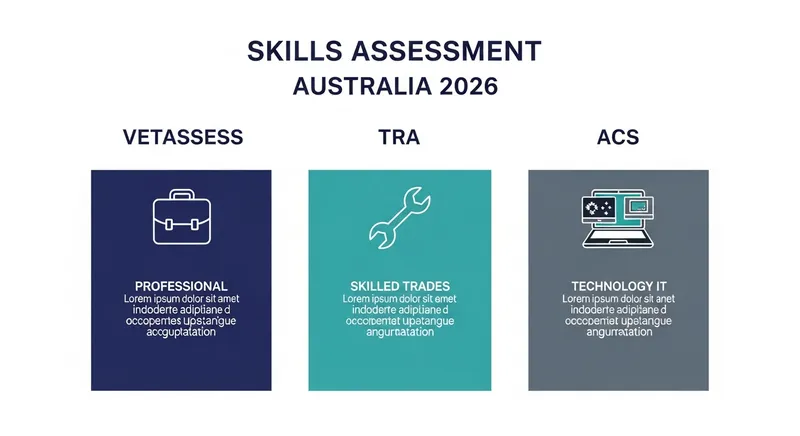
Once you've identified your occupation on the SOL, you'll be directed to one of dozens of assessing bodies. However, the vast majority of applicants will deal with one of three main authorities:
- VETASSESS: Assesses a wide range of general professional and some trade occupations.
- Trades Recognition Australia (TRA): The designated authority for most trade occupations.
- Australian Computer Society (ACS): The sole assessing body for all Information and Communications Technology (ICT) professions.
Here is a quick comparison to help you understand the key differences:
| Feature | VETASSESS | Trades Recognition Australia (TRA) | Australian Computer Society (ACS) |
|---|---|---|---|
| Primary Occupations | Marketing Specialist, University Lecturer, Internal Auditor, Construction Manager | Chef, Motor Mechanic, Electrician, Carpenter | Software Engineer, Business Analyst, Cyber Security Analyst, Network Engineer |
| Typical Cost (AUD) | ~$1,050 - $1,800+ (depending on priority processing) | ~$1,000 - $3,000+ (Job Ready Program is a multi-stage process) | ~$500 - $600 |
| 2026 Est. Processing Time | 7-10 weeks (standard) | Up to 12 months (for the full Job Ready Program) | 6-8 weeks |
| Key Challenge | Proving the depth and relevance of your employment duties. | Completing the mandatory in-country workplace assessment (JRP). | Meeting the strict 'Skill Level Requirement Met Date' criteria. |
Actionable Tip: Visit the official occupation lists for each body to confirm your path: VETASSESS Occupations, TRA Occupations, and ACS Occupations.
Navigating VETASSESS: Your 2026 Guide
VETASSESS is the assessing authority for the largest group of professional occupations, from scientists and marketers to various managers. An assessment from VETASSESS typically involves evaluating both your formal qualifications and your employment history.
Key Requirements:
- Qualification Assessment: VETASSESS will compare your degree or diploma against the Australian Qualifications Framework (AQF) to determine its equivalency. You'll need certified copies of your certificates and full academic transcripts.
- Employment Assessment: You must provide evidence of skilled employment that is highly relevant to your nominated occupation. This is often the most challenging part, requiring you to meticulously detail your duties for each role.
For 2026, VETASSESS has updated its service standards. Standard processing for a full skills assessment is targeted at around 7 weeks, with priority processing options available for a significantly faster turnaround (around 10 business days) at an additional cost.
The cost of a standard VETASSESS skills assessment in 2026 is approximately $1,058 AUD, with priority processing adding around $660 AUD to the fee. To ensure your employment evidence is perfectly aligned, you can use JobSparrow to build a detailed history of your roles and responsibilities, making your application stronger from the start.
Mastering Trades Recognition Australia (TRA) in 2026
If you are a skilled tradesperson, your pathway will almost certainly be through Trades Recognition Australia (TRA). TRA is a branch of the Australian government and handles assessments for occupations like chefs, mechanics, electricians, and carpenters.
For many applicants, the primary pathway is the TRA Job Ready Program (JRP). This is an employment-based program that takes place over at least 12 months and consists of four main steps:
- Provisional Skills Assessment (PSA): An initial assessment of your Australian qualification and limited work experience.
- Job Ready Employment (JRE): You must complete and meticulously document at least 1,725 hours of paid employment over a minimum of 12 months in an approved Australian workplace.
- Job Ready Workplace Assessment (JRWA): An assessor visits your workplace to observe you performing your duties.
- Job Ready Final Assessment (JRFA): Upon successful completion of all steps, you receive a positive skills assessment outcome.
Document requirements are intensive. Accurately logging 1,725 hours of specific tasks can be daunting, but building a Master Career Profile in JobSparrow can help you keep a running, detailed record. Preparing for the JRWA is also crucial, and practicing with an AI interview preparation tool can help you articulate your skills confidently to the assessor.
Cracking the ACS Skill Assessment for Tech Professionals (2026)
For anyone in the ICT sector, from Software Engineers to Cyber Security Analysts, the Australian Computer Society (ACS) is your designated authority. The ACS assessment process is unique and has a critical concept you must understand: the 'Skill Level Requirement Met Date'.
The ACS will first determine when you became 'skilled' in their eyes. They do this by looking at your qualifications and work experience, and then they will deduct a certain number of years (from 2 to 8, depending on your specific circumstances) from your employment history. Only work experience after this date is considered 'skilled employment' for migration points.
This makes the detail in your employment references absolutely critical. You must ensure your descriptions are comprehensive enough to pass this strict evaluation.
Documents required for an ACS skill assessment include:
- Certified copies of your qualifications and transcripts.
- Highly detailed employment reference letters that specify your exact roles and responsibilities.
- Evidence of paid employment, such as payslips.
Pro Tip: JobSparrow's Gap Filler tool is perfect for this. It asks targeted questions about your roles to ensure you haven't missed critical details, technologies, or responsibilities that the ACS looks for, helping you create bulletproof descriptions that satisfy their requirements.
The Most Critical Step: Preparing Your Work Experience Evidence
Across all three assessing bodies, one requirement stands out as the most common point of failure: providing detailed, verifiable evidence of your work experience. A generic resume or a simple letter stating your job title is not enough. You must prove that the duties you performed align closely with the official tasks outlined for your nominated occupation by the Australian Bureau of Statistics (ABS).
If you are unable to get a reference letter from a previous employer, you may be able to provide a Statutory Declaration (a legally binding statement). However, the gold standard is always an official letter from your employer.
A perfect employment reference letter must include:
- Being on official company letterhead.
- Your exact start and end dates of employment.
- Your official job title(s).
- A detailed description of at least 5-7 specific duties you performed.
- Whether you were full-time or part-time and the hours worked per week.
- The signature of a direct supervisor or HR manager, with their contact details included.
How JobSparrow Turns Hours of Work into Minutes
This is where the anxiety often peaks. How do you remember every task from a job five years ago? How do you phrase it professionally to match official standards?
JobSparrow's AI-powered platform solves this exact problem. What normally takes 8-10 hours of writing and rewriting can be done in under 30 minutes. Our AI analyzes official ANZSCO task lists for your occupation and helps you enhance your job descriptions, ensuring they are detailed, professional, and aligned with what assessors expect to see.
Actionable Tip: Use JobSparrow to build your Master Career Profile. Once you've detailed your career history, you can copy the AI-enhanced descriptions for each role and use that content as the foundation for your employment reference letters. Simply paste it into a document and send it to your former manager to place on company letterhead and sign. This transforms a difficult writing task into a simple copy-and-paste job, ensuring you never miss a critical detail.
Frequently Asked Questions
How long is a skills assessment valid for in Australia?
The validity period varies. As a general rule, most assessments are valid for two to three years. For example, a positive outcome from VETASSESS is typically valid for three years, while an assessment from the Australian Computer Society (ACS) is valid for 24 months. Always check the specific validity period on your official outcome letter.
Can I do a skills assessment without work experience?
This depends on your occupation. For some VETASSESS occupations, a qualifications-only assessment is possible but generally not sufficient for a skilled visa application, as you cannot claim points for employment. For trade occupations under TRA and ICT roles under ACS, relevant work experience is almost always mandatory.
What happens if my skills assessment is negative?
A negative assessment is a setback, but not always the end. Most bodies offer a review or appeal process, though this costs more time and money. The alternative is to address the feedback-by gaining more experience or qualifications-and then re-apply. This underscores the importance of submitting a comprehensive, decision-ready application the first time to maximize your chances of success.
Do I need a migration agent for a skills assessment?
No, you are not required to use a migration agent. You can lodge your application directly. While an agent may help in complex cases, they are a significant financial cost. Resources like this guide and tools such as JobSparrow are designed to empower you to prepare a high-quality application on your own, saving you thousands of dollars.
How much does a skills assessment cost in 2026?
The cost varies widely, from approximately $500 to over $3,000 AUD. The final price depends on the assessing body and services required. For example, a standard ACS assessment is one of the least expensive, while the multi-stage TRA Job Ready Program is one of the most expensive. You can review our Pricing to see how affordable it is to get the document preparation help you need.
Can I use my skills assessment for any skilled visa?
Yes. Your positive skills assessment is tied to a specific occupation, but you can use that single assessment to apply for any skilled migration visa that lists your occupation as eligible. This includes the Skilled Independent visa (subclass 189), State Nominated visas (subclass 190 and 491), and many employer-sponsored visa streams. It is an essential key to unlocking multiple visa pathways.
Your Next Step to Australia
The skills assessment is the biggest administrative hurdle in your migration journey, but it is a hurdle you can clear with confidence. By understanding the requirements and preparing your evidence meticulously, you can put yourself in the strongest possible position for a positive outcome.
Don't let paperwork stand between you and your dream. Build a rock-solid foundation for your application and prove your skills beyond a doubt.
Start building your career profile today and simplify your skills assessment!
Tags
Keep reading
Recommended articles.
acs skills assessment · anzsco codes
ACS Skills Assessment Resume Guide: Prove ANZSCO Alignment & Avoid Rejection (2026)
Master the 2026 ACS CV format. Map ANZSCO codes, avoid rejection, and secure your migration points. Start free at JobSparrow.
accountant resume · australian migration
How to Write an Accountant Resume for Australian Migration (Aligned with CPA Standards)
Write an accountant resume aligned with CPA Australia and ANZSCO 221111. Secure migration points and land top Australian jobs. Start free today.
ai cv review · ats optimization
Free AI CV Review: How to Instantly Optimize Your Resume for ATS (2026)
Stop getting ghosted. Use JobSparrow's free AI CV review to identify keyword gaps and fix formatting issues for instant ATS resume optimization.