
cover letter
How to Write a Cover Letter for an Internal Promotion: 2026 AU/NZ Guide + Examples
By Job Sparrow Team

Applying for an internal role feels different, doesn't it? It's a strange mix of excitement and anxiety. You're not an outsider, but you're not a shoo-in either. The hiring manager might be your colleague from the next pod, or even your current boss. How do you formally express your value to people who see you every day? How do you leverage your insider knowledge without sounding entitled, and navigate these tricky relationships with professionalism?
This is the core challenge that most guides miss. They give you generic templates but fail to address the delicate balance of familiarity and formality unique to internal applications. This comprehensive 2026 guide is specifically designed for job seekers, career changers, and migrants in Australia and New Zealand. We'll provide the strategic playbook you need to not only write a compelling cover letter but also to navigate the entire internal application process with confidence.
Quick Win: Before you start writing, spend 15 minutes reviewing the internal job posting. List three projects you've worked on that directly relate to the new role's requirements. This becomes the backbone of your letter.
Forget blank page anxiety. While this guide gives you the strategy, JobSparrow's Intelligent Cover Letter Generator can create a personalized first draft in seconds, letting you focus on what matters most: proving you're the best person for the job.
Why a Cover Letter for an Internal Role is Non-Negotiable
It can be tempting to think a quick email or a chat in the hallway is enough, especially if you have a good relationship with the hiring manager. However, skipping a formal cover letter is a missed opportunity and a potential career misstep. It formalizes your intent and allows you to control the narrative.
Here's why it's essential:
| Action | Without a Formal Cover Letter | With a Formal Cover Letter |
|---|---|---|
| Perception | May seem casual or not serious about the role. | Demonstrates professionalism and respect for the process. |
| HR Process | Creates an inconsistency in application records. | Provides an official document for fair and compliant hiring. |
| Narrative | Lets others define you by your current role. | Allows you to re-frame your skills for the new role. |
| The Pitch | Assumes the hiring manager will connect the dots. | Directly connects your achievements to the new role's needs. |
As recruitment experts advise, your approach to an internal promotion should be 'always-on', and that includes formal application documents.
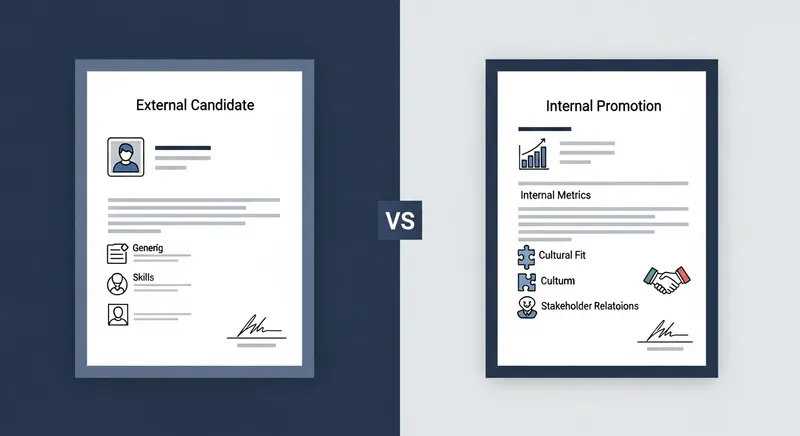
The AU/NZ Insider's Edge: What Makes an Internal Application Different Down Under
While the principles of a good cover letter are universal, applying within an Australian or New Zealand company has its own set of unwritten rules and expectations. Understanding these nuances gives you a significant advantage.
Understanding Local Terminology
In New Zealand, you will frequently encounter the term Expression of Interest (EOI). An EOI can be used for an advertised job or to show interest in working for an organisation that hasn't advertised a specific role. For internal candidates, this is a powerful tool. An EOI cover letter allows you to proactively signal your ambition, even for roles on the hidden job market.
Demonstrating Cultural Fit
You have a massive head start here. You already understand the company's values, communication style, and the general workplace culture (the 'vibe'). Your cover letter should reflect this. Instead of saying "I am a great team player," you can say, "My experience collaborating with the sales and product teams on the 'Project Kookaburra' launch demonstrates my ability to work cross-functionally and deliver results, which I know is key to this department's success."
Leveraging Relationships Without Being Presumptuous
The AU/NZ workplace often has a friendly, relatively flat structure. You might call your CEO by their first name. However, your cover letter must strike a professional tone. Acknowledge relationships, but focus the letter on your professional qualifications for the role itself. This is about managing perceptions, a key challenge in internal moves.
The Politics & Professionalism Playbook: Navigating Internal Dynamics
This is the part no one talks about, but it's often the most stressful. Here's how to handle the social complexities with grace.
Should I Tell My Current Boss?
This is the million-dollar question. The answer depends on your relationship and your workplace culture.
- If you have a supportive manager and regular career discussions: Absolutely. A good manager wants to see you grow, even if it means leaving their team. As career experts note, "If no one knows, then no one can help you." Frame it as seeking their advice and support.
- If your relationship is strained or you fear a negative reaction: You may want to wait until you are further along in the process (e.g., have secured an interview). However, be aware that the hiring manager will likely speak to your current manager as part of their due diligence. It's almost always better if your manager hears it from you first.
Actionable Tip: Schedule a private meeting. Start by expressing gratitude for your current role and what you've learned. Then, explain why the new role aligns with your long-term career goals. Ask for their perspective and support.
Addressing the Letter: Salutations for Colleagues and Managers
Keep it simple and professional. Even if you call them 'Jono' in the breakroom, use their professional name in the letter.
- Safe Bet:
Dear [First Name Last Name](e.g.,Dear John Smith) - Slightly More Formal:
Dear Mr./Ms. [Last Name](e.g.,Dear Ms. Jones) - If you know them well and the company culture is very informal:
Dear [First Name](e.g.,Dear Sarah) is often acceptable, but the full name is safer.
When in doubt, err on the side of formality. It shows respect for the process.
Is This Role the Right Fit? Unsure if you meet the requirements for that next level? Use JobSparrow's Match Score to see how your current skills align with the internal job description before you apply.
How to Structure Your Internal Cover Letter: A Step-by-Step Guide
Your internal cover letter should follow a professional format, but the content will be supercharged with your insider knowledge.
Step 1: The Header
Include your full name, phone number, email, and a link to your LinkedIn profile. Then, add the date and the recipient's details: their full name, title, and department.
Step 2: The Opening - Hook Them Immediately
Don't waste time with generic openings. Get straight to the point and establish your shared context.
Instead of: "I am writing to express my interest in the Senior Marketing Manager position I saw advertised on the company intranet."
Try: "Having successfully managed the 'Go-West' campaign for the past two years within the Sydney marketing team, I am writing to formally express my enthusiastic interest in the Senior Marketing Manager role. My deep understanding of our brand voice and customer acquisition channels positions me to deliver immediate value in this leadership capacity."
This opening immediately frames your experience in a relevant, internal context.
Step 3: The Body Paragraphs - Your Insider's Thesis
This is where you connect your specific, quantifiable achievements to the specific needs of the new role. Use 2-3 paragraphs.
- Paragraph 1: Prove Your Value with Insider Metrics. Use your knowledge of internal projects, data, and goals. Including specific details and measurable outcomes is crucial.
- Paragraph 2: Show You Understand the New Role's Challenges. Demonstrate that you've thought about the role beyond the job description. Mention upcoming projects or departmental goals you're aware of. For example, "I understand the department is focused on expanding into the WA market in H2 2026, and my experience with the 'Go-West' campaign has given me direct insight into the specific customer profile and regulatory hurdles we will face."
- Paragraph 3: Align with Future Goals. Connect your aspirations to the company's trajectory. This is especially important for leadership roles, like those covered in our Executive Resume Guide.
Step 4: The Closing - Reiterate, Re-engage, and Look Forward
End with a confident and professional closing. Reiterate your excitement and suggest the next step.
Example: "Thank you for considering my application. I am passionate about continuing to grow my career with [Company Name] and am confident I have the skills, experience, and insider knowledge to excel as Senior Marketing Manager. I look forward to discussing how I can contribute to the team's success in an interview."
Finish with a professional sign-off, such as Sincerely, or Kind regards, followed by your typed name.
Scenario-Specific Strategies & Examples (AU/NZ Focused)
Generic templates don't work. Here's how to adapt your approach for different internal moves.
Example 1: The Classic Promotion (Cover Letter for Promotion to Manager)
Focus: Demonstrating leadership potential and strategic thinking.
Key Phrase: "In my current role, I took the initiative to mentor junior staff, which improved our team's bug-fix resolution time by 15%. This experience has prepared me to take on the formal leadership responsibilities of the Manager role."
Example 2: The Lateral Move or Career Change Within the Company
Focus: Highlighting transferable skills and your motivation for the change.
Key Phrase: "While my experience in the Finance department has been invaluable for developing my analytical skills, my passion for direct customer impact has led me to pursue the Customer Success Manager role. My ability to deconstruct complex problems, honed during three years of financial reporting, aligns directly with the core responsibilities of this position." This shows you have the future-proof skills the company needs.
Example 3: The Internal Secondment
Focus: Emphasizing flexibility, a desire to learn, and a commitment to bringing new skills back to your home team.
Key Phrase: "I am eager to apply for the six-month secondment in the Product team to gain hands-on experience in the agile development cycle. I am confident that this experience will not only allow me to contribute to the 'Project Alpha' launch but also bring valuable product-side insights back to the Marketing team."
Example 4: The Expression of Interest (EOI) for an Unadvertised Role
Focus: Proactivity, ambition, and aligning your skills with the company's known direction.
Key Phrase: "Following the recent all-hands where expanding our data analytics capabilities was highlighted as a key priority for 2027, I am writing to express my interest in any upcoming roles within this area. Having recently completed a professional certification in SQL and Power BI, I am eager to apply these skills to help drive data-led decision-making at [Company Name]."
Quantifying Your Achievements: The Insider's Advantage
Anyone can list their duties. As an internal candidate, you have access to the most powerful tool for persuasion: specific, quantifiable results. This is about showcasing your 'task-specific human capital', a concept that refers to the unique skills you build doing a specific job.
Here's how to transform a vague statement into a powerful, metric-driven achievement.
-
Before:
"Helped improve team efficiency." -
After:
"Initiated and led the adoption of Asana for project tracking, which reduced time spent in status update meetings by 3 hours per week and decreased missed deadlines by 25% in Q1 2026." -
Before:
"Worked on a major company project." -
After:
"As a key member of the 'Project Endeavour' migration team, I was responsible for testing and validating 500+ client accounts, identifying 15 critical bugs pre-launch and ensuring a 99.8% successful data transfer rate."
Actionable Tip: It can be hard to recall these specifics on the spot. Use JobSparrow's Gap Filler feature. It's designed to help internal candidates by asking targeted questions about your projects, helping you uncover the metrics and results that aren't in your original job description. You can then store these in your Master Career Profile for any future application.
Mistakes to Avoid When Applying Internally
- Being Too Casual: This is the most common trap. In flat Australian workplaces where everyone uses first names, candidates often write overly casual applications. Avoid starting with 'Hey Sarah' or using slang. Always maintain a professional tone to show you respect the process.
- Assuming They Know Your Value: Don't just list project names. Explain your role in the project and the impact you had. Spell it out clearly.
- Not Tailoring to the Job Description: Read the internal job posting as carefully as you would an external one. Your letter and resume must speak directly to its requirements and keywords, ensuring you get past any internal ATS screening.
- Gossiping or Being Negative: Never speak ill of your current role, team, or manager. Focus on the positive pull of the new opportunity, not the push from your current situation.
Automate the Basics, Focus on Strategy with JobSparrow
Writing an internal cover letter requires more strategy and political savvy than writing an external one. Your energy shouldn't be wasted on formatting and phrasing. It should be focused on articulating your unique insider value.
This is where an AI-powered platform gives you a competitive edge. JobSparrow acts as your personal career assistant:
- Store Everything: Use your Master Career Profile as a central database for every achievement, project, and metric from your career.
- Generate a First Draft Instantly: Select the role and our Intelligent Cover Letter Generator will create a high-quality, personalized draft that weaves your specific experiences into a compelling narrative.
- Focus Your Energy: With the first 80% of the work done, you can concentrate on adding the insider knowledge, strategic insights, and political nuance that will make your application truly stand out.
Ready to make your next move? Tailor your first internal application in 60 seconds and start your free trial.
Frequently Asked Questions
How do I write an EOI for an internal position in NZ?
An Expression of Interest (EOI) for an internal role in New Zealand is your proactive tool for career advancement. Structure it like a formal cover letter, but focus on aligning your ambitions with the company's known strategic goals. Start by stating which department or type of role you're interested in. Then, connect your proven skills and achievements - quantified with internal metrics - to that area's objectives. For example, mention a specific company priority from a recent town hall meeting and explain how your skills can help achieve it. This shows you are not just looking for a new job, but are invested in the company's future.
Is a cover letter for an internal position different from a normal one?
Yes, fundamentally. While the format is the same, the content strategy is different. An external cover letter's main job is to introduce you and prove you're a potential fit. An internal cover letter's job is to reframe how the company already sees you. It leverages your insider knowledge of culture, challenges, and goals to prove you can deliver value from day one. You're not just a 'cultural fit' - you're part of the existing culture. Your goal is to move from being seen as 'Jane from Accounts' to 'Jane, the strategic future leader for the Finance Manager role'.
How do I show leadership potential in a cover letter for a promotion?
To show leadership potential for a promotion in Australia or New Zealand, you must provide concrete examples of you acting like a leader, even without the title. Dedicate a paragraph to this. Did you mentor a new team member? Did you volunteer to lead a challenging project? Did you identify a flaw in a process and propose a solution that was adopted? Describe the situation, the action you took, and the positive result for the team or company. This demonstrates a proactive, problem-solving mindset - the core of leadership.
What's the best way to address a cover letter to a colleague or someone I know?
Always err on the side of professional formality. Even if you're on a first-name basis, using their full name and title in the salutation (Dear Jane Smith, Hiring Manager) shows you respect the formal HR process. This professionalism protects both you and them. It subtly shifts the context from a casual chat between colleagues to a formal application, which is exactly what the situation requires. Avoid overly casual greetings like 'Hi Jane' or 'Hey team'.
Should I tell my current boss I am applying for another internal role?
In most healthy work cultures in Australia and New Zealand, the answer is yes. It's a professional courtesy that prevents them from being blindsided when the hiring manager inevitably contacts them. A supportive boss can become your greatest advocate. Schedule a private meeting and frame the conversation around your long-term career growth. Express gratitude for your current role and explain why this new opportunity is the logical next step for you. If you have a difficult relationship with your boss, the decision is harder, but know that they will likely find out regardless.
How do I express interest in an internal job that hasn't been advertised?
This is a classic 'hidden job market' scenario and requires a proactive Expression of Interest (EOI). Identify a department or area where you want to contribute. Research its current challenges and future goals. Then, write a letter to the department head. State your purpose clearly: you are writing to express your keen interest in contributing to their team's goals. Highlight 2-3 key skills you have that align with their needs and propose a brief chat to discuss how you might be able to add value. This positions you as a strategic thinker, not just a job seeker.
Tags
Keep reading
Recommended articles.
cover letter · internal promotion
The Ultimate Guide to Internal Promotion Cover Letters in AU & NZ (2026)
Navigate internal politics, avoid tall poppy syndrome, and write a promotion cover letter that earns respect in AU & NZ workplaces. Step-by-step guide + template.
cover letter · internal application
Internal Cover Letter Guide: Examples & Templates for AU/NZ
Land your next internal role in AU/NZ. Our guide provides expert tips, templates for promotion or career change, and examples to write a compelling cover letter.
ai · cover letter
How to Use an AI Cover Letter Generator Without Sounding Like a Robot (AU/NZ Guide)
Tired of sounding like a robot? Learn how to use an AI cover letter generator to create human-sounding applications that land interviews in Australia & NZ.