
career advice
Australia's Future Job Market: The Top 10 Skills You'll Need by 2027
By Job Sparrow Team

Does automation make you wonder if your decade of experience will become irrelevant overnight? Does the thought of a rapidly changing economy give you a sense of uncertainty about your career? That 3am anxiety about whether you should retrain-or if it's already too late-is exhausting. You're not alone, and you're not overreacting.
This guide is your antidote to that anxiety. We're moving beyond speculation to give you a data-driven, actionable roadmap for Australia's future job market. Based on official government reports and expert industry analysis, we'll pinpoint the exact skills that will be in high demand by 2027. Knowing what employers need is the first step. The next is showing them you have it.
Ready to stand out? Tailor your resume and cover letter for AU/NZ in minutes with JobSparrow.
The Big Picture: What's Shaping Australia's Job Market Towards 2027?
To understand the skills of the future, we first need to understand the forces driving the change. Australia's economy isn't just growing; it's transforming. The Australian Government's 2023 'Working Future' White Paper sets a clear national strategy focused on boosting productivity and building a skilled workforce for the challenges ahead.
This strategy is a response to several powerful megatrends. Australia's national science agency, CSIRO, identifies major shifts like the unstoppable move to a digital and data-driven world, the urgent need to adapt to climate change, and a growing services economy. While these forces will change some jobs, they are creating incredible new opportunities and a projected growth of nearly a million jobs over the next decade, according to Jobs and Skills Australia's 2024 projections.
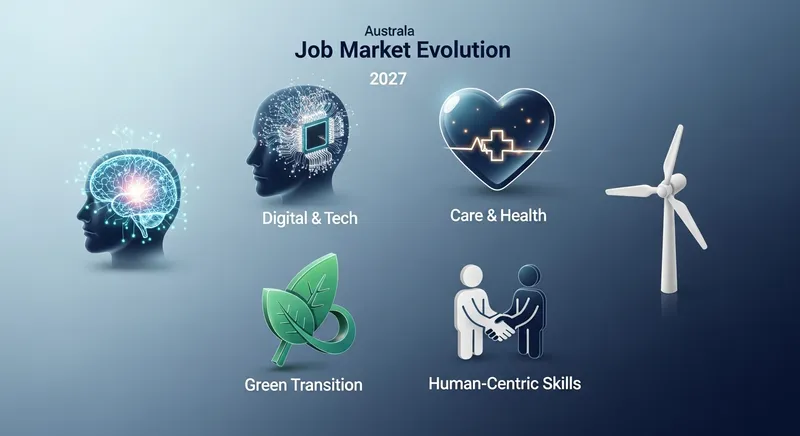
The Top In-Demand Skills for 2027: A Sector-by-Sector Breakdown
Instead of just a random list, we've grouped the top 10 skills into the four critical growth sectors where the most future-proof jobs will be found.
Growth Sector 1: The Digital & Tech Economy
The tech sector is booming, with a shared government and industry goal to have 1.2 million tech workers in Australia by 2030. The demand for digital skills extends far beyond pure tech companies into every industry.
-
Skill 1: Artificial Intelligence & Machine Learning: Generative AI has the potential to add up to $115 billion to Australia's economy annually. This skill isn't just for developers; it's for marketers, business analysts, and managers who can leverage AI tools.
- Actionable Tip: Start by exploring free introductory AI courses on platforms like Coursera or edX. For a more structured approach, look into short courses like those offered by universities such as RMIT to gain practical, industry-relevant knowledge.
-
Skill 2: Cybersecurity: As business operations move online, protecting data is no longer an IT problem-it's a core business risk. This has created a massive, ongoing shortage of cybersecurity professionals.
- Actionable Tip: Consider foundational certifications like CompTIA Security+ to build a strong knowledge base that is recognised by employers.
-
Skill 3: Data Analytics & Literacy: The ability to interpret data and make informed decisions is now a vital skill in marketing, finance, logistics, and HR. You don't need to be a data scientist to be data-literate.
- Actionable Tip: Get hands-on experience with in-demand tools. Microsoft Power BI and Tableau both offer free versions you can download and use to practice with public datasets.
Once you've built these skills, you need to prove them. That's why it's important to use tools like JobSparrow's AI Mock Interviews to practice articulating your new expertise with confidence.
Growth Sector 2: The Care & Health Economy
According to the Australian Government's Your Career website, Health Care and Social Assistance is Australia's largest industry and is projected to have the strongest job growth. These are deeply human-centric roles that technology can assist but not replace.
-
Skill 4: Aged & Disability Support: With an ageing population, the demand for compassionate and qualified carers is surging. The National Disability Insurance Scheme (NDIS) has also significantly increased the need for skilled support workers.
- Actionable Tip: Look into a Certificate III or IV in Individual Support (Ageing or Disability). These are often supported by government funding programs, so check your state's TAFE or skills gateway.
-
Skill 5: Nursing & Allied Health: Registered Nurses are consistently on Australia's skills shortage lists. The demand extends to related fields like physiotherapy, occupational therapy, and mental health support.
- Actionable Tip: If you're a career changer with a previous bachelor's degree, you may be eligible for a two-year, graduate-entry Master of Nursing Science degree, providing an accelerated pathway into the profession.
Growth Sector 3: The Green Transition & Renewable Energy
Massive government and private investment in decarbonisation is creating a new wave of jobs. The transition to a green economy requires both new expertise and the adaptation of existing skills.
-
Skill 6: Renewable Energy Project Management: The development of solar farms, wind farms, and battery storage projects requires skilled professionals who can manage complex timelines, budgets, and stakeholders.
- Actionable Tip: If you already have project management experience, you can pivot into this sector by taking short courses focused on renewable energy fundamentals and policy.
-
Skill 7: Construction & Trades for Green Infrastructure: Traditional trades are critical to the green transition. Electricians are needed for EV charger installations, plumbers for heat pump systems, and builders for constructing energy-efficient homes.
- Actionable Tip: If you're a qualified tradesperson, seek out 'green skills' micro-credentials or certifications to specialise in sustainable technologies and practices.
Growth Sector 4: The Essential Human-Centric Skills
As technology handles more routine tasks, uniquely human skills become more valuable. A report from Deloitte Access Economics predicts that by 2030, two-thirds of all jobs will rely on soft skills. These are the abilities that set you apart.
-
Skill 8: Creativity & Critical Thinking: AI can generate content, but it can't devise a novel business strategy or solve a unique client problem. This is where human innovation shines.
- Actionable Tip: Document a problem you solved uniquely in your current role. Use the STAR method (Situation, Task, Action, Result) to craft this into a compelling achievement statement for your resume, providing tangible evidence of your creative thinking.
-
Skill 9: Communication & Emotional Intelligence: In a world of hybrid teams and digital communication, the ability to collaborate, lead with empathy, and build strong relationships is more important than ever.
- Actionable Tip: Volunteer to lead a small team project or mentor a junior colleague. This provides a low-stakes environment to practice your leadership and communication skills, which you can then add to your resume as a specific accomplishment.
-
Skill 10: Change Management & Adaptability: The most durable skill is the ability to learn and adapt. Employers want people who can embrace new tools and pivot to new challenges.
- Actionable Tip: Don't just list these skills. Showcase them with specific examples. Use the best AI cover letter generator to craft a narrative that explains how you adapted to a major change at work, learned a new system, or helped your team navigate a transition.
A Practical Roadmap for Career Changers and Upskillers
Knowing the skills is one thing; acquiring them is another. If you're looking to change careers, follow this simple, three-step process.
- Audit Your Transferable Skills: Before you rush to enrol in a new degree, map your existing experience to the top 10 list. Your retail management experience is a foundation for data analysis; your teaching background has honed your communication skills. JobSparrow's AI can help automate this audit, analyzing your profile to surface hidden skills you may have overlooked.
- Identify Your Skill Gap: Once you've audited your skills, you can clearly see what's missing. Is it a technical tool (like Power BI)? A specific certification (like Security+)? Or industry knowledge (like renewable energy policy)?
- Build Your Upskilling Plan: Create a targeted plan to bridge that gap. This could be a TAFE certificate, a university short course, or even a series of online courses. The government's focus on filling skills needs means there are often subsidies available, so check your local state's skills programs.
For a complete walkthrough, check out our dedicated guide on how to write a career change resume in 2026.
For Migrants: Aligning Your Skills with Australia's Needs
For those looking to migrate to Australia, understanding these in-demand skills is crucial. The Australian Government maintains a Skilled Occupation List (SOL) which outlines the professions Australia has identified as being in demand and eligible for skilled migration visas.
Many of the skills and roles discussed here-especially in tech, healthcare, and engineering trades-feature prominently on this list. This provides a clear signal of which qualifications offer the strongest prospects for a successful migration journey.
Actionable Tip: Always check the official Department of Home Affairs website for the most current version of the SOL. JobSparrow's resume tailoring ensures your CV uses the exact occupation titles and skill keywords from the SOL, making your qualifications immediately recognizable to both ATS systems and migration assessors.
From Skills to Interviews: How to Showcase Your Value with JobSparrow
Acquiring new skills is a huge achievement, but it's worthless if employers don't see it. Today, most large companies use Applicant Tracking Systems (ATS) to scan resumes for keywords before a human ever reads them. This is where you connect your new skills to real job opportunities.
-
Action 1: Tailor Your Resume for Every Application: Your resume must speak the language of the job description. JobSparrow's AI instantly analyzes a job ad, identifies the key skills, and helps you tailor your resume to match, giving you an ATS Match Score so you know exactly where you stand. Learn more about ATS resume optimisation in AU & NZ.
-
Action 2: Write a Compelling Cover Letter: Use your cover letter to tell the story behind your skills. Explain why you decided to upskill into cybersecurity or how your project management background is perfect for the renewable energy sector.
-
Action 3: Build Interview Confidence: Once your new resume gets you in the door, you need to be ready. JobSparrow's AI Mock Interviews create practice sessions based on the specific job you're applying for, so you can build the confidence to deliver your answers under pressure.
Conclusion: Your Future-Proof Career Starts Today
The future of work in Australia and New Zealand is not something to fear-it's something to prepare for. The shift towards a digital, green, and care-based economy is creating a wealth of opportunities for those who are ready to adapt.
By focusing on a combination of technical, in-demand skills and timeless human-centric abilities, you can build a resilient and rewarding career. The journey from identifying a skill gap to landing an interview can seem long, but taking strategic, informed steps makes all the difference.
Ready to see how your current resume stacks up against the skills of the future? Get an instant analysis and ATS Match Score with our Free AI CV Checker for AU & NZ.
Frequently Asked Questions
What is the fastest-growing job sector in Australia?
According to official projections from Jobs and Skills Australia, the Health Care and Social Assistance sector is both the country's largest employer and is expected to see the most significant job growth. This is driven by an ageing population and the expansion of services like the NDIS. Use JobSparrow to build a targeted resume that highlights your experience for these in-demand roles.
Will AI take my job in Australia?
It's more likely that AI will change parts of your job rather than eliminate it entirely. Reports from bodies like the Tech Council of Australia and CSIRO suggest AI will automate routine tasks, creating demand for people who can focus on strategy and creativity. JobSparrow's AI Mock Interviews can help you practice articulating how you'll work alongside AI, positioning you as AI-savvy, not AI-threatened.
What trades are in high demand in Australia for 2027?
Construction and engineering trades remain in high demand, particularly those essential to infrastructure and the green economy. This includes electricians (especially with expertise in solar and EV chargers), welders, and construction managers. Ensure your resume highlights any 'green skills' or sustainable technology certifications you have to stand out.
Is it too late to change careers to tech?
Not at all. The Tech Council of Australia highlights a significant tech skills shortage. This has led to an increase in alternative pathways like bootcamps and short courses, making it more accessible than ever for career changers. JobSparrow can help you translate your past experience into transferable skills that tech employers are looking for.
How do I future-proof my career if I don't want to work in tech or healthcare?
Focus on developing transferable, human-centric skills. A report from Deloitte emphasizes that skills like communication, leadership, and creativity are becoming more valuable in every industry. Use JobSparrow's AI CV Checker to see how well these critical soft skills are represented in your current resume.
Tags
Keep reading
Recommended articles.
linkedin · job search australia
LinkedIn for Job Seekers Australia 2026: How to Get Noticed by Recruiters
Master LinkedIn for the Australian job market in 2026. Expert tips for migrants & career changers to optimize profiles, beat bots, and land interviews.
career change · transferable skills
Career Change Australia: Your 10-Step Guide to Highlighting Transferable Skills (2026)
Discover how to identify and showcase your transferable skills for a successful career change in Australia. Follow our 10-step guide to land interviews faster.
cover letter · internal application
How to Write a Cover Letter for an Internal Position (Template & Examples for Promotion and Lateral Moves)
Ready for a promotion or internal move? Learn how to write a strategic cover letter that leverages your insider knowledge and beats the competition. Templates included.