
job search
Job References in AU & NZ: Your Ultimate 2026 Guide to Choosing and Managing Referees
By Job Sparrow Team

Navigating the job market in Australia and New Zealand can feel like a high-stakes game, and the final hurdle, the reference check, often brings the most anxiety. You've perfected your resume, aced the interview, and now your future rests in the hands of a few former colleagues. This uncertainty is a significant pain point for many job seekers, especially for migrants, career changers, or those just starting out. You're left wondering: Have I chosen the right people? Do they know what to say? What are my legal rights if something goes wrong?
This guide is your single, comprehensive resource to eliminate that uncertainty. We will walk you through the entire process, from strategically selecting referees to navigating the specific legal nuances of the Australian and New Zealand job markets. By the end of this article, you'll view your references not as a procedural hurdle, but as your most powerful career advocates-and you'll see how tools like JobSparrow can help you stay organized throughout the process.
The Great Debate: Reference vs. Referee in Australia & New Zealand
While the terms are often used interchangeably, there's a subtle distinction worth noting, particularly for those new to the AU and NZ job markets. A "reference" can be the person (a referee) or the statement they provide. A "referee" is always the person you nominate to speak on your behalf.
In Australia and New Zealand, the focus is squarely on the referee. Employers want to have a conversation to gain a deeper, more dynamic understanding of your skills, work ethic, and character. This is a crucial difference from some cultures where a written letter of recommendation is the norm.
Actionable Tip for NZ Job Seekers: It is common and often expected in New Zealand to list two or three referees directly on your CV, including their name, title, and contact details. In Australia, the convention is to provide these on a separate document when requested. Store all referee details in your JobSparrow Master Career Profile so you never scramble to find contact information when an opportunity arises.
The Referee Lifecycle: A Strategic Approach
Managing your referees shouldn't be a last-minute scramble. By treating it as a strategic lifecycle with distinct stages, you can ensure a smooth, professional, and effective process every time.
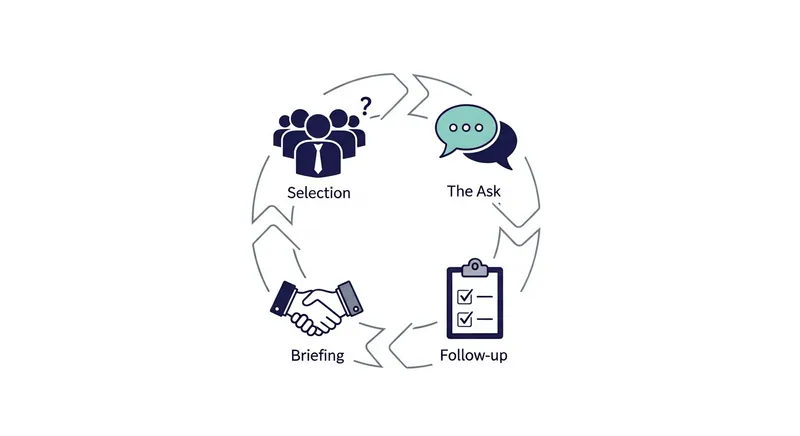
Stage 1: Selection - Who Should You Ask?
The referees that recruiters value most are those who have directly supervised you. According to global recruitment firm Hays, these individuals can speak authoritatively about your performance, responsibilities, and personal attributes. Similarly, experts at Robert Half advise choosing referees who can provide specific examples of your accomplishments. Your goal is to choose 2-3 people who have seen your best work and can articulate it clearly.
As we move into 2026, the efficiency of this process is paramount, with many companies using digital platforms to collect feedback. Choosing a responsive and well-prepared referee is more important than ever.
For Experienced Professionals: Prioritize your most recent direct managers. If your current manager doesn't know you're looking, your previous manager is the next best choice. Supplement with a senior colleague or a key client if relevant.
For Career Changers: Focus on referees who can speak to your transferable skills. A former manager from a different industry is still valuable if they can attest to your project management, leadership, or problem-solving abilities. You can use JobSparrow's tools to build a powerful resume that highlights these transferable skills in your resume summary.
For Migrants: This is a common challenge. While an international referee who knows your work well is good, a local referee is often better. If you're new to the country, consider:
- Short-term contract work: Even a brief project can yield a local referee.
- Volunteer positions: This demonstrates community engagement and provides a local supervisor who can speak to your reliability.
- Professional organization leaders: If you've been active in a local chapter.
When providing international referees, give the recruiter context on time zones and offer to help schedule a call. For more on navigating the local job market as a migrant, see our guide to finding visa sponsorship.
For Graduates or Those with No Experience: Don't panic. Employers understand you won't have a long list of managers. Consider:
- Academic Referees: A lecturer, tutor, or thesis supervisor who knows you and your work ethic.
- Work Experience or Internship Supervisors.
- Volunteer Coordinators.
- Character References: A respected person in your community (like a coach or long-time family friend in a professional role) who can speak to your character, reliability, and integrity.
Stage 2: The Ask - Etiquette and Templates
Always ask for permission before listing someone as a referee. A surprise call is unprofessional and can lead to a lukewarm reference. A phone call is personal and effective, but an email is a perfectly acceptable and common way to ask.
Actionable Tip: When you ask, you are not just asking for a favor; you are asking them to be part of your professional journey. Frame it as such.
Email Template to Request a Reference:
Subject: Reference Request - [Your Name]
Hi [Referee's Name],
I hope this email finds you well. I'm writing to you today because I'm in the process of applying for a [Job Title] position at [Company Name], and I was hoping you would be willing to act as a professional referee for me.
Your guidance and mentorship during my time as a [Your Former Role] at [Your Former Company] were incredibly valuable, and I believe you could speak to my skills in [Skill 1] and [Skill 2].
Please let me know if you would be comfortable being a referee for me. If so, I can send across my updated resume and the job description for your reference. Of course, I completely understand if you're not in a position to do so at this time.
Thank you for your consideration.
Best regards,
[Your Name]
Stage 3: Briefing - Setting Your Referees Up for Success
This is the most critical and most-often-missed step. Do not assume your referee remembers the specifics of your work from three years ago. Your job is to make their job easy.
Once they agree, send them a single, well-organized email containing:
- Your Tailored Resume: The exact version you submitted for the role.
- The Job Description: Highlight the key responsibilities and requirements.
- A Briefing Note: A few bullet points connecting your experience to the job's needs. For example: "They are looking for someone with strong data analysis skills. You might want to mention the Q3 sales report project we worked on together."
Use JobSparrow's resume analysis tools to identify which achievements and skills are most relevant to the role, then highlight these same points in your referee briefing note. This ensures your reference is perfectly aligned with the employer's needs.
Stage 4: Follow-Up - Closing the Loop
Whether you get the job or not, always follow up to thank your referee for their time. This maintains a positive professional relationship for the future.
Thank You Email Template:
Subject: Thank You for the Reference!
Hi [Referee's Name],
Just a quick note to say thank you for acting as a referee for me for the [Job Title] role at [Company Name]. I really appreciate you taking the time to speak with them.
I'll be sure to keep you updated on the outcome.
Thanks again for your support.
Best regards,
[Your Name]
Navigating the Legal Landscape: Your Rights in Australia & NZ
Understanding your rights is key to navigating the reference process with confidence. Australia and New Zealand have robust privacy laws, but their application to job references has important nuances.
In Australia: The Privacy Act and Employer Obligations
In Australia, the process is largely governed by the Privacy Act 1988. The most important thing for candidates to know is that employers must gain your consent before contacting your referees. This is confirmed by industry leaders like SEEK and government bodies like the Fair Work Ombudsman.
- Can a manager refuse to be a reference? Yes. There is no legal obligation for a former employer to provide a reference.
- Can I see what my referee said? Potentially. According to legal analysis from ER Strategies, the Privacy Act gives individuals the right to access personal information an organization holds about them, which could include a referee's report. However, exceptions can apply, particularly if confidentiality was promised.
In New Zealand: Confidentiality and Good Faith
New Zealand's laws offer strong protections but also carve out specific exceptions to encourage honest feedback. According to The People Project, while there's no legal duty to provide a reference, if one is given, it must be fair, accurate, and not misleading.
The Office of the Privacy Commissioner NZ notes a key point: if a referee provides information under a promise of confidentiality, the employer may be able to withhold that information from the candidate. This is designed to allow for "free and frank" assessments.
- What are my rights? You have the right for the information collected about you to be accurate and for it to be handled securely. You also have the right to nominate who can be contacted. The University of Auckland's recruitment policy, for example, explicitly states that no referee will be contacted without the candidate's express permission.
Reference Checks for Government Jobs: What to Expect
Applying for a role in the public service often involves a more formal and rigorous reference checking process. According to the Australian Public Service Commission (APSC), selection panels are advised to conduct at least two referee checks, with one ideally from a current or recent supervisor.
Unlike some private sector checks, these are not just a formality. The APSC notes that questions can be tailored to each candidate to probe specific claims or areas of interest. Expect the process to be thorough and directly linked to the selection criteria. Preparing for a government job often includes a panel interview, and the reference check serves to validate what you discussed. JobSparrow's Application Tracking feature is especially useful here for managing the longer, more formal public sector hiring timelines.
Frequently Asked Questions (FAQ)
How many referees should I provide? Two to three is the standard across Australia and New Zealand. Quality is more important than quantity; it's better to have two strong, well-briefed referees than three who are unprepared.
Should I write 'references available upon request' on my resume? No. This phrase is outdated and wastes valuable resume space. It is assumed you will provide references when asked. Use that space to perfect your resume summary or list more achievements.
What do I do if I suspect I have a bad reference? If you have a choice, simply don't use that person as a referee. If they are a critical recent manager that a recruiter insists on speaking to, you have two options: 1) Proactively and briefly explain the situation to the recruiter (e.g., "We had different working styles, which is why I'm seeking a new environment"). 2) Offer another senior colleague or manager from the same company who can provide an alternative perspective.
Can my former manager refuse to be a reference? Yes, absolutely. In both Australia and New Zealand, there is no legal obligation for a former manager or employer to provide a reference. This is why it's crucial to ask for their permission first.
Can I use a referee from overseas for a job in Australia or New Zealand? Yes, and it's common for migrants. Aim to have at least one local referee if possible. When providing an international referee, make it easy for the recruiter by providing their contact details, their time zone, and offering to help coordinate a call. A strong overseas referee who managed you directly is often better than a weak local one.
What's the difference between a professional and character reference? A professional reference (the standard) speaks to your work skills and performance. A character reference speaks to your personality, integrity, and trustworthiness and is typically used only when you have limited professional experience.
How JobSparrow Streamlines Your Entire Job Search
Managing referees is just one piece of the job search puzzle. The entire process involves juggling multiple applications, tailoring documents, and managing professional relationships, all of which can lead to job search burnout. JobSparrow is designed to be your personal AI career assistant, automating the tedious parts so you can focus on what matters most.
- Manage Referee Information: Use the Master Career Profile as your single source of truth. Store contact details and notes for all your potential referees in one secure place.
- Stay Organized: With the Job Application Tracking dashboard, you can keep notes on which referees you assigned to which application, ensuring you don't overwhelm any single person with requests.
- Free Up Your Time: By using the AI Agent Skill to instantly tailor your resume and AI cover letters for each role, you save hours of administrative work. You can then reinvest that time into building strong relationships with your referees and preparing for interviews, perhaps even with our AI mock interview tools for tech roles.
By handling the heavy lifting, JobSparrow allows you to approach your job search with more energy and strategic focus.
Your Strongest Career Asset
Your references are more than just a box to tick at the end of the hiring process; they are living proof of your skills and character. By moving from a reactive to a proactive approach, you transform your referees from a source of anxiety into your strongest career asset.
Take the time to choose wisely, ask professionally, brief thoroughly, and show gratitude. This strategic approach will give you the confidence to navigate the final stages of the hiring process and land the job you deserve. Ready to transform your entire job search? Start building your Master Career Profile on JobSparrow and see how easy it is to manage your applications and referees in one place.
Tags
Keep reading
Recommended articles.
job search · resume tips
Job Application Black Hole AU/NZ: 8 Reasons You're Not Hearing Back & How to Fix It
Getting ghosted by jobs in AU/NZ? We reveal 8 reasons your application is ignored and a framework to get seen. Get your free resume match score now.
redundancy · job search
Made Redundant? Your 90-Day Action Plan for a Better Job in AU/NZ
Made redundant in AU/NZ? This 90-day action plan helps you land a better job faster. From mental health to AI-powered applications, regain control today.
job search · automation
The Anti-Burnout Job Search: An AU/NZ Guide to Automating Your Applications in 2026
Beat job search burnout in AU/NZ. Automate applications, tailor resumes with AI, and manage your search in one place. Start free.